美国政府停摆

Search documents
美国10月CPI数据未能如期公布
Sou Hu Cai Jing· 2025-11-13 14:42
Core Points - The U.S. government shutdown has delayed the release of critical economic data, including the October CPI, which is essential for the Federal Reserve's monetary policy decisions [1][2] - The shutdown began on October 1 due to a failure to reach an agreement on a temporary spending bill between the Republican and Democratic parties, and it officially ended on November 12 when President Trump signed a temporary funding bill [1] - During the shutdown, the release of September and October non-farm employment data was also delayed, and the September CPI data was released nearly 10 days late [2] Economic Data Impact - The October CPI data, which typically reflects inflation trends for the previous month, was expected to be crucial for economic analysis but may never be published due to the shutdown [1] - The September CPI showed a year-over-year increase of 3%, which was below market expectations of 3.1%, and the previous value was 2.9% [2] - The core CPI for September also rose by 3% year-over-year, again falling short of the anticipated 3.1% [2]
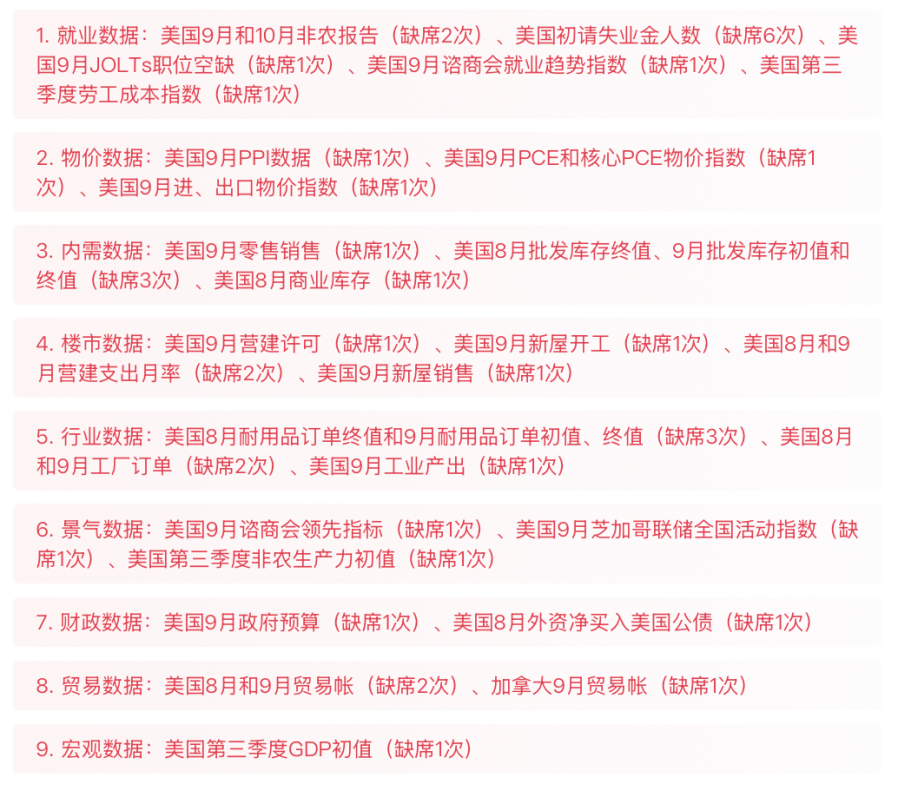
综述|创纪录的美国联邦政府“停摆”闹剧落幕
Shang Hai Zheng Quan Bao· 2025-11-13 10:53
Core Points - The recent U.S. federal government shutdown lasted for 43 days, breaking the previous record of 35 days from late 2018 to early 2019, and was resolved when Congress passed a temporary funding bill that was signed by President Trump [1][2] - The shutdown had significant economic and social impacts, affecting over one million federal employees who faced financial pressure due to unpaid wages, and causing widespread disruptions in air travel, with approximately 5.2 million passengers affected by delays or cancellations [1] - The shutdown also marked the first suspension of the 60-year-old Supplemental Nutrition Assistance Program, impacting around 42 million low-income individuals, many of whom live below the poverty line [1] Political Implications - Both parties in Congress engaged in mutual blame, focusing on advancing their political agendas rather than resolving the shutdown to alleviate public suffering [2] - Public sentiment has shifted negatively, with 65% of respondents expressing disappointment in the Trump administration's performance, particularly regarding economic management and inflation [2] - A significant portion of the population perceives increasing political polarization, with 66% expressing distrust in the government and 59% believing that political divisions have worsened over the past five years [2] Economic Impact - The Congressional Budget Office estimated that the six-week shutdown would result in an economic loss of approximately $11 billion for the U.S. economy [2] - The shutdown has been characterized as sending a dangerous signal to the world about the U.S.'s reliability as a partner, as stated by Kansas Republican Senator Jerry Moran [2]
U.S. Futures, Global Markets Mostly Higher as U.S. Government Shutdown Ends
WSJ· 2025-11-13 09:37
Core Insights - The S&P 500 futures increased following the conclusion of a record 43-day U.S. government shutdown, which reinstated hundreds of thousands of government employees and allowed for the resumption of data [1] Group 1 - The U.S. government shutdown lasted for 43 days, marking a record duration [1] - The end of the shutdown resulted in the return of hundreds of thousands of government staff to work [1] - The resumption of data collection and reporting is expected to impact market dynamics positively [1]


菜油仍相对偏强,关注上方技术阻力有效性
Zhong Xin Qi Huo· 2025-11-13 08:00
Report Industry Investment Ratings No specific industry investment ratings are provided in the report. Core Views - The vegetable oil market shows a differentiated trend, with rapeseed oil relatively strong. Soybean meal and rapeseed meal are expected to fluctuate. Corn prices are in short - term high - level oscillations. Pig prices are weak due to loose supply and demand. Natural rubber may have a pulse upward movement, and synthetic rubber will maintain a short - term oscillatory pattern. Cotton prices decline slightly, sugar prices fluctuate narrowly, pulp is dominated by capital with the long - side advantage unchanged, double - offset paper will stabilize in November, and logs are in a destocking cycle and oscillate [1][7][8]. Summary by Related Catalogs 1. Oils and Fats - **View**: Rapeseed oil is relatively strong, and attention should be paid to the effectiveness of the upper technical resistance. - **Logic**: The US soybean market is waiting for the clarity of export demand. The US federal government may resume operation this week, and the market expects the Fed to cut interest rates again this year. The USDA will release a report on Friday. The US soybean harvest is nearing completion, and there is a possibility of a decrease in yield per unit. Brazilian and Argentine soybean planting progress lags behind last year. Domestic soybean imports are expected to be at a high level, and the de - stocking speed of domestic soybean oil is expected to be slow. Malaysian palm oil production and exports have declined in November, and Indonesian palm oil inventory remains low. Domestic rapeseed supply is tight, and rapeseed oil inventory continues to decline, but future supply is expected to increase [1][7]. - **Outlook**: Soybean oil will oscillate, palm oil will oscillate, and rapeseed oil will oscillate strongly. The positive driving factors in the vegetable oil market include tight domestic rapeseed supply, declining rapeseed oil inventory, the palm oil production - reduction season, and rising domestic soybean import costs [2][7]. 2. Protein Meal - **View**: US soybeans are testing the upper pressure level, and the reverse spread of Dalian soybean meal should be held. - **Logic**: The USDA will release a supply - and - demand report on November 15. The market expects a possible decrease in US soybean yield per unit. China's purchase of US soybeans has been digested, and the premium of US soybeans has loosened. Brazilian soybean exports are seasonally decreasing, but exports to China in November are expected to increase year - on - year. Brazilian and Argentine soybean sowing is progressing smoothly. Domestically, the de - stocking of soybean meal in oil mills is slow in the short term, and downstream inventory has decreased. In the medium term, the purchase of December shipments is advancing, but the January import is still at a loss. In the long term, the supply in the fourth quarter of 2025 is expected to be sufficient, and there may be a soybean shortage in the first quarter of 2026 [8]. - **Outlook**: US soybeans and Dalian soybean meal will oscillate. It is recommended to buy on dips, not chase after highs, and sell near - term contracts and buy far - term contracts [9]. 3. Corn and Starch - **View**: The market is in a stage of tight supply, and prices will oscillate at a high level in the short term. - **Logic**: Domestic corn prices are rising, with low arrival volume. The cold weather has increased farmers' reluctance to sell. The demand for feed grains in the sales area is concentrated in the Northeast, and the railway freight adjustment has increased the trading cost. The central reserve grain rotation is ongoing. In the fourth quarter, there is pressure on spot prices due to the new - grain listing [11]. - **Outlook**: Prices will oscillate strongly. There may be an opportunity to short when the price rebounds to around 2200 [11]. 4. Hogs - **View**: Supply and demand are loose, and pig prices are weak. - **Logic**: In the short term, the supply of commercial pigs in November is still large. In the medium term, the number of live - weight pigs for slaughter is expected to increase in the fourth quarter. In the long term, the production capacity of sows is being reduced, and the supply pressure may ease in the second half of 2026. The ratio of meat to pig price has increased, the average slaughter weight has increased, and the utilization rate of secondary - fattening pens has increased [12]. - **Outlook**: Prices will oscillate weakly. The near - term contracts are under pressure, while the far - term contracts are supported by the expectation of production - capacity reduction. Attention should be paid to the reverse - spread strategy [12]. 5. Natural Rubber - **View**: With the approaching expiration of the 11 - contract, attention should be paid to the possible pulse upward movement. - **Logic**: The rubber futures market rose slightly yesterday, which may be related to the upcoming expiration of the RU11 contract. The supply in overseas production areas is affected by the weather, and the demand has not changed significantly recently. Seasonally, without strong expectations and macro - driving factors, rubber prices may face downward pressure [12][14]. - **Outlook**: Rubber prices will maintain a bottom - oscillating and high - elasticity trend. Attention should be paid to widening the spread between RU and NR [14]. 6. Synthetic Rubber - **View**: The raw - material trading is stable, and the futures market rebounds strongly. - **Logic**: The BR futures market rebounded strongly yesterday due to the good trading of butadiene in recent days. The price of butadiene stopped falling and consolidated this week. The supply of butadiene is abundant, and the downstream buying sentiment is cautious. The market has a short - term bottom support [15][16]. - **Outlook**: Given the large pressure on the fundamentals and raw - material side, it is recommended to short on rallies before the obvious supply - and - demand contradiction of butadiene appears [16]. 7. Cotton - **View**: Cotton prices decline slightly. - **Logic**: The positive factors in the cotton market have been digested, and the expected increase in supply and the peak - season listing of new cotton have brought downward pressure on prices. The cost of new cotton provides support [16]. - **Outlook**: In the short term, the 01 - contract will oscillate within a range. In the long term, the cotton market may destock, driving prices upward [16]. 8. Sugar - **View**: Sugar prices fluctuate narrowly. - **Logic**: Internationally, the focus of sugar supply has shifted from Brazil to the Northern Hemisphere. New - season sugar production in India, Thailand, and Brazil is expected to increase. Domestically, the new - season sugar production is expected to increase, and the tightening of import policies supports the domestic market, but the increase in supply during the peak - production period will bring downward pressure [17]. - **Outlook**: In the medium - and long - term, prices will oscillate weakly. In the short term, prices will fluctuate between 5400 - 5500 yuan/ton, and it is recommended to short on rallies [17]. 9. Pulp - **View**: The futures market is dominated by capital, and the long - side advantage remains unchanged. - **Logic**: The futures market is oscillating at a high level, and the long - side funds are dominant. The positive factors include the rise in packaging paper prices, the increase in import costs, the good production - and - sales expectations of white cardboard and cultural paper, and the possible shortage of delivery warehouse receipts. The negative factors include low demand for softwood pulp, slow procurement by downstream enterprises, the disturbance of warehouse - receipt issues, and weak downstream consumption [17][18]. - **Outlook**: Prices will oscillate. The spot market is dominated by warehouse - receipt and weak - supply - and - demand factors, while the futures market is driven by capital. It is recommended to wait and see [18]. 10. Double - Offset Paper - **View**: November is the tender peak season, and prices will stabilize in an oscillating manner. - **Logic**: In November, supported by the tender season and cost pressure, paper mills are strongly willing to support prices, and the market may stop falling and rebound. In December, the "volume - boosting price - cutting" by dealers may drag down the market. In the first quarter of 2026, the market will enter a stage of narrow - amplitude oscillation [19]. - **Outlook**: The tender for double - offset paper is starting, and prices will stop falling and stabilize [19]. 11. Logs - **View**: Logs are in a destocking cycle and will oscillate. - **Logic**: In the short term, the increase in shipments from New Zealand will lead to an increase in arrivals in December, and the import pressure will ease seasonally in the first quarter of 2026. In the long term, there is still supply pressure. The demand is expected to be weak and stable in 2026, with a small increase in inventory replenishment in the fourth quarter and a seasonal decline in the first quarter. The real - estate industry cannot strongly drive the demand for logs, and prices will oscillate weakly around the cost line [21]. - **Outlook**: The fundamentals of logs are weakening, and spot prices are under pressure, with a recent bottom - oscillating trend [21].
高地集团:美国政府关门即将结束,市场都在盯哪些关键数据?
Sou Hu Cai Jing· 2025-11-13 07:17
随着美国政府"停摆"临近结束,市场焦点正从政治僵局迅速转向即将重启的宏观经济数据。此次停摆造 成的大量经济数据延迟发布,使投资者短暂失去了政策与市场的导航仪,如今随着政府运作恢复在即,积压 已久的"数据洪流"即将释放,金融市场正进入一个关键的观察窗口。 第三季度GDP初值 —— 预计在停摆结束后约两周发布; 10月就业报告 —— 有望赶在美联储12月会议前夕公布。 鉴于本次停摆时间长、覆盖面广,部分10月数据如CPI、零售销售可能推迟至12月中下旬才能见到,这也 意味着,美联储在12月会议前掌握的经济信息仍将极为有限。 12月利率决议:数据拼图未完待续 在12月9日至10日即将召开的政策会议上,美联储将面临前所未有的"信息稀缺期"。按目前进度判断,决策 者能看到的核心数据主要集中在三方面: 数据堆积后的"洪水闸门" 本轮停摆自10月初持续至今,涵盖了整个10月份的数据收集周期,就业、通胀、零售销售等关键指标被迫 推迟,造成信息真空,随着政府恢复运作,市场预计数据将呈"阶梯式回归": 首波公布 —— 预计首份重要数据将是9月非农就业报告,或在停摆结束后约3个工作日发布; 第二波释放 —— 9月零售销售与生产者物 ...
终于结束了!但明年1月美国政府恐再次面临停摆
Di Yi Cai Jing· 2025-11-13 06:46
Group 1 - The U.S. government has been reopened after a 43-day shutdown, with President Trump signing a funding bill that provides continuous appropriations until January 30, 2026 [1] - The House of Representatives passed a temporary funding bill with a vote of 216 in favor and 207 against, with some bipartisan support from Democratic members [1] - The shutdown has caused significant disruptions, including the interruption of food stamp benefits and unpaid work for hundreds of thousands of federal employees [1] Group 2 - Healthcare issues, particularly the extension of tax credits under the Affordable Care Act (ACA), are central to the ongoing political debate, with Democrats advocating for an extension and Republicans proposing alternative solutions [2] - There is a possibility of another government shutdown in January due to unresolved healthcare funding issues, as indicated by senior Democratic lawmakers [2] - The struggle for healthcare and cost of living improvements is expected to continue, with Democratic leaders expressing determination to push for their agenda [2] Group 3 - Experts predict that even with the government reopening, normal commercial air travel in the U.S. may take weeks to fully resume due to the need for staff to return to their positions and operational adjustments [3] - The Federal Aviation Administration (FAA) has slowed down flight numbers to maintain safety standards during the shutdown, exacerbating existing shortages of air traffic controllers [4] - Public should prepare for a gradual recovery in air travel, as many air traffic controllers were on unpaid leave or sick during the shutdown, impacting overall operations [4]
特稿丨盘点美政府“停摆”的经济民生“坏账”
Xin Hua Wang· 2025-11-13 05:36
Core Points - The U.S. government shutdown lasted for a record 43 days and has now ended with the passing of a temporary funding bill, but the economic and social impacts are significant and lasting [1][3] Economic Impact - The Congressional Budget Office estimates that the shutdown could lead to a $11 billion economic loss if it lasts for 6 weeks, and up to $14 billion if it extends to 8 weeks, with a potential decrease in GDP growth rate by 1 to 2 percentage points in Q4 [7] - The shutdown has exacerbated an already weak U.S. economy, with canceled flights and delayed consumer spending contributing to long-term economic repercussions [7] Social Impact - Approximately 42 million Americans are affected by disruptions in the Supplemental Nutrition Assistance Program due to the shutdown, leading to significant hardship for low-income families [2] - Federal employees have also faced wage delays, with some relying on food assistance programs during the shutdown [2] Transportation Sector Impact - The shutdown has caused significant disruptions in the aviation sector, with thousands of flights delayed or canceled, leading to operational chaos at airports [4][6] - The Federal Aviation Administration has reduced flight numbers at 40 major airports, with daily cancellations reaching nearly 3,000 and delays exceeding 10,000 flights on certain days [4][6] Political Context - The shutdown reflects deep political polarization in the U.S., with both parties blaming each other for the suffering of the public, particularly low-income individuals [2][3] - The political stalemate has made it increasingly difficult to reach compromises on critical issues such as government funding [7]
视频丨美国政府终于“开门” 但这些损害确定无法恢复
Yang Shi Xin Wen· 2025-11-13 04:00
Core Points - The longest government shutdown in U.S. history lasted 43 days and has ended, but the damage caused is largely irreversible [1] - The shutdown resulted in a significant economic impact, with an estimated GDP growth reduction of 1.5 percentage points for Q4, translating to an economic loss of approximately $7 to $15 billion [4] - The shutdown particularly affected Washington D.C., where over 40% of the workforce are government employees, leading to a 50% drop in restaurant revenues during this period [4] Economic Impact - The U.S. Congressional Budget Office estimated that the shutdown caused a permanent economic loss equivalent to the cost of building a new aircraft carrier, approximately $13 billion [4] - Consumer confidence in the U.S. has plummeted to a three-year low, decreasing by 6% from the previous month and nearly 30% year-over-year [6][7] Government Operations - The reopening of government does not mean an immediate return to normal operations, as agencies need time to recall personnel and process backlogged work [9] - The backlog includes critical reports on inflation and labor markets that may never be published due to the shutdown [9] Future Risks - The temporary funding measure only extends government operations until January 30, raising concerns about another potential shutdown in less than three months if budget negotiations fail [10] - Key issues remain unresolved, particularly regarding the extension of Obamacare subsidies, which could lead to significant increases in healthcare costs for millions of Americans [10][12] Political Landscape - The political divide remains significant, with increasing difficulty for bipartisan agreements, as evidenced by tensions within the Democratic Party following the shutdown [13] - The next potential shutdown crisis looms as leaders may have to choose between maintaining government operations and preserving their political positions [13]
特朗普签字,美国政府史上最长“停摆”结束
Zhong Guo Xin Wen Wang· 2025-11-13 03:57
美国联邦政府自10月1日开始"停摆",这场由两党政治博弈引发的治理危机严重冲击食品救济、医保福 利、民航交通等多个民生领域。 来源:中国新闻网 特朗普签字,美国政府史上最长"停摆"结束 中新网11月13日电 据美媒报道,当地时间12日晚,美国总统特朗普正式签署了国会参众两院通过的临 时拨款法案。至此,这场持续了43天、创下美国历史上最长纪录的联邦政府"停摆"风波正式结束。 编辑:付健青 广告等商务合作,请点击这里 本文为转载内容,授权事宜请联系原著作权人 中新经纬版权所有,未经书面授权,任何单位及个人不得转载、摘编或以其它方式使用。 关注中新经纬微信公众号(微信搜索"中新经纬"或"jwview"),看更多精彩财经资讯。 ...
大消息,美国政府“停摆”将结束!
Zhong Guo Ji Jin Bao· 2025-11-13 03:51
Core Points - The U.S. House of Representatives passed a bill to end the government shutdown, which lasted for 43 days, with a vote of 222 in favor and 209 against [1][2] - The bill includes funding for food assistance programs, back pay for federal employees, and the restoration of air traffic control operations [2] - A recent poll indicated that 50% of Americans blame the Republican Party for the shutdown, while 47% blame the Democratic Party [2] Economic Impact - The Congressional Budget Office projected that the six-week shutdown would reduce the actual GDP growth rate by 1.5 percentage points for the current quarter [3] - Approximately half of the GDP loss may be recovered in early next year as federal projects resume and government employees receive back pay [3] Data Release Delays - The shutdown resulted in the absence of numerous official data releases, including employment, price, domestic demand, housing, industry, economic indicators, fiscal, trade, and macroeconomic data [4][5] - Specific data points missing include two non-farm payroll reports for September and October, initial jobless claims, and various price indices [5]