
能源结构转型

Search documents
新签约近2.8万亿!电力基建巨头调整业务布局
Zhong Guo Dian Li Bao· 2026-01-27 02:26
随着国家能源战略的深化推进和"双碳"目标的全面落实,我国电力基础设施建设迈入高质量发展新阶 段。2026年初,中国电力建设集团(以下简称"中国电建")、中国能源建设集团(以下简称"中国能 建")和中国安能建设集团(以下简称"中国安能")相继召开2026年度工作会议,系统总结了"十四 五"发展成就,并公布了面向"十五五"的战略蓝图。 从披露的数据与规划看,新能源业务、境外业务与新兴业务已成为行业增长的三大支柱——新能源电力 业务特别是新能源与抽水蓄能持续领跑,境外市场拓展步伐加快,而以储能、综合智慧能源、数字基建 为代表的新兴业务迅猛增长,共同推动能源电力基建央企在结构优化中实现稳步跃升。 新能源业务、境外业务与新兴业务已成行业增长三大支柱 就在上周,中国电建、中国能建相继披露2025年新签合同额。中国电建全年新签合同总额达13332.83亿 元,同比增长4.93%;中国能建全年新签合同额14493.84亿元,同比增长2.88%,两家企业均保持良好增 长态势。 两家央企新签合同额增速与上年相比有所放缓。"十四五"以来,两家央企签约额增速经历了抛物线走 势。需要看到的是,近两年来增速放缓的背后是结构性跃升。 新能 ...


中国电建、能建揽下2.8万亿订单,钱往哪里去?
Xin Lang Cai Jing· 2026-01-26 13:17
Core Insights - The core focus of the articles is the significant shift in China's energy sector towards renewable energy, as evidenced by the substantial new contracts signed by major state-owned enterprises, China Electric Power Construction (China Electric) and China Energy Engineering (China Energy), totaling nearly 2.8 trillion yuan in new orders, primarily directed towards renewable energy projects [2][6]. Group 1: New Contracts and Performance - In 2025, China Electric signed new contracts worth 1.333 trillion yuan, with energy projects contributing 841.6 billion yuan [2]. - China Energy's new contract amount reached 1.449 trillion yuan, with its renewable and integrated smart energy business contracts totaling 592.6 billion yuan, reflecting a year-on-year growth of 6.7% [2][3]. - The data indicates a structural transformation in the energy industry, with traditional thermal power contracts declining and renewable energy projects, particularly wind and storage, experiencing rapid growth [3][7]. Group 2: Shift from Traditional to Renewable Energy - China Electric's thermal power contracts fell sharply by 46.25% to 33.8 billion yuan, while its wind power contracts surged by 54.67% to 182.9 billion yuan [3]. - China Energy's renewable energy and integrated smart energy business now account for over 40% of its total contracts, with growth rates surpassing overall business growth [3]. - The trend of "wind power rising while solar power declines" reflects a market reassessment of technology maturity and efficiency [3]. Group 3: Energy Storage Developments - The rapid growth of renewable energy installations has highlighted the need for energy storage solutions, which are becoming a key battleground worth hundreds of billions [4]. - In the first nine months of 2025, China Electric signed 142 new energy storage projects with a total contract value of 36.7 billion yuan [4]. - Successful energy storage projects are transitioning from cost burdens to profitable assets, with innovative revenue models emerging [5]. Group 4: Global Expansion of Renewable Energy - Both companies are expanding their renewable energy capabilities into international markets, with China Electric's overseas contracts reaching 213.8 billion yuan, a year-on-year increase of 21.45% [6]. - Recent international projects include significant wind and solar energy contracts in Vietnam and the Middle East, showcasing a comprehensive solution that includes technology and business model exports [6]. - The global outreach of Chinese renewable energy solutions is reshaping the discourse on global energy governance [6][7].

青岛能源集团:以“青能强基”改革深化提升行动 激发发展新动能
Qi Lu Wan Bao· 2026-01-26 08:01
齐鲁晚报·齐鲁壹点记者 赵波 通讯员 康在龙 在国有企业改革深化提升行动收官之际,青岛能源集团紧扣山东省、青岛市国有企业"五控"(控机构、 控岗位、控总量、控总额、控招录)要求,结合能源结构战略转型,创新开展"青能强基"行动,聚焦组 织管控及人力资源管理提升,系统性破解国企改革中存在的薪酬体系不统一、发展通道单一等管理症 结,率先完成"五控"任务,为国企高质量发展提供了"青能"样本。 ●专班攻坚破局:构建改革推进"强引擎" "以前技术再好也只能走管理岗,但搞管理又不是我的优势,现在有了专门的技术、技能通道,干专业 更有奔头了。"刚完成跨级晋升的国家级劳模胡克涛倍感鼓舞。在转序推荐过程中,也得到了基层一线 员工的积极拥护与响应。集团创新性搭建职务管理(M序列)、专业技术(T序列)、技能操作(S序 列)三维职业发展通道,打造"纵向晋级+横向转换"的复合型成长路径,一方面支持员工在本序列内深 耕细作、阶梯式晋升;另一方面畅通跨序列发展渠道,拓宽职业赛道、实现多元发展。这一举措有效破 除传统单一化的人才发展晋升通道,为各类人才脱颖而出搭建了广阔的发展平台。 为推动新机制落地,集团领导带头宣贯,各单位层层开展专题培训, ...
又一新能源项目落户老山脚下
Xin Hua Ri Bao· 2026-01-25 19:13
Core Viewpoint - The establishment of the wind power yaw motor manufacturing project by Dime Electric in Nanjing Jiangbei New Area represents a significant step towards green low-carbon development and enhancing the quality of the manufacturing industry in the region [1] Group 1: Project Overview - The Dime project is located in the Pukou Development Zone, covering an area of approximately 13,600 square meters with a total construction area of about 17,000 square meters [1] - The project will serve as a production base for wind power yaw motors, featuring two production lines for wind power yaw motors and one production line for solar tracking motors, with an expected annual output of around 150,000 units [1] Group 2: Technological Advancements - The company utilizes multi-field coupling simulation technology and self-developed control algorithms to produce high power density and high control precision permanent magnet synchronous motors [1] - The products are designed to significantly enhance the efficiency of wind and photovoltaic power generation, with solar tracking systems improving solar energy utilization by approximately 35% compared to traditional fixed solar panels [1] Group 3: Strategic Alignment - The project aligns with the "14th Five-Year Plan" focus on promoting energy structure transformation and expanding the green manufacturing industry [1] - It emphasizes the research and manufacturing of core components for clean energy equipment, contributing to the establishment of a green low-carbon industrial system in the region and supporting the "dual carbon" goals [1]
同比增长383%!2025年蒙东四盟市绿电交易量大幅增长
Xin Lang Cai Jing· 2026-01-25 13:04
Core Insights - The article highlights the significant growth in green electricity trading in the four leagues of Inner Mongolia, with a projected trading volume of 49 billion kilowatt-hours by 2025, representing a year-on-year increase of 383% [1] - The region's abundant wind and solar resources, along with its proximity to major electricity markets, position it as a key player in the transition to a cleaner energy structure and national energy security [1] - The establishment of innovative market mechanisms and a blockchain-based system for tracking green electricity transactions enhances transparency and efficiency in the trading process [1] Group 1 - By July 1, 2025, all new energy in the four leagues will fully enter the electricity market, with a projected green electricity trading volume of 27.82 billion kilowatt-hours, marking a 435% year-on-year increase [2] - Cumulative green electricity transactions are expected to reach 10,800, with a tenfold increase compared to previous years [2] - The company will establish a monthly supply-demand coordination mechanism with East and North China grid companies, facilitating cross-regional green electricity trading [2] Group 2 - The annual delivery of green electricity to Beijing is expected to exceed 1 billion kilowatt-hours, with the first-time delivery to Shanghai, Jiangsu, and Anhui, resulting in a total external trading volume of 21.2 billion kilowatt-hours, a 313% increase year-on-year [2]
25Q4电力持仓已至低点,南网2026计划固投1800亿
GOLDEN SUN SECURITIES· 2026-01-25 11:22
Investment Rating - The investment rating for the electricity sector is maintained as "Increase" [5] Core Insights - In Q4 2025, the holdings of active funds in the electricity and public utilities sector slightly decreased, while index funds saw a slight increase. The overall holdings ratio for both types of funds was 1.18%, showing little change compared to Q3 [11] - Southern Power Grid plans to invest CNY 180 billion in fixed assets for 2026, marking a historical high for five consecutive years, with an average annual growth rate of 9.5% over the past five years. The investment will focus on new power system construction, strategic emerging industries, and enhancing quality power supply services [3][15] - The report suggests paying attention to high-dividend coal-fired power leaders and companies with stable electricity prices and coal-electric integration, such as Huaneng International and Huadian International, as well as flexible coal-fired power leaders like Qingda Environmental Protection [4] Summary by Sections Market Overview - The Shanghai Composite Index closed at 4136.16 points, up 0.84%, while the CSI 300 Index closed at 4702.5 points, down 0.62%. The CITIC Power and Utilities Index closed at 3177.58 points, up 2.24%, outperforming the CSI 300 Index by 2.86 percentage points [63] Fund Holdings - Active funds' holdings in the electricity and public utilities sector decreased to 0.61%, down 1.31 percentage points year-on-year and down 0.03 percentage points quarter-on-quarter. In contrast, index funds' holdings increased to 1.77%, down 1.35 percentage points year-on-year but up 0.02 percentage points quarter-on-quarter [11][12] Investment Plans - Southern Power Grid's investment plan for 2026 includes CNY 180 billion, focusing on three areas: new power system construction, strategic emerging industries, and quality power supply service enhancement. This investment will support the integration and consumption of 40 million kilowatts of new energy installations in the southern region [3][15] Key Stocks - Recommended stocks include Huaneng International (A+H), Huadian International (A+H), Guodian Power, and Datang Power, which are identified as high-dividend coal-fired power leaders. Additionally, attention is drawn to wind and solar sectors, including Xintian Green Energy and Longyuan Power [4][8]



川润股份:预计2025年全年净亏损1900.00万元—2700.00万元
2 1 Shi Ji Jing Ji Bao Dao· 2026-01-23 10:31
Core Viewpoint - The company, Chuanrun Co., Ltd., anticipates a significant decline in net profit for the year 2025, projecting a loss between 19 million to 27 million yuan, which represents a year-on-year decrease of 76.66% to 83.58% [1] Group 1: Financial Performance - The expected net profit attributable to shareholders for 2025 is projected to be a loss of 37 million to 45 million yuan when excluding non-recurring gains and losses, reflecting a year-on-year reduction of 64.08% to 70.47% [1] - The company attributes the anticipated improvement in performance to business growth and asset quality optimization [1] Group 2: Business Growth Drivers - The company's renewable energy business is experiencing rapid growth, driven by the global and domestic energy structure transformation, leveraging its leading technology and service capabilities in hydraulic, lubrication, and temperature control sectors [1] - The strategic liquid cooling business has seen significant sales growth during the reporting period, supported by the ongoing development of AI computing power and related energy infrastructure [1] - The overall gross profit margin of the main business has steadily improved due to continuous enhancements in technology, processes, and material innovation [1] Group 3: Asset Quality Optimization - The company has improved asset quality by enhancing the management of accounts receivable and inventory, resulting in a substantial decrease in asset impairment losses year-on-year, further aiding in profit recovery [1]

鄂尔多斯“暖流”这样涌向全国
Bei Jing Ri Bao Ke Hu Duan· 2026-01-22 08:17
新华社呼和浩特1月22日电隆冬时节,寒气袭人。夜幕降临,内蒙古自治区鄂尔多斯市乌审旗蒙大矿业 纳林河二号煤矿灯火通明,装车站内,精量装车系统根据车厢的大小精准装煤。一列3600吨的运煤列车 不到1小时即可完成装车。 "10月份以来,煤矿进入了冬季保供阶段,通过四班三倒工作制度全力保障煤炭发运。"乌审旗蒙大矿业 有限责任公司运销部副经理郭拴宝介绍,该煤矿日均产煤2.4万吨,扣除化工用煤后,每日稳定发运3列 电煤,主要供应南方地区的多个电厂。 随着寒潮来袭、新春佳节临近,全国多地供电、供暖等用煤需求持续攀升,能源保供迎来"大考"。鄂尔 多斯市能源局局长云小平介绍,作为能源大市,鄂尔多斯在全国能源保供大局中发挥着"主力军"的作 用。2025年,鄂尔多斯市承担5.6亿吨电煤保供任务。目前,在生产发运一线,鄂尔多斯市各大煤炭企 业正开足马力冲刺保供,日煤炭产量稳定在250万吨以上。 鄂尔多斯市能源局提供的数据显示,2025年,全市新能源发电量达310.4亿千瓦时、增长68.7%,创历史 新高。随着新能源规模的不断增加,鄂尔多斯新能源发电装机规模将在"十五五"初超过煤电,电力生产 供应绿色化不断深入。 联创罕台川北站煤炭 ...

英诺赛科早盘高开近6% 董事长Weiwei Luo博士自愿承诺禁售1.547亿公司股份
Xin Lang Cai Jing· 2026-01-22 01:40
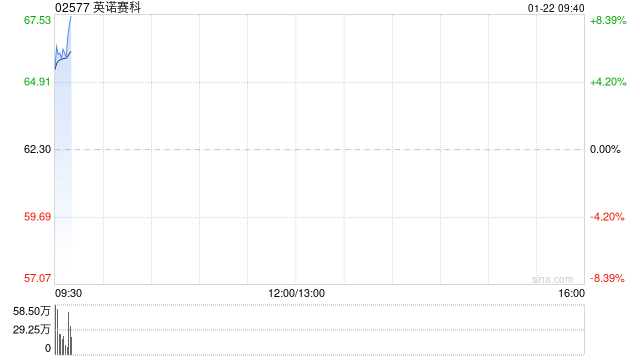
热点栏目 自选股 数据中心 行情中心 资金流向 模拟交易 热点栏目 自选股 数据中心 行情中心 资金流向 模拟交易 客户端 英诺赛科(02577)早盘高开逾6%,截至发稿,股价上涨5.86%,报65.95港元,成交额1.54亿港元。 客户端 英诺赛科(02577)早盘高开逾6%,截至发稿,股价上涨5.86%,报65.95港元,成交额1.54亿港元。 1月22日,英诺赛科发布公告,公司接获公司董事长兼执行董事、控股股东集团成员Weiwei Luo博士发 出的承诺函件。根据禁售承诺,Weiwei Luo博士将自2026年1月22日起后的12个月内不减持其实益拥有 的1.547亿股公司股份(包括7735.28万股境内未上市股份及7735.28万股H股)。 禁售承诺的作出基于Weiwei Luo博士对公司未来发展的信心及长远投资价值的充分认同。公司坚信,在 全球能源结构转型与能源效率革命性提升的时代背景下,氮化镓功率芯片以其高频、高效、高功率密度 的卓越特性,将在新能源汽车、数据中心、工业储能、人形机器人及消费电子等关键领域扮演颠覆性角 色,市场前景极为广阔,Weiwei Luo博士的禁售承诺将有利于公司持续、稳定、 ...
英诺赛科高开逾5% 董事长Weiwei Luo博士自愿承诺禁售1.547亿公司股份
Zhi Tong Cai Jing· 2026-01-22 01:33
消息面上,1月22日,英诺赛科发布公告,公司接获公司董事长兼执行董事、控股股东集团成员Weiwei Luo博士发出的承诺函件。根据禁售承诺,Weiwei Luo博士将自2026年1月22日起后的12个月内不减持其 实益拥有的1.547亿股公司股份(包括7735.28万股境内未上市股份及7735.28万股H股)。 禁售承诺的作出基于Weiwei Luo博士对公司未来发展的信心及长远投资价值的充分认同。公司坚信,在 全球能源结构转型与能源效率革命性提升的时代背景下,氮化镓功率芯片以其高频、高效、高功率密度 的卓越特性,将在新能源汽车、数据中心、工业储能、人形机器人及消费电子等关键领域扮演颠覆性角 色,市场前景极为广阔,Weiwei Luo博士的禁售承诺将有利于公司持续、稳定、健康发展。 英诺赛科(02577)高开逾5%,截至发稿,涨5.46%,报65.7港元,成交额1139.24万港元。 ...