通胀对冲

Search documents
金荣中国:白银午盘窄幅震荡盘整,等待回落支撑位多单布局
Sou Hu Cai Jing· 2025-12-18 09:49
Fundamental Analysis - Silver prices have surpassed historical records, reaching over $66.80 per ounce, marking one of the strongest rebounds in commodities for 2025, driven by ongoing market dynamics [1] - The current surge in silver prices is supported by a structural shortage in the global silver market for the fifth consecutive year, limited mining output, and increasing demand from renewable energy and electronics sectors [1] - Expectations of global monetary policy easing and declining real yields have reduced the opportunity cost of holding non-yielding assets, attracting institutional investors seeking asset diversification and inflation hedging, creating a rare resonance between industrial and investment demand [1] Price Trends - Silver has reached its long-term target's minimum threshold, with potential for further increases, ideally targeting $75 to $80, contingent on year-end market performance [3] - Silver prices have increased nearly 4% to $66.22 per ounce, with an intraday high of $66.87, reflecting a year-to-date increase of 129%, significantly outpacing gold's 65% rise [3] Market Dynamics - The internal dynamics of the Federal Reserve and the succession of its chairperson are significant variables affecting gold prices, with potential political interference raising concerns about the Fed's independence [4] - The dollar's performance is closely linked to global central bank policies, with a year-to-date decline of approximately 9.5%, the largest annual drop since 2017, providing support for gold prices [5] - Upcoming decisions from multiple central banks, including the Bank of England and the European Central Bank, are anticipated to further influence the dollar's exchange rate and, consequently, gold prices [5] Technical Analysis - Current silver market trends indicate an upward price trajectory, with support around $65.00 and a bullish outlook based on technical indicators [9] - Suggested trading strategies include positioning for long trades near the $65.00 support level, with stop-loss at $64.30 and profit targets between $68.60 and $69.00 [9]


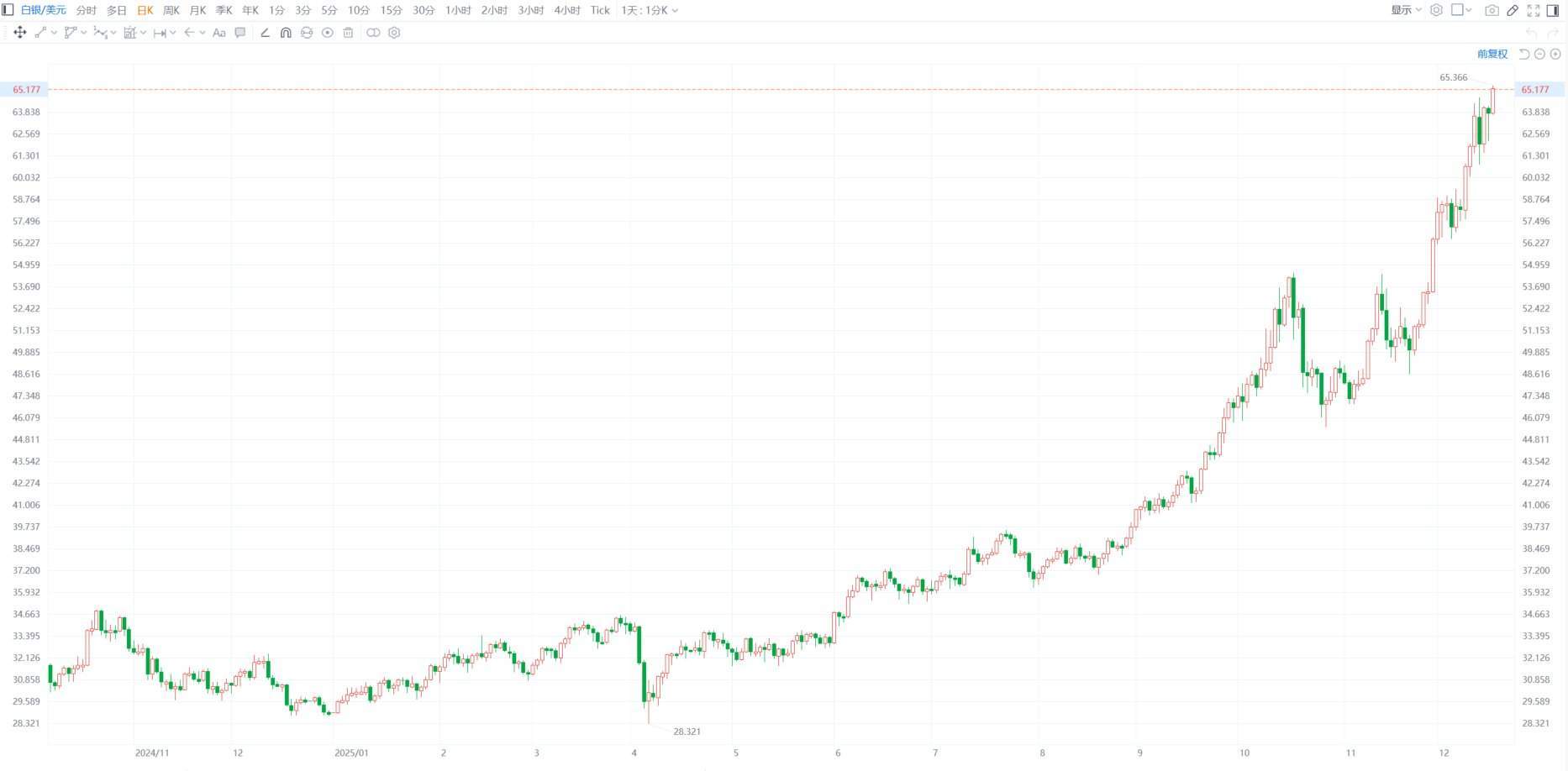
现货白银首次突破65美元创历史新高,年内累涨126%!调查显示白银市场连续第五年出现结构性短缺
Ge Long Hui· 2025-12-17 04:07
格隆汇12月17日|财经网站分析师Eamonn Sheridan表示,国际现货白银价格飙升至历史新高,不断变化的市场动态正推动这种工业金属的表现远远超出历 史常态。在今天早盘交易中,现货白银涨至每盎司65美元以上的,突破此前纪录高位,创2025年大宗商品中最强劲的反弹之一。持续的供应短缺,以及行业 和投资者的强劲需求,罕见地结合在一起,支撑了这轮上涨。全球调查显示,白银市场连续第五年出现结构性短缺,原因是开采产出仍然受限,而可再生能 源、电子产品和其他工业部门的消费继续扩大。宏观因素也有影响。对宽松货币政策和实际收益率持续压缩的预期降低了持有贵金属等非收益资产的机会成 本,吸引了寻求多元化和通胀对冲的机构投资组合的兴趣。 | 65.177 | | | | | | | | | | --- | --- | --- | --- | --- | --- | --- | --- | --- | | 63.838 | | | | | | | | | | 62.569 | | | | | | | | | | 61.301 | | | | | | | | | | 60.032 | | | | | | | | | | 58.7 ...
供紧需增,白银首次突破65美元/盎司
Jin Rong Jie· 2025-12-17 01:56
持续的供应短缺,以及行业和投资者的强劲需求,罕见地结合在一起,支撑了这轮上涨。全球调查显 示,白银市场连续第五年出现结构性短缺,原因是开采产出仍然受限,而可再生能源、电子产品和其他 工业部门的消费继续扩大。宏观因素也有影响。对宽松货币政策和实际收益率持续压缩的预期降低了持 有贵金属等非收益资产的机会成本,吸引了寻求多元化和通胀对冲的机构投资组合的兴趣。 美股频道更多独家策划、专家专栏,免费查阅>> 责任编辑:栎树 来源:金十数据 财经网站分析师Eamonn Sheridan表示,国际现货白银价格飙升至历史新高,不断变化的市场动态正推 动这种工业金属的表现远远超出历史常态。在今天早盘交易中,现货白银涨至每盎司65美元以上的,突 破此前纪录高位,创2025年大宗商品中最强劲的反弹之一。 ...
Gold Climbs Near Fresh Record on Fifth Day of Gains
Youtube· 2025-12-15 20:57
Can this rally be sustained. Well, I think you have to kind of stand back and look at the bigger picture. You know, the rally that we saw, for instance, in the late seventies and early eighties was something that was, you know, remarkable at the time.But if you look at today's rally and comparison, you know, it's still barely a scratch on that. I'm not obviously saying that necessarily it's going to go to the same extremes. We're already ahead of it in nominal terms.But in terms of when it's a regime shift, ...
白银闪耀:年内暴涨100%碾压黄金
Sou Hu Cai Jing· 2025-12-02 11:50
Core Viewpoint - Silver prices have surged to historical highs, surpassing $58 per ounce, with a notable increase of over 100% in recent days, outpacing gold's approximately 60% rise this year [1][2]. Group 1: Market Dynamics - The recent spike in silver prices is attributed to a combination of industrial demand and speculative trading, with significant investments betting on further price increases [6][7]. - As of December 1, the total funds in silver futures exceeded 50 billion yuan, indicating strong market interest and positioning [2]. Group 2: Industrial Demand - Approximately 60% of silver's usage is in industrial applications, including electronics, renewable energy, and healthcare, with a notable increase in demand driven by the green energy revolution and advancements in technology [3][4]. - The automotive electrification process, AI industry expansion, and surging photovoltaic demand are identified as key structural factors driving industrial silver demand [4]. Group 3: Supply Constraints - The World Silver Survey indicates a projected supply deficit of 95 million ounces by 2025, with a continuous decline in global silver mine production over the past decade [5]. - India's robust silver consumption, primarily for jewelry and decorative items, further exacerbates supply constraints, as the country relies heavily on imports for 80% of its silver needs [5]. Group 4: Price Projections and Market Sentiment - Analysts predict that silver prices may continue to rise, with some forecasts suggesting prices could reach $60 per ounce by 2026, and even potentially exceed $100 per ounce [7]. - The current market environment, characterized by expectations of Federal Reserve interest rate cuts and geopolitical uncertainties, has heightened the appeal of silver as a safe-haven asset [6][7]. Group 5: Broker Insights - Recent reports from brokers highlight that silver's dual nature as both a financial and industrial metal positions it favorably in the current market, with expectations of continued price strength amid declining inventories [8][9]. - The current silver price dynamics suggest a potential upward trajectory, with a target of $63 per ounce, while cautioning against blind buying and recommending waiting for pullback opportunities [8].
机构看金市:12月2日
Xin Hua Cai Jing· 2025-12-02 06:10
Core Viewpoints - The precious metals market is supported by weak economic data and geopolitical risks, with gold and silver showing strong upward trends [1][2][3][4][5] Group 1: Market Analysis - Citic Futures indicates that gold has a high safety margin for long positions, while silver shows greater elasticity under squeezed trading conditions [1] - Guoxin Futures highlights that the recent ISM manufacturing PMI data from the U.S. has raised concerns about economic slowdown and monetary policy easing, while geopolitical uncertainties have increased risk aversion [2] - Guoyuan Futures notes a divergence in U.S. economic momentum, with manufacturing facing pressures from weak new orders and record inventory backlogs, while the Fed's dovish signals support a long-term bullish outlook for precious metals [3] Group 2: Price Trends and Predictions - Zaye Capital Markets reports that gold prices have stabilized around $4,238 per ounce, driven by macroeconomic factors and geopolitical developments, with expectations of continued upward momentum [4] - Axis Securities emphasizes that factors such as central bank gold purchases, escalating global risks, and hints of U.S. rate cuts could sustain gold's upward trend into 2026, with potential for record highs if current trends continue [5]
商品ETF迎来高光时刻!一文看尽双丰收背后的投资价值深度解析!
市值风云· 2025-11-26 10:08
Core Viewpoint - The commodity ETF market has experienced significant growth in both scale and performance, indicating its transition from a niche option to a core strategic asset in asset allocation [3][4]. Group 1: Growth in Scale and Performance - The total scale of commodity ETFs has increased by over 200% since the beginning of the year, with a total net inflow of 966.2 billion yuan, bringing the total scale to 2,267 billion yuan [5][7]. - Gold ETFs have emerged as the main driver of this growth, with an average scale increase of 4.8 times this year, significantly outperforming traditional equity and bond assets [7][9]. Group 2: Factors Driving Growth - The explosive growth of commodity ETFs is attributed to a combination of macroeconomic conditions, market structure, and investor awareness, with gold ETFs particularly benefiting from their inflation-hedging and asset preservation functions [9][10]. - The price of gold has surged, reaching a peak of over 4,100 USD per ounce, which has been a key factor in the strong performance of gold ETFs, with returns close to 50% this year [9][21]. Group 3: Investment Value Analysis - Gold ETFs dominate the commodity ETF market, accounting for over 95% of the total scale, making it essential to analyze future gold price trends for assessing the investment value of commodity ETFs [17][18]. - The anticipated easing of monetary policy by the Federal Reserve is expected to support gold prices, as historical trends show that a rate-cutting cycle typically leads to a weaker dollar and stronger gold prices [18][19]. Group 4: Selection and Allocation Strategies - For investors focused on asset preservation and risk hedging, gold ETFs are the preferred choice, while those looking to capitalize on economic cycles may consider allocating to industrial metal or energy ETFs [24][25]. - A diversified allocation strategy is suggested, with varying proportions of gold ETFs, industrial metal ETFs, and energy ETFs based on the investor's risk tolerance and market outlook [25]. Group 5: Future Outlook - The future of the commodity ETF market appears promising, with ongoing product innovation expected to solidify commodity ETFs as a standard allocation in investment portfolios, especially in times of global uncertainty [26].

三大核弹引爆黄金市场 央行扫货与ETF狂潮共舞
Jin Tou Wang· 2025-11-24 06:22
Group 1 - The current spot gold price is around $4043.95 per ounce, with a slight decline of 0.51% [1] - Since the outbreak of the Russia-Ukraine conflict in 2022, there has been a significant shift in the international economic landscape, leading to a surge in central banks' gold reserves [2] - The average gold reserve ratio for global central banks is approximately 20%, while China's is only 8%, indicating a potential increase in gold purchases by central banks aiming for a target of 30% [2] Group 2 - Gold ETF holdings have seen a remarkable increase of 17% this year, reflecting a shift in investor strategies towards hard assets amid high inflation [2][3] - The continuous rise in gold ETF holdings demonstrates strong market interest from both institutional and retail investors in gold as a valuable investment [3] - By 2026, the market anticipates that the Federal Reserve will likely maintain a rate-cutting cycle, which could further support gold prices due to low interest rates and a weak dollar [3] Group 3 - The current technical analysis of gold indicates a weak trend, with moving averages pointing downwards and a potential strategy of shorting before a rebound [4] - Key support levels are identified around $4025, with resistance levels between $4050 and $4100, suggesting a cautious trading approach [4] - Market participants are advised to monitor the strength of the European session to inform trading decisions in the U.S. session [4]
鸽派信号提振信心,降息预期创新高,金价止跌回升
Mei Ri Jing Ji Xin Wen· 2025-11-24 01:16
Group 1 - The Federal Reserve officials released hawkish statements, leading to a decrease in gold prices initially, but a subsequent dovish comment from New York Fed's Williams reversed the trend, causing gold prices to recover [1] - The COMEX gold futures fell by 0.77% to $4062.8 per ounce for the week, while the gold ETF Huaxia (518850) dropped by 2.85% and the gold stock ETF (159562) decreased by 4.63% [1] - The U.S. non-farm payroll report for September showed an increase of 119,000 jobs, significantly exceeding market expectations, which raised concerns about inflation and prompted hawkish comments from multiple Fed officials [1] Group 2 - Jim Wyckoff, a senior analyst at Kitco Metals, noted that the Fed's interest rate cut expectations are positively correlated with gold prices, as a lower interest rate environment reduces the opportunity cost of holding non-yielding gold [2] - Despite the increase in jobs, the unemployment rate slightly rose, and the August data was revised to show negative growth, indicating signs of weakness in the labor market that further strengthen the necessity for rate cuts [2]
澳大利亚主权财富基金增持黄金
Di Yi Cai Jing Zi Xun· 2025-11-18 14:55
Core Viewpoint - The Future Fund of Australia highlights increasing risks of "more frequent and severe new shocks" to the global economy, prompting a shift in asset allocation towards gold, actively managed stocks, and hedge funds [1][3]. Group 1: Investment Strategies - The Future Fund has raised its allocation to gold and other commodities to provide asymmetric protection against supply-driven inflation and stagflation [3][4]. - The fund aims for long-term returns exceeding 4% to 5% above the consumer price index (CPI) while managing risk at an acceptable level [3]. - The report indicates a fundamental shift in the global investment landscape, characterized by increased uncertainty, rising inflation pressures, and heightened market volatility [3]. Group 2: Gold Demand and Price Projections - Global gold demand increased by 1% year-on-year in the first ten months of the year, reaching 3,717 tons, with a value increase of 41% to $384 billion [1]. - Goldman Sachs projects that gold prices could rise to $4,900 per ounce by the end of 2026, driven by private investors diversifying their portfolios with gold [1][6]. - Central banks are expected to continue significant gold purchases, with a projected average monthly purchase of 80 tons from Q4 2025 to 2026 [5]. Group 3: Central Bank Trends - A survey indicates that 64% of central banks plan to increase foreign exchange reserves, with 47% explicitly stating intentions to increase gold holdings as a strategic tool against geopolitical and financial risks [5]. - In the first three quarters of the year, global central bank gold demand reached 220 tons, a 28% increase from the previous quarter [5]. Group 4: Gold ETFs and Market Performance - Global physically-backed gold ETFs experienced net inflows for five consecutive months, with October's inflow reaching $8.2 billion, indicating strong annual performance [6]. - As of the end of October, total assets under management (AUM) for global gold ETFs grew by 6% to $503 billion, with holdings increasing by 1% to 3,893 tons [6]. - Major financial institutions have raised their gold price forecasts, with Bank of America projecting a target price of $5,000 per ounce by 2026 [6].