
跨境支付

Search documents
金涌投资搭上稳定币快车,盘中涨超650%
Huan Qiu Lao Hu Cai Jing· 2025-07-08 09:40
Group 1 - Jin Yong Investment experienced a significant stock surge, closing up 533.2% at 12.6 HKD, with a market capitalization reaching 3.233 billion HKD [1] - The surge was driven by the announcement of a strategic cooperation framework with AnchorX, a leader in the digital currency sector, focusing on cross-border payments, stablecoin applications, digital asset management, and blockchain technology investments [1] - AnchorX is set to issue a stablecoin, AxCNH, pegged 1:1 to offshore RMB, which aims to reduce reliance on the US dollar and the SWIFT system, thereby lowering transaction costs [2] Group 2 - Recent favorable policies in China regarding stablecoins and cross-border payments have contributed to the positive market sentiment, including the People's Bank of China's draft rules for the RMB Cross-Border Payment System [3] - The Hong Kong government is expected to issue a limited number of stablecoin licenses, with regulations anticipated to take effect in August, promoting a more regulated environment for the stablecoin market [3]
科蓝软件“一字万金”全球征名:为鸿蒙智能数币机器人定义万亿蓝海
Quan Jing Wang· 2025-07-08 06:23
Core Insights - Beijing Kelong Software (300663.SZ) has launched a global naming event for its revolutionary financial technology product, the Hongmeng Intelligent Digital Currency Robot, with the slogan "One Word is Worth a Thousand Gold" [1][2] - The event aims to find a brand name that encapsulates the product's essence and global market positioning, with the winner receiving a Huawei Aito M5 flagship smart car [1][2] Group 1: Product Overview - The Hongmeng Intelligent Digital Currency Robot is positioned as a game-changer in the financial services sector, with a market potential estimated in the trillions [3] - Its core competitive advantages include integration of the Hongmeng operating system, AI capabilities, and robotics, enabling a seamless transition to intelligent financial ecosystems and replacing traditional banking services [3] - The product supports digital currencies and cross-border payments, leveraging Kelong Software's extensive experience in digital currency and blockchain technology [3][4] Group 2: Market Strategy - The robot offers an integrated payment solution that combines online and offline services, ensuring a consistent user experience regardless of location [4] - It features a modular design that allows for quick deployment without extensive renovations, promising significant cost reductions and improved customer experiences for banks [4] - The domestic market for this technology exceeds hundreds of billions, with substantial potential for global expansion targeting the trillion-dollar market [4] Group 3: Company Background - Kelong Software has a 26-year history of leading financial technology innovations, maintaining a dominant market position in digital and mobile banking [5] - The company has been recognized as a leader in the industry, holding the number one market share in digital banking for nine consecutive years according to IDC reports [5] - Kelong's strategic focus on AI technologies positions it well for future growth, with the Hongmeng Intelligent Digital Currency Robot being a key product in its AI strategy [5][6]


月流水10亿美元,省下千万元手续费?义乌稳定币交易真相调查:仅个别商户在用
21世纪经济报道· 2025-07-08 04:04
Core Viewpoint - The article discusses the current status and potential of stablecoin usage in Yiwu, China, highlighting the gap between market expectations and actual merchant adoption [1][9]. Group 1: Stablecoin Usage in Yiwu - Yiwu has become a focal point for stablecoin applications in cross-border payments, with estimates suggesting over $10 billion in stablecoin transactions in 2023 [1][9]. - Despite claims of over 3,000 merchants using stablecoins like USDT, many merchants are unaware of stablecoins and express concerns about compliance and costs [1][2][8]. - A small number of merchants show interest in stablecoins, but most still rely on traditional payment methods [7][9]. Group 2: Yiwu International Trade City - Yiwu International Trade City is the largest small commodity distribution center globally, with over 6.4 million square meters of operating space and 75,000 business units [3]. - The city attracts over 560,000 foreign buyers annually, with products exported to 233 countries and regions [3]. Group 3: Advantages and Challenges of Stablecoins - Stablecoins offer advantages such as reduced transaction times (from days to minutes) and lower costs compared to traditional cross-border payment methods [12]. - However, the widespread adoption of stablecoins faces challenges, including the potential loss of export tax rebates and the need for traditional banking data for loans [13][14]. - Merchants are also concerned about the risks associated with stablecoin transactions, such as money laundering and account freezes [14]. Group 4: Regulatory Considerations - Yiwu Small Commodity City is monitoring the regulatory framework for stablecoins in Hong Kong and may apply for a stablecoin license through its cross-border payment platform, Yiwu Pay [16].



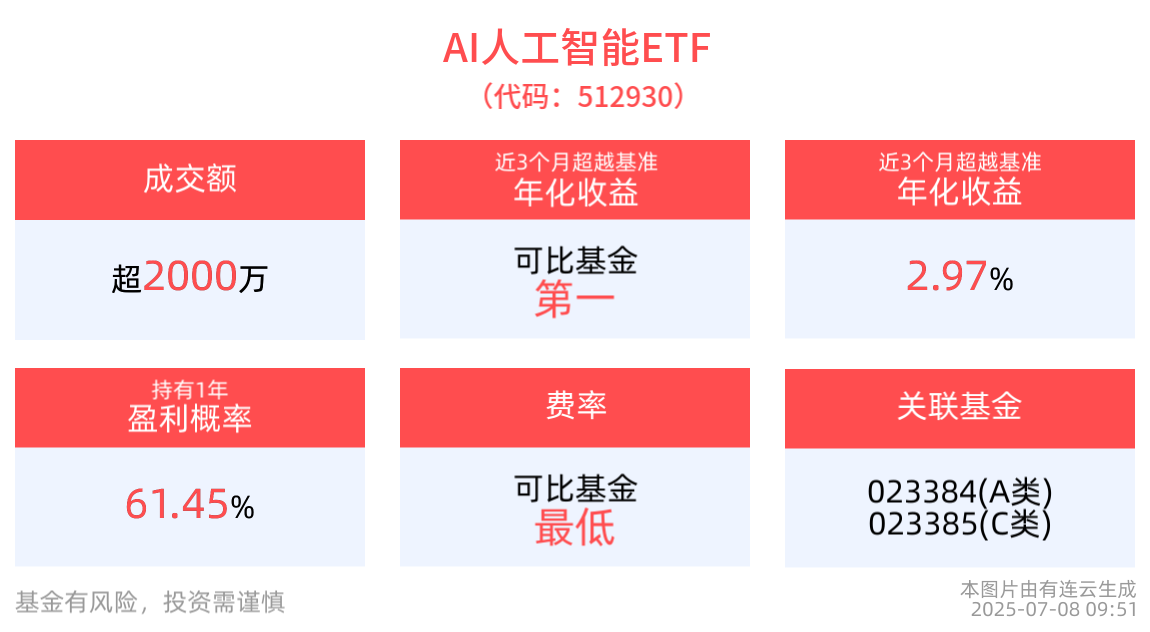
马斯克Grok4 大语言模型周四直播亮相,AI人工智能ETF(512930)红盘上扬,消费电子ETF(561600)上涨超1%
Xin Lang Cai Jing· 2025-07-08 02:24
Group 1: AI Industry Insights - The China Securities Artificial Intelligence Theme Index (930713) increased by 0.84%, with notable gains from companies such as Lexin Technology (688018) up 5.32% and Inspur Information (000977) up 2.51% [1] - Elon Musk announced the live release of Grok 4, while DeepMind's Isomorphic Labs is preparing to test AI-designed drugs on humans, indicating advancements in AI applications in drug development [1] - The top ten weighted stocks in the China Securities Artificial Intelligence Theme Index account for 52.8% of the index, with companies like Zhongji Xuchuang (300308) and Hikvision (002415) among the leaders [8] Group 2: Consumer Electronics Sector - The China Securities Consumer Electronics Theme Index (931494) rose by 1.28%, with significant increases from companies like Jingwang Electronics (603228) up 7.42% and Industrial Fulian (601138) up 7.17% [4] - The Consumer Electronics ETF (561600) has seen a net value increase of 22.37% over the past year, reflecting strong performance in the sector [4] - The top ten weighted stocks in the China Securities Consumer Electronics Theme Index represent 51.02% of the index, featuring companies such as Luxshare Precision (002475) and SMIC (688981) [11] Group 3: Online Consumption Market - The China Securities Hong Kong-Shenzhen Online Consumption Theme Index (931481) increased by 0.90%, with stocks like NetEase Cloud Music (09899) rising by 4.58% [6] - The Online Consumption ETF (159793) has shown a remarkable net value increase of 44.37% over the past year, indicating robust growth in online consumption [6] - The top ten weighted stocks in the China Securities Hong Kong-Shenzhen Online Consumption Theme Index account for 52.54%, with major players including Tencent Holdings (00700) and Alibaba-W (09988) [14]





央行:中巴在双边本币互换、金融市场、跨境支付和发展融资等领域合作的积极进展
news flash· 2025-07-08 01:55
Core Viewpoint - The People's Bank of China and the Central Bank of Brazil have made significant progress in bilateral cooperation in areas such as currency swaps, financial markets, cross-border payments, and development financing [1] Group 1: Bilateral Cooperation - Both central banks have acknowledged the positive developments in bilateral currency swaps and financial market cooperation [1] - Agreements such as the Financial Strategic Cooperation Memorandum and the Currency Swap Agreement between the People's Bank of China and the Central Bank of Brazil will continue to be implemented [1] Group 2: Sustainable Development Fund - The second committee meeting of the China-Brazil Sustainable Development Capacity Expansion Cooperation Fund was recently held, exploring future cooperation opportunities [1] - The second batch of project outcomes under the China-Brazil Fund is diverse, and both parties will continue to promote exchanges and cooperation under this mechanism [1]
中国人民银行行长潘功胜会见巴西中央银行行长加利波罗
news flash· 2025-07-08 01:53
Core Insights - The meeting between the Governor of the People's Bank of China, Pan Gongsheng, and the Governor of the Central Bank of Brazil, Roberto Campos Neto, highlighted the positive progress in bilateral cooperation in areas such as currency swaps, financial markets, cross-border payments, and development financing [1] Group 1 - Both parties acknowledged the advancements made in bilateral currency swap agreements and financial market cooperation [1] - There is a commitment to continue implementing the signed financial strategic cooperation memorandum and the currency swap agreement between the People's Bank of China and the Central Bank of Brazil [1] - The focus is on promoting financial cooperation across various sectors between China and Brazil [1]
A股指数即将上新;央行连续8个月增持黄金……盘前重要消息一览
Zheng Quan Shi Bao· 2025-07-08 00:38
Group 1 - The People's Bank of China has increased its gold reserves for eight consecutive months, with the latest figures showing a rise of 70,000 ounces to a total of 73.9 million ounces as of the end of June [2] - By the end of 2027, China aims to have over 100,000 high-power charging facilities nationwide, focusing on local economic development and the promotion of new energy vehicles [2] - The Shanghai Stock Exchange and the China Securities Index Company will launch several specialized indices on July 21, including the Shanghai Stock Exchange Specialized New Index and the China Securities Specialized New 100 Index [3] Group 2 - A new mandatory national standard for passenger car braking systems will take effect on January 1, 2026, introducing requirements for electric transmission braking systems and emergency braking signals [3] - An international standard for testing scenarios of autonomous vehicle systems has been officially released, detailing evaluation processes and testing methods [4] - The U.S. President has signed an executive order extending the delay for "reciprocal tariffs" until August 1, affecting imports from 14 countries with varying tariff rates [8][5] Group 3 - The U.S. stock market saw declines across major indices, with the Dow Jones down 0.94%, the Nasdaq down 0.92%, and the S&P 500 down 0.79%, impacting stocks of Japanese and Korean companies listed in the U.S. [5] - Companies such as Nissan and Toyota experienced significant stock drops, with Nissan down over 7% and Toyota down nearly 4% [5] - The market sentiment is shifting towards a balanced approach, with a focus on large-cap stocks and potential inflows of incremental capital in July [8][9]




早新闻 | 重磅指数将发布!
Zheng Quan Shi Bao· 2025-07-08 00:23
Group 1: Macro Trends - Shenzhen Stock Exchange will launch the Shenzhen Specialized and Innovative Index and the ChiNext Specialized and Innovative Index on July 21, 2025, to support the development of "little giant" enterprises [1] - Shanghai Stock Exchange will also release the Shanghai Sci-Tech Innovation Board Specialized and Innovative Index and the Shanghai Specialized and Innovative Index on July 21, 2025, providing diverse performance benchmarks and investment targets [2] Group 2: Industry Developments - Four departments, including the National Development and Reform Commission, issued a notice to promote the scientific planning and construction of high-power charging facilities, focusing on public transport, logistics, and heavy-duty freight [3] - As of June 2025, China's foreign exchange reserves reached $33,174 billion, an increase of $32.2 billion from May, reflecting a 0.98% rise due to macroeconomic policies and asset price changes [4] - In the first five months of 2025, China's textile industry saw a 3.4% year-on-year increase in industrial added value, with significant growth in production and exports [5] Group 3: Regulatory Changes - A new mandatory national standard for passenger car braking systems will be implemented on January 1, 2026, introducing requirements for electric transmission braking systems and single-pedal braking [6][7] Group 4: Company News - Xinyada announced that its cross-border payment business will account for less than 5% of total revenue in 2024, indicating limited impact on overall operations [8] - Landa Technology is planning a change in control, with stock suspension effective July 8, 2025, due to potential share transfer by major shareholders [9] - ST Texin will suspend trading for one day on July 8, 2025, and will remove other risk warnings, changing its stock name from "ST Texin" to "Tefa Information" [10] - Shanghai Washba intends to participate in the public auction for the transfer of lithium sulfide business assets from Yuyuan Rare Earth, with the outcome uncertain [11] - Tuoxin Pharmaceutical received approval for the market launch of its raw material drug, cytidine diphosphate choline, from the National Medical Products Administration [12]
7月8日早间新闻精选
news flash· 2025-07-08 00:20
Group 1 - The U.S. President Trump announced new tariffs on 14 trade partners, with rates ranging from 25% to 40% depending on the country, and extended the implementation date to August 1 [1] - The European Union is still negotiating a bilateral trade agreement with the U.S. before the July 9 deadline [2] - China's gold reserves increased to 73.9 million ounces (approximately 2,298.55 tons) as of the end of June, marking the eighth consecutive month of increases [3] Group 2 - The EU has postponed the signing of a climate action joint statement with China, emphasizing continued international cooperation on climate change [5] - The National Development and Reform Commission of China announced plans to promote the construction of over 100,000 high-power charging facilities by the end of 2027 [6] - Several companies, including Longsys Technology and Rockchip, reported significant year-on-year profit increases for the first half of the year, with some companies expecting profits to grow by over 180% [8] Group 3 - BlueDai Technology announced plans for a change in company control, leading to a stock suspension [10] - Shanghai Xiba plans to bid for assets related to the lithium sulfide business of Yuyuan Rare Earth [11] - Guodian Securities is preparing to apply for a virtual asset trading license through its Hong Kong subsidiary [13] Group 4 - Major U.S. stock indices fell, with the Dow down 0.94% and the Nasdaq down 0.92%, influenced by declines in Japanese and Korean companies listed in the U.S. [15] - U.S. Treasury Secretary indicated that the Federal Reserve is expected to cut interest rates twice this year, with Goldman Sachs moving the anticipated rate cut to September [16]

盘前必读丨特朗普宣布对14国关税税率;中国央行连续第8个月增持黄金
Di Yi Cai Jing· 2025-07-07 23:59
Group 1 - The current market is in a high-level consolidation phase, and the mid-year reporting period is a key window for identifying structural opportunities [1][13] - The overall market valuation is under pressure, making performance-driven factors crucial [13] - Industries such as solid-state batteries, copper, aluminum, and pharmaceuticals are highlighted for potential investment due to revenue growth and improved profitability [13] Group 2 - Industrial Fulian expects a net profit increase of 36.84% to 39.12% year-on-year for the first half of 2025, driven by the explosion of AI-related business [10][11] - Chuanjinno anticipates a net profit growth of 152% to 182% year-on-year for the first half of 2025, benefiting from strong market demand and optimized production [12] - Rockchip expects a net profit increase of 185% to 195% year-on-year for the first half of 2025, supported by its long-term strategic layout in AIoT products [13]

