
金融科技

Search documents
超9000家关停!银行网点正在消失
第一财经· 2025-12-08 14:55
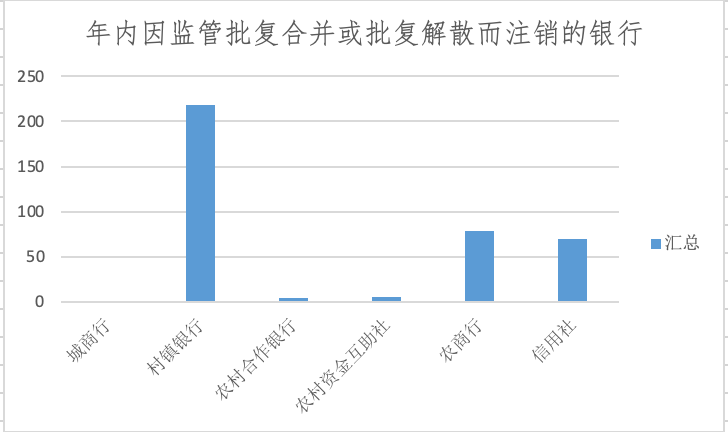
2025.12. 08 本文字数:2285,阅读时长大约4分钟 作者 | 第一财经 王方然 "周围的银行网点好像越来越少了。"家住广东东莞的王女士近日发现,自己常去的村镇银行悄然解 散,变成了某家股份制银行的网点,隔壁镇上的几家农商行网点也陆续传出关闭的消息。"对日常生 活影响不大,但总觉得有些不一样。"她说。 记者注意到,许多被注销的村镇银行实际上是被并入更大规模的银行机构。例如,国家金融监督管理 总局的批复显示,迁安襄隆村镇银行股份有限公司已于11月28日解散,其全部资产、负债、业务、 人员及相关权利义务由收购方唐山银行承继。 (第一财经据企业预警通数据梳理) 分区域来看,年内因监管批复合并或批复解散而注销的数量最高的省份为内蒙古,达139家。这主要 与当地农信系统的大规模整合有关。5月17日,内蒙古农村商业银行股份有限公司正式成立,注册资 本达580.2亿元,成为全国首家一次性整合120家农信机构及村镇银行的省级统一法人银行。类似整 合案例还在继续,10月30日,国家金融监督管理总局赤峰监管分局发布批复,同意中国农业银行股 份有限公司收购克什克腾农银村镇银行有限责任公司,并设立分支机构。 此外,四川、山 ...


银行网点正在消失:今年超9000家关停,370余家银行注销
Di Yi Cai Jing· 2025-12-08 12:53
银行物理网点正以前所未有的速度减少。 "周围的银行网点好像越来越少了。"家住广东东莞的王女士近日发现,自己常去的村镇银行悄然解散, 变成了某家股份制银行的网点,隔壁镇上的几家农商行网点也陆续传出关闭的消息。"对日常生活影响 不大,但总觉得有些不一样。"她说。 王女士的直观感受背后,中小银行及网点正在加速消失。第一财经记者梳理最新数据发现,截至12月8 日,年内因合并或解散而注销的银行已达377家,较去年全年的190余家大幅增长。与此同时,银行物理 网点正迅速减少。今年已有超过9000家网点获批退出,较去年同期增幅超过200%。 银行正在加速"消失" 银行及其网点数量正快速收缩。据第一财经观察,减少最为明显的区域集中在内蒙古、山东等地。这些 地区正是2010年以来中小银行数量扩张最为迅猛的区域之一。其中,农商行成为受冲击最大的一个类 型。 企业预警通统计数据显示,以最新批复日期统计,截至12月8日,今年因监管批复合并或解散而注销的 银行已达377家,超过去年全年水平。其中,村镇银行注销数量最多,达到218家,占比近六成;农商行 和信用社分别注销79家和70家。 记者注意到,许多被注销的村镇银行实际上是被并入更大 ...
永安期货涨4.97%,成交额3.45亿元,近5日主力净流入2605.21万
Xin Lang Cai Jing· 2025-12-08 12:16
Core Viewpoint - Yong'an Futures has shown a significant increase in stock price, rising by 4.97% with a trading volume of 345 million yuan and a market capitalization of 22.75 billion yuan [1] Group 1: Company Overview - Yong'an Futures primarily engages in commodity futures brokerage, financial futures brokerage, asset management, and futures investment consulting, with risk management services provided through its wholly-owned subsidiary, Yong'an Capital [2] - The company is state-owned, with its ultimate control held by the Zhejiang Provincial Finance Department [2] - As of September 30, Yong'an Futures reported a net profit of 475 million yuan for the first nine months of 2025, representing a year-on-year growth of 13.31% [6] Group 2: Financial Performance - The company's main revenue sources include risk management services (90.17%), futures brokerage (6.90%), overseas business (2.24%), and other segments [6] - Yong'an Futures has distributed a total of 1.035 billion yuan in dividends since its A-share listing, with 627 million yuan distributed over the past three years [7] Group 3: Market Activity - The stock has seen a net inflow of 19.01 million yuan today, with a total of 35.36 million yuan in main trading volume, indicating a lack of strong control by major investors [4] - The average trading cost of the stock is 15.25 yuan, with the current price approaching a resistance level of 15.66 yuan, suggesting potential for upward movement if this level is surpassed [5]

大象论股|3900点全线爆发!跨年行情开始?
Sou Hu Cai Jing· 2025-12-08 12:05
从技术走势来看,我们在上周指数连续调整时明确提示买点出现,并且在周四的实战课布局的证券方向,周五大涨后今天也一度冲击涨停。 而今天虽然指数全线爆发但比较好的买点其实在上周,市场就是这样,节奏永远比操作更重要。 在周末适度拓宽券商资本空间与杠杆上限与调整保险公司相关业务风险因子的消息刺激下,今天金融科技全线爆发,让指数重新站上3900点,创业板一度 涨3%,成交量也重新回到了2万亿的水平,今天是难得的题材,容量趋势和谐上涨的一天,机构,量化,游资,都比较积极.虽然下午尾盘有所回落,但是全天还是放 量3100多亿,所以明天指数能否继续反弹量能很关键,不需要再放量3000亿,但只要不大幅缩量指数就有望继续冲击4000点。 而且本周作为超级周将有一系列消息即将落地,包括美联储议息会议,中央经济工作会议,CPIPPI,社融信贷等一系列经济数据,都有望成为指数冲击 4000点的重要催化剂。 从技术走势来看,周五就跟大家提示指数本周初有望继续延续反弹,而指数在今天已经放量突破了日线级别的20日均线的位置,代表短期趋势开始走好, 但在30分钟级别来看,指数向上反弹力度在为怕逐步减弱,所以明天指数大概率会走出冲高回落的走势,但 ...

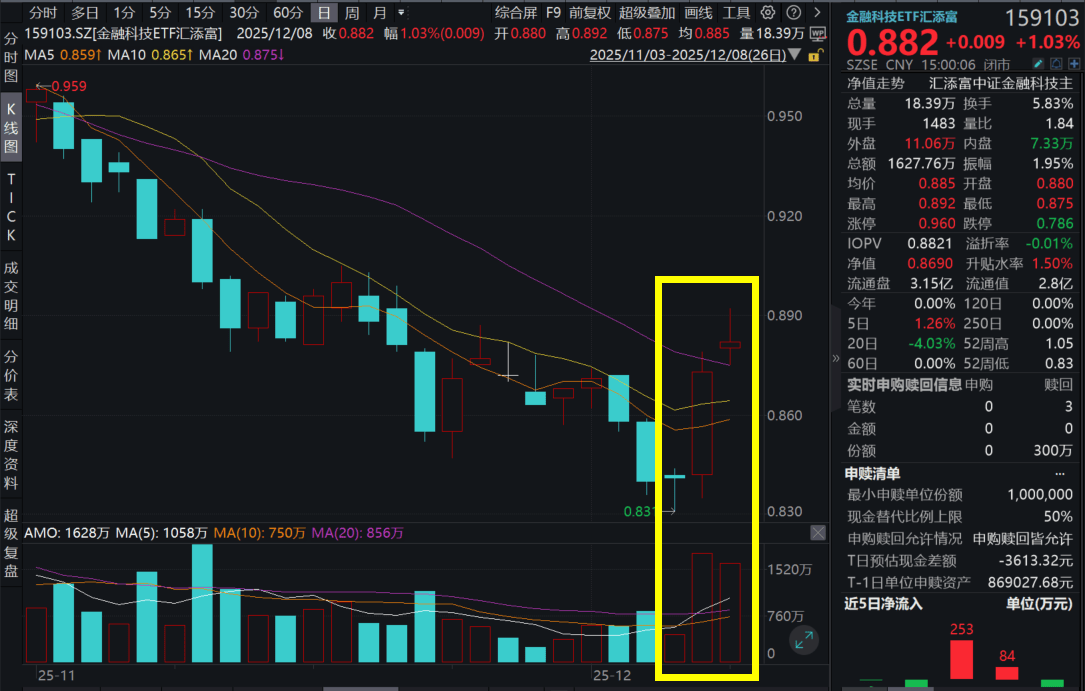
金融科技继续走强,银之杰涨超3%,“旗手2.0”金融科技ETF汇添富(159103)强势涨超1%喜提3连涨!险资风险因子下调,千亿增量资金有望入市
Sou Hu Cai Jing· 2025-12-08 09:26
Core Viewpoint - The A-share market experienced a rebound on December 8, with the financial technology ETF Huatai (159103) opening higher and achieving a three-day consecutive increase, closing up by 1.03% after rising over 2% at one point [1]. Group 1: Financial Technology ETF Performance - The financial technology ETF Huatai (159103) showed strong performance, with significant gains in its component stocks, including Sifang Jingchuang and Yinzhijie, which rose over 3%, and Hengsheng Electronics, which increased over 2% [6]. - The index of the financial technology ETF covers various sectors, including internet brokerage, financial IT, AI applications, and cross-border payments, highlighting its high elasticity and growth potential in a favorable liquidity environment [7]. Group 2: Regulatory Changes Impacting Insurance Companies - Recent adjustments to the risk factors for insurance companies' stock investments aim to enhance their solvency and encourage long-term capital investment in the equity market. The risk factor for stocks held over three years has been reduced from 0.3 to 0.27, and for stocks held over two years, it has been lowered from 0.4 to 0.36 [4]. - The adjustments are expected to release a minimum of 326 billion yuan in capital, with potential market inflows of 1,086 billion yuan if the insurance funds increase their allocation to the CSI 300 index stocks [5].






证监会主席的表态,“适当松绑”对券商意味着什么?
华尔街见闻· 2025-12-08 03:40
证监会主席吴清近日明确提出对优质券商"适度松绑",进一步优化风控指标,适度打开资本空间和杠杆限制。这一表态被市场视为券商行业政策环境转向积极 的重要信号。 12月6日,中国证监会主席吴清在中国证券业协会第八次会员大会上表示,各证券公司要立足自身资源禀赋,发挥好比较优势,从价格竞争加快转向价值竞 争。头部机构要保持时不我待、不进则退的紧迫感,在市场竞争力、客户和投资者服务、风险管理等方面树标杆做表率,要进一步增强资源整合的意识和能 力,用好并购重组机制和工具,实现优势互补、高效配置,力争在"十五五"时期形成若干家具有较大国际影响力的头部机构。 "需要强调的是,一流投行不是说就是头部机构的专属,中小机构也要把握优势、错位发展,在细分领域、特色客户群、重点区域等方面集中资源,深耕细作, 努力打造'小而美'的精品投行、特色投行和特色服务商。"吴清说。 吴清表示,证监会将着力强化分类监管、扶优限劣,对优质机构适当松绑,进一步优化风控指标,适度打开资本空间和杠杆限制,提升资本利用效率;对中小 券商、外资券商在分类评价、业务准入等方面,探索实施差异化监管,促进特色化发展;对少数问题券商要依法从严监管,违法的要依法从严惩治。 ...




金融科技ETF指数(563670)涨超2.3%,政策催化金融股持续走强
Sou Hu Cai Jing· 2025-12-08 02:49
Group 1 - The core viewpoint is that the financial technology sector is experiencing strong growth, with the China Securities Finance Technology Theme Index rising by 2.48% and several constituent stocks showing significant gains [1] - The China Securities Regulatory Commission (CSRC) announced on December 6 that it will enhance classified regulation, optimize evaluation indicators for quality institutions, and moderately expand capital space and leverage limits to improve capital utilization efficiency [1] - Non-bank financials are currently undervalued, providing a safety margin, with the insurance sector benefiting from economic recovery and rising interest rates, particularly in health and pension insurance [1] Group 2 - The Financial Technology ETF closely tracks the China Securities Finance Technology Theme Index, which reflects the overall performance of listed companies in the financial technology sector [2] - As of November 28, 2025, the top ten weighted stocks in the index account for 53.31% of the total, including companies like Tonghuashun and Dongfang Caifu [2]


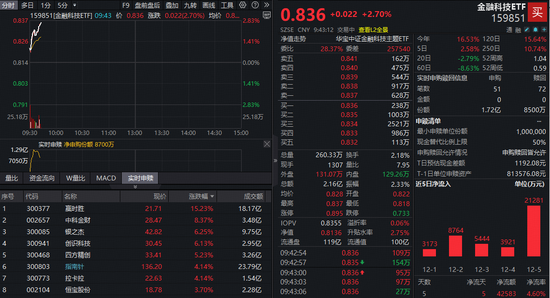
金融科技ETF(159851)放量再涨超2%,单周吸金超4亿元!A股迎新增量资金,板块有望持续受益
Xin Lang Ji Jin· 2025-12-08 02:23
Core Viewpoint - Financial technology sector is experiencing significant gains due to favorable news, with major stocks like WinTimes rising over 15% and several others increasing by more than 5% [1] Group 1: Market Performance - Financial technology stocks opened high, with notable increases in companies such as WinTimes, Zhongke Jincai, and Chuangshi Technology [1] - The largest financial technology ETF (159851) rebounded over 2%, with a trading volume exceeding 200 million yuan and a net subscription of 87 million units [1] - The financial technology ETF has a current scale exceeding 9 billion yuan, with an average daily trading volume of 800 million yuan over the past six months, leading among similar ETFs [2] Group 2: Regulatory Impact - The recent reduction of risk factors for insurance companies by the financial regulatory authority is expected to expand the scale of insurance capital investment in A-shares, indicating a positive signal for the A-share market and potential influx of new capital [1] Group 3: Investment Strategy - The financial technology sector is anticipated to benefit from improved liquidity, with internet brokerages expected to see continued fundamental improvements [2] - Investment strategies for 2026 focus on two main lines: short-term market activity and mid-term performance elasticity of financial IT companies, driven by policy support and steady progress in brokerage innovation [2] - Recommendations include focusing on financial technology ETFs (159851) and related funds, which cover a wide range of themes including internet brokerages and AI applications [2]



证监会主席的表态,“适当松绑”对券商意味着什么?
Hua Er Jie Jian Wen· 2025-12-08 00:18
证监会主席吴清近日明确提出对优质券商"适度松绑",进一步优化风控指标,适度打开资本空间和杠杆 限制。这一表态被市场视为券商行业政策环境转向积极的重要信号。 12月6日,中国证监会主席吴清在中国证券业协会第八次会员大会上表示,各证券公司要立足自身资源 禀赋,发挥好比较优势,从价格竞争加快转向价值竞争。头部机构要保持时不我待、不进则退的紧迫 感,在市场竞争力、客户和投资者服务、风险管理等方面树标杆做表率,要进一步增强资源整合的意识 和能力,用好并购重组机制和工具,实现优势互补、高效配置,力争在"十五五"时期形成若干家具有较 大国际影响力的头部机构。 "需要强调的是,一流投行不是说就是头部机构的专属,中小机构也要把握优势、错位发展,在细分领 域、特色客户群、重点区域等方面集中资源,深耕细作,努力打造'小而美'的精品投行、特色投行和特 色服务商。"吴清说。 吴清表示,证监会将着力强化分类监管、扶优限劣,对优质机构适当松绑,进一步优化风控指标,适度 打开资本空间和杠杆限制,提升资本利用效率;对中小券商、外资券商在分类评价、业务准入等方面, 探索实施差异化监管,促进特色化发展;对少数问题券商要依法从严监管,违法的要依法从 ...



以金融担当赋能农业国际合作
Zheng Quan Ri Bao· 2025-12-07 15:19
Core Viewpoint - The conference on promoting high-quality development of international agricultural cooperation emphasized the need for financial support to overcome cooperation bottlenecks and enhance agricultural international collaboration [1] Group 1: Financial Support for Agricultural Cooperation - Financial institutions are urged to implement diverse measures to inject financial momentum into international agricultural cooperation [1] - Establishing a robust cross-border financial service foundation is a primary task, requiring banks to create an integrated cross-border financial service system covering trade, investment, settlement, and value-added services [1] Group 2: Trade Financing and Cross-Border Settlement - In trade financing, banks should optimize processes like letter of credit issuance and document negotiation, promoting products such as order financing and warehouse receipt pledges to alleviate cash flow pressure for agricultural exporters [2] - There is a strong push for cross-border RMB settlement to reduce currency exchange costs and settlement risks for agricultural enterprises engaged in international trade [2] Group 3: Policy Coordination and Financial Innovation - Deepening policy coordination is essential, with banks encouraged to engage with government departments to implement special financial support policies and enhance service precision [2] - Financial innovation is vital, with banks expected to leverage fintech to create digital service platforms and explore supply chain finance models to support small agricultural enterprises [2] Group 4: Risk Management - Establishing a multi-dimensional risk prevention system is crucial, utilizing big data to identify risks in international agricultural cooperation and implementing risk warning mechanisms [3] - Banks should offer tools like foreign exchange options and collaborate with insurance institutions to develop specialized insurance products to cover risks associated with overseas agriculture [3] Group 5: Strategic Importance of Agricultural Cooperation - International agricultural cooperation is linked to food security and the broader context of foreign openness, necessitating that financial services be deeply integrated into all aspects of agricultural international cooperation [3]