
京津冀协同发展

Search documents
平原新城创投行”首站“晒单” 4个项目签约、总投资2.5亿元
Bei Jing Shang Bao· 2025-09-16 11:34
Core Insights - The "Pingyuan New City Venture Capital Tour" event in Changping District resulted in the signing of four projects with a total investment of 250 million yuan, covering sectors such as robotics, healthcare, and industrial-grade 3D printing [1] Group 1: Economic Development - Changping District has shown strong economic growth, with an average GDP growth rate of 6.2% since the 14th Five-Year Plan, and a notable 7.1% growth in the first half of this year, ranking among the top in the city [2] - The district aims to double its GDP by 2030 compared to 2020 levels, focusing on integrating technology and education, and enhancing the development of leading industries such as advanced energy, healthcare, and intelligent manufacturing [2] Group 2: Investment and Financing - The "Pingyuan New City Venture Capital Tour" aims to create a precise and efficient investment and financing platform, facilitating the integration of policies, capital, and projects to drive economic development in the region [3] - A total of 74 quality projects were identified during the preparation for the event, with a total investment demand of 51.35 billion yuan and financing needs of 7.08 billion yuan [2] Group 3: Strategic Importance - Pingyuan New City is a crucial component in promoting coordinated development between Beijing, Tianjin, and Hebei, serving as an important node for connecting the central urban area and the surrounding regions [1] - The district is positioned as a new growth pole for the capital's future development, with a focus on creating a vibrant urban environment and enhancing the quality of life for residents [2]
"平原新城创投行”首站“晒单” 4个项目签约、总投资2.5亿元
Bei Jing Shang Bao· 2025-09-16 11:27
Group 1 - The "Pingyuan New City Venture Capital Tour" event in Changping District resulted in the signing of 4 projects with a total investment of 250 million yuan, covering sectors such as robotics, healthcare, and industrial-grade 3D printing [1] - Changping District has shown strong economic growth, with an average GDP growth rate of 6.2% since the 14th Five-Year Plan, and a notable 7.1% growth in the first half of this year, positioning it among the top in the city [2] - The district aims to double its GDP by 2030 compared to 2020 levels, focusing on technology education integration and the development of key industrial zones [2] Group 2 - The event serves as a platform for understanding industrial planning, key enterprise dynamics, and financial cooperation needs in Changping, promoting a favorable business environment [3] - The initiative aims to transform the funding approach from "capital seeking projects" to a deep integration of "policy + capital + projects," injecting new momentum into the economic development of Pingyuan New City [3]
解读京津冀上市公司品牌价值:4年增长超万亿元,哪行涨得最猛?
Mei Ri Jing Ji Xin Wen· 2025-09-16 10:55
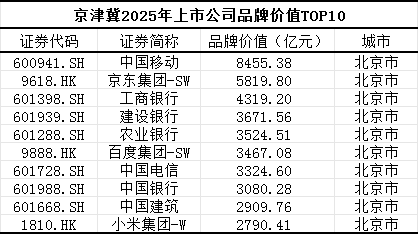
Core Insights - The Beijing-Tianjin-Hebei region achieved a GDP of 5.7 trillion yuan in the first half of 2025, reflecting a year-on-year growth of 5.4% [1] - The region has seen continuous improvement in overall strength over the past 11 years, crossing six trillion yuan milestones, becoming a strong driver for high-quality national development [1] - The analysis of brand value among listed companies in the region highlights the need for enhanced industrial collaboration and innovation, particularly in nurturing emerging industries and upgrading traditional sectors [1] Company Brand Value - China Mobile ranks first in brand value within the region, valued at 845.54 billion yuan [2][3] - The top ten companies in the Beijing-Tianjin-Hebei region are all based in Beijing, primarily consisting of state-owned enterprises and well-known internet companies [2][3] - The total brand value of 416 listed companies in the region reached 99,581.76 billion yuan, with Beijing accounting for 93.81% of this total [4] Year-on-Year Brand Value Changes - Beijing's brand value increased from 67,310.05 billion yuan in 2022 to 93,417.65 billion yuan in 2025, marking a growth of 26,107.60 billion yuan over four years [5] - In contrast, cities like Tianjin and Hebei cities showed minimal growth or declines in brand value, indicating a disparity in economic development [5] - The number of listed companies in Beijing decreased from 347 in 2022 to 329 in 2025, while Tianjin saw a slight increase [6] Industry Insights - The telecommunications sector experienced significant growth, with brand value increasing by over 1 trillion yuan over four years, largely driven by China Mobile's return to the A-share market [10][11] - The leisure industry faced a decline, with a reduction of 10 companies and a total brand value drop of 534.59 billion yuan, attributed to cyclical fluctuations in consumer markets [10][11] - Other sectors like finance, oil, and construction also showed notable brand value increases, while industries such as real estate and retail faced challenges [10][11] Recommendations for Regional Development - To address the imbalance in development within the region, it is suggested that leading companies in Beijing and Tianjin extend high-value segments of their operations to Hebei [13] - Hebei is encouraged to focus on transforming traditional industries towards high-end, intelligent, and green practices, while fostering a local digital economy [13] - The establishment of collaborative innovation platforms among enterprises, universities, and research institutions is recommended to enhance regional brand image and competitiveness [13]







天津宝坻:“十四五”获多项“国字号”荣誉 拓展京津冀协同发展路径
Zhong Guo Xin Wen Wang· 2025-09-16 04:53
Core Insights - Tianjin Baodi District has received multiple national honors and is actively integrating into the Beijing-Tianjin-Hebei coordinated development strategy, establishing various alliances and achieving significant industrial growth [1][3]. Group 1: Achievements and Honors - Baodi District has formed the Beijing-Tianjin-Hebei New Power System Industry-Academia-Research-Application Alliance and the Beijing-Tianjin-Hebei Low Altitude Economy Industry Alliance [1]. - The district has been recognized as a National Ecological Civilization Construction Demonstration Zone, a National Dual Support Model City, and a National Civilized City [1][3]. Group 2: Economic and Industrial Growth - Since the beginning of the 14th Five-Year Plan, the number of technology-based enterprises in Baodi has increased by 39% compared to the end of the 13th Five-Year Plan [3]. - The output value of the intelligent equipment industry has surpassed 100 billion, and several products developed by local enterprises have reached international leading levels [3]. - The district's power battery industry has been included in the national-level characteristic industrial cluster for small and medium-sized enterprises [3]. Group 3: Environmental and Social Development - Baodi has established five major parks and a dual-ring water system, which have passed national health zone re-evaluation [3]. - The entire section of the Chaobai River has been recognized as a national "Green Water and Green Mountain is Gold and Silver Mountain" practice innovation base, marking it as the first case of its kind in the country [3]. - Rural residents' income has increased by 6,800 yuan compared to the end of the 13th Five-Year Plan, consistently outpacing GDP growth for four consecutive years [3].
经济上台阶 民生增福祉——“数读”北京市“十四五”经济社会发展“成绩单”
Xin Hua Wang· 2025-09-16 02:03
Core Insights - Beijing's "14th Five-Year Plan" showcases significant achievements in economic and social development, emphasizing high-quality growth through strategic initiatives [1][6] Group 1: Economic Development - The Beijing-Tianjin-Hebei coordinated development strategy has led to the reduction of non-capital functions, with a cumulative decrease of 150 square kilometers in urban construction land and the exit of over 3,000 general manufacturing enterprises [1][3] - The GDP of Beijing is projected to exceed 5 trillion yuan during the "14th Five-Year Plan," with an economic increment of approximately 1.4 trillion yuan, equivalent to the economic output of a district like Haidian [6][7] - By 2024, the per capita GDP in Beijing is expected to reach $32,000, with labor productivity at 444,000 yuan per person, ranking first among all provinces and cities in China [6][7] Group 2: Infrastructure and Connectivity - The construction of the Beijing Subway Line 22 is accelerating, reducing travel time from Yanjiao in Hebei to Beijing's sub-center to just 9 minutes, and to the CBD in 32 minutes [5] - A transportation network connecting major cities in the region has been established, creating a 1 to 1.5-hour travel circle among Beijing, Tianjin, and Hebei [3][5] Group 3: Innovation and Market Vitality - Beijing maintains a research and development investment intensity of around 6%, positioning itself among the top global innovation cities [7] - The city has registered 158 large models, accounting for approximately 30% of the national total, and has a significant presence in the commercial aerospace sector [7] - Over the past five years, more than 1,700 measures have been introduced to improve the business environment, resulting in an annual growth rate of 6.2% in the number of business entities, reaching a total of 2.686 million [7] Group 4: Environmental and Social Improvements - Air quality in Beijing has significantly improved, with PM2.5 levels dropping to an average of 30.5 micrograms per cubic meter in 2024, a 65.9% decrease from 2013 [10] - The city has added over 152 kilometers of urban rail transit in the past five years, with a 90% transfer rate between buses and rail within 50 meters [10] - Public services have expanded, with over 150,000 new primary and secondary school places and a 94% enrollment rate for eligible children in kindergartens [10]
驶上发展“快车道”,京津中关村科技城入驻市场主体1883个
Bei Jing Ri Bao Ke Hu Duan· 2025-09-16 01:08
Core Insights - The Tianjin government is actively promoting the integration of the Baodi District into the Beijing-Tianjin-Hebei collaborative development strategy, enhancing its significance in the region [1] Group 1: Industrial Development - The "Zhongguancun-like" industrial ecosystem is being established in the Beijing-Tianjin Zhongguancun Science City, with 1,883 market entities and sustained double-digit growth in key economic indicators [3] - The Science City has signed an agreement with the Zhongguancun Development Group to deepen cooperation, with an 80 million yuan investment planned for a new round of capital increase [3] - Baodi District has adopted a comprehensive service package from Zhongguancun, implementing 22 policy measures to support high-quality development in the Science City [3][4] Group 2: Innovation and Technology - The Science City has developed a full-chain incubation system, recognized as an innovative base for entrepreneurship by the China Association for Science and Technology [4] - Collaborations with prestigious universities have led to the appointment of "technology vice presidents" for ten companies, enhancing innovation capabilities [4] - Significant technological advancements have been achieved, with certifications for international and domestic leading levels in semiconductor and robotics technologies [4] Group 3: Transportation Infrastructure - The opening of the Jing-Tang and Jing-Bin intercity railways has marked Baodi's entry into the "high-speed rail era," significantly improving transportation connectivity [5] - Baodi has upgraded 170 kilometers of trunk roads and constructed 39 kilometers of new primary roads, resulting in a total road network of 2,235 kilometers [5] - The Baodi Station has become a hub for high-speed rail, with a 34.8% increase in daily train services and a doubling of average passenger volume since the initial opening [6]

借鉴稳评制度建设经验,推进政策环评制度建设
Zhong Guo Huan Jing Bao· 2025-09-16 00:31
Core Viewpoint - The article emphasizes the importance of establishing a policy environmental impact assessment (EIA) system to enhance decision-making processes and support the construction of a beautiful China, drawing on the experiences of the social stability risk assessment (SRA) system [1][3]. Group 1: Policy Environmental Impact Assessment - The new regulation requires local government leaders to analyze and predict environmental impacts before making significant administrative decisions, providing a direct basis for policy EIAs [1]. - The establishment of the policy EIA system is seen as a crucial step towards improving the scientific, democratic, and legal levels of decision-making, ultimately contributing to high-quality development [1]. Group 2: Lessons from Social Stability Risk Assessment - The SRA system, initiated in 2005, has evolved through various stages, culminating in the formal establishment of the mechanism in 2012, which serves as a model for the development of the policy EIA system [2]. - The experiences from the SRA system highlight the need for a systematic approach to policy EIAs, including pilot projects to test and refine methodologies [4]. Group 3: Integration with National Strategies - The policy EIA should align with the goals of the beautiful China initiative, integrating environmental considerations into all aspects of economic and social development [3]. - The policy EIA can help identify solutions to significant resource and environmental issues that hinder the beautiful China initiative, such as the management of industrial waste [3]. Group 4: Implementation Strategies - The article suggests using pilot projects to promote the policy EIA system, allowing for practical exploration of methods and mechanisms while providing demonstrative support for policy formulation [4]. - The 2019 Interim Regulations on Major Administrative Decision-Making emphasize the importance of risk assessments, including environmental risks, which can serve as a foundation for the policy EIA [5]. Group 5: Incentives for Local Governments - Establishing an incentive mechanism for local governments to conduct policy EIAs is crucial, as it can enhance their willingness to engage in these assessments without fearing restrictions on decision-making [6]. - Integrating policy EIAs into local government performance evaluations can motivate officials to prioritize environmental assessments in their planning and decision-making processes [6].
北京日报社区小板报 | 双井“小哥”有了公租房,就在CBD
Bei Jing Ri Bao Ke Hu Duan· 2025-09-15 23:40
Group 1 - Beijing's PM2.5 average concentration for January to August 2025 is 25.6 micrograms per cubic meter, a year-on-year decrease of 17.2%, with 198 days classified as good air quality, an increase of 20 days [1] - The city plans to continue implementing the "0.1 microgram" action plan to improve air quality through structural, engineering, and management enhancements [1] Group 2 - A new public rental housing project named "Yishe" has been established in Beijing's CBD, providing 208 rooms for new employment groups, with a monthly rent of around 700 yuan [3] Group 3 - The Tsinghua University Science Museum is set to complete its structural topping this year, aiming to become China's first comprehensive research-oriented science museum by 2027 [6][7] Group 4 - Beijing's economic development during the 14th Five-Year Plan period is projected to exceed 5 trillion yuan, with significant resilience and potential despite challenges like the pandemic [7] - Over the past four years, more than 500 million square meters of high-quality commercial facilities have been put into operation, equivalent to the area of 25 Xidan Joy City [7] Group 5 - The opening of the 京东方 Life Science Industry Base in Fangshan District is part of Beijing's "Three 100" key projects, aimed at fostering new productive forces and promoting health industry collaboration in the Beijing-Tianjin-Hebei region [14] Group 6 - The "Book Aroma Beijing" themed train has been launched on the Beijing subway, promoting reading culture with a design concept centered around "New Knowledge After Reading" [16]


北京市级机关搬迁基本完成
Ren Min Ri Bao· 2025-09-15 21:28
北京通州区与河北廊坊北三县一体化发展向纵深迈进。"厂通路建成通车,跨界联通道路已达11条。"北 京市推进京津冀协同发展领导小组办公室副主任刘伯正介绍。 京津冀三省市通力合作,协同发展取得显著成效。北京城乡建设用地累计减量150平方公里,退出一般 制造业企业超3000家;支持雄安新区建设,"三校一院"交钥匙项目全部开学开诊,4000余家北京来源企 业在雄安新区扎根创业。京津冀主要城市1至1.5小时交通圈基本形成,区域内就诊可直接享受医保报销 待遇,"一卡通行"全面实现。科技成果区域转化效率和比重不断提升,北京输出津冀技术合同成交额由 2013年的70多亿元增长到2024年的840多亿元、年均增长25%。 本报北京9月15日电(记者王昊男)15日,北京市召开"十四五"时期经济社会发展成就新闻发布会。北京 市发展改革委主任杨秀玲介绍,"十四五"时期,北京城市副中心发展从有序拉开城市框架向全面提升功 能品质迈进,市级机关搬迁已基本完成。 ...
北京“十四五”的数字内涵
Bei Jing Qing Nian Bao· 2025-09-15 18:54
Group 1 - The core viewpoint of the article emphasizes Beijing's achievements during the "14th Five-Year Plan" period, highlighting the optimization of capital functions, significant events, and advancements in regional collaboration [1][2][3] - Beijing's GDP is projected to reach 5 trillion yuan by the end of the "14th Five-Year Plan," reflecting both the need for development and the feasibility of achieving this target [7] - The city has established three trillion-level industrial clusters, particularly in new-generation information technology, healthcare, and technology services, which are driving new economic momentum [5] Group 2 - The "Two Wings" concept, referring to the Xiong'an New Area and the Beijing Sub-Center, is crucial for the collaborative development of the modern capital metropolitan area, enhancing commuting, functional, and industrial integration [3][4] - The "12345" citizen hotline has evolved into a vital tool for modern urban governance, ensuring timely responses to public concerns and enhancing citizen satisfaction [2][8] - The "Double Benchmark and Double Engine" strategy has been initiated to promote digital and green economic development, creating a multiplier effect for the capital's growth [6] Group 3 - The "Seven New" initiatives outlined in the action plan for high-quality development focus on enhancing collaboration, new economic drivers, platform economy, new infrastructure, new opportunities, new scenarios, and renewable energy [9][10] - Beijing's R&D investment intensity remains above 6%, showcasing the city's commitment to innovation and technological advancement [7] - The city has achieved a preschool enrollment rate exceeding 90%, reflecting significant progress in early childhood education [13]