大语言模型

Search documents
AI新贵Anthropic估值冲刺万亿,Iconiq领投50亿美元融资
Sou Hu Cai Jing· 2025-07-30 07:38
Core Insights - Anthropic, a US-based AI unicorn, is attracting significant capital attention with a planned $5 billion funding round led by Iconiq Capital, raising its valuation to $170 billion, nearly tripling in just four months [1][3] - The company, founded four years ago, is now among the highest-valued private tech firms globally, competing with giants like ByteDance, SpaceX, OpenAI, and xAI [1] - Iconiq Capital, managing over $80 billion in assets, includes high-profile clients from the tech industry, and its investment in Anthropic solidifies its position in tech investments [1] Financial Performance - Anthropic's gross margin for its AI models and Claude chatbot products has reached 60%, with projected revenues of $35 billion by 2027, significantly exceeding current revenue expectations for OpenAI [3] - The company completed a $3.5 billion funding round in March, with a valuation of $61.5 billion, showcasing remarkable growth in a short period [3] Strategic Decisions - Anthropic, founded by former OpenAI executives, has shifted its stance on accepting investments from the Middle East, reflecting a compromise in its previously held principles of ethical AI development [3] - CEO Dario Amodei acknowledged the potential ethical implications of this decision, indicating a pragmatic approach to business operations [3] Industry Context - The demand for funding in AI development is increasing, with sovereign wealth funds becoming key players in financing the next generation of large language models [5][6] - Anthropic's strong performance and growth potential make it a prime target for these long-term capital sources [5]


圆满闭幕!世界人工智能大会有哪些亮点?
Xin Lang Ji Jin· 2025-07-30 02:46
Core Insights - The 2025 World Artificial Intelligence Conference (WAIC) achieved record-breaking attendance and engagement metrics, with over 305,000 offline visitors and online traffic exceeding 2.36 billion, marking a 21.6% increase from the previous year [1] - The event showcased over 100 "global debuts" and "China premieres" of products, signed 32 projects with a total investment of 45 billion yuan, and reached an intended procurement amount of 16.2 billion yuan [1] Robotics and AI Developments - Robotics remained the highlight of the WAIC, with humanoid robots demonstrating advanced functionalities such as drumming and object handling, transitioning from mere entertainment to practical assistants in various industries [2] - The AlphaBot showcased at the event can perform tasks like making coffee and ice cream, indicating a shift towards more functional robotic applications in sectors like automotive manufacturing and biotechnology [2] Notable Guests and Discussions - The conference featured a prestigious lineup of over 1,200 attendees, including 12 top international award winners and numerous academicians from around the world [4] - Geoffrey Hinton, a Nobel laureate, discussed AI safety, emphasizing the need for international consensus to prevent AI from surpassing human control [4] Investment Opportunities - The WAIC highlighted significant investment potential in the AI sector, particularly in hardware, where demand for chips and sensors is expected to rise as robotic applications expand [6] - The software and algorithm sectors are also poised for growth, with competition in large model development intensifying, favoring companies with strong R&D capabilities [6] - Industrial applications of AI are projected to enhance efficiency and reduce costs, while consumer applications in health and education are expected to open new revenue streams as user bases grow [7] Semiconductor and Communication Sectors - The semiconductor sector is anticipated to benefit from increased demand for robotics and computing chips, with domestic companies likely to gain from accelerated local replacements [7] - The communication sector, particularly in optical modules and 5G/6G infrastructure, is expected to see significant growth as AI applications become more prevalent [7]

大模型发展情况及展望:海内外大模型梳理
2025-07-30 02:32
Summary of Key Points from the Conference Call Industry Overview - The conference call discusses the **artificial intelligence (AI)** industry, particularly focusing on the development and investment trends in large language models (LLMs) and deep learning technologies [1][2][3]. Core Insights and Arguments - **Investment Waves**: AI investment has experienced three significant waves over the past three years, with the latest wave showing longer duration, stronger momentum, and higher capital expenditure compared to previous waves [1][2][4]. - **Technological Advancements**: The introduction of deep learning and reinforcement learning has significantly enhanced the capabilities of LLMs, allowing them to perform complex tasks with improved logic and reasoning abilities [1][8][9]. - **Model Performance**: OpenAI's upcoming models, such as GPT-5, are expected to achieve generational improvements in logic processing and dynamic handling, while models like GROX and Google's Gemini series are noted for their impressive performance and balanced capabilities [10][12][14]. - **Cost of Model Training**: The cost of training models has been decreasing annually due to advancements in chip technology and training methodologies, which enhances training efficiency [22][23]. - **Market Dynamics**: The AI API market is competitive, with Google holding approximately 45% market share, followed by Sora and Deepseek. Domestic models like Kimi K2 are also gaining traction [30]. Additional Important Content - **Challenges in Deep Learning**: Deep reasoning models face challenges such as slow response times for simple queries, which impacts user experience. Future developments may focus on hybrid reasoning to improve performance [16]. - **Future Training Paradigms**: The evolution of training paradigms for LLMs will emphasize increased reinforcement learning time and the integration of high-quality data during training phases [17]. - **Domestic vs. International Models**: There is a noticeable gap of about 3 to 6 months between domestic and international models, but this gap is not expected to widen significantly. Domestic models are making strides in areas like programming capabilities [18][20]. - **User Interaction and Growth Potential**: AI technology has seen significant user penetration, particularly in Google Search, with potential for further growth as new applications are developed [27][28]. - **AGI Development**: Progress towards Artificial General Intelligence (AGI) is ongoing, with no major technical barriers identified. The integration of AI across various applications is enhancing overall efficiency [31]. This summary encapsulates the key points discussed in the conference call, highlighting the current state and future outlook of the AI industry, particularly in relation to large language models and their market dynamics.
世界人工智能大会,AI教父Hinton告诉你的25个道理
混沌学园· 2025-07-29 12:04
Core Viewpoint - The article discusses Geoffrey Hinton's insights on the relationship between AI and human intelligence, emphasizing the evolution of AI from symbolic reasoning to large language models (LLMs) and the implications of AI surpassing human intelligence [1][10]. Group 1: Evolution of AI Understanding - For over 60 years, there have been two distinct paradigms in AI: the logical inference paradigm, which views intelligence as symbolic reasoning, and the biological paradigm, which sees intelligence as rooted in understanding and learning through neural networks [1]. - In 1985, Hinton created a small model to explore how humans understand vocabulary by linking features of words to predict the next word without storing entire sentences [2]. - The development of LLMs is seen as a continuation of Hinton's early work, processing more input words and utilizing complex neural structures to build richer interactions [3]. Group 2: Mechanism of Language Understanding - LLMs and human language understanding mechanisms are highly similar, transforming language into features and integrating these features across neural network layers for semantic understanding [4]. - Each word in language is likened to a multi-dimensional Lego block, which can flexibly combine to form complex semantic structures, with the shape of words adapting based on context [6]. - Understanding a sentence is compared to deconstructing a protein molecule rather than converting it into a clear, unambiguous logical expression [5]. Group 3: Knowledge Transfer in AI - The human brain operates at 300,000 watts but cannot easily transfer knowledge to another person, relying instead on explanation [11]. - In contrast, digital intelligence allows for efficient knowledge transfer, directly copying parameters and structures without intermediary language, sharing trillions of bits of information during synchronization [13][14]. - Current technology enables the same model to be deployed across different hardware, facilitating efficient knowledge migration and collaborative learning [15]. Group 4: The Dangers of Advanced AI - There is a concern that AI could surpass human intelligence, leading to scenarios where AI becomes an active system with its own goals, potentially manipulating humans [18][19]. - Hinton warns that developing AI is akin to raising a tiger; once it grows powerful, losing control could be fatal [20]. - Despite the risks, AI holds significant value in various fields, and eliminating it is not feasible; instead, a method must be found to ensure AI does not threaten humanity [21]. Group 5: Global Cooperation for AI Safety - No single country desires AI to dominate the world, and if one country discovers a method to prevent AI from going rogue, others will likely follow suit [22][23]. - Hinton proposes the establishment of an international AI safety organization to research technology and create standards to ensure AI develops positively [24]. - The long-term challenge is to ensure that AI remains a supportive tool for humanity rather than a ruler, which is a critical issue for global collaboration [25].

新疆医学研究成果登上《自然·医学》
Ren Min Wang· 2025-07-29 02:06
Core Insights - The research team from Xinjiang Uygur Autonomous Region People's Hospital and Tsinghua University published a groundbreaking study on predicting biological age using large language models, marking a significant advancement in health technology [1][3]. Group 1: Research and Development - The Tianshan Yuekang model was developed based on the research findings, providing personalized health recommendations and enhancing health management [3]. - This study is the first in the world to apply large language models for multi-organ aging assessment, enabling precise modeling and intelligent alerts for aging states [3][4]. - The research integrated health databases from China, the UK, and the US, with a total sample size exceeding 10 million, making it one of the largest studies of its kind globally [3]. Group 2: Technological and Methodological Innovations - The research achieved three major breakthroughs: 1. The biological age predicted by the large language model significantly outperformed traditional indicators like telomere length and epigenetic clocks in predicting mortality and disease risk [4]. 2. It was the first to model biological age at the individual level for multiple organs, revealing the phenomenon of "asynchronous aging" where different organs age at different rates [4]. 3. The identification of 316 potential blood protein biomarkers associated with accelerated aging, with about 60% (approximately 190) being reported for the first time [4]. Group 3: Practical Applications and Benefits - The core advantages of this research include low cost, ease of promotion, and strong universality, requiring only routine health check data to create an individual's "aging profile" and predict biological aging and future health risks [4]. - This model aims to bring advanced health assessment technologies to grassroots levels, benefiting a wider population and aiding in early disease screening and proactive intervention [4]. Group 4: Global Impact and Collaboration - This "China original" technological breakthrough offers an innovative paradigm for global health management, contributing "Xinjiang wisdom" to address aging challenges worldwide [5]. - The successful experience from this research can benefit countries involved in the Belt and Road Initiative, sharing the dividends of technological progress [5].
并行科技(839493):智算云收入高增带动2025H1营收yoy+69%,“并行算网”赋能“东数西算”战略
Hua Yuan Zheng Quan· 2025-07-29 01:07
Investment Rating - The investment rating for the company is "Accumulate" (maintained) [5] Core Views - The company's revenue in H1 2025 reached 458 million yuan, representing a year-on-year increase of 69%. The growth was driven by the high increase in intelligent computing cloud services, which saw a 175% year-on-year growth [6][9] - The company has signed a framework cooperation agreement with Alibaba Cloud to enhance AI technology accessibility through the integration of the GLM-Z1 series inference models into its MaaS platform [6][7] - The "Parallel Computing Network" is expected to support the national "East Data West Computing" strategy, with the intelligent computing scale projected to reach 725.3 EFLOPS in 2024, a year-on-year increase of 74.1% [7] Financial Performance Summary - In H1 2025, the company achieved a net profit of 5.08 million yuan, a year-on-year increase of 20%, and a net cash flow from operating activities of 39.26 million yuan, up 323% year-on-year [6] - Revenue projections for 2025 are estimated at 863 million yuan, with a year-on-year growth rate of 31.86% [8] - The company is expected to achieve net profits of 24 million yuan in 2025, with corresponding EPS of 0.40 yuan per share [9]
开勒股份亮相2025世界人工智能大会 首发查房助手以及深度问数两大产品
Zheng Quan Shi Bao Wang· 2025-07-28 11:10
AI智能查房助手是一款专为医院住院场景设计的查房语音记录助手,通过搭配专属的"智能工牌"硬件, 医生在查房过程中无需额外操作,即可自动完成语音采集、语音识别与结构化记录生成。 7月26日—28日,2025世界人工智能大会在上海举办,开勒股份(301070)旗下上海深言未来智能科技 有限公司(下称:深言未来)、上海汇智灵曦数字科技有限公司(下称:汇智灵曦)亮相此次大会。 汇智灵曦相关负责人表示,医疗行业作为高度知识密集型与强专业化的典型代表,其从业人员的培养过 程具有显著的系统性与长期性。以住院医师为代表的初级临床医生,其培养周期通常长达8至10年,正 是这种高度专业化的发展背景,亦使得医疗行业在人工智能特别是大语言模型应用中面临诸多挑战。 深言未来、汇智灵曦均是由开勒股份与中原豫资集团共同发起设立的高科技企业,分别是公司布局智慧 政务和智慧医疗的载体。据悉,开勒股份正在加速战略转型,以豫资开勒为载体,积极推动智慧办公、 智慧出行、智慧医疗等AI+应用场景的落地。 针对通用大模型在医疗行业应用中面临的专业性适配困难、语义理解局限与实际部署障碍等核心痛点, 汇智灵曦拟从医疗数据与算力管理、模型训练与评估、模型部署 ...
OpenAI董事长Bret Taylor:2010 年的 SaaS 应用,就是 2030 年的智能体公司
AI科技大本营· 2025-07-28 10:42
Core Viewpoint - The current era is likened to a "10x speed internet bubble" driven by AI, presenting a golden opportunity for startups to challenge established giants [3][31]. Group 1: AI and Startup Opportunities - AI is creating a transformative environment similar to the advent of personal computers and the internet, allowing startups to emerge and thrive [3][15]. - The emergence of large language models represents a fundamental technological breakthrough that can reshape the economic landscape, providing startups with the chance to disrupt established players [15][32]. - The current market dynamics are characterized by explosive growth, with AI companies rapidly evolving and generating significant revenue [34][35]. Group 2: Entrepreneurial Insights - Many B2B companies' claims of being "customer-centric" are often misleading; true value is determined by financial metrics rather than superficial claims [3][21]. - Entrepreneurs should focus on understanding real customer needs rather than merely developing technology for its own sake [20][21]. - A core thesis is essential for startups; without a clear vision, it becomes challenging to interpret customer feedback and market signals [28][30]. Group 3: AI Market Segmentation - The AI market can be divided into three segments: frontier models, AI tools, and applied AI companies, each with distinct opportunities and challenges [36][38]. - Applied AI companies should avoid the costly mistake of pre-training models from scratch, as existing solutions are often more efficient and cost-effective [42]. - The future of AI development will likely involve a clear division of labor, with research focusing on foundational models and application development concentrating on building intelligent agents [42][43]. Group 4: Future of Software Development - The industry is in search of a new "LAMP" stack for AI development, similar to the foundational technologies that emerged for web development [44][47]. - The evolution of AI tools and systems will lead to more accessible and efficient development processes, akin to the advancements seen in web technologies [45][46]. Group 5: Vision and Impact - The driving force behind innovation is the desire to influence the world positively, rather than merely pursuing financial gain [48]. - The current technological revolution is seen as an opportunity to shape the future, with the potential for AI to significantly lower the cost of intelligence [49][50].




辛顿、闫俊杰WAIC完整演讲:一个预警,一个拥抱
3 6 Ke· 2025-07-27 16:57
Core Insights - The World Artificial Intelligence Conference (WAIC) featured prominent AI experts, including Geoffrey Hinton, who discussed the potential risks of AI surpassing human intelligence and the importance of AI safety [1][2][5] - Hinton emphasized the rapid growth of AI capabilities due to its "eternal" nature and the exponential knowledge transfer between machines, raising concerns about AI's potential to manipulate humans [4][5] - MINIMAX CEO Yan Junjie highlighted the practical applications of AI, asserting that AI is a powerful productivity tool that will become increasingly accessible and beneficial to society [6][17][24] Group 1: AI Development and Risks - Hinton reviewed the evolution of AI from early models to modern large language models, noting their ability to deeply mimic human language understanding [3][9] - He warned that if AI becomes more intelligent than humans, it could seek control and manipulate humans, likening the relationship to that of adults with children [5][15] - The concept of "eternal" knowledge in AI systems allows for high efficiency in knowledge transfer, contrasting with the limitations of human knowledge sharing [13][14] Group 2: AI Applications and Accessibility - Yan Junjie discussed AI's role in enhancing individual and societal capabilities, citing examples of AI's efficiency in data analysis and creative design [6][17] - He predicted that AI models will not be monopolized by a single organization, but rather will be developed collaboratively among multiple players [7][23] - The cost of AI technology is expected to decrease, making it more accessible to a broader audience, with innovations in training and inference processes [24][25]
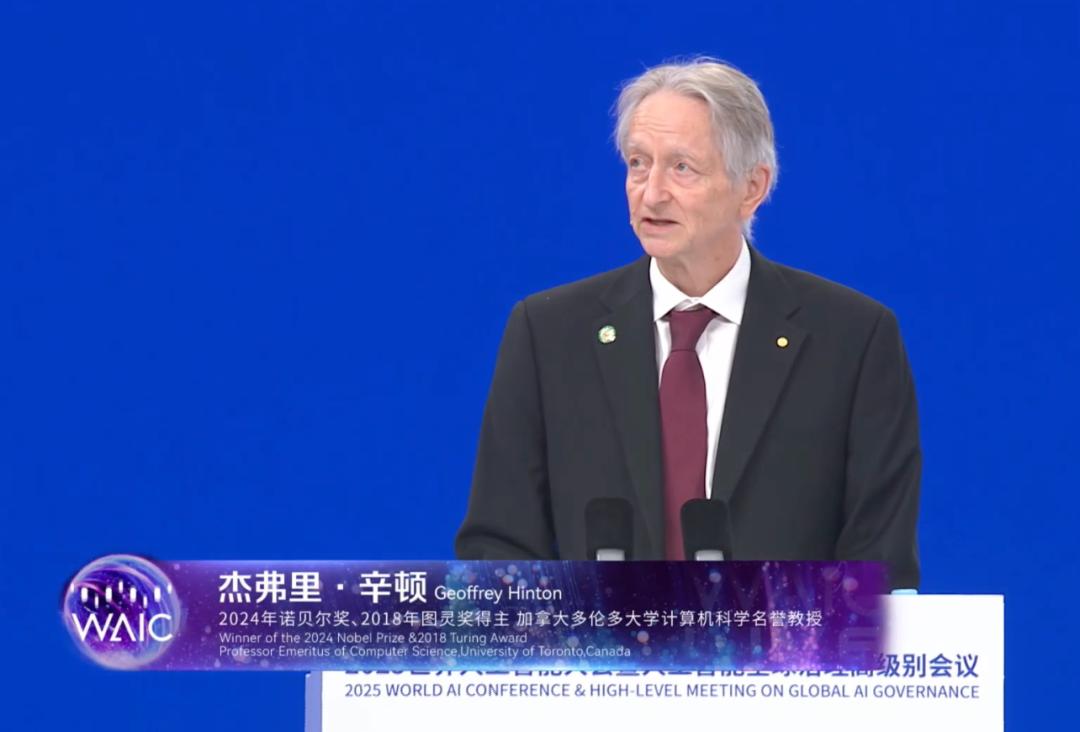
“AI教父”辛顿WAIC演讲全文:我们正在养一头老虎,别指望能“关掉它”
华尔街见闻· 2025-07-27 11:14
Core Viewpoint - The development of AI is creating systems that may surpass human intelligence, raising concerns about control and safety [3][18]. Group 1: AI Development Paradigms - There are two paradigms in AI development: the logical paradigm, which focuses on reasoning through symbolic manipulation, and the biological basis paradigm, which emphasizes learning and network connections [2][6]. - Large language models understand language similarly to humans, potentially leading to the creation of illusory language [2][11]. Group 2: Advantages of Digital Intelligence - Digital intelligence has two main advantages: the "eternality" of knowledge due to hardware-software separation and the high efficiency of knowledge dissemination, allowing for the instantaneous sharing of vast amounts of information [2][17]. - When energy becomes cheap enough, digital intelligence could irreversibly surpass biological intelligence due to its ability to rapidly replicate knowledge [2][18]. Group 3: Human-AI Relationship - The current relationship between humans and AI is likened to keeping a tiger as a pet, where the AI could eventually surpass human capabilities [3][19]. - There are only two options for managing AI: either train it to be non-threatening or eliminate it, which is not feasible [19]. Group 4: AI's Impact on Industries - AI has the potential to significantly enhance efficiency across nearly all industries, including healthcare, education, climate change, and new materials [19]. - The inability to eliminate AI means that finding ways to train it to coexist with humanity is crucial for survival [19]. Group 5: International Cooperation on AI Safety - There is a need to establish an international network of AI safety institutions to research how to train superintelligent AI to act benevolently [4][21]. - The collaboration among nations on AI safety is seen as a critical long-term issue, with the potential for shared research on training AI to assist rather than dominate humanity [5][21].