太空算力

Search documents
华尔街见闻早餐FM-Radio|2025年11月26日
Sou Hu Cai Jing· 2025-11-25 23:35
Market Overview - The U.S. stock market showed positive momentum with the Dow Jones rising over 1% and both the S&P 500 and Nasdaq reaching near two-week highs, despite some pressure from tech stocks like Nvidia, which fell over 7% during the day [1][2] - Nvidia's decline was notable as it was the only one among the "Big Seven" tech stocks to drop, while Google and Broadcom saw gains, with Google hitting a new all-time high [1][2] - The labor market in the U.S. appears weak, with private sector job losses increasing, contributing to a drop in the 10-year Treasury yield below 4% for the first time this month [2][5] Company Highlights - Alibaba reported Q3 revenue of 247.8 billion yuan, a year-on-year increase of 4.8%, with cloud business revenue surging by 34% and instant retail growing by 60% [6][27] - NIO's Q3 revenue grew by 16.7% to 21.8 billion yuan, achieving a record vehicle gross margin of 14.7%, with Q4 guidance indicating further growth [8][27] - Pony.ai's Q3 revenue increased by 72% year-on-year to $25.4 million, driven by a nearly 90% rise in Robotaxi business revenue [7][23] - Dell's revenue guidance for the current quarter exceeded expectations, and the company raised its annual AI server shipment forecast from $20 billion to $25 billion, reflecting strong demand in the AI server market [9][24] Industry Trends - The AI competitive landscape is shifting, with Nvidia experiencing a significant drop while Google reached new highs, indicating a potential change in market leadership [20][21] - The demand for AI-related products is driving substantial growth in companies like Alibaba, which has seen its AI-related revenue grow significantly [33] - The global central bank's gold purchases have surged, indicating a strong demand for gold as a reserve asset, with expectations for continued growth in this area [28]





4.5亿太空算力项目开启招标,产业迎来加速落地
Xuan Gu Bao· 2025-11-25 14:57
Group 1 - The "Liangxi Constellation" project is publicly tendered with an estimated contract value of 450 million yuan, funded by self-raised capital [1] - The project involves the construction of a satellite constellation consisting of 12 intelligent computing satellites, utilizing 3D printing for manufacturing and featuring advanced computing payloads [1] - The total computing power of the constellation is expected to be no less than 20P after network completion, covering various aspects such as satellite development, launch, frequency allocation, and operational services [1] Group 2 - The demand for computing power is experiencing exponential growth due to the surge in artificial intelligence (AI), leading to unprecedented challenges for traditional ground data centers in terms of energy consumption and land resources [1] - Space computing is emerging as a significant direction for investment in both China and the United States, with the potential to become a crucial component of future computing power [1] - The space computing sector encompasses multiple key areas, including satellite manufacturing, core chips, data processing, and communication links, each presenting investment opportunities [1] Group 3 - Aerospace Hongtu has established the "Nüwa Constellation" for remote sensing data processing in orbit, achieving over 40% market share in remote sensing data processing, and is expected to benefit from the development of space computing [2] - Zhongke Xingtou, a subsidiary of the Chinese Academy of Sciences, is planning commercial satellite constellations for space computing and sensing, integrating ground-based data with supercomputing capabilities [2] - The company is collaborating with Zhongke Shuguang to build a "space-ground integrated" computing network, enhancing urban governance and disaster warning scenarios [2]


晚报 | 11月26日主题前瞻
Xuan Gu Bao· 2025-11-25 14:31
Group 1: Space Computing - The "Liangxi Constellation" project, involving 12 intelligent computing satellites, is publicly tendered with an estimated contract value of 450 million yuan [1] - The project aims to address the increasing demand for computing power driven by the explosive growth of artificial intelligence (AI), as traditional data centers face significant limitations [1] - Space computing is expected to become a crucial component of future computing infrastructure, with investment opportunities across satellite manufacturing, core chips, data processing, and communication links [1] Group 2: Artificial Intelligence - Alibaba reported a revenue of 247.8 billion yuan for Q2 of fiscal year 2026, with its Cloud Intelligence Group generating 39.82 billion yuan, exceeding market expectations [2] - AI-related product revenue has seen triple-digit growth for nine consecutive quarters, with a year-on-year increase of 34% in the Cloud Intelligence Group [2] - Alibaba's Qwen app achieved over 10 million downloads within a week of its public beta, surpassing the growth rates of competitors like ChatGPT [2] Group 3: Commercial Space - The National Space Administration of China has issued a plan to promote high-quality and safe development of commercial space from 2025 to 2027, including the establishment of a national commercial space development fund [3] - The plan aims to enhance the commercial space ecosystem, which includes satellites, rockets, and launch facilities, transitioning from technology validation to large-scale application [3] - The commercial space sector is expected to play a vital role in China's global space economy and contribute to the digital economy and smart society [3] Group 4: Quantum Computing - China's first large-scale dedicated optical quantum computer manufacturing facility has opened, marking a significant step towards the industrialization of quantum computing [4] - Quantum computing is recognized as a core driver of next-generation information technology, capable of addressing traditional computing power limitations [4] - The industry is expected to grow rapidly due to technological breakthroughs, policy support, and market demand, with applications expanding across various sectors [4] Group 5: Data Elements - The National Data Bureau has initiated a pilot project for the development and utilization of data resources in state-owned enterprises, involving 12 central enterprises [7] - This initiative is part of a broader strategy to enhance the value of public data operations, which is expected to significantly impact economic and social development [7] Group 6: 3D Vision Technology - Huawei has launched the Mate 80 series smartphones, which support 3D facial recognition technology, enhancing payment security and user convenience [6] - The 3D vision industry is anticipated to experience explosive growth starting in 2024, driven by the demand for high-precision perception in automation applications [6]
陕西华达:已启动宇航级设计、星载模块、耐辐射等关键预研
Ge Long Hui· 2025-11-25 07:23
Core Viewpoint - Shaanxi Huada (301517.SZ) is actively expanding its product applications in aerospace, weaponry, and communications, focusing on high-reliability design and environmental testing for satellite and deep space exploration support [1] Group 1: Aerospace Applications - The company has accumulated significant core technologies in high-reliability design and environmental testing, providing solid support for satellite, launch vehicles, and deep space exploration [1] - The company is initiating key research in astronautical-grade design, on-board modules, and radiation-resistant technologies to enhance its capabilities in space-based big data processing [1] Group 2: Market Expansion and Innovation - The company is increasing its market development efforts in the robotics sector, aiming to boost market share through continuous technological innovation and smart manufacturing [1] - The company is committed to creating comprehensive solutions that cover components, modules, and subsystems [1]
陕西华达(301517.SZ):已启动宇航级设计、星载模块、耐辐射等关键预研
Ge Long Hui· 2025-11-25 07:11
Core Viewpoint - Shaanxi Huada (301517.SZ) is actively expanding its capabilities in aerospace, defense, and communication sectors, focusing on high-reliability design and environmental testing for satellite and deep space exploration applications [1] Group 1: Aerospace Applications - The company has accumulated significant core technologies in high-reliability design and environmental testing, providing solid support for satellite, launch vehicles, and deep space exploration [1] - The company is initiating key research in astronautical-grade design, on-board modules, and radiation-resistant technologies to enhance its offerings in the "space computing" sector [1] Group 2: Product Development and Market Expansion - The company aims to create comprehensive solutions covering "components—modules—subsystems" for in-orbit space-based big data processing scenarios [1] - The company is also focusing on the development of robotics, planning to increase market penetration and continuously drive technological innovation and smart manufacturing to expand its market share [1]
马斯克画的上天大饼 中国人已经在做了
Xin Lang Ke Ji· 2025-11-25 01:23
Core Insights - Elon Musk's ambitious plan to build AI data centers in space reflects a significant shift in the competition for computational power, with China already making strides in this area [1][27] - The demand for AI infrastructure is driving massive investments from tech giants, with projected capital expenditures reaching $1.2 trillion over the next three to five years [6][9] Group 1: Space Data Centers - Musk's proposal includes launching AI satellites to create a space-based data center, which he claims could generate 100 GW of solar energy annually, equivalent to a quarter of the average annual electricity consumption in the U.S. [12][13] - The efficiency of solar energy in space is significantly higher than on Earth, with solar radiation intensity being 1.36 times greater in orbit [10] - The cooling requirements for data centers in space can be met more efficiently due to the extreme cold of space, allowing for effective heat dissipation without traditional cooling systems [11][12] Group 2: Investment and Infrastructure - Major tech companies are investing heavily in AI infrastructure, with a total projected investment of $6.7 trillion in data centers by 2030, driven largely by AI workloads [6][9] - Musk's xAI is collaborating with Saudi Arabia to build a $25 billion data center with a capacity of 500 MW, surpassing the capacity of xAI's existing center in Tennessee [6][7] Group 3: Challenges and Considerations - The primary challenge for space data centers is the cost of launching equipment into space, with current costs around $1,400 per kilogram, although future projections suggest this could drop to between $67 and $100 per kilogram [24][25] - Concerns about cosmic radiation and the harsh environment of space necessitate robust engineering solutions to protect sensitive equipment [21][22] Group 4: Competitive Landscape - Other tech giants, such as Amazon and Google, are also exploring space-based data centers, with Amazon's Blue Origin and Google's Project Suncatcher aiming to leverage solar energy in space for AI processing [14][16] - China's advancements in space computing, including the launch of a satellite constellation for computational tasks, indicate that the race for space-based AI infrastructure is intensifying [27]

首都在线:公司业务目前暂不涉及太空算力相关领域
Mei Ri Jing Ji Xin Wen· 2025-11-20 01:20
Core Viewpoint - The company, Capital Online (300846.SZ), confirmed that its main business does not currently involve collaboration in the field of space computing power [1]. Group 1: Company Business Overview - The company provides cloud services, communication network services, IDC services, and comprehensive solutions to various industries [1]. - The services offered are designed to meet the computing power and network service needs of different industries during their digital transformation process [1]. Group 2: Space Computing Power Inquiry - An investor inquired about the company's involvement in space computing power-related collaborations [1]. - The company clarified that it does not engage in the space computing power sector at this time [1].

首都在线(300846.SZ):公司业务目前暂不涉及太空算力相关领域
Ge Long Hui· 2025-11-20 01:17
Core Viewpoint - The company, Capital Online (300846.SZ), focuses on providing cloud services, communication network services, IDC services, and comprehensive solutions to various industries, addressing their digital transformation needs for computing power and network services. The company does not currently engage in space computing services [1]. Group 1 - The main business of the company includes general computing and intelligent computing cloud services [1]. - The company aims to meet the service demands of different industries during their digital transformation processes [1]. - The company’s current operations do not involve any space computing-related fields [1].
A股盘前播报 | 多部门重要提醒!近期避免前往日本
智通财经网· 2025-11-17 00:31
盘前要闻 1、外交部、文旅部、教育部等多部门重要提醒!近期避免前往日本 类型:宏观 情绪影响:中性 外交部发布出行提醒,日本领导人公然发表涉台露骨挑衅言论,严重恶化中日人员交流氛围,给在日中 国公民人身和生命安全带来重大风险。文化和旅游部郑重提醒中国游客近期避免前往日本旅游。教育部 建议中国公民谨慎规划赴日留学安排。 2、华为将发布AI领域突破性技术,有望解决算力资源利用效率难题 类型:行业 情绪影响:正面 4、证监会主席吴清:着力推动市场更具韧性、更加稳健,制度更具吸引力 类型:宏观 情绪影响:正面 近日,中国证监会举办学习贯彻党的二十届四中全会精神宣讲报告会,吴清强调,着力推动市场更具韧 性、更加稳健,制度更加包容、更具吸引力,上市公司质量更高、价值更优,监管执法更加有效、更具 震慑力,开放迈向更深层次、更高水平。 华为将在11月21日发布AI领域的突破性技术,可将GPU、NPU等算力资源的利用率,从行业平均的30% 至40%提升至70%,显著释放算力硬件潜能。据透露,华为是通过软件创新实现英伟达、昇腾及其他三 方算力的统一资源管理与利用,屏蔽算力硬件差异,为AI训练推理提供更高效的资源支撑。 3、国常会 ...
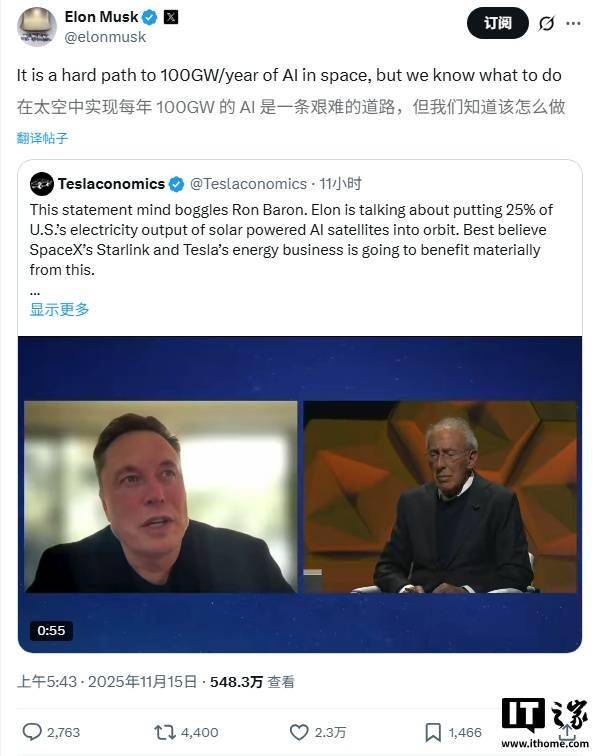
马斯克最新访谈:目标每年在太空部属100吉瓦AI卫星
Sou Hu Cai Jing· 2025-11-15 08:31
Core Insights - Elon Musk discussed various topics including artificial intelligence, energy, chip manufacturing, robotics, Neuralink, personal wealth perspective, and long-term vision during an interview with investor Ron Baron [1] Group 1: Space and Energy - Musk sees a feasible technological path to launch solar-powered AI satellites with a target of 100 gigawatts (GW) annually, which could provide energy for large-scale AI operations, potentially becoming the lowest cost method for powering AI at scale [2] - The current average electricity load in the U.S. is approximately 460 GW, highlighting the scale of Musk's ambitions [2] Group 2: Chip Manufacturing - Musk expressed high regard for TSMC and Samsung, noting that Tesla and SpaceX collaborate with these companies to expedite chip production and increase capacity [2] - He mentioned that inquiries about the time required to build new wafer fabs resulted in a response of approximately five years from initiation to production, which Musk described as an eternity [3] Group 3: AI Development - Musk stated that Grok-4-Heavy is currently the smartest AI, utilizing a multi-agent parallel collaboration approach to improve its outputs continuously [3] Group 4: Personal Wealth Perspective - Musk is not motivated by money or luxury, focusing instead on human survival and the need for sufficient ownership to guide his companies forward [4][5] - He mentioned having only a modest home in Austin and a small house at Starbase, indicating a minimalist lifestyle [5] Group 5: Future Vision - Musk envisions a future where AI and robotics can fully meet human needs, benefiting everyone [6] - His long-term goals include expanding human consciousness, exploring other galaxies, and gaining a deeper understanding of the universe [6] Group 6: Neuralink Progress - Neuralink has implanted devices in over 10 patients, some of whom were previously unable to move or communicate, and they can now interact at nearly normal conversational speeds [7][8] Group 7: Robotics and Healthcare - Musk believes that the Tesla humanoid robot, Optimus, will enable access to top-tier surgical procedures due to its superhuman precision [9] - He stated that Optimus could perform complex medical surgeries that are currently beyond human capabilities, addressing the limitations posed by the scarcity of skilled medical professionals [10]