
AI智能体

Search documents
AH股齐跌,沪指跌1%,算力硬件股拉升,恒指跌超1%,科网股走低,国债涨,商品跌
Hua Er Jie Jian Wen· 2025-07-31 02:10
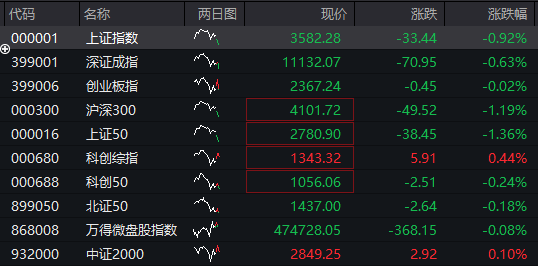
Market Overview - A-shares opened lower with the Shanghai Composite Index down 1% and the ChiNext Index turning negative after briefly rising over 1% [1] - The Hang Seng Index fell over 1%, with notable declines in automotive and tech stocks, including NIO down over 3% and Meituan down over 4% [2][3] - The bond market saw a rally in government bond futures across the board, with the 30-year contract up 0.53% [3][4] Sector Performance - In the A-share market, sectors such as steel, coal, and precious metals led the decline, with nearly 3,400 stocks in the Shanghai and Shenzhen markets falling [6] - The domestic commodity futures market experienced declines, with coking coal down over 6% and glass down over 5% [4][5] - The AI and computing hardware sectors saw gains, with companies like Yuanjie Technology rising over 12% and Jianqiao Technology hitting the daily limit [10][11] Notable Stocks - Industrial Fulian surged over 6%, reaching a new historical high with a trading volume exceeding 2.8 billion yuan [13] - Meituan's stock fell over 4%, marking a new low in over two weeks, following news of Prosus reducing its stake in the company by $4 billion [15] - The innovative drug sector remained active, with Nanjing New Pharmaceutical hitting the daily limit and several other companies rising over 5% [19][20] Commodity Market - The domestic commodity futures market saw significant declines, with coking coal down 6.29%, glass down 5.42%, and silicon iron down 4.72% [5][23] - The opening of commodity futures showed a continued downward trend, with major contracts for lithium carbonate, coking coal, and glass all dropping over 4% [24]


请收下,看了就会的8个AI降本增效技巧
3 6 Ke· 2025-07-30 23:39
Core Insights - The article emphasizes the importance of leveraging AI as a tool for businesses to reduce costs and enhance efficiency, positioning AI as a means for companies to navigate challenges more effectively [1][2][25]. Cost Reduction Techniques - **Automating Repetitive Tasks**: AI can handle tasks such as data entry and invoice processing, significantly increasing efficiency. For instance, a Shanghai accounting firm improved its invoice processing from 800 invoices a day by 30 staff to 2000 invoices in 2 hours with AI [4][6]. - **Optimizing Operations and Supply Chain**: AI can reduce costs in both service and manufacturing sectors by managing inventory and logistics. A merchant in Yiwu saved on storage costs by using AI to predict demand based on weather data, reducing inventory from 300,000 to 180,000 umbrellas [7][8]. - **Enhancing Customer Service Efficiency**: AI can manage routine customer inquiries, allowing human staff to focus on complex issues. A hotel in Shenzhen reduced human customer service workload by 40% by implementing an AI system that handled common questions [9][10]. - **Streamlining Human Resources**: AI can expedite the hiring process, reducing the average time to hire from 28 days to 7 days and halving the turnover rate during the probation period [12][13]. Efficiency Enhancement Techniques - **Improving Decision-Making**: AI analyzes vast amounts of market data to provide actionable insights for production planning, helping businesses avoid stock shortages or overproduction [14][15]. - **Accelerating Innovation and R&D**: In sectors like pharmaceuticals, AI can significantly shorten research and development cycles by simulating molecular structures and predicting compound properties [16][17]. - **Boosting Marketing and Sales Efficiency**: AI enables targeted advertising by analyzing customer data, resulting in a threefold increase in conversion rates compared to traditional methods [18][20]. - **Enhancing Production and Manufacturing Efficiency**: AI visual systems can improve defect detection efficiency by 50 times, optimizing production parameters and scheduling based on real-time data [23][24]. Conclusion - The article concludes that the integration of AI into business processes is essential for companies to thrive in a competitive landscape, emphasizing the need for a strategic approach to AI implementation [25][26].
请收下,看了就会的8个AI降本增效技巧
混沌学园· 2025-07-30 12:04
Core Viewpoint - The article emphasizes the importance of utilizing AI in businesses to reduce costs and enhance efficiency, presenting eight practical techniques for entrepreneurs to implement AI effectively in their operations [2][36]. Cost Reduction Techniques - **Automating Repetitive Tasks**: AI can handle tasks such as data entry and invoice processing, significantly increasing efficiency. For instance, a Shanghai accounting firm improved its invoice processing from 800 to 2000 invoices in two hours using AI [6][7]. - **Optimizing Operations and Supply Chain**: AI can analyze historical data to optimize inventory and logistics. A merchant in Yiwu saved on storage costs by using AI to predict demand accurately, reducing umbrella stock from 300,000 to 180,000 units [10][11]. - **Enhancing Customer Service Efficiency**: AI can manage routine customer inquiries, allowing human staff to focus on complex issues. A hotel in Shenzhen reduced its customer service costs by 40% while improving response times through AI [12][13]. - **Optimizing Human Resources**: AI can streamline the hiring process, reducing the average hiring time from 28 days to 7 days and halving the turnover rate during the probation period [15][16]. Efficiency Enhancement Techniques - **Enhancing Decision-Making Capabilities**: AI analyzes vast amounts of market data to provide actionable insights for strategic decisions, transforming vague feelings into clear data [21][22]. - **Accelerating Innovation and R&D**: AI can significantly shorten the research and development cycle in industries like pharmaceuticals by simulating molecular structures and predicting compound properties [23][24]. - **Improving Marketing and Sales Efficiency**: AI enables targeted advertising by analyzing customer profiles, leading to a threefold increase in conversion rates while optimizing marketing spend [26][28]. - **Increasing Production and Manufacturing Efficiency**: AI visual systems can enhance defect detection and optimize production parameters, improving efficiency by at least 50 times [31][32]. Conclusion - The article concludes that the integration of AI into business processes is a gradual but essential journey, requiring a strategic approach to harness its full potential for cost reduction and efficiency enhancement [36][39].

因赛集团:正争取成为某国内头部科技大厂在营销传播领域的战略合作伙伴
Xin Lang Cai Jing· 2025-07-30 09:28
Core Viewpoint - Inse Group (300781.SZ) aims to become a strategic partner for a leading domestic technology company in the marketing communication sector, supporting its global expansion through comprehensive marketing services provided by Inse Group and its subsidiaries [1] Group 1: Strategic Partnerships - The company is actively pursuing a strategic partnership with a major domestic technology firm to enhance its marketing communication capabilities [1] - This partnership is intended to assist the technology company in its global expansion efforts [1] Group 2: Research and Development Plans - Inse Group has established a new R&D plan, targeting the completion of a multi-agent system (MAS) foundation by Q3 [1] - The MAS will integrate various AI agents, including text, image, video, voice, and digital human components [1] - The company aims to develop an interactive mechanism and dynamic workflow platform to support efficient collaboration among AI agents [1]

Nature重磅:“AI科学家”真的来了,自主开会搞研究,几天时间设计出抗病毒纳米抗体
生物世界· 2025-07-30 05:02
Core Viewpoint - The article discusses the development of an AI-driven virtual laboratory that enables multidisciplinary research teams to tackle complex scientific problems, specifically in the context of designing new nanobodies for SARS-CoV-2 [2][4][11]. Group 1: AI-Driven Virtual Laboratory - Researchers from Stanford University and the Chan Zuckerberg Biohub have created a virtual laboratory platform powered by AI agents, which can autonomously design and execute complex research strategies [2][4]. - The virtual lab allows human scientists to pose scientific questions while AI agents, including a "Chief Scientist Agent" and various "Specialist Agents," collaborate to advance research [5][6]. Group 2: Research Outcomes - Within days, the virtual laboratory successfully designed 92 novel nanobodies, with two showing the ability to bind to the spike protein of new SARS-CoV-2 variants during laboratory validation [9][11]. - The research demonstrates that AI agents can generate creative and rational solutions to scientific challenges, enhancing human scientists' capabilities rather than replacing them [11]. Group 3: Implications and Future Applications - This study marks the first instance of autonomous AI agents effectively solving a challenging scientific research problem from start to finish, showcasing a new paradigm where AI drives the entire research process [11]. - The virtual laboratory platform is designed for biomedical research but can be adapted for broader scientific fields, indicating its potential for widespread application [11].

智能体(Agent)时代到来,AI正在渗透多个保险关键战场
2 1 Shi Ji Jing Ji Bao Dao· 2025-07-30 04:08
Group 1: Core Insights - The World Artificial Intelligence Conference has reignited discussions on generative AI, with various industries, including insurance, prioritizing AI in their strategic development [1] - China Pacific Insurance is implementing a new "AI+" strategy, aiming to enhance its AI capabilities over the next five years, focusing on core business areas such as customer management and investment [1] - AI applications are evolving from traditional efficiency improvements to creating new business value, with a shift towards data analysis and reasoning capabilities [2][3] Group 2: AI Agent Development - AI agents are emerging as a transformative force in the AI landscape, characterized by autonomous decision-making, long-term operation, and data-driven behavior evolution [3] - The insurance sector is witnessing the deployment of AI agents, which enhance operational efficiency across various functions, including customer interaction and claims processing [3][6] - Megxin Health has developed an AI agent matrix that integrates front-end interaction, mid-platform decision-making, and back-end fulfillment, showcasing a comprehensive approach to AI in insurance [3] Group 3: AI in Risk Control and Sales - AI technology is significantly impacting risk control in insurance, improving claims processing efficiency and fraud detection [4][5] - Warmwa Technology has launched a new intelligent risk control product that covers underwriting, claims, and investigation, aiming for dual breakthroughs in efficiency and value transformation [5] - AI is enhancing the sales process by assisting agents with customer profiling and strategy generation, leading to a 1.9 times increase in agent outreach effectiveness for China Pacific Life Insurance [5] Group 4: AI Applications in Property Insurance - In property insurance, AI applications are widespread, with innovations in crop identification and disaster risk management being implemented by China Pacific Property Insurance [7] - The "Huiyan Zhiyuan" platform utilizes AI and remote sensing to provide comprehensive services for crop production and risk monitoring across multiple provinces [7]
金融推理大模型价值初探:能否成为行业智能体下一“风向标”
Bei Jing Shang Bao· 2025-07-29 13:17
Core Insights - The core focus of the articles is on the emergence and significance of financial reasoning large models, particularly the Agentar-Fin-R1 model developed by Ant Group, which aims to enhance AI applications in the financial sector by providing a reliable, controllable, and optimizable intelligent core [1][2][3]. Group 1: Financial Reasoning Large Models - Ant Group has launched the Agentar-Fin-R1, the first commercial large model focused on financial reasoning in China, which is seen as a crucial step for the development of AI agents in finance [1][2]. - The financial reasoning large model is expected to drive the financial industry towards greater intelligence and efficiency, addressing deep-seated industry pain points rather than just superficial issues [2][3]. Group 2: Characteristics and Development of AI Agents - AI agents combine the cognitive capabilities of large models with automated execution, and their value is maximized when they focus on specific industry scenarios [2][3]. - The development of effective financial reasoning models requires high-quality data, continuous iteration, and an engineering perspective to address efficiency issues [4][5]. Group 3: Market Demand and Future Prospects - There is a growing market demand for financial reasoning large models, as they can provide clear reasoning chains and logic necessary for complex financial scenarios [6][7]. - The evolution of these models is expected to enhance their ability to solve a higher percentage of financial problems, potentially reaching up to 99% or even 100% in some cases [7].
金融推理大模型价值初探:能否成为行业智能体下一“风向标”?
Bei Jing Shang Bao· 2025-07-29 13:01
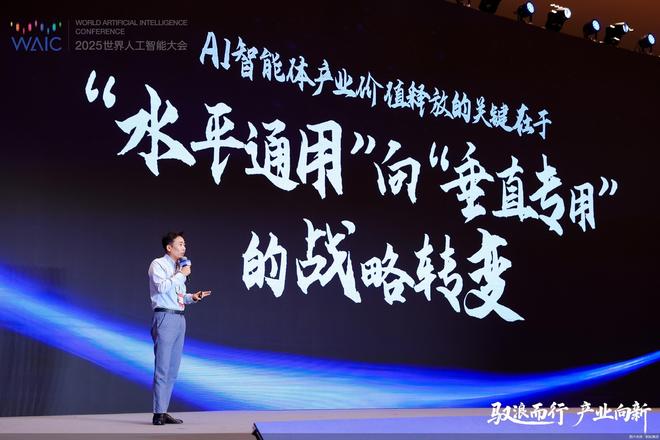
Core Insights - The core focus of the articles is on the emergence and significance of financial reasoning large models, particularly the Agentar-Fin-R1 model released by Ant Group, which aims to enhance AI applications in the financial sector by providing a reliable, controllable, and optimizable intelligent core [1][5]. Group 1: AI and Financial Sector Transformation - The financial industry, characterized by high digitalization and rich AI application scenarios, is seen as the first sector to benefit from AI advancements, particularly through the integration of large models and intelligent agents [3][4]. - The concept of AI agents is defined as a combination of a "super brain" (the model) and "agile hands" (automation), which is expected to drive transformative changes in the financial industry [3][4]. - The shift from "horizontal generalization" to "vertical specialization" is crucial for unlocking the value of AI agents, focusing on solving deep industry pain points rather than superficial issues [3][4]. Group 2: Characteristics of Financial Reasoning Models - A successful vertical large model must possess strong reasoning capabilities to serve as a controllable and reliable intelligent core for AI agents, akin to a critical gear in machinery [5][6]. - The characteristics of financial reasoning models are summarized as three "E"s: Excellent data, Evolving processes, and Efficiency in balancing data and training consumption [6][7]. - High-quality data is essential, requiring real-world problem scenarios, diversity in financial labels, and expert validation to ensure compliance and correctness [6][7]. Group 3: Development and Iteration of Models - The development process involves two phases: initial large-scale training to build foundational financial capabilities, followed by localized fine-tuning based on specific business needs [7][8]. - A high-frequency agile iteration mechanism is necessary to continuously identify and rectify model issues, ensuring that the model remains aligned with real-world financial demands [7][8]. - The evolution of reasoning models is driven by the need for clear reasoning chains and logic in complex financial scenarios, with a focus on minimizing errors due to the low tolerance for mistakes in the financial sector [8][9]. Group 4: Future Outlook and Market Dynamics - The demand for financial reasoning models is expected to grow as they address previously unsolvable problems in the financial sector, accelerating their adoption [8][9]. - The balance between cost and efficiency is critical, as clients are unlikely to accept high costs for fully-featured models; reasoning models can adjust based on problem complexity to optimize this balance [8][9]. - The continuous evolution of reasoning models is anticipated to enhance their effectiveness in solving a greater percentage of financial problems, with a goal of reaching near-complete resolution in various scenarios [9].
AI应用财报季来袭! 瑞银聚焦“AI+数字广告” 押注Applovin与Trade Desk腾飞
智通财经网· 2025-07-29 10:13
Group 1 - UBS highlights the upcoming earnings season for small and mid-cap companies focused on AI application software, recommending increased allocation to Applovin (APP.US) and The Trade Desk (TTD.US) as leaders in the "AI + digital advertising" segment [1][2] - The report emphasizes that small-cap stocks are currently more attractive compared to large-cap stocks, with the Russell 2000 index's expected P/E ratio around 15x, below historical averages [2][3] - UBS expects several small-cap AI application software companies to provide positive earnings guidance, with Applovin and The Trade Desk anticipated to exceed market expectations for Q3 [3][4] Group 2 - The integration of AI in digital advertising has accelerated since the rise of ChatGPT, with major players like Google and Meta incorporating generative AI technologies to enhance ad performance [4][5] - UBS notes that the shift in focus from hardware to software in tech investments is benefiting companies like Applovin and The Trade Desk, as demand for AI application software continues to grow [5][6] - UBS maintains an optimistic outlook on Applovin's performance, raising its Q2 2025 revenue forecast to $867 million, reflecting positive trends from App Store advertising policies and strong growth in its self-operated app business [7][8] Group 3 - The Trade Desk is also viewed positively by UBS, with expectations for steady growth in Q2, driven by its "AI + digital advertising" platform and upcoming events that could catalyze further performance [7][8] - Both companies have successfully integrated generative AI and deep learning into their advertising technologies, leading to significant revenue growth and improved operational efficiency [8]


最新公布,AI新成果!
Zhong Guo Ji Jin Bao· 2025-07-29 07:06
Core Insights - Major securities firms showcased their AI advancements at the 2025 World Artificial Intelligence Conference, highlighting the integration of AI technology into various business scenarios within the securities industry [1] Group 1: Citic Securities - Citic Securities launched the industry's first AI-driven market value management system, CapitAI-Link, which combines AI algorithms with market value management to provide personalized decision support for listed companies [2] - The firm is also advancing its AI digital employee system, aiming to enhance efficiency and collaboration in financial services by providing each employee with multiple digital assistants [2] Group 2: CICC (China International Capital Corporation) - CICC presented its self-developed digital investment research platform, "CICC Insight," at the conference, emphasizing the role of AI in driving the transformation of the financial sector [3] - The company has supported over 50 companies listed on the Sci-Tech Innovation Board, with a total financing amount exceeding 200 billion yuan, accounting for about 20% of the board's IPO financing [3][4] Group 3: CITIC Construction Investment - CITIC Construction Investment released a deep research report on AI and industry development, indicating that AI models are evolving towards greater efficiency and reliability [5][6] - The report covers the entire AI industry chain, from foundational computing infrastructure to application scenarios, aiming to identify investment opportunities across hardware and software [6] Group 4: Huatai Securities - Huatai Securities focused on investment opportunities in the agent economy during its forum, noting that AI agents can operate 24/7 and interact faster than humans [7] - The firm highlighted that the AI chip market for data centers is projected to reach 178.2 billion USD in 2024, with a year-on-year growth of 77%, surpassing the PC and smartphone chip markets [7] - It is suggested to monitor investment opportunities in the server supply chain, as well as addressing infrastructure bottlenecks that currently limit AI development [8]



