人工智能芯片

Search documents
科创板迎硬核玩家:沐曦IPO获受理 ,国产GPU上市提速
2 1 Shi Ji Jing Ji Bao Dao· 2025-07-01 12:52
Core Viewpoint - The rise of domestic AI chip companies, particularly Muxi Integrated Circuit (Shanghai) Co., Ltd., is accelerating their entry into the capital market, with Muxi's IPO on the Sci-Tech Innovation Board being a significant event in the GPU sector [1][2]. Company Overview - Muxi aims to raise 3.904 billion yuan for the development and industrialization of next-generation general-purpose GPUs, AI inference chips, and advanced heterogeneous computing architectures [1]. - Founded in 2020, Muxi is part of the "Four Little Dragons" of domestic GPUs, alongside companies like Moore Threads and Birran Technology [2]. - Muxi's flagship product, the "Xiyun C series," is a self-developed GPU chip that has achieved significant sales and application in AI public computing platforms [3]. Financial Performance - Muxi's revenue projections for 2022 to 2024 are 426,000 yuan, 53.021 million yuan, and 743 million yuan, respectively, indicating substantial growth [3]. - Despite revenue growth, Muxi is facing significant net losses projected at 780 million yuan, 870 million yuan, and 1.41 billion yuan over the same period, totaling 3.06 billion yuan in losses [3]. Market Context - The domestic AI chip market is still in its early stages, with increasing penetration rates for local brands, but lacking a clear competitive landscape [1]. - The rise of domestic GPU manufacturers is driven by the growth of AI models, the "East Data West Computing" initiative, and ongoing policies promoting domestic innovation [5]. - By 2025, domestic AI chips are expected to account for 40% of the AI server market in China, while NVIDIA's share is projected to decrease to 41.5% [7]. Policy Environment - The recent reforms in the Sci-Tech Innovation Board have created a more favorable environment for unprofitable but technologically advanced companies like Muxi, signaling a shift towards supporting "hard tech" enterprises [4].
大国总师一席谈|中国电子窦强:锻造自立自强“中国芯”
Xin Hua She· 2025-06-16 11:56
Core Viewpoint - The article emphasizes the importance of self-reliance and innovation in China's semiconductor industry, particularly through the efforts of Dou Qiang and his team at China Electronics Feiteng, who are dedicated to developing high-performance domestic CPU chips to support national strategic needs and economic development [1][2][5]. Group 1: Development and Achievements - Dou Qiang has led the development of over ten mass-produced chips, achieving domestic substitution in high-end servers, desktop systems, and embedded industrial control applications, with products widely used in key national projects [1][2]. - The establishment of Feiteng in 2014 and the subsequent development of the FT-2000/4 desktop CPU chip marked significant milestones, with the latter becoming the first domestic desktop CPU to sell over one million units after overcoming substantial technical challenges [2][3]. - Feiteng has created a comprehensive product line that includes high-performance server CPUs, efficient desktop CPUs, and high-end embedded CPUs, providing core computing power for various devices [2][3]. Group 2: Market Integration and Ecosystem - Feiteng has collaborated with over 7,300 manufacturers to develop more than 5,800 hardware solutions, fostering a robust information industry ecosystem [3][4]. - The company is focused on deepening market engagement and understanding user needs, emphasizing that chip performance is realized through the overall system operation [3][4]. Group 3: Future Directions - With the increasing demand for AI computing power, Feiteng is accelerating its research and development in AI chips to support major national projects and key industries [5]. - Dou Qiang expresses confidence in leading the high-quality development of China's chip industry by focusing on core technology innovation and serving societal needs with "Chinese chips" [5].
36万亿美债濒临崩盘!特朗普喊话中国,7天内必须见一面?
Sou Hu Cai Jing· 2025-06-09 06:52
Group 1 - The rise in the 10-year U.S. Treasury yield by over 6 basis points and the 30-year yield surpassing 5% signals a looming economic crisis in the U.S. with a staggering $36 trillion in debt at risk of collapse [1] - Major credit rating agencies have downgraded the U.S. credit rating, with Moody's lowering it from "Aaa" to "Aa1" in May 2024, citing excessive government debt and interest burdens [3] - The U.S. federal debt reached $36.2 trillion, accounting for 124% of GDP, with projections indicating it could rise to 134% by 2035, alongside a fiscal deficit of $2.1 trillion for the 2024 fiscal year [3] Group 2 - The downgrade of the U.S. credit rating triggered significant market reactions, with major stock indices falling, including a 1.49% drop in Nasdaq futures and a 4% pre-market decline for Tesla [4] - Investors reacted by selling off U.S. Treasuries, leading to a spike in the 30-year Treasury yield above 5% and the 10-year yield exceeding 4.5% [4] - The dollar index fell by 0.8%, while gold prices surged, with COMEX gold futures rising over 2% [4] Group 3 - Financial leaders, including JPMorgan's CEO Jamie Dimon, warned that extreme fiscal policies could lead to a crisis in the U.S. debt market, labeling the rising government debt as the "biggest risk" to the macroeconomy [6][7] - The potential collapse of U.S. Treasuries could create a dilemma for the government, as increasing taxes or cutting fiscal support would be challenging [7] - Trump's urgent desire to communicate with China is seen as an attempt to alleviate U.S. financial pressures, as China has been reducing its holdings of U.S. debt, now down to $765.4 billion [7][9] Group 4 - Despite some progress in U.S.-China negotiations, significant differences remain, with the U.S. imposing restrictions on China, complicating the potential for dialogue [9] - The crisis surrounding the $36 trillion U.S. debt is not only a domestic issue but poses a significant challenge to the global economy, indicating a potential shift in the global economic landscape [9]


国投基金如何成为服务国家战略的“关键落子”?——专访国投集团党组成员、总会计师柴艳丽
Shang Hai Zheng Quan Bao· 2025-06-08 18:07
Core Viewpoint - The article discusses how the State-owned Capital Investment Corporation (Guotou Group) plays a pivotal role in leveraging state capital to support national strategic initiatives, particularly through private equity and venture capital investments [1]. Group 1: Guotou Group's Fund Management - Guotou Group has developed a distinctive fund management business that aligns with national strategic needs, managing 48 funds with a total subscribed capital exceeding 200 billion yuan, including 10 national-level funds with a management scale of over 160 billion yuan [2]. - The national-level funds have achieved a nearly sixfold leverage effect from central government finances, effectively amplifying the funds' impact [2]. - The funds managed by Guotou Group are closely aligned with major national strategies, including poverty alleviation and technological innovation, demonstrating a commitment to contributing to significant economic and social outcomes [3]. Group 2: Investment Characteristics - Guotou Group's investment strategy is characterized by early-stage investments, with over one-third of its investments in A-round or earlier projects and approximately 56% in B-round or earlier projects, outperforming the industry average by 10 percentage points [3]. - The company has made significant investments in artificial intelligence, notably leading rounds for Cambrian's A and B rounds with a total investment of 903 million yuan, becoming its largest institutional investor [3]. Group 3: High-Quality Development Strategies - Guotou Group aims to enhance its mission to serve national strategies by focusing on emerging industries, key technological breakthroughs, and upgrading traditional industries [5]. - The company emphasizes the importance of a professional fund operation mechanism to ensure high-quality development, continuously improving its human resources, decision-making, incentive, and performance evaluation systems [6][7]. - Guotou Group advocates a dual investment model of "fund investment + direct investment" to support the development of strategic emerging industries and foster an investment ecosystem [8].
美上诉法院恢复实施特朗普关税政策!胖东来红内裤事件博主被判赔40万!哪吒汽车总部LOGO被连夜拆除!英伟达市值一度重回全球第一!
新浪财经· 2025-05-30 00:58
Group 1: Trade Policy - The U.S. Court of Appeals has temporarily reinstated Trump's tariff policies, allowing the government to impose tariffs on multiple countries until further notice [3][4]. Group 2: Company Legal Issues - A court in Xuchang ruled that a blogger must pay 400,000 yuan for defamation against the Pang Donglai Group, following a complaint about a defective product [6][8]. Group 3: Automotive Industry - Nezha Auto's logo was removed from its Shanghai headquarters due to the expiration of the lease, with plans for relocation underway [11]. - Nezha Auto's debt restructuring plan through debt-to-equity swaps has failed, with outstanding debts to suppliers amounting to approximately 6 billion yuan [12]. Group 4: Technology Sector - Nvidia reported a revenue of $44.1 billion for Q1 of fiscal year 2026, marking a 12% increase from the previous quarter and a 69% increase year-over-year [14][16]. - Nvidia's market capitalization briefly surpassed Microsoft, reaching $3.4 trillion, with a single-day increase of $106.8 billion [18].
特朗普政府已要求美国半导体软件设计公司停止向中国出售服务
news flash· 2025-05-29 03:51
Core Viewpoint - The Trump administration has requested American semiconductor software design companies to cease providing services to China, marking a significant move to curb China's ability to develop advanced AI chips [1] Group 1: Government Actions - The U.S. Department of Commerce has instructed electronic design automation (EDA) companies, including Cadence, Synopsys, and Siemens EDA, to stop supplying technology to China [1] - The directive was communicated through letters sent to these companies, although it remains unclear if all U.S. EDA firms received such letters [1] Group 2: Industry Impact - This action represents a major new initiative by the U.S. government aimed at limiting China's advancements in the semiconductor sector, particularly in the development of cutting-edge artificial intelligence chips [1]


英伟达或再推特供中国AI芯片
21世纪经济报道· 2025-05-26 03:53
Core Viewpoint - Nvidia is set to launch a new AI chip based on the Blackwell architecture for the Chinese market, with a significantly lower price range of $6,500 to $8,000 compared to the previous H2 0 chip, indicating a potential downgrade in specifications and manufacturing processes [1][2]. Group 1: Nvidia's Strategy in China - Nvidia emphasizes the importance of the Chinese market, with CEO Jensen Huang stating the company will continue to optimize products that comply with regulatory requirements [2]. - The company plans to expand its office space in Shanghai, indicating a commitment to deepening its presence in China while adhering to current export controls [2]. - Currently, the Chinese market accounts for approximately 14% of Nvidia's revenue, which was around $17 billion last year [2]. Group 2: Market Dynamics and Challenges - Nvidia's market share in China has dropped from 95% at the beginning of the Biden administration to around 50% currently [2]. - Huang criticized the U.S. export controls on AI chip sales to China, suggesting that the initial assumptions behind these regulations are fundamentally flawed [2]. - The upcoming quarterly earnings report from Nvidia is anticipated to provide more insights into the company's performance and strategy regarding the Chinese market [2].


日本晶圆厂,为啥不如预期
半导体行业观察· 2025-05-25 02:52
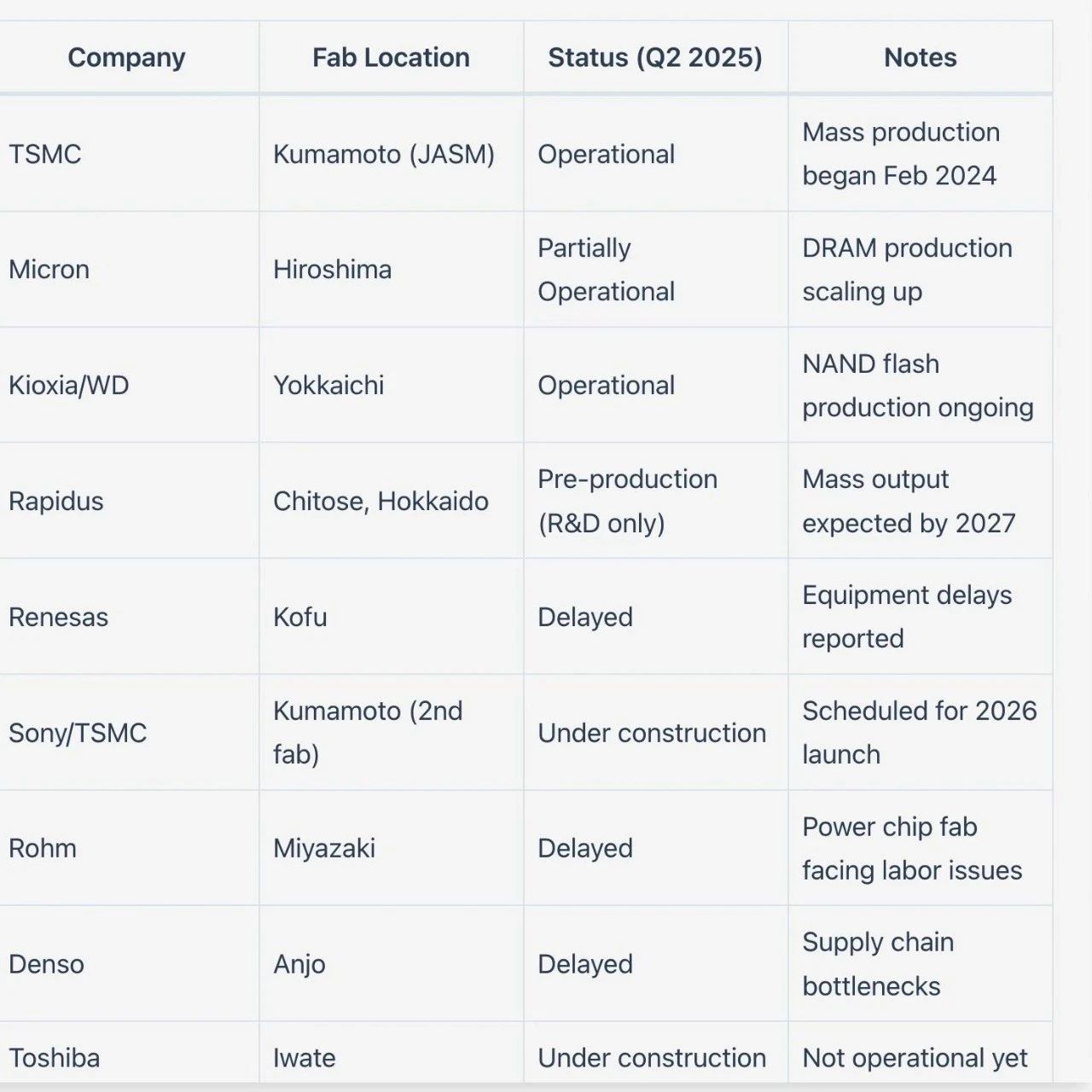
如果您希望可以时常见面,欢迎标星收藏哦~ 来源:内容来自 techovedas 。 日本承诺芯片产业的复兴——从纸面上看,这似乎势不可挡。台积电、美光和Rapidus等巨头纷纷 推出大胆计划。数十亿美元的政府补贴也源源不断地涌入。日本各地的新芯片厂开始拔地而起。但 问题在于:其中一半的工厂仍未实现量产。 在这些头条新闻的背后,有些事情似乎不太对劲。工程延误、设备短缺以及技术工人的匮乏,正在 悄悄地阻碍着日本的高科技雄心。对于一个正努力在全球芯片领域重夺地位的国家来说,经济放缓 来得可不是时候。那么,日本半导体复兴停滞不前背后究竟发生了什么?让我们深入挖掘。 五点概述 截至2025年5月,日本15座新建芯片厂中只有7座投入量产。 对传统和非人工智能芯片的需求延迟导致运营停滞。 人工智能芯片的热潮正在超越传统芯片领域,打破以往的预测。 受影响的公司包括瑞萨电子、罗姆和铠侠。 由于晶圆厂闲置,日本 130 亿美元的补贴计划受到严格审查。 日本斥资650亿美元进军半导体领域 日本政府已承诺投入超过10 万亿日元(约合 650 亿美元)重建其芯片产业。 此举旨在减少对外国半导体的依赖,尤其是来自中国大陆和台湾的半导体。 ...


商务部再回应美国对人工智能芯片出口管制
news flash· 2025-05-22 07:19
Core Viewpoint - The Chinese Ministry of Commerce has reiterated its opposition to the U.S. export controls on artificial intelligence chips, stating that such actions are a violation of international law and harm the legitimate rights of Chinese companies [1] Group 1: U.S. Export Controls - The U.S. is accused of abusing export controls to suppress China, which is seen as a violation of basic international relations principles [1] - The Chinese government emphasizes that these measures severely damage the legitimate rights and interests of Chinese enterprises [1] Group 2: China's Response - China will closely monitor the subsequent actions of the U.S. and is prepared to take resolute measures to protect its legitimate rights [1]
行业组织:欧盟芯片支出需增加四倍
半导体芯闻· 2025-05-06 11:08
该 27 国集团正在咨询行业利益相关者,包括位于布鲁塞尔的 SEMI 欧洲分支机构,以规划 2028 年至 2034 年期间的长期支出,并计划于 7 月公布预算。 SEMI 在 路 透 社 看 到 的 信 函 中 表 示 , 欧 盟 委 员 会 将 需 要 在 整 个 半 导 体 供 应 链 中 拨 款 200 亿 欧 元 (226.4亿美元),这将引发公共和私人实体总计超过2600亿欧元的投资。 3月下旬,欧洲审计院表示,按照目前的速度,欧盟到2030年芯片产量达到全球20%的目标无法实 现。 欧盟最高审计机构在报告中表示,欧盟委员会迄今仅为430亿欧元的《欧洲芯片法案》投入了45亿 欧元,而约80%的公共资金来自成员国。 SEMI表示,单独的欧盟预算将有助于创造整个地区公平的竞争环境,因为目前每个成员国都首先 投资于自己的民族产业。 如果您希望可以时常见面,欢迎标星收藏哦~ 来源:本文编译自路透社 ,谢谢 。 国际半导体产业协会 (SEMI) 周二在对欧盟即将出台的投资预算进行磋商的官方回应中表示,欧盟 应该将其芯片支出增加四倍,并为此分配单独的预算。 欧洲立法者和行业团体正在推动"芯片法案2.0",力求 ...