
全球布局

Search documents
里昂:维持泡泡玛特跑赢大市评级 目标价升至368港元
Zhi Tong Cai Jing· 2025-08-26 07:11
Core Viewpoint - The report from Citi indicates that Pop Mart (09992) is experiencing strong global demand and improving supply chain conditions, supporting growth prospects. The company is projected to achieve a 172% year-on-year sales increase by 2025, reaching 35.4 billion RMB, with sales from China and overseas expected to each account for 50% of total sales [1]. Group 1 - The global demand for Pop Mart's products remains robust, as evidenced by the recent overseas international toy exhibition in Singapore [1]. - Supply chain improvements are anticipated to further support the company's growth trajectory [1]. - Sales forecasts for Pop Mart have been revised upward for the years 2025 to 2027, with sales and adjusted net profit estimates increased by 14%, 12%, 12% and 23%, 20%, 20% respectively [1]. Group 2 - The projected gross margin and core operating profit margin are expected to rise to 71.4% and 44.6%, respectively [1]. - The target price for Pop Mart has been raised from 318 HKD to 368 HKD, maintaining a "Outperform" rating [1].

研报掘金丨东吴证券:维持北新建材“买入”评级,继续期待两翼和海外业务发力
Ge Long Hui A P P· 2025-08-22 08:02
Core Viewpoint - Dongwu Securities report indicates that Beixin Building Materials' net profit attributable to shareholders for the first half of 2025 is 1.93 billion yuan, a year-on-year decrease of 12.85% [1] Financial Performance - In Q2 2025, the net profit attributable to shareholders is 1.09 billion yuan, reflecting a year-on-year decline of 21.88% [1] - The gypsum board segment experienced a revenue decline of 8.57% year-on-year, while the keel business saw a revenue drop of 10.72% [1] Business Segments - The waterproof and coating businesses are expanding, with waterproof building materials revenue increasing by 5.99% year-on-year and coating business revenue reaching 2.16 billion yuan, a growth of 44.42% year-on-year [1] - The strategic focus on "one body and two wings, global layout" is expected to enhance the global market share of the gypsum board main business [1] Future Outlook - The potential for new business expansion and the competitive advantages of the gypsum board main business are anticipated to contribute to sustained growth [1] - The waterproof and coating businesses are expected to provide continuous rapid incremental contributions through both organic growth and external expansion [1]


北新建材(000786):石膏板业务有所承压 继续期待两翼和海外业务发力
Xin Lang Cai Jing· 2025-08-22 00:33
Core Viewpoint - The company reported a decline in revenue and net profit for the first half of 2025, with a notable growth in its paint business and a focus on international expansion [1][2]. Financial Performance - In H1 2025, the company achieved revenue of 13.558 billion, a year-on-year decrease of 0.29%, and a net profit attributable to shareholders of 1.930 billion, down 12.85% [1]. - Q2 2025 revenue was 7.312 billion, reflecting a year-on-year decline of 4.46%, while net profit for the same period was 1.087 billion, down 21.88% [1]. - The gypsum board segment faced challenges, with revenue down 8.57%, and the keel business revenue decreased by 10.72% [1]. - The waterproof and paint businesses showed growth, with waterproof materials revenue increasing by 5.99% and paint revenue reaching 2.163 billion, up 44.42% [1]. Profitability and Cash Flow - The gross margin for H1 2025 was 30.35%, slightly lower than the previous year, with gypsum board gross margin at 38.68%, down 0.94 percentage points, and waterproof materials gross margin down 2.34 percentage points [2]. - The company experienced an increase in credit impairment losses, amounting to approximately 0.07 billion, up by about 0.06 billion from the previous year [2]. - Operating cash flow for H1 2025 was 0.962 billion, a significant decline of 52.86% year-on-year, primarily due to the impact of consolidating Jia Baoli and a decrease in cash received from sales [2]. Strategic Outlook - The company aims to enhance its global market share in the gypsum board sector and expects continued rapid growth in its waterproof and paint businesses through both organic and external expansion [3]. - The net profit forecasts for 2025-2027 have been adjusted to 3.997 billion, 4.523 billion, and 5.010 billion, respectively, with corresponding PE ratios of 11.1X, 9.8X, and 8.9X [3]. - The company maintains a "buy" rating, considering the potential of new business expansions and the competitive advantages in the gypsum board sector [3].
中原证券:给予龙佰集团增持评级
Zheng Quan Zhi Xing· 2025-08-21 12:48
Core Viewpoint - Longbai Group's performance in the first half of 2025 was under pressure, with a decline in revenue and net profit, but the company is enhancing its industrial layout to build long-term competitiveness [1][2]. Financial Performance - In the first half of 2025, Longbai Group achieved operating revenue of 13.331 billion yuan, a year-on-year decrease of 3.34% [2]. - The net profit attributable to shareholders was 1.385 billion yuan, down 19.53% year-on-year, with a basic earnings per share of 0.58 yuan [2][3]. - The company's titanium dioxide business revenue was 8.684 billion yuan, a decline of 7.68% due to falling prices [3]. Product Performance - Titanium dioxide production reached 682,200 tons, an increase of 5.02%, while sales were 612,000 tons, up 2.08% [2]. - Sponge titanium production was 36,200 tons, up 9.30%, with sales of 38,700 tons, an increase of 25.51% [2]. - Revenue from iron-based products and zirconium products was 1.169 billion yuan and 515 million yuan, respectively, with year-on-year growth of 10.61% and 18.95% [3]. Profitability Analysis - The overall gross margin was 23.62%, down 3.91 percentage points year-on-year, with a net profit margin of 10.48%, a decrease of 1.94 percentage points [3]. - The gross margin for the titanium dioxide business was 27.11%, down 6.40 percentage points, while iron-based products saw a gross margin of 53.89%, up 11.79 percentage points [3]. Industry Context - The titanium dioxide industry is experiencing a downturn due to capacity expansion, demand slowdown, and anti-dumping measures, with prices at their lowest since 2020 [4]. - Longbai Group maintains good profitability amid industry challenges due to its upstream resource security and integrated industrial chain advantages [4]. Strategic Initiatives - The company is enhancing its upstream resource security and pursuing two key projects: the joint development of the Hongge North Mine and the Xujiagou Iron Mine, which will increase titanium concentrate capacity to 2.48 million tons per year and iron concentrate capacity to 7.6 million tons per year [4]. - Longbai Group is also expanding its global footprint and adjusting its business strategy in response to anti-dumping investigations affecting the titanium dioxide industry [4]. Investment Outlook - The expected earnings per share for 2025 and 2026 are projected to be 1.20 yuan and 1.47 yuan, respectively, with corresponding price-to-earnings ratios of 14.90 and 12.15 based on the closing price of 17.89 yuan on August 20 [5].


北新建材(000786):石膏板有承压 两翼表现突出
Xin Lang Cai Jing· 2025-08-21 08:36
Core Insights - The company reported a total revenue of 13.56 billion yuan for H1 2025, a slight decrease of 0.3% year-on-year, and a net profit attributable to shareholders of 1.93 billion yuan, down 12.9% year-on-year [1] - In Q2 2025, the company achieved a revenue of 7.31 billion yuan, a decline of 4.5% year-on-year, with a net profit of 1.09 billion yuan, down 21.9% year-on-year [1] Revenue Breakdown - Product-wise revenue: Gypsum board (6.68 billion yuan, -8.6%), keel (1.14 billion yuan, -10.7%), waterproof membrane (1.72 billion yuan, +0.63%), and coatings (2.51 billion yuan, +40.8%) [1] - Regional revenue: Northern region (4.20 billion yuan, +1.5%), Southern region (6.69 billion yuan, -1.0%), Western region (2.35 billion yuan, -3.0%), and overseas (320 million yuan, +68.8%) [1] Profitability Metrics - Gross margin decreased by 0.6 percentage points to 30.4%, with specific margins for gypsum board (38.7%, -0.9 points), keel (21.7%, +0.4 points), waterproof membrane (17.0%, -2.3 points), and coatings (31.8%, +0.5 points) [2] - Sales expense ratio increased by 0.7 percentage points to 5.2%, while management expense ratio rose by 0.2 percentage points to 4.2% [2] - The company recorded an increase in bad debt provisions by 70 million yuan, leading to a decline in net profit margin by 2.0 percentage points to 14.6% [2] Strategic Initiatives - The company is pursuing a "one body, two wings, global layout" strategy, focusing on product diversification and market expansion [3] - New product categories are being developed, including "gypsum board+" and regional cultural products, alongside the cultivation of gypsum fiberboard as a second growth curve [3] - The company is enhancing its global presence, particularly in Southeast Asia, Central Asia, the Middle East, and Europe, with significant overseas project advancements [3] Financial Forecast - Earnings per share (EPS) are projected to be 2.37 yuan, 2.90 yuan, and 3.34 yuan for 2025-2027, with corresponding price-to-earnings (PE) ratios of 11x, 9x, and 8x [3] - The company maintains a strong competitive position and is expected to show performance resilience, with a "buy" rating suggested [3]
爱美客(300896):2025年半年报点评:短期业绩承压,关注国际化并购与新品管线
Minsheng Securities· 2025-08-20 13:37
Investment Rating - The report maintains a "Recommended" rating for the company, with a current price of 188.50 CNY [6][11]. Core Insights - The company experienced short-term performance pressure, with H1 2025 revenue of 1.299 billion CNY, down 21.59% year-on-year, and a net profit of 789 million CNY, down 29.57% year-on-year [1]. - The company has a rich pipeline of products under development, including 12 approved Class III medical devices and new products in the biopharmaceutical and chemical drug sectors, which are expected to drive sustainable growth [2]. - The company is undergoing an internationalization transformation through acquisitions, notably acquiring 85% of Korean REGEN for 190 million USD, which will enhance its global presence and production capacity [4]. Financial Performance Summary - In H1 2025, the company's gross margin was 93.44%, a decrease of 1.48 percentage points year-on-year, with a net profit margin of 60.77%, down 6.88 percentage points year-on-year [3]. - Revenue projections for 2025-2027 are 3.213 billion CNY, 3.574 billion CNY, and 4.263 billion CNY, with corresponding net profits of 2.048 billion CNY, 2.303 billion CNY, and 2.778 billion CNY, reflecting growth rates of 4.6%, 12.4%, and 20.6% respectively [5][8]. - The company’s PE ratios for 2025, 2026, and 2027 are projected to be 28X, 25X, and 21X respectively, indicating a favorable valuation trend [4][5].
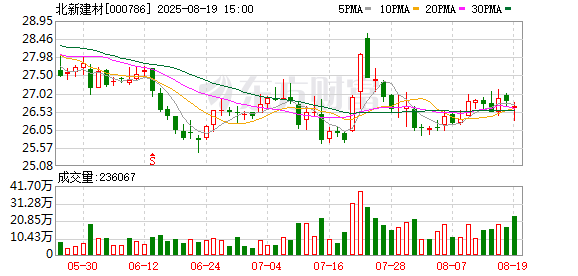
加速“一体两翼”业务布局 北新建材上半年实现营收135.58亿元
Zheng Quan Ri Bao· 2025-08-19 07:40
Core Viewpoint - North New Group Building Materials Co., Ltd. reported a revenue of 13.558 billion yuan and a net profit of 1.93 billion yuan for the first half of 2025, reflecting the company's strategic focus on expanding its gypsum board and related businesses while transitioning into a comprehensive manufacturer and service provider in the consumer building materials sector [2]. Group 1: Financial Performance - In the first half of 2025, the company achieved an operating income of 13.558 billion yuan and a net profit attributable to shareholders of 1.93 billion yuan [2]. Group 2: Strategic Development - The company has implemented a "one body, two wings, global layout" development strategy, aiming to strengthen and expand its gypsum board and "gypsum board+" businesses while accelerating growth in waterproofing and coatings [2]. - Investments include a new production line for 20 million square meters of gypsum fiberboard in Tai'an, Shandong, and a 20,000-ton industrial coatings production base in Anqing, Anhui [2]. Group 3: Product Innovation and Market Expansion - The company has enhanced its product promotion efforts, launching a series of culturally themed products under the Taishan Gypsum brand to cultivate a second growth curve [3]. - New product divisions have been established to focus on five core products, including the Longpai Luban universal board and heating board, which are expected to increase profit margins through premium pricing [3]. - North Waterproof has introduced several new products in response to market demands, including innovative waterproof coatings and materials [3]. - The company’s subsidiary, Jiaboli, has expanded its high-end positioning by adding over 200 high-end stores for artistic coatings and stone-like paints in the first half of the year [3].
怡合达(301029):中报业绩高增 毛利率持续提升
Xin Lang Cai Jing· 2025-08-16 04:39
Core Insights - The company reported strong performance in the first half of 2025, with revenue of 1.461 billion yuan, a year-on-year increase of 18.70%, and a net profit attributable to shareholders of 282 million yuan, up 26.49% [1] - The growth was driven by robust demand in the new energy and automotive sectors, with significant contributions from various downstream industries [1] - The company's gross margin improved, reaching 39.10% in H1 2025, an increase of 3.46 percentage points year-on-year, indicating enhanced profitability [2] Financial Performance - In Q2 2025, the company achieved revenue of 841 million yuan, a year-on-year increase of 21.79%, and a net profit of 160 million yuan, up 26.50% [1] - Revenue from the new energy sector was 321 million yuan, a 53.17% increase, while the automotive sector generated 175 million yuan, also up 53.25% [1] - The gross margin for the new energy sector was 33.85%, while the automotive sector had a gross margin of 37.12% [2] Cost Management - The company maintained stable expense ratios, with a sales expense ratio of 4.98%, a management expense ratio of 7.67%, and a research and development expense ratio of 4.04% [2] - The net profit margin for H1 2025 was 19.28%, reflecting effective cost control measures [2] Strategic Development - The company is enhancing its one-stop service capabilities, focusing on providing comprehensive BOM product procurement solutions [3] - It is actively expanding its global presence, with operations in over 30 countries and regions across Asia, North America, Europe, South America, and Oceania [3] - The company aims to leverage opportunities from the transformation of China's manufacturing sector to strengthen its market position [3] Investment Outlook - The company is projected to achieve net profits of 521 million yuan, 628 million yuan, and 748 million yuan for the years 2025 to 2027, with corresponding EPS of 0.82, 0.99, and 1.18 yuan [3] - The expected PE ratios for the same period are 33 times, 27 times, and 23 times, indicating a favorable investment outlook [3]

创新国际赴港上市:双碳+产能红线紧逼!豪赌绿电、出海,募资40亿能否撕开铝业困局?
Jin Rong Jie· 2025-08-01 01:54
7月31日,创新国际实业集团有限公司(以下简称"创新国际")向港交所更新上市申请,拟募资拓展海 外产能及绿色能源项目。这家深耕铝产业链上游的龙头企业,以84%的氧化铝自给率和88%的电力自给 率构筑成本护城河,却在关联交易占比超59.8%、铝价波动加剧的行业变局下面临关键考验。 一体化布局与成本控制:铝业巨头的核心竞争力 内蒙古霍林郭勒市的电解铝生产基地,是创新国际核心竞争力的缩影。根据CRU报告,该基地2024年 产量位列华北第四、全国第十二,支撑公司电解铝现金成本控制能力跻身国内前5%。通过"能源-氧化 铝精炼-电解铝冶炼"垂直整合,公司实现氧化铝自给率84%、电力自给率88%,显著高于行业平均水 平。 地理布局进一步强化成本优势。山东滨州生产基地临近铝土矿进口港口,运输成本较内陆同行低约 15%;内蒙古基地则受益于0.28元/度的工业电价,较东部沿海地区低40%。2023年启动的400兆瓦风电 和110兆瓦光伏项目,预计2025年并网后可将绿电占比提升至35%,推动吨铝碳排放降低18%。这种"火 电保供+绿电降本"的能源结构,使其在工信部4500万吨电解铝产能红线政策下占据先发优势。 技术迭代与合规生产 ...
环球新材国际完成收购全球表面解决方案业务
Zhi Tong Cai Jing· 2025-07-31 13:38
Core Viewpoint - The acquisition of global surface solutions business by Global New Materials International (06616) marks a significant step in expanding its geographic coverage and sales channels, enhancing its global presence in key markets, particularly in the automotive and cosmetics sectors [1] Group 1: Strategic Acquisition - The strategic acquisition completed on July 31, 2025, allows the company to integrate highly complementary businesses, accelerating penetration into premium global markets [1] - The integration of global operations in high-performance materials, cosmetics, and industrial applications will enrich the company's product portfolio and enhance competitiveness [1] Group 2: Supply Chain and Operational Efficiency - The transaction strengthens the company's supply chain and provides a clear cost reduction pathway to achieve synergies, benefiting customers and improving overall operational efficiency [1] - New production facilities located in Germany, Japan, and the United States will serve as regional hubs for the expanded business [1] Group 3: Research and Development - The acquisition is expected to enhance the company's technological research and development capabilities, contributing to improved environmental, social, and governance standards [1]