
关税不确定性

Search documents
伯克希尔二季度净利润暴跌59%,巴菲特继续“卖卖卖”
2 1 Shi Ji Jing Ji Bao Dao· 2025-08-02 15:41
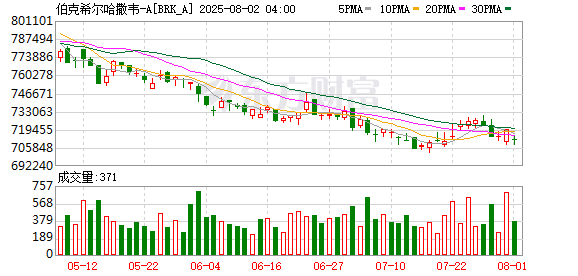
Core Viewpoint - Berkshire Hathaway's financial results for Q2 showed significant fluctuations, with revenue exceeding market expectations but net profit experiencing a dramatic decline compared to the previous year [2][5]. Financial Performance - Q2 revenue reached $92.515 billion, surpassing market expectations of $91.963 billion, but down from $93.653 billion year-over-year [2][4]. - Q2 net profit was $12.370 billion, exceeding market expectations of $10.703 billion, but down 59% from $30.348 billion in the same quarter last year [2][4]. Investment Performance - Investment net income for Q2 was $4.970 billion, a significant drop from $18.750 billion in the same period last year [5]. - The fair value of Berkshire's top five holdings accounted for 67% of its portfolio, including American Express, Apple, Bank of America, Coca-Cola, and Chevron [5]. Market Conditions - In Q2, U.S. stock markets experienced volatility due to tariff uncertainties, with the Dow Jones up 4.98%, Nasdaq up 17.75%, and S&P 500 up 10.57%, while Berkshire's stock price fell 8.72% [6]. - Trade tensions accelerated in the first half of 2025, posing threats to Berkshire's diversified businesses, with revenue declines reported in its clothing and toy brands [6]. Leadership Transition - Warren Buffett announced plans to retire by the end of the year, raising concerns among investors despite having named Greg Abel as his successor in 2021 [7]. Stock Management - In Q2, Berkshire sold approximately $3 billion in stocks, marking the 11th consecutive quarter of net stock sales, and did not engage in stock buybacks [8]. - As of the end of Q2, Berkshire's cash and cash equivalents stood at $344.1 billion, slightly down from $347.7 billion in the previous quarter, with Buffett indicating a cautious approach to investment opportunities [8].

全球视角 | 特朗普关税关键一周!“关税谈判对投资不利的迹象越来越明显”
Sou Hu Cai Jing· 2025-07-29 10:12
Group 1 - The average tariff in the U.S. is currently estimated to be slightly below 13.5%, significantly higher than last year's 2.5%, with potential increases to 16% if an agreement is reached with the EU [2] - The trade barriers established by the U.S. under the Trump administration are expected to have a long-term negative impact on global trade and investment, with predictions of a $2 trillion economic shock by the end of 2027 [2] - Major U.S. companies like General Motors, Dow, and Tesla have reported that tariffs have negatively affected their profitability, although there has not yet been a significant inflationary impact [5][6] Group 2 - The uncertainty caused by tariffs is leading to a significant delay in investment decisions among global companies, with many firms adopting a wait-and-see approach [3][7] - The construction and equipment procurement data in the U.S. are weak, contributing to a forecasted GDP growth rate of around 1% for the second quarter, indicating stagnation in non-residential investment [6][7] - The imposition of tariffs has led to a decline in foreign direct investment (FDI) globally, with a notable drop of 11% in 2024, as investors face increased uncertainty [8][9] Group 3 - The recent decision to impose tariffs on tomatoes from Mexico has adversely affected companies like NatureSweet Tomatoes, which relies on imports for production inputs [8] - The automotive industry in Japan is experiencing similar concerns, with a predicted GDP impact of 0.55% from new tariffs, which is still above Japan's average growth rate [9] - The overall economic indicators related to trade are expected to show contraction this year, reflecting a broader trend of investment fatigue and slow productivity growth [10]

特朗普关税关键一周!“关税谈判对投资不利的迹象越来越明显”
Di Yi Cai Jing· 2025-07-29 02:35
Group 1: Tariff Impact on Companies - The average tariff in the U.S. is currently estimated to be slightly below 13.5%, significantly higher than last year's 2.5% [1] - Major companies like General Motors, Dow, and Tesla have experienced profit erosion due to tariffs, although there has not been a significant inflationary impact yet [4] - NatureSweet Tomatoes, a major tomato producer, has had its expansion plans halted due to tariffs on imports from Mexico, affecting its production costs [7] Group 2: Economic Predictions and Investment Uncertainty - Oxford Economics predicts that the uncertainty caused by tariffs will significantly impact investment decisions, with effects expected to manifest over two quarters [6] - The GDPNow model forecasts a slowdown in U.S. GDP growth to around 1% for the second quarter, influenced by weak construction and equipment procurement data [6] - The World Bank highlights that unclear policy directions may lead companies to delay restructuring decisions, contributing to a prolonged period of weak trade growth and investment [9] Group 3: Global Trade and Investment Trends - The global foreign direct investment (FDI) is expected to decline again this year, with tariffs causing uncertainty that affects investment projects aimed at restructuring supply chains [8] - European automakers, such as Volkswagen, are facing increased costs due to tariffs, leading to lowered profit expectations for brands like Audi and Porsche [8] - Japan's automotive industry is also experiencing challenges, with a significant drop in exports to the U.S. and concerns over the impact of tariffs on GDP growth [8]

关税不确定性让美国纺织服装业“压力山大”
news flash· 2025-07-28 02:32
过去几年,严重依赖进口的美国纺织服装行业已然承受供应链调整的巨大压力。今年以来,特朗普政府 推出包括所谓"对等关税"在内的一系列新关税措施,给这一行业带来更大冲击。半年一度的纽约纺织服 装展日前开幕,主办方在展会首日安排了两场与关税和供应链相关的对话和研讨活动,现场座无虚席, 部分观众站立旁听。美国时尚行业协会总裁朱丽娅·休斯在活动中表示,当前供应链充满不确定性,所 有人都将"不确定性"作为描述行业决策困难的关键词。(新华社) ...
半导体三强法说会运营聚焦 市场关注最新财报、汇率冲击、后续展望
Jing Ji Ri Bao· 2025-07-26 22:41
Group 1: Industry Overview - Major semiconductor companies are set to hold earnings calls, including foundry companies like UMC and testing interface provider Chroma, as well as chip giant MediaTek, focusing on recent financial results, the impact of the TWD exchange rate, and future market outlook [1][2] - UMC's June consolidated revenue reached NT$44.7 billion, showing a month-on-month increase of 26% and a year-on-year increase of 9%, outperforming last year's figures [1] - Despite the increase in shipments, UMC's Q2 revenue decreased to NT$116.9 billion, a quarter-on-quarter decline of approximately 2.1%, primarily due to a 12% appreciation of the TWD against the USD [1] Group 2: Company-Specific Insights - MediaTek's Q2 consolidated revenue was NT$1503.6 billion, reflecting a quarter-on-quarter decrease of 1.9% but a year-on-year increase of 18.1%, marking the third-highest quarterly performance in history [2] - MediaTek's cumulative revenue for the first half of the year reached NT$3036.8 billion, with a year-on-year growth of 16.4% [2] - UMC will discuss its latest financial performance and operational outlook for Q3 and the full year during its earnings call, addressing concerns about wafer shipment momentum and capacity utilization [2] Group 3: Technological Developments - Chroma has introduced several advanced testing solutions, including a high-speed 112Gbps PAM4 probe card and PCIe 6 test boards, to meet the evolving needs of global chip design clients as the industry approaches the traditional peak season in Q3 [3]
惠誉:尽管存在关税不确定性,巴西企业仍表现出韧性。
news flash· 2025-07-24 14:25
Core Insights - Despite tariff uncertainties, Brazilian companies demonstrate resilience in their performance [1] Group 1 - Brazilian enterprises are showing strong adaptability in the face of external economic pressures [1] - The overall economic environment in Brazil remains challenging, yet companies are managing to sustain their operations effectively [1] - The resilience of Brazilian firms may indicate potential investment opportunities in the region [1]
新西兰联储首席经济学家:对关税的不确定性可能会降低新西兰的商业投资和通货膨胀。
news flash· 2025-07-24 01:38
Core Viewpoint - The uncertainty surrounding tariffs may lead to a decrease in business investment and inflation in New Zealand [1] Summary by Relevant Categories Economic Impact - The chief economist of the New Zealand Reserve Bank suggests that tariff uncertainties could negatively impact business investment levels [1] - There is a potential risk that inflation rates may also be affected due to these uncertainties [1]
América Móvil(AMX) - 2025 Q2 - Earnings Call Transcript
2025-07-23 16:02
Financial Data and Key Metrics Changes - The second quarter revenue totaled ARS $234 billion, reflecting a 13.8% year-on-year increase, partly due to the depreciation of the Mexican peso against other currencies [9][12] - EBITDA was ARS 92.4 billion, up 11.2% in Mexican peso terms and 5.1% at constant exchange rates [12] - Net profit for the quarter was ARS 22.3 billion, equivalent to ARS 37 per share and ARS 38 per ADR [13] - Net debt fell by ARS 7.3 billion over six months to June, with CapEx amounting to ARS 54.9 billion [13][14] Business Line Data and Key Metrics Changes - The company added 2.9 million postpaid clients, with Brazil contributing 1.4 million [7] - Prepaid platform recorded net disconnections of 1.1 million subscribers, but overall wireless subscribers increased by 1.7 million [8] - Fixed line segment gained 462,000 broadband accesses, with significant contributions from Mexico [8] - Postpaid service revenue expanded by 9.5%, while prepaid ARPU in Mexico climbed by 2.2% [10][11] Market Data and Key Metrics Changes - The U.S. Dollar depreciated against most currencies in the region, impacting revenue growth positively [7] - The company experienced strong revenue performance across various countries, particularly in Mexico and Colombia [10][11] Company Strategy and Development Direction - The company is focusing on improving network quality and expanding coverage in Brazil, which has led to strong postpaid revenue growth [20][22] - The new telecommunications law in Mexico introduces regulatory changes that may impact competition and operational strategies [23][24] - The company aims to maintain its CapEx targets around ARS 6.7 billion to ARS 6.8 billion for the year [34] Management's Comments on Operating Environment and Future Outlook - Management noted that the economic activity in Mexico is starting to grow, which is expected to positively impact revenue in the coming quarters [37] - The competitive environment remains aggressive, but the company believes it has a strong network and customer care to sustain its market position [36][38] - Consolidation in markets like Colombia is anticipated to lead to more rational competition [46] Other Important Information - The company reported a significant increase in broadband net adds due to enhanced commercial efforts and a high percentage of customers connected with fiber [57] - A litigation provision in Colombia was booked, affecting margins, but management indicated that the case is closed and payments will be made until the end of the year [59][60] Q&A Session Summary Question: Comments on the Brazilian mobile environment and revenue drivers - Management highlighted strong performance in postpaid due to network quality improvements and successful commercial strategies [19][20] Question: Insights on regulatory changes in the Mexican telco framework - Management discussed the new telecommunications law and its implications for competition and operational strategies [23][24] Question: Outlook for Mexico's economic activity and competitive environment - Management noted that economic activity is trending positively, with no significant changes in competition compared to the previous year [36][37] Question: Expectations for labor obligations and outflows - Management indicated that labor obligations will not see major changes compared to the previous year [44] Question: Dynamics of market consolidation in Colombia - Management expressed optimism about consolidation leading to more rational competition [46] Question: Comments on Bait's performance and market competition - Management acknowledged improvements in their prepaid segment while noting challenges in comparing with competitors like Bait [52][54] Question: Acceleration in broadband volumes in Mexico - Management attributed broadband growth to increased sales force and customer retention efforts [57] Question: Details on litigation provision in Colombia - Management confirmed that the provision is for a closed case and payments will be made until the end of the year [59][60]

机构:关税不确定性可能会促使欧洲央行不止一次降息
news flash· 2025-07-23 13:55
Core Viewpoint - The uncertainty surrounding tariffs may lead the European Central Bank (ECB) to lower interest rates more than the market currently anticipates [1] Group 1: Economic Impact - Algebris Investments analyst Gabriele Foa suggests that trade tensions and tariff developments could result in a lower endpoint for the rate-cutting cycle than what the market expects [1] - Current market expectations indicate that the ECB is likely to cut rates by 25 basis points in December [1] Group 2: Timeframe for Effects - Foa notes that the spillover effects of tariffs on Europe may take longer to manifest [1]