新能源上网电价市场化改革

Search documents
电费标准迎来调整?官方已作出回应,居民用电价格上涨?
Sou Hu Cai Jing· 2025-10-17 23:12
Core Points - The recent electricity price reform in 2025 aims to adjust pricing structures, particularly benefiting large households and commercial users while keeping residential and agricultural rates stable [3][4][5] - The reform includes a new policy allowing households with five or more members to apply for an additional 100 kWh of basic electricity per month, which helps them stay within lower pricing tiers [4][5] - The overall goal of the reform is to promote the high-quality development of renewable energy and improve the electricity market's efficiency [6][10] Summary by Category Residential Users - The electricity price for residential and agricultural users remains unchanged, ensuring stability for ordinary households [3] - Households with five or more members can apply for increased basic electricity, allowing them to benefit from lower rates even with higher consumption [4][5] Commercial Users - The average electricity price for commercial users is expected to remain stable in the first year, with potential decreases in areas with low electricity demand and abundant renewable energy [3][5] - New time-of-use pricing structures are being implemented, allowing businesses to reduce costs by shifting usage to off-peak hours [5][6] Renewable Energy and Market Reform - The reform is part of a broader initiative to enhance the marketization of electricity pricing, reflecting the rapid growth of renewable energy sources [6][10] - A new coal power capacity pricing mechanism will be introduced, allowing coal power plants to charge based on both output and installed capacity, which may increase costs for commercial users [6][8] Energy Efficiency and Consumer Actions - Households are encouraged to adopt energy-saving practices, such as using appliances during off-peak hours and upgrading to energy-efficient devices [9] - The installation of distributed solar systems is promoted as a way for families to reduce electricity costs and benefit from government subsidies [8][9]

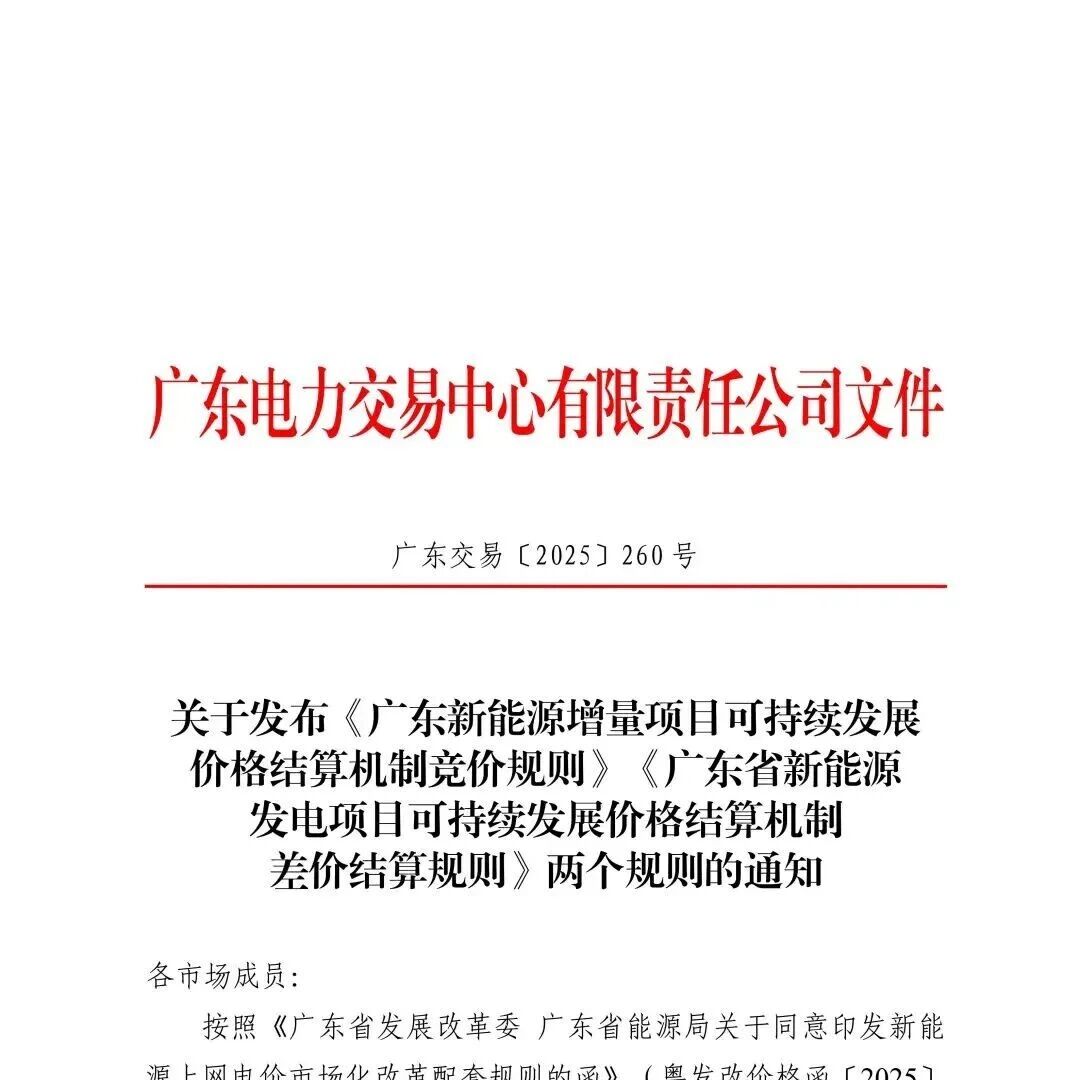
广东新能源增量项目价格结算机制竞价规则发布!
中关村储能产业技术联盟· 2025-10-16 12:17
Core Viewpoint - The Guangdong Power Trading Center has released two rules regarding the sustainable development pricing settlement mechanism for new energy projects, aiming to enhance market-oriented pricing and support the high-quality development of the new energy sector [2][7]. Group 1: Auction Rules - The auction for new energy projects will be organized annually at the end of each year, starting with the first auction in the fourth quarter of 2025 [4][14]. - Eligible projects include those that are completed and have government approval after June 1, 2025, excluding offshore wind projects determined before this date [3][14]. - The auction will allow project investors to submit bids, which can be modified or withdrawn before the deadline [4][20]. Group 2: Pricing Mechanism - The pricing mechanism for new energy projects will include a price difference settlement based on the average market price for different types of renewable energy, such as offshore wind, other wind, and solar [5][32]. - The execution period for the pricing mechanism will be 14 years for offshore wind projects and 12 years for solar projects, after which the mechanism price will no longer apply [22][29]. Group 3: Settlement Process - The settlement of the price difference will occur monthly, with the average market price calculated based on the actual power generation of the projects [31][39]. - The projects must meet the "four conditions" (observable, measurable, adjustable, controllable) before the pricing mechanism can be executed [22][27]. Group 4: Responsibilities and Management - The responsibilities for managing the new energy projects are divided among various entities, including power grid companies, trading institutions, and local energy authorities [29][30]. - A credit management system will be implemented to ensure compliance and maintain fair competition among auction participants [28].
我省新能源上网电价新政策发布
Liao Ning Ri Bao· 2025-10-14 00:58
Core Viewpoint - The province is implementing a market-oriented reform of the electricity pricing mechanism for renewable energy, establishing a sustainable pricing settlement mechanism that differentiates between existing and new projects [1] Group 1: Existing Projects - The existing projects are defined as those that were put into operation before June 1, 2025, with all approved or filed capacity fully constructed and connected to the grid [1] - The mechanism's electricity scale for individual projects will not exceed the previous year's level [1] - The mechanism price is set at 0.3749 yuan per kilowatt-hour [1] - The execution period is determined based on the remaining lifecycle utilization hours of each project compared to the earlier month of either the project’s operational month or the month when it reaches 20 years of operation [1] Group 2: New Projects - New projects refer to those that will be put into operation starting June 1, 2025 [1] - The electricity scale for these projects will be dynamically adjusted each year based on factors such as the national renewable energy consumption responsibility weight and user affordability [1] - The first year of implementation will ensure that the newly included electricity aligns with the non-market proportion of renewable energy in 2025 [1]
2025年黑色商品四季度策略报告:四季度价格或前低后高,关注合金低估值区间-20251013
Zhong Hui Qi Huo· 2025-10-13 06:36
1. Report Industry Investment Rating No information provided in the report. 2. Core Viewpoints of the Report - In the fourth quarter, the prices of ferroalloys may be low at first and then high. It is recommended to pay attention to the low - valuation range of alloys. The current prices of silicon manganese and silicon iron have limited downward space compared with the lows in the first half of the year. Short - term empty - position waiting is advisable, and mid - term opportunities to go long on dips after the seasonal decline of commodities can be focused on. The reference price range for the silicon manganese main contract is 5400 - 7000 yuan/ton, and for the silicon iron main contract is 5100 - 6600 yuan/ton [3][4][94]. - The supply - demand structure of ferroalloys will gradually return to a loose state in the fourth quarter. Although the inventory pressure in the statement has been released to some extent, the warehouse receipt levels of both silicon manganese and silicon iron are still at historical absolute highs, which significantly suppresses the spot prices. The demand for alloys still has short - term resilience but shows marginal weakening signs, and new production capacity will continue to be released in the fourth quarter [3][93]. - For silicon manganese, the port inventory of manganese ore has been at the lowest level in the past five years for ten consecutive months. High - grade ores such as those from Gabon have low inventories, and the concentration of oxide ore ownership is relatively high. Foreign manganese mines have raised their far - month quotes to China since the second half of the year, which provides strong short - term support for alloy prices. The price of silicon iron fluctuates around the coal price, and the industry profit has dropped to a low level in the same period. There is an expectation of supply tightening in the fourth quarter [3][93]. 3. Summary According to the Directory Chapter 1: Silicon Manganese Fundamental Analysis 1.1 Market Review - In the first half of the year, the silicon manganese futures price hit a new low since 2017. After the "anti - involution" and capacity reduction on July 1st, the futures price center continued to move up and hit the daily limit at the end of the month. As of September 30th, the SM601 contract closed at 5758 yuan/ton, with a cumulative decline of 11.1% compared with the highest point in July. The latest price of Jiangsu 6517 in the spot market was 5750 yuan/ton, with a cumulative decline of 6.5% compared with the highest price in July. The silicon manganese procurement price of HeSteel Group in September was 6000 yuan/ton, a decrease of 200 yuan/ton compared with August [8]. 1.2 Silicon Manganese Supply - Demand Analysis - **Supply**: From January to September, the total national silicon manganese output was 751.8 million tons, a decrease of about 1.6% compared with the same period last year. The third - quarter output was 262.7 million tons, an increase of about 1.4% compared with the same period last year. The average starting rate from July to September was about 44%, and the national starting rate continued to rise since the third quarter, reaching 45.9% in September. In the north, the starting rate was relatively stable, with the daily output in Inner Mongolia maintained at about 14,500 tons and that in Ningxia at about 6300 tons. In the third quarter, Yunnan entered the wet season, with the daily comprehensive electricity price of manufacturers at about 0.37 yuan/kWh, significantly lower than other regions. The starting rate in Yunnan has been above 90% for six consecutive weeks, with the daily output basically above 2000 tons, but its production capacity accounts for a relatively low proportion of the national total, and its impact on prices is relatively limited. As of September 26th, the sample enterprise inventory was 233,800 tons, at a high - level in the same period. The average available days of silicon manganese inventory in steel mills from July to September were 14.24, 14.98, and 15.93 respectively. The inventory levels in August and September were slightly higher than those of last year but still significantly lower than the previous average. The warehouse receipts have been decreasing since May, and as of September 30th, the total of silicon manganese warehouse receipts and valid forecasts was about 281,000 tons, a cumulative decrease of about 57% compared with the highest point in May [9][11][18]. - **Demand**: Except for the week of the military parade, the molten iron output in the third quarter basically remained above 2.4 million tons. As of October 3rd, 2025, the daily average molten iron output of 247 steel enterprises was 2.4181 million tons, second only to the same period in 2023. However, since this year, the performance of steel for housing construction has been poor, and the flow of molten iron in steel mills has shifted. The actual output and proportion of rebar, which accounts for the largest proportion of silicon manganese downstream demand, are also at a low level in the same period in recent years, making it difficult to support the actual demand for silicon manganese. The tender volume in the third quarter increased month - on - month, and the replenishment demand in the peak seasons of August and September was released. The overall level was higher than that of last year. The downstream price - pressing intention was still strong, and the procurement price of the iconic steel mill in September was 5800 yuan/ton, not exceeding market expectations. After the National Day holiday, the short - term molten iron output still provides stable support for the demand for silicon manganese, but the apparent demand for rebar has shown signs of weakening. In the fourth quarter, the actual demand for silicon manganese may decline under pressure, and the weak demand will still suppress prices [23]. 1.3 Silicon Manganese Cost - Profit Analysis - **Cost - Profit**: As of September 30th, the production cost of silicon manganese in the northern region was 5829 yuan/ton, with an immediate profit of - 168 yuan/ton; in the southern region, the production cost was 6236 yuan/ton, with an immediate profit of - 547 yuan/ton. The cost line in the production areas gradually moved up in the third quarter. From the perspective of spot profit, the industry suffered losses for most of the time, with the northern spot profit maintained at - 50 to - 200 yuan/ton and the southern spot profit at - 400 to - 550 yuan/ton. Currently, the profit in some production areas is acceptable (such as Inner Mongolia and Yunnan). After the holiday, some new production capacity will enter the ignition period. The wet season in the southwest is coming to an end, and attention should be paid to the profit changes in the production areas in mid - to - late October [28]. - **Manganese Ore Price**: In the third quarter, the port manganese ore price did not rise or fall significantly. Traders maintained their intention to hold prices, but the downstream acceptance of high - priced ore was limited, so the ore price generally fluctuated within a range following the futures price. For foreign ores, as of the end of September, the quotes of some mines for November to China continued to rise, but the increase was relatively limited. The price difference between high - grade ores in Tianjin Port was basically maintained at 1 - 2 yuan/ton degree. The price of South32 Australian blocks was basically the same as that of Gabonese blocks. The difference in inventory structure between the two ports was mainly reflected in semi - carbonate ore, with the ownership of semi - carbonate ore in Qinzhou Port being relatively concentrated and the price being relatively firm [35]. - **Manganese Ore Supply - Demand Analysis**: From January to August 2025, the cumulative import volume of manganese ore in China was 20.689 million tons, an increase of 1.817 million tons compared with the same period last year, a year - on - year increase of 9.6%. In August, the import volume of manganese ore was 3.486 million tons, a month - on - month increase of 742,000 tons (a 27.1% increase) and a year - on - year increase of 875,000 tons (a 33.5% increase). The countries with the largest import shares were South Africa, Australia, and Ghana. The import volume of Gabonese manganese ore decreased significantly in the third quarter. The port inventory has been rising since the second quarter, but it is still significantly lower than the same period in the past five years. As of September 26th, the national manganese ore port inventory was 4.478 million tons, with a three - year percentile of 20.5%; the inventory in Tianjin Port was 3.761 million tons, with a three - year percentile of 20.6%. The inventory of Australian ore has returned to a neutral level in the past three years, and the inventory levels of Gabonese blocks in both ports are significantly low. The inventory of medium - and low - grade ores in Tianjin Port is relatively abundant, and the inventory of South African semi - carbonate in Qinzhou Port is 204,000 tons, with a high concentration of ownership [45][55]. - **Other Costs**: The electricity price in Yunnan is significantly lower than that in other production areas. Attention should be paid to the electricity bill settlement in each production area in September [64]. Chapter 2: Silicon Iron Fundamental Analysis 2.1 Market Review - Since the "anti - involution" on July 1st, the silicon iron futures price center continued to move up and hit the daily limit at the end of the month. As of September 30th, the SM511 contract closed at 5494 yuan/ton, with a cumulative decline of 14.5% compared with the highest point in July. The latest price of Jiangsu silicon iron 72 in the spot market was 5750 yuan/ton, with a cumulative decline of 3.4% compared with the highest price in July. The silicon iron procurement price of HeSteel Group in September was 5800 yuan/ton, a decrease of 230 yuan/ton compared with August [67]. 2.2 Silicon Iron Supply - Demand Analysis - **Supply**: From January to September, the total national silicon iron output was 4.119 million tons, an increase of about 1.4% compared with the same period last year. The third - quarter output was 1.428 million tons, basically the same as that of last year. The average starting rate from July to September was about 57.4%, and the national starting rate continued to rise since the third quarter, slightly dropping to 58.8% in September. The daily output in Ningxia was maintained at about 4000 tons, and that in Inner Mongolia increased to over 5000 tons. The starting rates in Qinghai and Shaanxi were relatively stable, and the starting rate in Gansu was lower than that in other regions. The overall inventory level of production enterprises was at a relatively high position in the same period in the first half of the year. In the third quarter, the futures price continued to rise, and manufacturers were actively hedging, with part of the inventory transferred to the delivery warehouse. The warehouse receipts increased rapidly after being cancelled in June. As of August 6th, the total of warehouse receipts and valid forecasts was about 117,000 tons, at a high - level in the same period. Currently, it has entered the centralized cancellation period again, and attention should be paid to the situation of warehouse receipts being re - warehoused after cancellation. In the fourth quarter, as the downstream demand weakens, the inventory pressure in the production areas may further increase [68][70]. - **Demand**: From January to August, the cumulative apparent consumption of silicon iron was about 3.486 million tons, an increase of about 4.2% compared with the same period last year. The demand for crude steel in the third quarter was only higher than that of last year, but the situation in 2024 was relatively special, and the actual downstream demand this year was still significantly lower than the previous level. In terms of the tender volume of steel mills, the procurement volume in September exceeded market expectations, with the procurement quantity of HeSteel being 3151 tons, at the highest level in the past five years. However, the price - pressing intention was still strong, and the procurement prices of most steel mills in September were reduced by 200 - 250 yuan/ton compared with the previous round. In terms of exports, from January to August 2025, the cumulative export quantity of silicon iron in China was 254,200 tons, a decrease of 25,800 tons compared with the same period last year, a year - on - year decrease of 9.21%. In August, the export volume of silicon iron with a silicon content greater than 55% was 3.3 tons, a month - on - month decrease of 2.8% and a year - on - year decrease of 16.9%. The demand in the non - steel field still has resilience. From January to August 2025, the national magnesium ingot output was 580,000 tons, a year - on - year decrease of about 0.8%. The domestic magnesium metal market performed well in the third quarter, with the price increasing significantly compared with the previous period, and the overall export of magnesium ingots in July and August was good, providing certain support for the alloy demand [78]. 2.3 Silicon Iron Cost - Profit Analysis - **Cost - Profit**: As of September 30th, the production cost of silicon iron in Ningxia was 5684 yuan/ton, with an immediate profit of - 454 yuan/ton, and the cost increased by about 400 yuan/ton compared with the beginning of July. The cost line in the production areas gradually moved up in the third quarter, and the current loss in the production areas is relatively serious, with the spot profit in the whole production area ranging from - 300 to - 500 yuan/ton [83]. - **Raw Material End**: The coal price continued to decline in shock in the first half of the year, and the thermal coal price fell below the annual long - term contract price, and the loose supply - demand pattern in the industry was difficult to break. In the third quarter, the coal price showed a stable and rising trend. Affected by the price of raw material lump coal, the semi - coke price rebounded from the bottom, and the market experienced multiple rounds of price increases. As of September 30th, the latest price of small materials in Shaanxi was 700 yuan/ton, a cumulative increase of 120 - 160 yuan/ton compared with the end of the second quarter. Since this year, the new - energy installed capacity has maintained a high - speed growth trend. As of the end of August, the cumulative installed power - generation capacity in the country was 3.69 billion kilowatts, a year - on - year increase of 18.0%. The installed capacity of solar power generation was 1.12 billion kilowatts, a year - on - year increase of 48.5%; the installed capacity of wind power was 580 million kilowatts, a year - on - year increase of 22.1%. The electricity price in the production areas has changed frequently this year, and the electricity cost has generally shown an upward trend in the second half of the year. Currently, the comprehensive electricity cost of manufacturers in Inner Mongolia is 0.41 - 0.42 yuan/kWh, that in Ningxia has risen to 0.4 yuan/kWh, that in Qinghai has risen to 0.39 - 0.4 yuan/kWh, and the electricity cost in Gansu and Shaanxi is mostly concentrated at 0.4 - 0.42 yuan/kWh. Currently, the production cost in Qinghai is the lowest (about 5550 yuan/ton), that in Inner Mongolia and Ningxia is 5670 - 5700 yuan/ton, and that in Shaanxi is the highest (above 5730 yuan/ton) [89][91]. Chapter 3: Ferroalloy Fourth - Quarter Market Outlook - The current daily average output of silicon manganese is about 30,000 tons, and that of silicon iron is about 16,500 tons, both at high levels in the same period. The inventory pressure in the statement has been released to some extent, but the warehouse receipt levels of both are still at historical absolute highs, which significantly suppresses the spot prices. The demand for alloys still has short - term resilience but shows marginal weakening signs, and new production capacity will continue to be released in the fourth quarter. The supply - demand structure of ferroalloys will gradually return to a loose state [93]. - For silicon manganese, the port inventory of manganese ore has been at the lowest level in the past five years for ten consecutive months. High - grade ores such as those from Gabon have low inventories, and the concentration of oxide ore ownership is relatively high. Foreign manganese mines have raised their far - month quotes to China since the second half of the year, which provides strong short - term support for alloy prices. The price of silicon iron fluctuates around the coal price, and the industry profit has dropped to a low level in the same period. There is an expectation of supply tightening in the fourth quarter. Attention should be paid to the inventory changes in the production areas and the situation of warehouse receipts being re - warehoused after cancellation [93]. - As of September 30th, the closing price of the silicon manganese continuous contract was 5628 yuan/ton, and that of the silicon iron continuous contract was 5310 yuan/ton, corresponding to historical percentile values of 9.6% and 13.7% respectively. The current prices have limited downward space compared with the lows in the first half of the year. In October, attention should be paid to the changes in coal prices and macro - sentiment
电力设备与新能源行业周报:特高压技术迭代升级,OpenAI升级API推出更强模型-20251012
Western Securities· 2025-10-12 05:17
Investment Rating - The report recommends investment in the power equipment and new energy sectors, highlighting specific companies for potential investment opportunities [1][2][3]. Core Insights - The development of new energy is driving the iteration and upgrade of ultra-high voltage technology, with market-oriented reforms in the power sector promoting orderly and healthy development of new energy [1]. - The successful development of the world's first 800 kV 80 kA circuit breaker by Pinggao Electric provides crucial equipment support for China's ultra-high voltage development [1]. - The report emphasizes the progress in controllable nuclear fusion projects globally, recommending companies like XJ Electric and Dongfang Electric for investment [1]. - A significant investment agreement was signed between Xingan League and Goldwind for green hydrogen production, indicating positive prospects for wind power and green methanol production [1]. Summary by Sections Power Equipment - Recommended companies include Sien Electric, Shunhua Electric, Bull Group, Guoneng Rixin, and Nanfang Technology, with a focus on TBEA and GCL-Poly Energy for attention [1]. - The report highlights the successful development of key equipment for ultra-high voltage systems, which is crucial for the sector's growth [1]. Energy Storage - The report notes the operational launch of China's first large-capacity sodium-ion battery energy storage station, with recommended companies including CATL, EVE Energy, Sungrow Power, and Dewei Co., Ltd. [2]. - The focus on sodium-ion technology is emphasized, with specific attention to companies like Prilite [2]. Electric Vehicles - The Ministry of Commerce announced new export controls on lithium batteries and related materials, which is seen as a long-term benefit for companies with existing overseas production capacity [3]. - Recommended companies in the electric vehicle sector include Xinwangda, Haopeng Technology, and Shangtai Technology, with additional attention on Keda Manufacturing and Longpan Technology [3]. Robotics - The launch of the third-generation humanoid robot Figure03 by Figure AI marks a significant advancement in the commercialization of humanoid robots [3]. - Recommended companies in the humanoid robot sector include Wuzhou Xinchun, Zhaowei Electric, and Keda Li [3]. Photovoltaics - The report highlights price increases in the photovoltaic industry chain, with recommended companies including Aiko Solar, GCL-Poly, and Maiwei [4]. - The report also discusses the impact of new regulations on pricing and competition within the industry [4].
只有攻克“短期难”,才能锻造“长期强”
Ren Min Ri Bao· 2025-10-10 07:22
今年以来,一些地方推进新能源上网电价市场化改革,让新能源发电走出"温室"、走向市场。实施这项 政策看起来挺难的,为何还要出台呢? 换句话说,新能源发电已经不再是"襁褓里的婴儿",而是长成了"青春期的小伙子",需要"换大衣服"。 这件"大衣服",就是更科学、更合理、更利于长远发展的制度设计。 特别是要注意到,政策对"短期难"作了充分考虑,创新建立了"多退少补"的可持续发展价格结算机制, 帮助企业平稳过渡。 长期看,该通知将倒逼新能源发电企业从规模扩张转向质量提升,从过去的"多发电"转向"巧发电""发 好电"。充分竞争的到来,会促使企业通过寻找消纳新渠道、灵活配置储能等举措提升竞争力,也将在 整体上促进电力资源高效配置,从而取得"长期强"的成效。 不只是上网电价市场化改革,近年出台的许多政策都有"短期难、长期强"的特点。 "短期难"有普遍性。政策是奔着问题去的。改革走进深水区,政策要"有感觉""有分量",势必会触及更 多深层次矛盾、面对更多高难度问题。 ——人民网网友 这位网友提到的改革,源于今年初出台的《关于深化新能源上网电价市场化改革 促进新能源高质量发 展的通知》。其重点,在于"推动新能源上网电量全面进入电 ...
只有攻克“短期难”,才能锻造“长期强”(读者点题·共同关注)
Ren Min Ri Bao· 2025-10-09 21:52
Core Viewpoint - The article discusses the recent reforms in the pricing of renewable energy, emphasizing the transition from guaranteed returns to market-driven pricing, which poses short-term challenges but is expected to yield long-term benefits for the industry [1][2]. Group 1: Short-term Challenges - The transition to market pricing for renewable energy indicates the end of guaranteed returns, leading to a competitive environment where only the most efficient will survive [2]. - The current challenges reflect deeper issues accumulated over years of rapid growth in the renewable sector, including overcapacity in manufacturing and increasing difficulties in electricity consumption [2]. - The policy introduces a "multi-retreat and less-supplement" pricing mechanism to help companies transition smoothly during this challenging period [2]. Group 2: Long-term Benefits - The reforms are expected to shift the focus of renewable energy companies from mere expansion to enhancing quality, promoting smarter and more efficient energy production [2]. - Increased competition will drive companies to explore new consumption channels and optimize energy storage solutions, leading to more efficient allocation of electricity resources [2]. - The long-term vision aligns with broader national goals, as seen in other sectors like electric vehicles and environmental conservation, where initial challenges have led to significant advancements over time [6][7]. Group 3: Broader Policy Context - The article highlights that many recent policies share the "short-term difficulty, long-term strength" characteristic, indicating a trend in addressing deeper systemic issues [3][4]. - The complexity of these reforms often involves balancing multiple stakeholder interests and optimizing resource distribution across various sectors, such as healthcare and education [3][4]. - The article emphasizes the importance of patience and a long-term perspective in achieving sustainable development goals, as demonstrated by successful initiatives in other areas [8][9].
新能源上网电价迎来市场化改革
Liao Ning Ri Bao· 2025-10-07 23:57
Core Viewpoint - The implementation of the "Liaoning Province Deepening New Energy Grid Price Marketization Reform Implementation Plan" marks the first initiative in Northeast China to reform the new energy pricing mechanism, focusing on the deep-seated needs of energy structure transformation in the province [1] Group 1: Reform Mechanism - The reform plan considers the phased characteristics of energy transition within the province, implementing a differentiated "dual-track system" for existing and new projects [2] - For existing projects connected to the grid before June 2025, a fixed price of 0.3749 yuan per kilowatt-hour is established to stabilize investor expectations and ensure smooth project operations [2] - New projects after June 2025 will adopt a market-oriented approach, with 55% of the grid-connected electricity priced between 0.18 yuan and 0.33 yuan per kilowatt-hour, while the remaining electricity will be sold in the market [2] Group 2: Risk Management and Optimization - The introduction of a "price difference settlement" model transforms the physical risk of "generation forecast deviation" faced by new energy companies into a more manageable financial risk of "market price fluctuations" [3] - Companies will receive real-time income based on actual generation in the spot market, while medium- and long-term contracts will be settled as financial difference contracts, significantly reducing uncertainties and risk exposure for new energy enterprises [3] Group 3: Supporting Measures and Market Structure - The reform plan includes a series of collaborative measures to establish a multi-dimensional market system for energy quantity, capacity, and ancillary services [3] - A capacity compensation mechanism for the generation side and fixed capacity price compensation for new storage on the grid side are introduced to address the challenges of recovering storage costs [3] - The plan aims to enhance the flexibility of the power grid and optimize energy consumption structure, laying a solid foundation for the construction of a clean energy strong province [4]
一图读懂 | 广东新能源上网电价改革实施方案要点
中国能源报· 2025-10-03 07:08
Core Viewpoint - The article discusses the implementation of a market-oriented pricing mechanism for renewable energy in China, particularly in Guangdong Province, aimed at promoting high-quality development of renewable energy sources such as wind and solar power [1][4]. Group 1: Market Participation - From November 1, 2025, all renewable energy projects in Guangdong (wind and solar) will fully participate in the electricity market, with prices determined through market transactions [4][7]. - Renewable energy projects will be categorized based on grid voltage levels for market participation, encouraging those at or below 10 kV to report and quote for market transactions [7]. Group 2: Market Trading Mechanism - Renewable energy projects can participate in various trading cycles, including annual, monthly, and real-time markets, with specific rules to be defined later [9]. - Supply and demand parties can autonomously determine the terms of medium to long-term contracts without restrictions on signing ratios [9]. Group 3: Price Mechanism - The article outlines a flexible pricing mechanism for the spot market, with upper and lower limits for clearing prices based on current industrial peak electricity prices and other factors [10][11]. - The initial upper limit for spot market clearing prices is set at 1.8 yuan/kWh, while the lower limit is -0.05 yuan/kWh [11]. Group 4: Sustainable Development Pricing Mechanism - A sustainable development pricing settlement mechanism will be established for renewable energy projects participating in market transactions, with price differences settled by grid companies [12]. - For projects completed before June 1, 2025, a price settlement mechanism will apply, with specific limits on the proportion of mechanism electricity based on project type [13]. Group 5: Incremental Project Pricing - New renewable energy projects starting after June 1, 2025, that do not participate in the pricing mechanism will have their electricity priced according to market rates [5][14]. - The bidding limits for offshore wind and solar projects are set at 0.453 yuan/kWh and 0.40 yuan/kWh, respectively, with lower limits established as well [18][20]. Group 6: Settlement and Coordination - Monthly price settlements will be conducted for mechanism electricity, with differences between market prices and mechanism prices included in system operation costs [23]. - The article emphasizes the importance of policy coordination to support the high-quality development of renewable energy [25].

河北“136号文”:存量40%~100%机制电量,增量最高80%,执行期10~14年
中关村储能产业技术联盟· 2025-09-28 09:17
Core Viewpoint - The article discusses the implementation of market-oriented reforms for renewable energy pricing in Hebei Province, aiming to enhance the quality of renewable energy development and promote a clean, low-carbon energy transition [18][38]. Group 1: Existing Projects - The electricity scale for existing projects is set at 70% for centralized wind power, 40% for centralized solar power (100% for poverty alleviation projects), 80% for commercial distributed solar power connected to 10kV and above, and 100% for other distributed solar and decentralized wind power [3][25]. - The mechanism electricity price for Hebei South Grid is set at 0.3644 yuan/kWh, while for the Jibei Grid, it is 0.372 yuan/kWh [4][5]. - The execution period for existing projects will exit the price difference settlement mechanism after reaching the reasonable utilization hours for the entire lifecycle or after 20 years of operation [6][44]. Group 2: Incremental Projects - Incremental projects eligible for bidding include large commercial distributed solar power projects that commence operation after June 1, 2025, and do not fall under the mechanism price execution range [7][62]. - The mechanism electricity scale for incremental projects is capped at 80% of the grid electricity [9][46]. - The execution period for wind and solar power is tentatively set at 10 and 12 years, respectively, with adjustments based on market conditions [10][28]. Group 3: Full Capacity Grid Connection Regulations - For centralized projects, the grid connection time and capacity are based on the power business license, while for distributed projects, they are based on the provincial grid company's marketing system [11][64]. - Deviations in actual grid connection scale due to equipment selection are permissible within specified limits [12][64]. Group 4: Price Settlement Mechanism - A price settlement mechanism will be established to support the sustainable development of renewable energy, providing price difference compensation when market transaction prices fall below the mechanism price [42][49]. - The price difference settlement funds will be calculated based on the difference between the mechanism price and the market transaction average price [30][49]. - Projects can voluntarily apply to exit the price difference settlement mechanism during the execution period [32][51]. Group 5: Policy Coordination - The article emphasizes the need for coordination in planning renewable energy projects and aligning with national and provincial development goals [52]. - It highlights the importance of optimizing the green electricity and green certificate trading mechanisms to avoid double benefits [53]. - The article also discusses the cancellation of mandatory energy storage requirements for renewable energy projects approved after February 9, 2025, encouraging independent energy storage solutions [34][53].