
消费贷贴息政策

Search documents
消费贷“国补”开闸倒计时 机构借势拓增量
证券时报· 2025-08-25 00:35
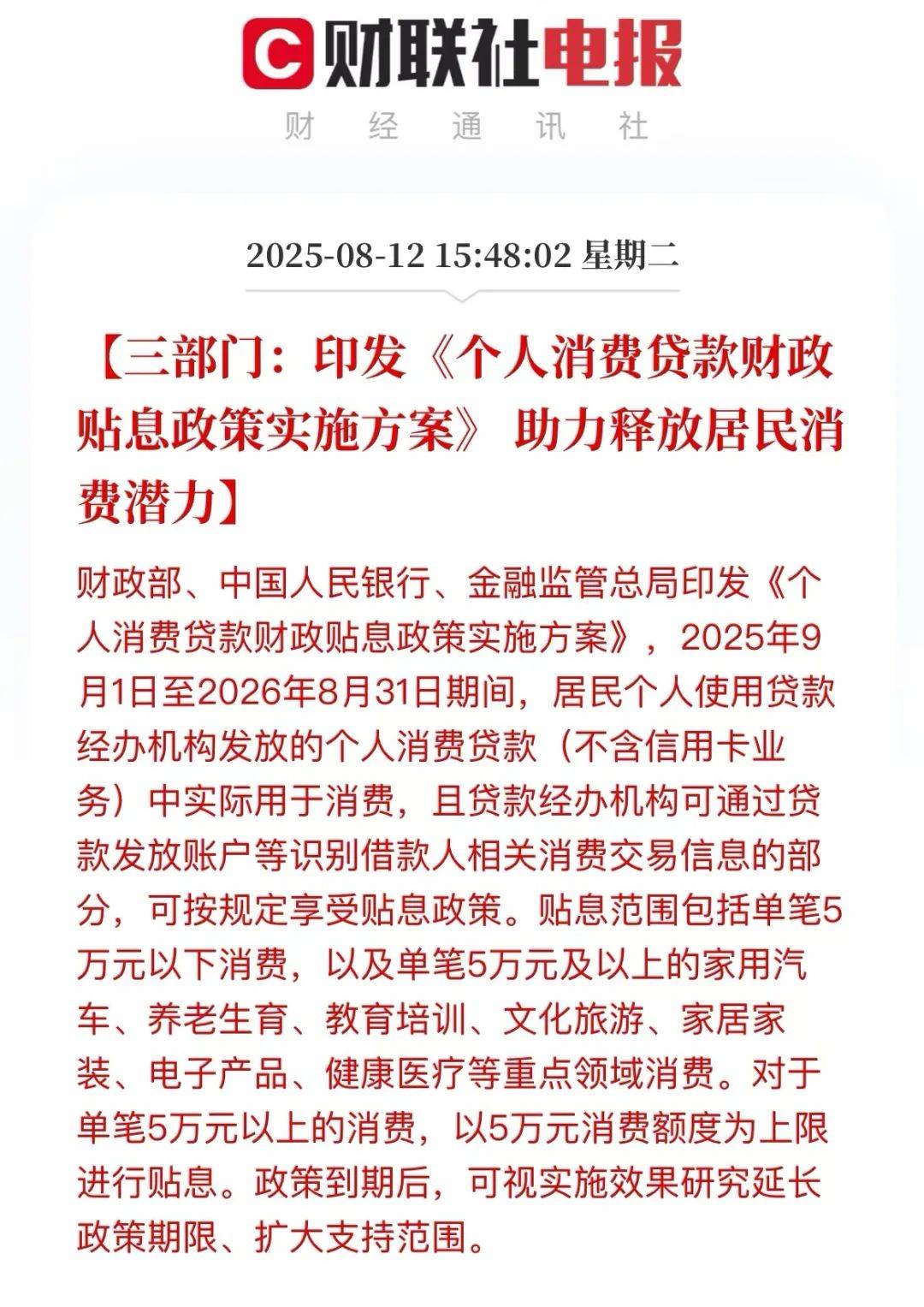
Core Viewpoint - The introduction of the personal consumption loan interest subsidy policy marks a significant shift in the government's approach to supporting consumer spending, focusing on the portion of loans actually used for consumption rather than the entire loan amount [1][3]. Group 1: Policy Implementation - The personal consumption loan interest subsidy policy will officially commence on September 1, with the first batch of loan processing institutions including 18 national commercial banks and 5 other personal consumption loan providers [3]. - The policy requires financial institutions to enhance their information systems to accurately identify the portion of loans used for consumption, ensuring that subsidy funds are effectively directed towards consumer spending [3][4]. - The policy's implementation is expected to drive financial institutions to innovate their consumption loan products and expand into various consumption scenarios through direct partnerships with merchants [1][6]. Group 2: Industry Impact - The subsidy policy is anticipated to have a substantial impact on the consumption finance industry, particularly benefiting the top four consumer finance companies by enabling them to significantly expand their business [6]. - However, challenges remain in monitoring the flow of funds for cash loan products, which complicates the identification of the portion used for consumption [6][8]. - The focus on scenario-based loans, which are tied to specific consumption contexts, is seen as a necessary approach to ensure compliance with the subsidy policy [6][8]. Group 3: Market Dynamics - The consumption finance sector is increasingly encouraged to develop scenario loans, with recent data indicating a focus on low-frequency consumption scenarios such as electronics, home appliances, and home renovations [8]. - The subsidy policy is expected to lower loan interest rates, thereby expanding the cost space for consumer finance companies to seek partnerships with merchants [8][9]. - Collaboration with major institutions and large-scale consumption scenarios is likely to become a priority for consumer finance companies, as it allows for rapid business growth [9].


2025年1-7月财政数据点评:公共财政收支增速差收窄
BOHAI SECURITIES· 2025-08-20 11:00
Revenue Insights - From January to July 2025, the national general public budget revenue reached CNY 135,839 billion, with a year-on-year growth of 0.1%[2] - The national general public budget expenditure was CNY 160,737 billion, showing a year-on-year increase of 3.4%[2] - Individual income tax revenue growth expanded to 8.8%, significantly higher than the overall tax revenue growth rate[2] Fund Budget Analysis - Government fund budget revenue decreased by 0.7% year-on-year, while expenditure surged by 31.7%[4] - The increase in fund expenditure is primarily due to the accelerated implementation of special national bonds and local special bonds[4] - The overall fiscal expenditure (public finance + government fund expenditure) grew by 9.3% year-on-year, reflecting a 0.4 percentage point increase from the previous month[4] Expenditure Trends - Public finance expenditure growth remained stable, with a focus on social welfare, which saw a 6.8% increase, particularly in social security and employment sectors, which grew by 9.8%[3] - Infrastructure spending continued to show negative growth, with specific sectors like urban community and transportation also experiencing declines[3] - Debt interest payments increased by 6.4%, indicating a rising trend in this area[3] Fiscal Performance Metrics - By the end of July 2025, the completion rate of the national general public budget revenue was 61.8%, below the five-year average of 63.5%[2] - The completion rate for public finance expenditure was 54.1%, also lower than the five-year average of 54.7%[3]
银行消费贷利率仍维持在3%以上
Zheng Quan Ri Bao· 2025-08-18 23:06
Core Viewpoint - The implementation details of the personal consumption loan interest subsidy policy, effective from September 1, are still pending, with banks awaiting further instructions from higher authorities [1][2][3]. Group 1: Policy Implementation - Major state-owned banks and national joint-stock banks have announced their commitment to implement the personal consumption loan interest subsidy policy starting September 1, 2025, with specific operational guidelines to be released later [2]. - The subsidy will be executed through a "pre-loan" model, where the government pre-allocates funds, and banks will deduct the subsidy amount from the interest charged to borrowers [2][4]. - The annual subsidy rate is set at 1%, with a maximum limit of 50% of the loan contract interest rate, and individual borrowers can receive up to 3,000 yuan in total subsidies [2][5]. Group 2: Current Market Conditions - As of now, consumer loan interest rates across banks remain stable at over 3%, with some banks offering rates as low as 3% [4][5]. - Banks are currently unable to provide specific application processes or guidelines for the subsidy, as they await further directives from their headquarters [3][4]. Group 3: Economic Impact - The subsidy policy is expected to lower financing costs for consumers, thereby boosting demand for personal loans [5]. - Analysts suggest that while the subsidy may temporarily reduce effective interest rates, the long-term trend will depend on the economic return rates and may lead to a stable but slightly declining interest rate environment [5][6].
个人消费贷款财政贴息政策将实施 银行消费贷利率仍维持在3%以上
Zheng Quan Ri Bao Zhi Sheng· 2025-08-18 16:09
Core Viewpoint - The implementation of the personal consumption loan interest subsidy policy is approaching, with banks awaiting specific operational guidelines from higher authorities [1][2][3]. Group 1: Policy Implementation - The personal consumption loan interest subsidy policy will officially take effect on September 1, 2025, with major banks responding by announcing their commitment to implement the policy [2]. - The subsidy will be executed through a "pre-loan" model, where the government allocates funds in advance, and banks will deduct the subsidy amount from the interest charged to borrowers [2][3]. - The annual subsidy rate is set at 1%, with a maximum limit of 50% of the loan contract interest rate, and individual borrowers can receive up to 3,000 yuan in total subsidies [2][3]. Group 2: Current Banking Practices - Banks have not yet received detailed execution guidelines and are currently in a waiting phase for further instructions from their headquarters [2][3]. - The current interest rates for personal consumption loans remain stable at over 3%, with specific rates varying by bank and borrower qualifications [4][5]. Group 3: Market Impact and Analysis - The subsidy policy is expected to lower financing costs for residents, thereby boosting demand for personal consumption loans [5]. - Analysts predict that while the subsidy will temporarily reduce actual interest rates, the long-term trend will see rates stabilize around the returns of the real economy, with a potential for structural optimization [5]. - There are concerns regarding the compliance of the use of subsidized loans, as misuse could lead to negative impacts on personal credit records [6].
央行发布第二季度货币政策执行报告;成都银行与成都农商银行董事长对调 | 金融早参
Sou Hu Cai Jing· 2025-08-17 23:57
Group 1 - The People's Bank of China emphasizes the importance of promoting a reasonable rebound in prices as a key consideration for monetary policy, aiming to maintain prices at a reasonable level [1] - The report highlights the need to improve the interest rate adjustment framework and strengthen the guidance of the central bank's policy rates, aiming to reduce the cost of bank liabilities and promote a decrease in the overall financing costs in society [1] - The report indicates that recent monetary policy efforts, including multiple reductions in reserve requirements and interest rates, have aimed to enhance liquidity and create favorable financing conditions, with a focus on achieving a positive supply-demand cycle to support price recovery [1] Group 2 - In July 2025, banks in China settled foreign exchange transactions amounting to 16,700 billion yuan and sold 15,070 billion yuan, with cumulative settlements from January to July reaching 98,835 billion yuan and sales at 99,020 billion yuan [2] - The data shows that in July 2025, the foreign exchange settlements in USD were 2,336 million and sales were 2,108 million, with cumulative settlements from January to July at 13,768 million and sales at 13,793 million [2] - The report suggests that the resilience of the foreign exchange market, supported by steady economic development, has contributed to the stable operation of the foreign exchange market amid increased volatility in international currency markets [2] Group 3 - The global economic environment is leading to divergent monetary policy paths among major economies, with some central banks adjusting rates while others remain cautious, making interest rate differentials a focal point for the market [3] - The expectation of a potential interest rate cut by the Federal Reserve is growing, with market discussions shifting from "whether to cut rates" to "how much to cut" [3] - The recent comments from the U.S. Treasury Secretary regarding the contrasting monetary policies of the U.S. and Japan have further solidified the anticipation of a rate cut, suggesting a potential revaluation of global assets if the Fed proceeds with a cut [3] Group 4 - A new policy for consumer loan interest subsidies has been implemented, with 23 financial institutions designated to handle these subsidies, presenting growth opportunities for those institutions while also imposing compliance costs and regulatory pressures [4] - The policy is expected to guide loan flows and impact the industry landscape, with major state-owned and joint-stock banks likely to increase their market share in the consumer loan sector due to the subsidy support [4] Group 5 - The leadership of Chengdu Bank and Chengdu Rural Commercial Bank has been reshuffled, with new appointments for the chairpersons of both banks, indicating potential strategic shifts within these institutions [5]
实探贴息新政下消费贷市场:银行网点尚未收到细则,利率最低3%
Xin Jing Bao· 2025-08-17 04:23
Core Viewpoint - The newly introduced personal consumption loan interest subsidy policy aims to lower the effective interest rates for consumers, but banks have not yet provided specific implementation details, and current loan rates remain above 3% [1][2][3]. Group 1: Policy Implementation - The personal consumption loan interest subsidy policy will be effective from September 1, 2025, and will apply to loans used for specific consumption purposes, with banks required to verify the usage through transaction information [3][4]. - Major banks, including Agricultural Bank, Construction Bank, and Bank of China, will implement the subsidy policy, but specific operational guidelines will be released later through various channels [4][5]. - The subsidy is limited to certain consumption areas, including household vehicles, education, and healthcare, and requires documentation to qualify [3][5]. Group 2: Market Reactions and Expectations - Market participants speculate that the subsidy will not directly lead to lower interest rates but may reduce effective rates after consumption verification [1][2]. - Financial experts suggest that while there is potential for interest rate reductions, the extent may be limited due to banks' net interest margin pressures [1][4]. - The policy is seen as an innovative measure to lower consumer credit costs and stimulate consumption, but it also raises concerns about the management of subsidy funds and loan usage [5][6]. Group 3: Risk Management and Compliance - Financial institutions are advised to maintain reasonable loan rates and enhance risk management practices to prevent misuse of subsidy funds [6]. - The policy's success may depend on the efficiency of provincial financial resources and the ability to manage the flow of funds effectively [5][6]. - There is a call for improved consumer demand analysis to prevent over-lending and protect consumer rights [6].
消费大变革来了,抓住红利期!
Sou Hu Cai Jing· 2025-08-16 06:53
Core Viewpoint - The recent financial data from the central bank indicates a significant decline in consumer lending and a weak willingness among residents to leverage for consumption, reflecting a lack of confidence in the current and future economic conditions [1][3]. Group 1: Financial Data Overview - In July, new social financing amounted to 1.16 trillion yuan, a year-on-year increase of 389.3 billion yuan, which was below the market expectation of 1.41 trillion yuan [1]. - New RMB loans were negative at -50 billion yuan, marking the first negative figure since July 2005 [1]. - New resident loans were -489.3 billion yuan, a decrease of 279.3 billion yuan year-on-year, indicating a "double negative" state for the second time since April [1]. Group 2: Government Response - On July 31, the State Council announced the implementation of a personal consumption loan interest subsidy policy [5]. - A plan was issued on August 12, providing a 1% interest subsidy for personal consumption loans and loans for service industry operators, effective from September and lasting for one year [6]. - The subsidy will cover major state-owned banks and leading consumer finance companies, with the central government bearing 90% of the costs [6]. Group 3: Impact of Subsidy - The subsidy applies to single loans below 50,000 yuan and for key consumption areas such as automobiles, education, and healthcare, with a maximum subsidy of 50,000 yuan [8]. - Each individual can receive a maximum annual subsidy of 3,000 yuan, which corresponds to a cumulative consumption amount of 300,000 yuan [9]. - The 1% subsidy can significantly reduce the interest burden, effectively cutting one-third of the interest costs for consumers [10]. Group 4: Consumer Behavior Insights - Despite government efforts to stimulate consumption, there remains a reluctance among consumers to take on debt due to concerns about repayment [12][19]. - The article warns against excessive consumption and leveraging, emphasizing that consumer loans do not create wealth and can lead to financial struggles [14][23]. - Historical examples illustrate the dangers of over-leveraging for consumption, highlighting cases where individuals faced severe financial consequences due to high debt levels [20][21]. Group 5: Strategic Recommendations - The article suggests that consumers should utilize the low-interest loans to refinance existing high-interest debts rather than incurring new debts for consumption [25]. - It advocates for a strategic approach to personal finance, emphasizing the importance of saving and planning over impulsive spending [32][34].
7月社零总额同比增长3.7%,无印良品回应多地关店 | 财经日日评
吴晓波频道· 2025-08-16 00:30
Group 1: Consumer Retail and Economic Indicators - In July, the total retail sales of consumer goods reached 38,780 billion yuan, with a year-on-year growth of 3.7%. Excluding automobiles, retail sales were 34,931 billion yuan, growing by 4.3% [2] - For the first seven months, total retail sales amounted to 284,238 billion yuan, with a growth rate of 4.8%. Excluding automobiles, the figure was 257,014 billion yuan, growing by 5.3% [2] - Online retail sales for the first seven months reached 86,835 billion yuan, with a year-on-year growth of 9.2%, and physical goods online retail sales accounted for 24.9% of total retail sales [2] - The industrial added value for large-scale enterprises in July grew by 5.7% year-on-year, with a month-on-month increase of 0.38% [4] - The real estate market showed a decline in housing prices across major cities, with new residential prices in first-tier cities dropping by 0.2% month-on-month [6][7] Group 2: Company Performance and Market Trends - NetEase reported a revenue of 27.9 billion yuan for Q2, a year-on-year increase of 9.4%, but below the expected 28.4 billion yuan [11] - JD.com achieved a revenue of 356.7 billion yuan in Q2, marking a year-on-year growth of 22.4%, but faced a significant drop in net profit by 51% [13] - MUJI announced the closure of several stores in China due to declining profitability, indicating challenges in maintaining market presence [15][16] - The stock market showed a rebound with the Shanghai Composite Index rising by 0.83%, indicating a shift in market sentiment and potential for further growth [17][18]



“消费板块或迎来一场重大机遇”
天天基金网· 2025-08-15 05:02
Core Viewpoint - The consumer sector is potentially entering a significant opportunity, described as an "epic opportunity," due to the introduction of personal consumption loan subsidies, which are expected to stimulate the consumption market [1][3]. Group 1: Policy Impact on Consumption - The newly introduced consumption loan interest subsidy policy aims to address insufficient domestic demand and weak consumer confidence, which are currently hindering economic recovery [5][6]. - The policy is designed to lower the cost of consumer loans, thereby enhancing residents' consumption capacity and stimulating market activity [6][8]. - Fund companies believe that the subsidy policy will benefit the consumer sector significantly, with expectations of continued policy support for consumption in the future [8][10]. Group 2: Market Performance and Investment Opportunities - The consumer sector has underperformed in the market, with the CSI Consumer Index down 2.11% year-to-date as of August 14, 2023, indicating a potential investment opportunity due to low valuations [10][11]. - Current market sentiment towards the consumer sector is pessimistic, with valuations dropping below 20 times earnings, suggesting that the sector may be oversold [10][11]. - Despite short-term challenges, structural opportunities within the consumer sector are still worth monitoring, particularly in areas like automotive and service consumption [9][10]. Group 3: Broader Economic Implications - The subsidy policy is not only focused on consumption but also aims to rebalance the entire domestic demand chain, potentially benefiting sectors like banking and technology services [12][13]. - Banks are expected to benefit from reduced financing costs and increased demand for retail loans, which could lead to a positive cycle of growth in the consumer market [12][13]. - The revival of consumer activity is likely to enhance transaction volumes in payment services and local life platforms, creating opportunities for technology service providers [12][13].

消费贷贴息“定向”经办更多金融机构期盼入围
Jing Ji Wang· 2025-08-15 03:03
Core Viewpoint - The new subsidy policy for consumer loans has been implemented, with 23 financial institutions designated to benefit from it, creating opportunities for expansion in consumer loan business while also presenting compliance and regulatory challenges [1][2]. Group 1: Policy Implementation - A total of 23 financial institutions have been selected to implement the consumer loan subsidy policy, including 6 state-owned banks, 12 joint-stock banks, and 5 other consumer loan providers [2]. - The inclusion of consumer finance companies in the first batch of institutions is a significant highlight of the policy, ensuring coverage across various income groups and both online and offline channels [2][3]. Group 2: Market Impact - The subsidy policy is expected to influence the market structure of consumer credit, with state-owned and joint-stock banks likely to increase their market share in the consumer loan sector [3]. - Local banks that did not qualify for the subsidy may lose competitive pricing advantages, potentially leading to a loss of high-quality customers [2]. Group 3: Compliance and Monitoring - The policy aims to prevent fraudulent activities by ensuring that subsidies are only granted for genuine consumer spending, requiring financial institutions to enhance their information systems for accurate tracking [4][5]. - Financial institutions face increased demands for precise management and monitoring of loan disbursements to ensure compliance with the subsidy conditions [5][6]. Group 4: Future Expansion - There is potential for the subsidy policy to expand in scope, with the possibility of including more financial institutions and extending the policy duration based on future evaluations [7]. - Local fiscal departments are encouraged to collaborate with the central government to provide additional support for consumer loans, thereby broadening the policy's reach [7].