红利低波策略

Search documents
红利基金:举起收益的“时间望远镜”
天天基金网· 2025-07-21 11:33
Core Viewpoint - The article emphasizes the importance of dividend low-volatility strategies for investors seeking stable returns without the need for market timing, highlighting the growing demand for investment products that provide a sense of certainty and lower risk exposure [4][6]. Group 1: Investment Strategies - Investors are increasingly looking for dividend funds that offer a high sense of gain, which can outperform cash management tools while minimizing the volatility associated with equity assets [4]. - Among various dividend investment strategies, the dividend low-volatility index has shown to have lower drawdowns and better meet the needs of clients seeking certainty [5][6]. Group 2: Performance Metrics - The article presents a comparison of different dividend indices, showing that the dividend low-volatility index has an annualized return of 18.4% since its inception, with a maximum drawdown of -13.5% and a dividend yield of 4.9% [5]. - The analysis of rolling returns from 2019 onwards indicates that the percentage of positive returns increases with the holding period, reaching 100% for periods of 2 years or more [13][14]. Group 3: Long-term Investment Value - The average return also improves with longer holding periods, with a mean return of 24.65% for 2 years and 38.40% for 3 years, indicating that longer investments yield better outcomes [13]. - The distribution of returns becomes more concentrated in the positive range as the holding period extends, suggesting a more stable long-term investment experience [14]. Group 4: Investor Considerations - Investors are encouraged to set personal "gain thresholds" to determine acceptable levels of positive returns over specific holding periods, which can help in selecting suitable products aligned with their investment goals [17]. - The article suggests that the importance of holding the dividend low-volatility index outweighs the need for market timing, advocating for a long-term investment approach [16].


E目了然 | 低利率环境下,配置红利低波资产或恰逢其时!
Sou Hu Cai Jing· 2025-07-21 05:37
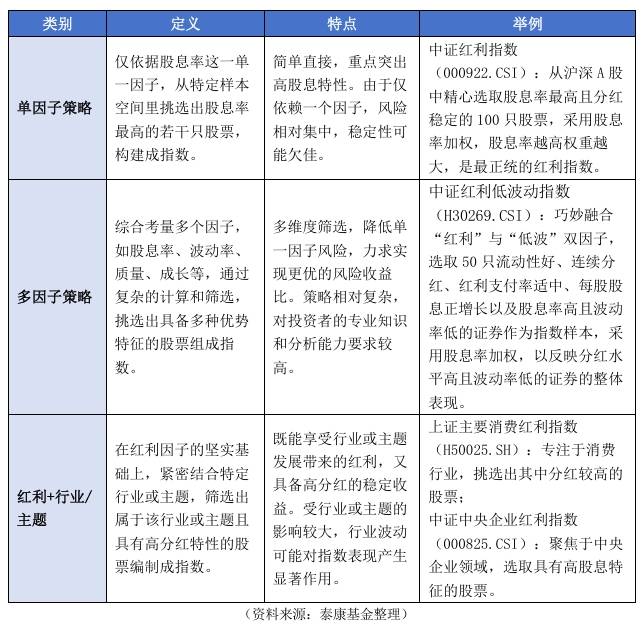
Group 1: Core Insights - The article highlights the increasing demand for stable returns in the context of low deposit rates, making high dividend yield indices, particularly the China Securities Dividend Low Volatility Index, a focal point for investors [1][11] - As of July 10, 2025, the China Securities Dividend Low Volatility Index reached a new high of 11,946.95 points, indicating strong performance in the current year [1] Group 2: Types of Dividend Indices - Dividend indices can be categorized into three main types: single-factor strategies, multi-factor strategies, and dividend + industry/theme strategies [2] - The single-factor strategy focuses solely on dividend yield, while the multi-factor strategy considers multiple factors such as dividend yield, volatility, quality, and growth [2] - The dividend + industry/theme strategy combines high dividend characteristics with specific industry or thematic focuses [2] Group 3: Advantages of the Dividend Low Volatility Index - The China Securities Dividend Low Volatility Index demonstrates strong risk resilience, with a maximum drawdown of -16.92% over the past five years, significantly lower than traditional dividend indices [3][4] - The index has a Sharpe ratio of 0.77 over the same period, indicating a superior risk-adjusted return compared to traditional dividend indices [5][6] - Since its inception, the index has achieved a cumulative return of 327.86%, outperforming traditional dividend indices and major broad market indices [6] - As of July 10, 2025, the index's 12-month dividend yield stands at 5.00%, well above the 10-year government bond yield of 1.66%, showcasing its attractive dividend characteristics [10] Group 4: Current Market Context - The current low deposit rate environment makes the high dividend yield of the Dividend Low Volatility Index particularly appealing to investors seeking asset appreciation [11] - Recent capital market reforms are expected to enhance dividend payouts from listed companies, further increasing the attractiveness of the Dividend Low Volatility Index [12] - Long-term capital, such as insurance funds, is increasingly favoring high dividend assets, creating a favorable environment for the Dividend Low Volatility Index [13] Group 5: Investment Opportunities - The Dividend Low Volatility ETF, such as the Taikang Dividend Low Volatility ETF (code: 560150), offers investors a convenient way to access high-quality dividend low volatility assets, with quarterly dividends enhancing cash returns [14]
A股红利低波资产受追捧
Huan Qiu Wang· 2025-07-17 02:30
Group 1 - The popularity of the dividend low-volatility strategy in the A-share market is increasing, with rapid growth in related ETF sizes and accelerated layout by public fund institutions [1][3] - The strategy is gaining traction due to the improvement of the A-share dividend mechanism, the influx of medium to long-term funds, and the decline in risk-free interest rates, making it a core equity tool for investors seeking stable long-term returns [1][3] - Several dividend low-volatility ETFs have been successfully issued since 2025, with the Huatai-PB CSI Dividend Low Volatility ETF leading the market with a scale of 21.235 billion yuan, an increase of 7.485 billion yuan since the beginning of the year [1] Group 2 - Major public fund companies such as E Fund, Huabao, and Ping An have recently applied for new dividend low-volatility ETF products, indicating the long-term value of these assets [3] - The strategy is viewed as a dividend enhancement strategy combined with low volatility factors, expected to provide stable performance across market cycles [3] - The weight of central state-owned enterprises in the dividend low-volatility index components exceeds 70%, enhancing the attractiveness of this strategy amid ongoing reforms [3]

四大证券报精华摘要:7月17日
Xin Hua Cai Jing· 2025-07-17 00:25
Group 1 - International investment institutions show renewed interest in Chinese assets, driven by stable economic growth and improving corporate earnings outlook [1][6] - A survey covering 83 sovereign wealth funds and 58 central banks managing approximately $27 trillion in assets indicates a positive sentiment towards A-shares [1] - Policies enhancing foreign participation in China's capital markets are anticipated [1] Group 2 - High-performing funds in the first half of the year focus on sectors like innovative pharmaceuticals, new consumption, and artificial intelligence [2] - The emergence of niche products such as short drama-themed funds and controllable nuclear fusion funds reflects a trend towards specialized investment strategies [2] Group 3 - The AI computing sector has seen significant growth, with several actively managed funds achieving net value increases exceeding 8% [3] - Major clients' demand in the AI industry is expected to continue expanding, benefiting Chinese firms [3] Group 4 - Energy companies are under pressure to ensure power supply during the summer peak, with national electricity demand projected to increase by approximately 100 million kilowatts year-on-year [4] - Companies are enhancing coal and natural gas production stability while maximizing renewable energy output to support electricity supply [4] Group 5 - Active equity funds are experiencing a trust reconstruction, with over 200 funds achieving returns exceeding 30% this year [5] - The issuance of new funds has surged, with 14 funds surpassing 1 billion yuan in size, more than double last year's figures [5] Group 6 - International investment banks have raised their economic growth forecasts for China, citing resilient exports and policy support as key factors [6] - The Chinese stock market is increasingly viewed as a promising investment target by foreign institutions [6] Group 7 - The number of A-share investors has surpassed 240 million, with over 12.74 million new investors added in 2024 alone [9] - The growth in investor numbers is attributed to both brokerage initiatives and favorable market conditions [9] Group 8 - The popularity of low-volatility dividend strategies is rising, with related ETFs seeing rapid growth [10] - The combination of high dividends and low volatility is making these assets attractive for long-term investment [10] Group 9 - Chinese securities firms are actively entering the virtual asset trading service market as Hong Kong accelerates its development as an international virtual asset center [11] - This move aims to diversify business operations and enhance international collaboration [11] Group 10 - The thermal power sector is experiencing a positive performance, with 8 out of 12 listed companies in the sector expecting profit growth due to lower coal prices [12] - The improved profitability of these companies is linked to favorable market conditions for thermal power generation [12]
红利低波策略升温 有望成为“长钱长投”重要方向
news flash· 2025-07-16 16:15
Core Viewpoint - The popularity of low-volatility dividend strategies is increasing, leading to rapid growth in related ETF sizes, as public institutions accelerate the layout of these products [1] Group 1: Market Trends - The continuous improvement of the dividend mechanism in the A-share market is enhancing the attractiveness of low-volatility dividend assets [1] - The influx of medium to long-term capital into the market is contributing to the rising interest in these investment strategies [1] - The decline in risk-free interest rates is further supporting the appeal of low-volatility dividend strategies [1] Group 2: Investment Implications - Low-volatility dividend assets are expected to become one of the core equity tools for long-term allocation by investors [1]
红利低波家族首只200亿ETF诞生【国信金工】
量化藏经阁· 2025-07-13 14:29
Market Review - The A-share market saw all major broad indices rise last week, with the CSI 1000 and ChiNext Index both gaining 2.36%, and the CSI 500 Index increasing by 1.96% [6][13]. - The financial, real estate, and non-bank financial sectors led in performance, with returns of 6.73%, 6.06%, and 3.94% respectively, while the automotive, home appliance, and banking sectors lagged with returns of -0.56%, -0.18%, and -0.13% [19][21]. - The People's Bank of China (PBOC) conducted a net withdrawal of 226.5 billion yuan through reverse repos, with a total of 652.2 billion yuan maturing [22]. Fund Performance - Last week, the active equity, flexible allocation, and balanced mixed funds achieved returns of 0.79%, 0.63%, and 0.53% respectively [34]. - Year-to-date, alternative funds have performed the best with a median return of 11.94%, while active equity, flexible allocation, and balanced mixed funds have median returns of 6.79%, 4.20%, and 2.25% respectively [36][41]. Fund Issuance - A total of 35 new funds were established last week, with a total issuance scale of 32.778 billion yuan, which is an increase from the previous week [3][46]. - The majority of new funds were passive index funds, with 12 being launched, and passive index bond funds totaling 10, with issuance scales of 3.031 billion yuan and 28.988 billion yuan respectively [48]. Gold Reserves - As of June 2025, China's official gold reserves stood at 73.9 million ounces, an increase of 70,000 ounces from the end of May, marking the eighth consecutive month of gold reserve accumulation by the central bank [9]. ETF Developments - The Huatai-PineBridge Dividend Low Volatility ETF became the first in the A-share market to exceed 20 billion yuan in size, reaching 20.788 billion yuan as of July 11, 2025 [12]. - Seven fund companies submitted applications for ETFs related to the ChiNext Composite Index following the announcement of revisions to the index compilation scheme by the Shenzhen Stock Exchange [5]. Bond Market - The central bank's reverse repo operations resulted in a net withdrawal of 226.5 billion yuan, with the 1-month pledged repo rate decreasing by 6.10 basis points [22][23]. - The yield spread for different maturities of government bonds has narrowed by 1.20 basis points, indicating a rise in yields across various credit ratings [24]. Quantitative Fund Performance - The median excess return for index-enhanced funds was 0.21% last week, while quantitative hedge funds reported a median return of -0.29% [37]. - Year-to-date, index-enhanced funds have a median excess return of 3.08%, while quantitative hedge funds have a median return of 0.62% [38]. FOF Fund Overview - As of last week, there were 245 ordinary FOF funds, 119 target date funds, and 154 target risk funds in the open-end public fund category [39]. - The median returns for ordinary FOF, target date, and target risk funds last week were 0.13%, 0.26%, and 0.10% respectively, with target date funds showing the best year-to-date performance at 4.13% [41].

基金周报:三只两百亿元红利低波ETF诞生,7只创业板综指相关ETF申报-20250713
Guoxin Securities· 2025-07-13 13:51
- The report does not contain any specific quantitative models or factors for analysis [1][2][3][4]
格雷厄姆真传:施洛斯的防御致胜哲学
雪球· 2025-07-12 07:46
Core Viewpoint - The article discusses the investment philosophy of Walter Schloss and his son Edwin Schloss, emphasizing their "cigar butt" strategy, which focuses on buying undervalued stocks with a strong margin of safety and minimal debt [2][3][9]. Investment Performance - Walter Schloss established his limited partnership in 1955, achieving a remarkable annual compound return of 15.3% from 1956 to 2000, compared to the S&P 500's 11.5% during the same period [3]. - An investment of $1 in Schloss's partnership in 1956 would have grown to $662 by 2000, while the same amount in the S&P 500 would have only reached $118 [3]. Investment Philosophy - The Schlosses are minimalists, focusing solely on financial statements and avoiding external influences, which allows them to concentrate on buying cheap stocks [4]. - Their investment strategy is characterized by a strong emphasis on safety margins, only purchasing stocks priced significantly below their net current asset value (NCAV) or tangible asset value [9]. - They adhere to a zero or low-debt principle, ensuring that companies have minimal long-term debt, which reduces the risk of bankruptcy due to debt defaults [10]. Market Neutrality - Schloss's approach does not rely on bull markets for returns; instead, it focuses on the intrinsic value of stocks, which can be realized through various catalysts such as fundamental improvements, asset sales, or mergers [12][15]. - The strategy aims to capture value recovery rather than relying on high growth or market bubbles [15]. Diversification - The Schlosses maintain a highly diversified portfolio, typically holding over 100 stocks, which mitigates individual stock risks and ensures that a few successful investments can offset losses from others [16][17]. - This diversification strategy allows them to avoid significant losses from any single investment, thereby enhancing overall portfolio stability [17]. Avoiding Valuation Bubbles - The core of their deep value strategy is to only buy extremely cheap stocks, avoiding investments during market bubbles, which protects against substantial downturns [19][20]. - By steering clear of high-growth stocks that are often overvalued, the Schloss strategy minimizes risk during market corrections [20]. Summary of Success Factors - The Schloss strategy emphasizes strong downside protection, capturing value recovery, and maintaining a diversified portfolio, which collectively contribute to consistent positive returns over time [21][22][23]. - The approach is particularly suitable for investors with moderate risk tolerance who seek stable returns and wish to avoid significant drawdowns, focusing on long-term growth through compounding [23].

两大稀土巨头,宣布涨价!事关提振消费!北京发力;七家上市公司,投了这家机器人公司
新华网财经· 2025-07-11 00:29
Group 1: Industry Developments - Baotou Steel and Northern Rare Earth both announced further increases in the transaction prices for rare earth concentrates [1][7] - The Ministry of Natural Resources reported that 38 new mineral sites were discovered in the first half of the year, a 31% increase year-on-year, with exploration investment in non-oil and gas minerals reaching 6.693 billion yuan, up 23.9% [3] - The China Automotive Industry Association reported that the automotive industry saw double-digit growth in multiple economic indicators in the first half of the year, with new energy vehicle sales reaching 6.968 million units, a year-on-year increase of 41.4% [6][8] Group 2: Company News - Kepler recently completed its A+ round of financing, with investors including Furan De and Taotao Automotive, marking the third financing update in six months [1][9] - Guotai Junan International expects its net profit for the first half of the year to be between 515 million and 595 million Hong Kong dollars, representing a year-on-year growth of 161% to 202% [11] - Ideal Auto announced that its six-seat pure electric SUV, the Ideal i8, will be officially launched on July 29 [12]

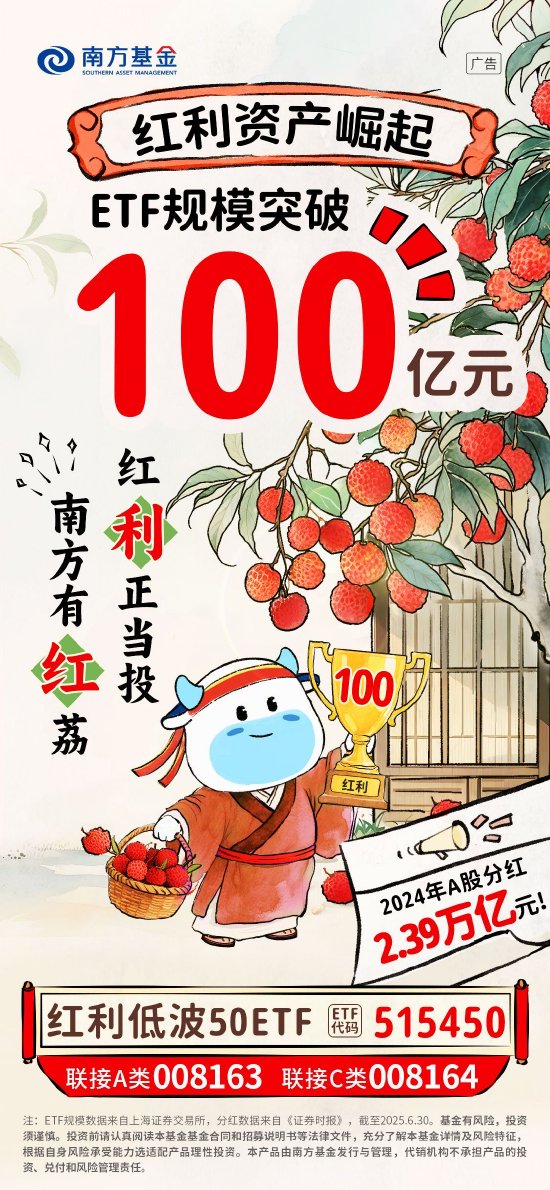
南方基金旗下红利低波50ETF(515450)突破100亿元
Xin Lang Ji Jin· 2025-07-01 02:13
Group 1 - The A-share market has been experiencing continuous fluctuations this year, with the Southern Dividend Low Volatility 50 ETF (515450) gaining popularity due to its steady performance in a volatile environment, surpassing a scale of 10 billion yuan as of June 30 [1][3] - The Southern Dividend Low Volatility 50 ETF closely tracks the S&P China A-Share Large Cap Dividend Low Volatility 50 Index, which selects 50 high dividend yield and low volatility large-cap stocks from the A-share market, constructed using a dividend yield weighting method [3] - As of June 27, 2025, the index's dividend yield reached 5.45%, significantly outperforming the yield of 10-year government bonds, highlighting its high allocation value in a low-interest-rate environment [3] Group 2 - The index is designed to prioritize low-volatility stocks among high-dividend stocks, providing strong downside protection during market fluctuations and effectively reducing market risk for investors [3] - The index is diversified across multiple sectors, including banking, utilities, and transportation, which mitigates single-industry risk and enhances overall stability [3] - Recent policies, such as the new "National Nine Articles," have strengthened dividend regulation for listed companies, increasing the attractiveness of dividend assets [3] Group 3 - The Southern Fund Index team has a diverse background in mathematics, computer science, and financial engineering, possessing extensive experience in index product development, quantitative research, and fund management, leading the industry in tracking error control [4] - As of March 31, 2025, the Southern Fund's stock ETFs have ranked first in tracking accuracy among peers over the past decade [4]