
经济放缓

Search documents
中漆集团发盈警 预期上半年股东应占亏损约2800万-3200万港元
Zhi Tong Cai Jing· 2025-08-06 08:52
Core Viewpoint - The company anticipates a significant increase in shareholder losses for the first half of 2025, estimated between 28 million to 32 million HKD, compared to a loss of 15 million HKD in the same period of 2024 [1] Group 1: Financial Performance - The estimated shareholder loss for the first half of 2025 is significantly higher than the previous year, indicating a worsening financial situation [1] - The decline in sales revenue from paint and coating products is a major contributor to the increased losses [1] - The company reported a fair value loss on investment properties in mainland China during the first half of 2025, contrasting with a fair value gain of 3.2 million HKD in the same period of 2024 [1] Group 2: Market Conditions - The decrease in sales revenue is attributed to the economic slowdown in mainland China and Hong Kong, a weak real estate market, and intense competition within the paint and coating industry [1] - The overall market environment is challenging, impacting the company's revenue and profitability [1]
美国就业崩了吗?7月非农数据解读
2025-08-05 03:15
Summary of Key Points from the Conference Call Industry Overview - The conference call primarily discusses the **U.S. labor market** and its implications for the economy and monetary policy, particularly in light of the **July non-farm payroll data** [1][2]. Core Insights and Arguments - **July Non-Farm Payroll Data**: The July non-farm payroll data showed an increase of only **73,000 jobs**, significantly below the expected **104,000 jobs**. Additionally, the job numbers for May and June were revised down by approximately **100,000 jobs** [2]. - **Unemployment Rate**: The unemployment rate rose to **4.2%**, which was in line with expectations. However, the average monthly job growth over the past three months was only **35,000 jobs**, a stark decline from the pre-pandemic average of **100,000 jobs** per month [2][5]. - **Sector Performance**: Job growth was concentrated in the **education and healthcare sectors**, which added **79,000 jobs** in July. In contrast, sectors like manufacturing and wholesale trade, which are sensitive to tariffs and interest rates, showed weakness [2][5]. - **Labor Market Dynamics**: The decline in labor participation rates has contributed to a downward pressure on the unemployment rate. Factors such as early retirements and reduced immigration due to strict policies have led to a rigid labor supply [4][9]. - **Economic Resilience Concerns**: Despite positive GDP data, the disruptions in imports and inventory, along with weak non-farm data, have raised concerns about economic resilience and increased expectations for interest rate cuts by the Federal Reserve [1][5]. Monetary Policy Implications - **Interest Rate Expectations**: The market widely anticipates that the Federal Reserve will cut interest rates by **25 basis points** in September. However, the lack of clear signals from the Fed regarding easing has led to fluctuations in these expectations [6][7]. - **Future Monetary Policy Adjustments**: If inflation data does not exceed expectations in the coming months, the Fed may be prompted to lower rates, especially as signs of weakness appear in residential investment, manufacturing, and auto consumption [5][6]. Political Environment Impact - **Political Influence on Economic Policy**: The current political climate, particularly actions by former President Trump against Federal Reserve officials, has increased uncertainty in economic policy and market conditions. This interference may lead to heightened asset volatility and a shift in market risk appetite [8][9]. Additional Important Points - **Labor Market Challenges**: The prolonged unemployment duration and the rise in long-term unemployed individuals indicate adverse effects on the job market due to demand contraction [1][2]. - **Market Reactions**: The adjustments in employment data and the political environment are likely to influence market behavior and investor sentiment moving forward [9].
Why Shopify Stock Is Rising Today
The Motley Fool· 2025-08-04 16:07
Core Insights - Shopify's stock rebounded by over 5% following positive news regarding the European Union delaying retaliatory tariffs against the U.S. for six months, which helped restore investor optimism despite previous negative economic data [1][4][5] Group 1: Economic Context - Investors are closely monitoring economic indicators ahead of Shopify's Q2 earnings report, with the stock showing a gain of 4.8% as of 11:29 a.m. ET [2] - A weak jobs report for June and revised numbers for May had previously spooked investors, leading to a sell-off in stocks [5] - The U.S. economy's growth is crucial for Shopify, as its performance is tied to the growth of U.S. companies and the creation of new businesses [6] Group 2: Earnings Outlook - Profit growth for Shopify has been slowing, and the upcoming Q2 report will provide insights into the company's current trajectory [4][7] - The next few quarters are critical for Shopify investors, as uncertainties surrounding hiring and tariffs may take time to resolve [7]



港股&海外周观察:策略点评:全球为何普跌?
Soochow Securities· 2025-08-04 12:48
Market Performance - Developed and emerging markets both declined by 2.5% during the week of July 28 to August 1, 2025[1] - The Hang Seng Index fell by 3.5%, while the Hang Seng Tech Index dropped by 4.9%[1] - The S&P 500 decreased by 2.4%, and the Dow Jones Industrial Average led the decline with a 2.9% drop[4] Economic Indicators - U.S. non-farm payrolls added only 73,000 jobs in July, significantly below the expected 104,000 and previous month's 147,000[4] - The U.S. manufacturing PMI fell to 48 in July, below the expected 49.5, indicating a contraction in the manufacturing sector[4] - The U.S. Q2 GDP growth rate was 3.0%, surpassing expectations of 2.4%[4] Market Sentiment and Trends - There is a consensus to focus on dividend-paying stocks and identify sectors with growth potential, particularly in healthcare[1] - Concerns remain regarding internet technology stocks due to consumer spending factors, although some funds are increasing their allocations[1] - The market is experiencing increased volatility due to rising overseas risks and expectations of interest rate cuts in the U.S.[1] Tariff Impacts - The U.S. is set to implement reciprocal tariffs starting August 7, affecting various countries with rates as high as 39% for some[5] - The market's sensitivity to tariff issues appears to be diminishing, but ongoing monitoring is necessary[1] Fund Flows - Global equity ETFs saw a net inflow of $29.579 billion, with the U.S. leading at $19.55 billion[11] - Chinese equity ETFs experienced the largest outflow, totaling $5 billion[11] - Institutional investors are slightly reducing gold holdings, while retail investors are marginally increasing their positions[10]
大摩警告:关税风暴未结束,8月1日警惕变盘
Jin Shi Shu Ju· 2025-07-28 05:41
Group 1 - The evolving tariff situation continues to create both pressure and opportunities for the market [2][5] - The most likely economic scenario is slow growth with persistent inflation, with a 40% probability assigned to this outcome [2] - The potential for a mild recession increases if tariffs are raised on key trading partners, as they account for nearly half of U.S. goods imports [5] Group 2 - Fixed income markets are expected to see rising U.S. Treasury prices due to anticipated dovish shifts from the Federal Reserve [3] - The stock market may experience a differentiated impact, with the S&P 500 likely to continue its upward trend despite growth slowdowns, driven by a weaker dollar and tax incentives for key sectors [3] - Industries sensitive to trade policies will face varying impacts, with industrial goods benefiting from domestic investment while consumer goods and retail sectors may struggle due to rising import costs [3][5]
特朗普关税威胁下欧央行按兵不动,PMI与Ifo指数将揭晓或定调后续政策
智通财经网· 2025-07-21 06:40
Group 1 - Investors are closely monitoring economic reports this week as they prepare for the European Central Bank's (ECB) interest rate decision meeting on Thursday, which will be crucial for assessing the direction of monetary policy amid trade uncertainties and geopolitical tensions [1] - The data released this week is unlikely to alter the ECB's decision to pause interest rate cuts for the first time in a year, but it will provide clues on whether further cuts are needed, either in September or later [1] - Goldman Sachs' chief economist for Europe, Jari Stein, noted that while the data itself may not decide on rate cuts, signs of economic slowdown would strengthen the case for further easing [4] Group 2 - The quarterly bank lending survey released on Tuesday is particularly significant as it reflects the impact of interest rate adjustments following Trump's tax policy announcement in April [4] - HSBC economist Fabio Balboni believes the survey will reveal how tariffs and geopolitical uncertainties affect policy transmission, with improvements in credit conditions under external pressures reinforcing the notion of "credit easing" [6] - Bloomberg's economic forecast suggests that the ECB is in a wait-and-see mode, with potential rate cuts expected in September and December, while the policy statement after the July 24 meeting is likely to remain consistent with June's, allowing for rate cuts without making commitments [6] Group 3 - There are differing views among ECB council members regarding the economic outlook, with some warning of growth obstacles and low inflation, while others emphasize the resilience of businesses and households [6] - The first quarter's economic performance exceeded expectations, but the ECB's vice president predicts stagnation in growth for the second and third quarters [6] - The key issue is whether public spending in Germany and other parts of Europe can offset the impacts of tariff uncertainties and euro appreciation on competitiveness [9]
押注经济放缓,对冲基金大举做空美股小盘股
Hua Er Jie Jian Wen· 2025-07-17 11:29
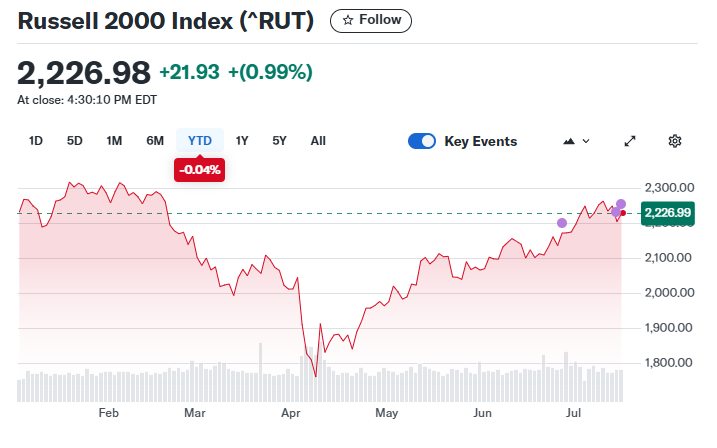
Group 1 - Hedge funds are increasing short positions on small-cap stocks, with short positions on the Russell 2000 index reaching $16 billion in July, the highest level since 2021 [1] - There is a growing gap between short positions on small-cap stocks and bullish futures on the Nasdaq 100 index, indicating market concerns about the U.S. economic outlook [1][2] - Small-cap companies are more sensitive to economic fluctuations due to weaker balance sheets and lower borrowing capacity compared to S&P 500 companies [1] Group 2 - The Russell 2000 index has risen 26% since its low in April, but some investors warn that this surge may signal overheating risk sentiment [2] - Concerns about economic growth and expectations for prolonged high interest rates are particularly detrimental to small-cap companies, which rely more on external capital [2][4] - If economic growth remains robust or moderate inflation supports the Federal Reserve in lowering interest rates, shorting small-cap stocks may face challenges [4] Group 3 - There is caution regarding excessive shorting of small-cap stocks due to the potential for a short squeeze, where price reversals force short sellers to buy back shares [5] - Despite the resilience of the economy and the potential for higher long-term yields, maintaining an optimistic outlook on small-cap stocks is challenging [5]
美联储罕见持续呛声,大A又要受牵连了!
Sou Hu Cai Jing· 2025-07-17 07:20
Group 1 - The core message from the Federal Reserve's John Williams indicates that the impact of tariffs on the economy will soon become apparent, leading to a slowdown in economic growth and a cautious stance on monetary policy [3][12] - The market's reaction to macroeconomic changes, such as tariffs and economic slowdown, will ultimately be reflected in trading behaviors within capital markets [3][12] Group 2 - Ordinary investors often focus on surface-level news and fail to recognize the true actions of market participants, which can lead to anxiety over trading decisions [5][10] - Two case studies illustrate the difference in trading behaviors: "Shenzhou Cell" showed clear institutional involvement in short covering, while "Hua Dong Pharmaceutical" appeared to be driven by short-term funds [6][9] Group 3 - Quantitative data can reveal market patterns, with specific indicators showing the level of institutional activity in trading behaviors [11][12] - Understanding how funds will respond to macroeconomic factors is crucial for determining investment returns, rather than solely focusing on the economic indicators themselves [12][14] Group 4 - Recommendations for investors include avoiding being swayed by surface news, distinguishing between market noise and real signals, and valuing quantitative data in trading behavior analysis [16]

诺伟:下半年市场将面临双重压力 需重新审视资产配置策略
Zhi Tong Cai Jing· 2025-07-10 11:12
Core Viewpoint - Nuveen anticipates that the second half of 2025 will face dual pressures of economic slowdown and policy uncertainty, prompting investors to reassess asset allocation strategies focusing on robust fundamentals, defensive characteristics, and spread advantages to enhance return potential and mitigate risks [1][2] Global Economic Outlook - The global investment committee of Nuveen expects potential interest rate cuts by the Federal Reserve in September and December, but inflation driven by tariffs may lead to a pause in easing [1] - The European Central Bank is expected to pause after previous rate cuts, while the Bank of Japan is likely to raise rates once [1] Asset Allocation Strategy - Nuveen recommends focusing on assets driven by spreads and reducing reliance on risk-free rates, with municipal bonds attracting long-term investors due to a steep yield curve [1] - The real estate market is gradually recovering after two years of stagnation, with strong demand observed in medical office spaces, grocery retail properties, and affordable housing [1] Stock Market Insights - Large U.S. tech companies are benefiting from the expansion of AI, increased demand for data centers, and power generation, leading to an upgrade in market positioning [1] - Defensive sectors such as finance and infrastructure are highlighted, while European equities present long-term value; emerging markets are becoming less attractive due to trade policy impacts [1] Investment Strategies - Nuveen advises investors to adopt a broadly diversified and actively managed strategy to navigate policy changes and economic slowdowns [2] - Preferred loans and securities are favored for their attractive valuations and solid credit quality, while investment-grade corporate bonds are viewed less favorably due to narrowing spreads [2] Real Estate Sector Focus - Nuveen continues to explore opportunities arising from demographic and educational diversity, with a positive outlook on medical, industrial, and residential sectors [2] - The office market faces challenges, with vacancy rates expected to improve but recovery still requiring time; real estate bonds currently offer valuation advantages over real estate stocks [2] Infrastructure Investment Preferences - Nuveen prefers public-private projects, particularly in electricity, utilities, and energy storage investments [2] - Agricultural land assets are seen as an inflation hedge, although returns are expected to slow in 2025, especially for grain crops affected by tariff pressures [2]
路透调查:经济放缓与通胀降温共振 澳联储周二料启动年内第三次降息
智通财经网· 2025-07-04 02:56
Group 1 - The Reserve Bank of Australia (RBA) is expected to implement an unexpected easing policy, with a forecast of a third 25 basis points rate cut due to easing inflation pressures and slowing economic growth [1][2] - A survey of 37 economists indicates that 31 expect the RBA to lower the official cash rate to 3.60% during the upcoming meeting, while only 6 predict it will remain unchanged [1] - The Australian economy is projected to grow by 1.6% this year and 2.3% in 2026, which is a downward revision from previous estimates [2] Group 2 - Over 60% of economists surveyed anticipate another 25 basis points cut this quarter, bringing the cash rate down to 3.35% [1] - Inflation has decreased from 2.5% at the beginning of the year to 2.1% in May, with expectations for an average of 2.6% in 2025 and 2.7% in 2026, remaining within the RBA's target range [2] - The Australian dollar has appreciated over 6% this year, driven by a general weakening of the US dollar, with expectations for a further 2% increase in the next six months [2]