
美债

Search documents
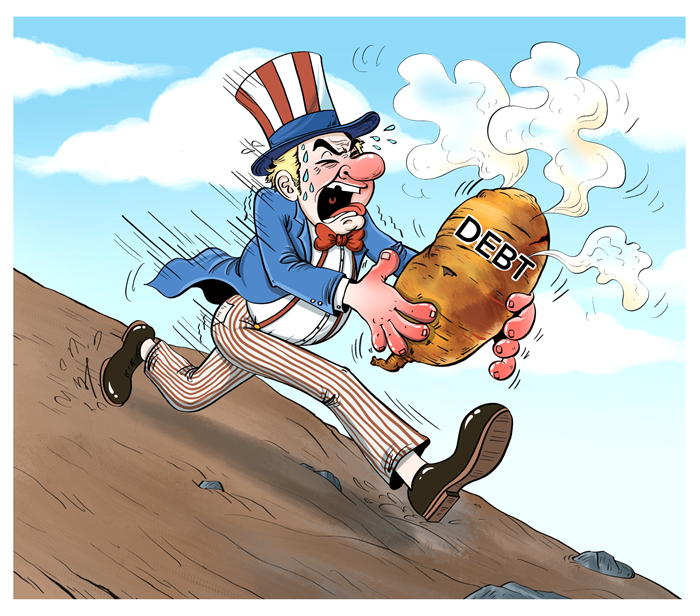
漫评美债突破37万亿美元:“烫手山芋”
人民网-国际频道 原创稿· 2025-08-21 03:01
Core Insights - As of August 11, the total federal government debt in the United States has exceeded $37 trillion [2] - The federal debt reached the statutory limit of $31.4 trillion in January 2023, indicating a significant increase in borrowing [2] - The U.S. government debt is projected to surpass $35 trillion by July 2024 and $36 trillion by November 2024 [2] - The escalating national debt is becoming a "hot potato," posing risks to long-term economic growth in the U.S. and potentially dragging down global economic development [2]

美元债双周报(25年第33周):通胀数据分化但降息预期稳固,市场短期聚焦杰克逊霍尔-20250818
Guoxin Securities· 2025-08-18 08:17
Report Industry Investment Rating - The investment rating for the industry is "Underperform" [1] Core Viewpoints - US inflation data is divided, with July CPI lower than expected but PPI far exceeding expectations. However, most institutions maintain the prediction of a 25 - basis - point interest rate cut in September, and the market fully prices in two interest rate cuts within the year [2] - The Jackson Hole Global Central Bank Annual Conference is expected to focus on the policy framework rather than interest rate cut guidance. Powell may use the framework adjustment to re - emphasize the central bank's independence, and there is a potential "expectation gap" risk [3] - US Treasury yields have risen, and the yield curve has become steeper. It is recommended to maintain medium - and short - duration US Treasuries as the core allocation and moderately increase high - grade Chinese - funded US dollar bonds, while being cautious about long - end fluctuations [3][4] Summary by Directory 1. US Treasury Benchmark Interest Rates - The figures related to 2 - year and 10 - year US Treasury yields, the yield curve, bid - to - cover ratios of various maturities, issuance winning bid rates of 2 - 30 - year US Treasuries, monthly issuance volume of US Treasuries, and the implied number of interest rate cuts in the federal funds rate futures market are presented [14][22][24] 2. US Macroeconomic and Liquidity - Data on US inflation year - on - year trends, the federal government's annual cumulative fiscal deficit, economic surprise index, ISM PMI, consumer confidence index, financial conditions index, housing rent growth rate, number of unemployment benefit claims, hourly wage year - on - year growth rate, non - farm payroll data, real estate new housing approval, start, and sales volume year - on - year growth rates, personal consumption expenditure year - on - year growth rate, breakeven inflation expectations, and non - farm industry contributions are shown [28][30][42] 3. Exchange Rates - Information about the one - year trend of non - US currencies, changes in non - US currencies in the past two weeks, Sino - US sovereign bond spreads, the relationship between the US dollar index and the 10 - year US Treasury yield, the relationship between the US dollar index and the RMB index, and the change in the one - year US dollar - RMB forward exchange hedging cost is provided [56][58][60] 4. Overseas US Dollar Bonds - The price trends of US dollar bonds in the US, the combined US - European US dollar bonds, global investment - grade US dollar bonds, and global high - yield US dollar bonds and Chinese domestic bonds are presented, along with the two - week return comparison of the global bond market, the US Treasury volatility MOVE index and the VIX fear index, and the price increases and decreases of US Treasury ETFs of different maturities [63][68][72] 5. Chinese - Funded US Dollar Bonds - The return trends of Chinese - funded US dollar bonds since 2023 (by grade and industry), the yield and spread trends of investment - grade and high - yield Chinese - funded US dollar bonds, the two - week returns (by grade and industry), the net financing amount trend, and the maturity scale of each sector are shown [81][84][89] 6. Rating Actions - In the past two weeks, the three major international rating agencies took 8 rating actions on Chinese - funded US dollar bond issuers, including 5 rating upgrades, 1 rating withdrawal, and 2 initial ratings [91]
最后24小时,美国终于签字!特朗普转身对中国提了个要求:若能答应,一切都好说?中方回应亮了
Sou Hu Cai Jing· 2025-08-16 18:38
Group 1 - The core point of the article revolves around the extension of the US-China tariff measures for 90 days, highlighting the underlying strategic negotiations between the two nations [1][3] - The US is pressuring China to increase soybean imports significantly, aiming to reduce the trade deficit, despite the impracticality of this approach given the scale of the deficit and China's current sourcing from Brazil [3][9] - China's position is clear: it seeks a balanced resolution to trade issues, emphasizing the need for the US to lift restrictions on key exports like advanced chips, rather than solely focusing on agricultural products [3][9] Group 2 - The article discusses the ongoing negotiations regarding rare earth exports from China and the US's restrictions on chip exports, indicating that both sides have specific demands that need to be addressed for progress [3][6] - The US's economic situation, including a national debt exceeding $37 trillion, adds pressure to avoid escalating tariffs, as this could lead to significant domestic financial instability [6][7] - Political pressures within the US are also influencing negotiations, with some factions criticizing the administration for perceived leniency towards China, complicating the negotiation dynamics [7][9] Group 3 - The article notes that China has established stable supply channels for soybeans, reducing its urgency to import from the US, while also accelerating its own chip development to lessen reliance on foreign technology [9] - The future of US-China trade relations hinges on both parties demonstrating genuine willingness to negotiate in good faith, with mutual respect being essential for a successful resolution [9]

海外高频 | 特朗普提名米兰为美联储理事(申万宏观·赵伟团队)
赵伟宏观探索· 2025-08-11 16:03
Group 1: Market Performance - Developed markets experienced a rebound, with major indices such as the Nasdaq rising by 3.9% and the S&P 500 by 2.4% [2][3] - Emerging markets also saw gains, with the Ho Chi Minh Index up 6.0% and the Cairo CASE 30 up 4.7%, while the Indian SENSEX fell by 0.9% [3][11] - The Hang Seng Index and related indices all rose, with the Hang Seng Index increasing by 1.4% and the Hang Seng Tech Index by 1.2% [11] Group 2: Commodity Prices - WTI crude oil prices fell by 7.8% to $63.9 per barrel, while Brent crude dropped by 8.4% to $66.4 per barrel [26][27] - Coking coal prices surged by 12.3% to 1,227 yuan per ton, indicating strong demand [26][30] - Precious metals saw an increase, with COMEX gold rising by 1.3% to $3,403.5 per ounce and silver up by 4.4% to $38.4 per ounce [30][31] Group 3: Economic Indicators - The ISM Services PMI for July in the U.S. was reported at 50.1, below the market expectation of 51.5, indicating a slowdown in the services sector [40] - The upcoming U.S. CPI data for July is anticipated to show a core CPI month-over-month increase of 0.3%, aligning with market expectations [43][44] - Germany's industrial production for June fell by 1.9%, significantly below the expected decline of 0.5%, suggesting ongoing economic weakness [46] Group 4: Trade and Tariffs - The U.S. announced a 100% tariff on all imported semiconductor chips, with exemptions for companies that establish or commit to establishing manufacturing in the U.S. [32] - Additionally, a 25% tariff on Indian goods was implemented, totaling 50%, effective from August 28 [32] Group 5: Bond Market - The U.S. Treasury auction for 10-year bonds saw weaker demand, with a high yield of 4.26% and a tail of 1.13 basis points, indicating reduced interest from investors [34] - The 10-year U.S. Treasury yield rose by 4.0 basis points to 4.3%, while yields on other developed market bonds generally declined [16][19] Group 6: Federal Reserve Developments - President Trump nominated Miran to fill the vacancy left by the resignation of Fed Governor Kugler, which may influence future monetary policy [36] - Market reactions to the nomination included a decline in short-term U.S. Treasury yields, reflecting expectations of a more dovish stance [36]

美国炒作“清债”为哪般?想赖美债又转移视线,中国立场坚定不变
Sou Hu Cai Jing· 2025-08-01 06:17
Core Viewpoint - The recent discourse around "Qing Dynasty bonds" by some U.S. media and politicians, claiming that China owes $1.6 trillion in "old debts," is fundamentally flawed and politically motivated, disregarding international law and historical context [1][5]. Group 1: Nature of the Bonds - The so-called "Qing Dynasty bonds" were issued during the late Qing Dynasty for purposes such as railway construction and war reparations, but due to regime changes and turmoil, they have become unclaimed historical artifacts [1]. - According to international law's "clean slate" principle, the new Chinese government established in 1949 is not obligated to inherit the foreign debts of the previous regime [3]. Group 2: Legal Validity - Many of these bonds have become collectibles over the past century, with original holder information obscured and many replicas in circulation, failing to meet basic legal evidence requirements [3]. - In the 1987 case "Jackson v. People's Republic of China," a U.S. federal court ruled that China is not liable for Qing Dynasty debts, establishing a legal precedent that remains valid [3]. Group 3: Political Motivations - The U.S. is currently facing high inflation, rising fiscal deficits, and a debt ceiling crisis, leading some politicians to use the "China owes debt" narrative to divert domestic attention and create a victim narrative [5]. - Politicians like Senator Blackburn and Congressman Vance are promoting "debt justice" proposals, which appear to be more about political maneuvering than factual accuracy [5]. Group 4: Implications for U.S. Creditworthiness - If the U.S. were to attempt to offset legitimate U.S. debt with these invalid old debts, it would undermine its own creditworthiness, potentially leading to a loss of global investor confidence and destabilizing the dollar's international standing [5]. - The Bank for International Settlements reports that over 60% of global central bank foreign exchange reserves are denominated in dollars, indicating that any breach of trust could have long-lasting repercussions [5]. Group 5: China's Position - China maintains a clear stance that it does not inherit Qing Dynasty debts, supported by international law and U.S. judicial precedents, and emphasizes that its holdings of U.S. debt are legitimate market transactions [7]. - The ongoing "old debt farce" reflects the political anxieties within the U.S. and highlights the shortsightedness of certain politicians, as true leadership involves adhering to contractual obligations and international rules [7].

刘煜辉:稳定币可能成为美元体系延续其货币主导地位的“自救型工具”
Xin Lang Zheng Quan· 2025-07-29 08:36
Group 1 - The core viewpoint is that the U.S. fiat currency system is facing structural risks, with stablecoins being positioned as a key mechanism to rebuild the credibility of the dollar system [1][2] - Long-term industrial hollowing has led to a high dependence of the U.S. economy on global capital inflows, while rising inflation and interest rates have increased fiscal burdens, creating significant debt rollover pressure [1] - A large proportion of current U.S. fiscal revenue is allocated to servicing national debt interest, indicating a declining ability for fiscal self-balancing and increased volatility in dollar and U.S. Treasury asset values [1] Group 2 - The stablecoin legislation is viewed as a systematic response to the challenges faced by the dollar system, with stablecoins essentially being "dollar cash" on the blockchain, backed by compliant assets, primarily U.S. Treasuries [1] - This design transforms the demand for stablecoins in the blockchain market into real purchasing power for U.S. Treasuries, thereby introducing new external support for the imbalanced dollar credit system [1] - Recent global financial market recognition of the institutional logic behind stablecoin legislation has led to a balance in the buying and selling forces in the U.S. Treasury market, with significant recovery in U.S. stock and crypto asset prices [2]

稳定币如何影响美债需求和全球货币格局?
China Post Securities· 2025-07-24 09:36
Group 1: Stablecoin Market Overview - As of July 2025, the total market capitalization of stablecoins reached $260 billion, with over 98% being dollar-pegged stablecoins like USDT and USDC[2][15] - Tether (USDT) and Circle (USDC) dominate the market, accounting for approximately 86% of the total stablecoin market[12][15] - The stablecoin market has shown strong growth, with a 22% increase in the first half of 2025 alone[15] Group 2: Impact on U.S. Treasury Bonds - Stablecoins have created new demand for U.S. Treasury securities, particularly short-term bonds, with Tether being the seventh-largest U.S. Treasury buyer globally, holding over $120 billion[3][21] - The "GENIUS Act" mandates that stablecoin issuers maintain a 1:1 reserve with high-quality liquid assets, primarily short-term U.S. Treasury securities[3][17] - The focus on short-term bonds may exacerbate the steepening of the U.S. Treasury yield curve, as stablecoins have minimal impact on long-term bonds[3][37] Group 3: Strengthening the Dollar's Position - Stablecoins have not undermined the dollar's global dominance; instead, they have enhanced its efficiency and usage, particularly in high-inflation countries[4][51] - The regulatory framework in the U.S. and Hong Kong supports the growth of stablecoins, with the latter allowing multi-currency pegging, potentially challenging the dollar's supremacy[5][62] - Stablecoins facilitate cross-border transactions, significantly reducing costs and increasing the speed of transfers compared to traditional banking methods[58] Group 4: Risks and Considerations - The reliance on stablecoins poses risks, including potential loss of control over the dollar's monetary policy and vulnerabilities highlighted by events like the Silicon Valley Bank incident[4][60] - The long-term credit risk of the U.S. dollar remains a concern, as increasing national debt could undermine confidence in stablecoins[5][60] - Regulatory changes and market volatility present ongoing risks to the stability and growth of the stablecoin market[68]
美元美债走势疲软,黄金亚盘持续走高!日内逼近3375前高,反弹是否见顶?立即观看超V推荐官Jason的分析,马上进入直播间>>>
news flash· 2025-07-21 11:56
Group 1 - The article highlights the weak performance of the US dollar and US Treasury bonds, indicating a potential shift in market dynamics [1] - Gold prices are rising in the Asian market, approaching the previous high of 3375, suggesting a bullish trend [1] - There is speculation about whether the current rebound in gold prices will reach a peak or continue to rise [1]
早餐 | 2025年7月21日
news flash· 2025-07-20 23:20
Group 1 - The S&P 500 index remained flat last Friday, with Federal Reserve Governor Waller's comments on interest rate cuts boosting U.S. Treasury bonds, while oil prices slightly declined and gold and industrial metals increased [1] - Japan's ruling Liberal Democratic Party faced historic losses in the Senate elections, but Prime Minister Kishida stated he would continue to govern [1] - After visiting Japan, Bessenet expressed optimism about a potential trade agreement between the U.S. and Japan following a meeting with Prime Minister Kishida [1] Group 2 - U.S. consumer confidence reached a five-month high, with significant declines in inflation expectations [1] - China's Vice Minister of Finance, Liao Min, reported that the balance of China's economy is good, with domestic consumption's share of GDP continuously rising; more proactive fiscal policies and high-level opening-up will be implemented in the second half of the year [1] - Reports indicate that NVIDIA's H20 inventory is limited, and there are no plans for production resumption; CEO Jensen Huang sold NVIDIA shares worth approximately $12.94 million [1] Group 3 - Bank of America’s Hartnett noted that all sell signals for U.S. stocks have been triggered, but the real selling catalyst may not be in the stock market but in the bond market [1] - A reminder was issued that China's July LPR will be announced today [1]
特朗普的AI和加密货币主管Sacks:GENIUS 法案将创造对美债的需求。
news flash· 2025-07-18 19:25
Core Insights - The GENIUS Act is expected to create significant demand for U.S. Treasury bonds, as stated by Trump's AI and cryptocurrency advisor, Sacks [1] Group 1 - The GENIUS Act aims to enhance the integration of artificial intelligence and cryptocurrency within the financial system, potentially leading to increased investment in U.S. Treasury securities [1] - Sacks emphasizes that the legislation will not only foster innovation but also stabilize the financial markets by driving demand for government bonds [1]