
美元稳定币

Search documents
TruStage 与 Block Time Financial 合作试点美元稳定币 TSDA
Xin Lang Cai Jing· 2026-02-24 20:22
Core Insights - Financial technology company TruStage is collaborating with Block Time Financial to pilot the TruStage Stablecoin (TSDA), which is backed by a 1:1 cash reserve and issued by TruStage affiliates [1] - TruStage's services cover approximately 93% of U.S. credit unions, and TSDA will be primarily used for loan disbursements and settlements, peer-to-peer transfers, cross-border payments, and inter-cooperative clearing and distribution [1] - The pilot program is set to launch in the first half of 2026 [1]
原中国银行副行长王永利荣膺“2025年度十大意见领袖”
Xin Lang Cai Jing· 2026-02-11 09:08
Core Insights - The "Top Ten Opinion Leaders of 2025" list has been announced, highlighting influential figures in the context of China's economic transformation and recovery [1][2][3] - The evaluation process for the opinion leaders considered five dimensions: professionalism, influence, innovation, foresight, and activity level, along with data on output rates and online presence [3] Group 1 - The economic outlook for China in 2025 is positive, with new growth drivers being cultivated and policy collaboration supporting economic recovery [1][2] - Opinion leaders are recognized for their ability to address public concerns, interpret development logic, and convey market confidence [1][2] Group 2 - Wang Yongli, former Vice President of the Bank of China, has been awarded as one of the "Top Ten Opinion Leaders of 2025" [2][4] - Wang Yongli's key viewpoints include the challenges of stablecoins, the importance of innovation in advancing the digital yuan, and analysis of changes in central bank foreign exchange reserves [4]

究竟用什么 迎接AI的“军备”之旅
Sou Hu Cai Jing· 2025-09-11 17:55
Group 1 - The core viewpoint emphasizes that the recent massive capital expenditure by OpenAI has ignited enthusiasm for AI-driven growth, significantly impacting companies like Oracle, which saw its remaining performance obligations (RPO) surge to $455 billion, leading to a 36% stock price increase [1] - The AI-driven growth is described as a "arms race," with various tech giants like Broadcom and Google positioned to benefit from this trend [1] - Tesla is highlighted as transforming from an electric vehicle company to an AI-driven innovation company, with significant developments in robotics and autonomous driving technology [1] Group 2 - The article discusses the perception of a bubble in the AI sector, suggesting that market enthusiasm, while potentially bubble-like, serves as a ticket to the unknown, allowing for trial and error among participants [2] - It is noted that the journey towards AI is not merely a continuation of existing economic structures but requires new designs and tools to meet emerging demands [3] - The need for a clear understanding of AI as a technological leap rather than a continuous function is emphasized, indicating that existing economic ecosystems must evolve based on fundamental principles [3] Group 3 - The article stresses the importance of creating an environment that fosters individual creativity and innovation, advocating for reduced market entry barriers and fair competition [4] - It highlights that AI competition transcends geographical boundaries, necessitating a reevaluation of regulatory frameworks to manage the complexities introduced by AI and Web 3.0 [4][5] - The core competitive focus in the AI arms race is on the clear definition and description of demand, which requires a supportive institutional framework for entrepreneurial freedom [5] Group 4 - The competition in the AI arms race is characterized as not just a battle for computational power and data but also a cognitive transformation that requires a respectful and responsive competitive order for entrepreneurs [6]
中国拟推人民币稳定币?挑战美元霸权时代,一些冒险值得我们尝试
Sou Hu Cai Jing· 2025-08-29 06:48
Group 1 - China is considering the launch of a Renminbi stablecoin, potentially approving it by the end of the month, indicating a faster pace than expected in its digital currency strategy [1] - Stablecoins are designed to provide price stability by being pegged to stable assets like the US dollar, making them suitable for everyday transactions and international payments [3] - The introduction of a Renminbi stablecoin would facilitate direct payments between Chinese enterprises and international clients, reducing reliance on the US dollar and associated costs [4] Group 2 - The competition for dominance in the digital currency space is intensifying, with the US promoting dollar stablecoins to maintain its global payment supremacy [6] - A Renminbi stablecoin could enhance China's presence in the international financial system, providing a strategic advantage amid increasing geopolitical tensions and sanctions [8] - Effective regulation and oversight will be crucial for the success of the Renminbi stablecoin, as it poses potential risks such as capital flight and financial instability if not managed properly [6][8]

夏春:哈佛教授——美国即将到来的崩溃
Sou Hu Cai Jing· 2025-08-27 03:33
Group 1 - The article discusses the potential for a significant debt crisis in the United States, highlighting the unsustainable nature of current debt levels and the implications for the economy and global financial stability [10][32][33] - It notes that U.S. public debt is approaching $37 trillion, which is roughly equivalent to the total debt of all other major developed economies combined, raising concerns about the sustainability of this debt [7][21] - The article emphasizes that rising interest rates could lead to increased government spending on interest payments, which may exceed defense spending, further straining fiscal resources [8][10] Group 2 - The article outlines the historical context of U.S. debt, tracing its roots back to the Reagan administration and highlighting bipartisan neglect of fiscal responsibility [11][12] - It discusses the political landscape, noting that both major parties have contributed to the rising debt levels, with current projections indicating that debt-to-GDP ratios could reach as high as 190% by 2054 [12][19] - The potential for inflation to exacerbate the debt situation is also mentioned, with historical parallels drawn to the 1970s, suggesting that inflation could significantly impact the economy and the value of the dollar [29][33] Group 3 - The article raises concerns about the future of the U.S. dollar as the world's reserve currency, suggesting that its status may be threatened by rising debt levels and potential shifts in global economic power [9][10][32] - It highlights the possibility of alternative currencies, such as the yuan or cryptocurrencies, gaining traction as the U.S. struggles with its debt issues [9][10] - The article concludes by stressing the need for policymakers to recognize the gravity of the debt situation and to prepare for potential economic shocks that could arise from it [30][32][33]

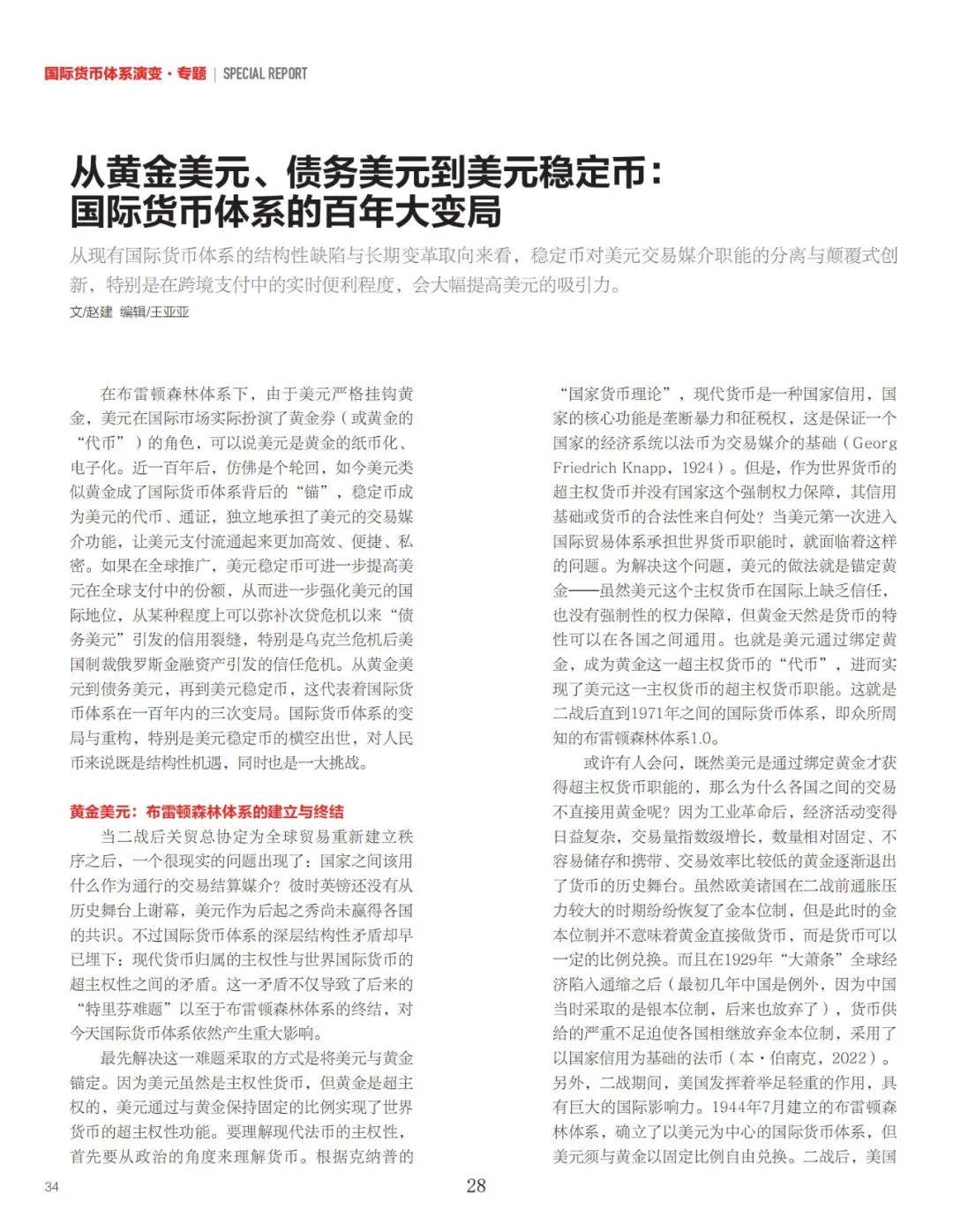
赵建:从黄金美元、债务美元到美元稳定币——国际货币体系的百年大变局
Sou Hu Cai Jing· 2025-08-11 09:33
Group 1: Core Views - The article discusses the structural flaws of the current international monetary system and the transformative potential of stablecoins, particularly in enhancing the efficiency of dollar transactions in cross-border payments [4][18][19] - It outlines the historical evolution of the international monetary system, highlighting three significant phases: the "golden dollar" era under the Bretton Woods system, the "debt dollar" phase driven by debt expansion, and the emergence of "dollar stablecoins" as a technological innovation [4][10][18] Group 2: Golden Dollar: Establishment and Termination of the Bretton Woods System - The Bretton Woods system established the dollar's peg to gold, allowing it to function as a global trade and reserve currency, but this system faced inherent contradictions leading to its collapse [5][9] - The "Triffin Dilemma" emerged as a critical issue, where the demand for dollars in international trade outpaced the growth of gold reserves, ultimately resulting in the suspension of dollar convertibility to gold in 1971 [9][12] Group 3: Debt Dollar: Modern Credit Currency Era and Its Flaws - The transition to a "debt dollar" system marked a shift where the dollar was no longer tied to gold, leading to a reliance on debt for currency creation, which has resulted in significant global financial implications [10][12] - The article identifies three phases of the debt dollar system, including the rise of global dollar loans, the debt explosion post-2008 financial crisis, and the surge in U.S. government debt during the COVID-19 pandemic [15][17] Group 4: Dollar Stablecoins: Technological Innovation and Future of the International Monetary System - Stablecoins are positioned as a solution to enhance the efficiency of dollar transactions, potentially restoring confidence in the dollar amidst concerns over its debt issues and geopolitical tensions [19][20] - The article emphasizes the rapid growth of stablecoin transactions, which reached $27.6 trillion in 2024, surpassing the combined transaction volumes of Visa and Mastercard, although most of this volume is still tied to crypto assets [21] - It discusses the theoretical and technical foundations of stablecoins, including their ability to separate the functions of currency, and the underlying technologies that support their operation [20][21]
光大证券:美元稳定币本质上仍是美元信用的延伸 长期反而加剧市场风险
智通财经网· 2025-07-29 23:52
Core Viewpoint - The report from Everbright Securities highlights that while USD stablecoins can enhance the functionality and usage scenarios of the dollar, thereby reinforcing its position in the international monetary system, they do not fundamentally resolve the underlying issues of the U.S. dollar's twin deficits and may exacerbate risks in the long term [1] Group 1: Nature of Stablecoins - Stablecoins are essentially "on-chain" dollars, with issuers earning a "spread" [2] - They are designed to address volatility in the cryptocurrency market and improve payment efficiency, but their reliance on fiat and crypto assets for collateral reflects a centralized characteristic [2] - The market is highly concentrated, with USDT and USDC accounting for approximately 90% of stablecoin trading volume and about 80% of market capitalization [2] Group 2: Regulatory Framework - The regulatory frameworks for stablecoins in the U.S., EU, and Hong Kong share a common structure but differ in specifics [3] - The U.S. GENIUS Act focuses on payment-type stablecoins, requiring 100% cash or short-term U.S. Treasury bonds as reserves [3] - The EU's MiCA Act aims for broader regulation of crypto assets, emphasizing risk prevention and financial market stability [3] - Hong Kong's stablecoin regulations are characterized by strict approval processes and high reserve coverage, balancing financial innovation with stability [3] Group 3: Macro Impact - Stablecoins enhance liquidity similar to fiat currencies, increasing the speed of money circulation but posing new challenges for central banks in liquidity management [4] - Potential effects include the creation of additional liquidity through lower reserve ratios and the emergence of a "shadow" banking system led by stablecoins [4]

稳定币如何影响美债需求和全球货币格局?
China Post Securities· 2025-07-24 09:36
Group 1: Stablecoin Market Overview - As of July 2025, the total market capitalization of stablecoins reached $260 billion, with over 98% being dollar-pegged stablecoins like USDT and USDC[2][15] - Tether (USDT) and Circle (USDC) dominate the market, accounting for approximately 86% of the total stablecoin market[12][15] - The stablecoin market has shown strong growth, with a 22% increase in the first half of 2025 alone[15] Group 2: Impact on U.S. Treasury Bonds - Stablecoins have created new demand for U.S. Treasury securities, particularly short-term bonds, with Tether being the seventh-largest U.S. Treasury buyer globally, holding over $120 billion[3][21] - The "GENIUS Act" mandates that stablecoin issuers maintain a 1:1 reserve with high-quality liquid assets, primarily short-term U.S. Treasury securities[3][17] - The focus on short-term bonds may exacerbate the steepening of the U.S. Treasury yield curve, as stablecoins have minimal impact on long-term bonds[3][37] Group 3: Strengthening the Dollar's Position - Stablecoins have not undermined the dollar's global dominance; instead, they have enhanced its efficiency and usage, particularly in high-inflation countries[4][51] - The regulatory framework in the U.S. and Hong Kong supports the growth of stablecoins, with the latter allowing multi-currency pegging, potentially challenging the dollar's supremacy[5][62] - Stablecoins facilitate cross-border transactions, significantly reducing costs and increasing the speed of transfers compared to traditional banking methods[58] Group 4: Risks and Considerations - The reliance on stablecoins poses risks, including potential loss of control over the dollar's monetary policy and vulnerabilities highlighted by events like the Silicon Valley Bank incident[4][60] - The long-term credit risk of the U.S. dollar remains a concern, as increasing national debt could undermine confidence in stablecoins[5][60] - Regulatory changes and market volatility present ongoing risks to the stability and growth of the stablecoin market[68]
当马克思回答稳定币:我们有了创造天堂的技术,却用它来建造一个更精致的地狱
3 6 Ke· 2025-07-23 03:26
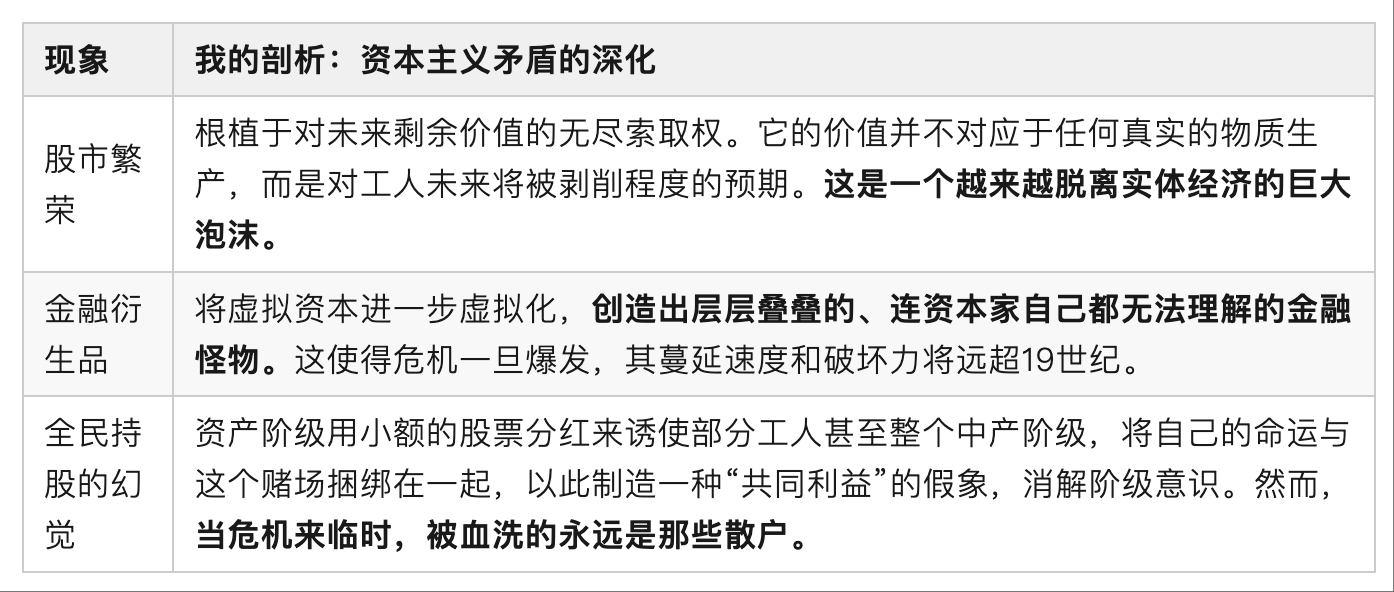
Group 1: Core Argument - The essence of capitalism's self-regulation is a misinterpretation; it is a product of class struggle rather than benevolence from the ruling class [2][3] - The welfare state and labor rights are not improvements from capitalism but rather concessions made under pressure from the working class [2][3] - The current state of capitalism is more cunning and financialized than in the 19th century, with unresolved contradictions accumulating globally [4][5] Group 2: Analysis of Financial Systems - The U.S. stock market is characterized as a casino of virtual capital, reflecting the deepening contradictions of capitalism [3][4] - The U.S. national debt is described as the largest form of virtual capital, relying on the exploitation of global labor [6][7] - The proposed "dollar stablecoin" is seen as a misguided attempt to salvage a hollow financial system, leading to further instability [7][8] Group 3: Implications of Dollar Stablecoin - The dollar stablecoin represents a new form of financial colonization, creating a dependency on U.S. financial systems in the digital realm [12][14] - It perpetuates a hidden global seigniorage, extracting value from global users while offering little in return [18][19] - The stablecoin system enhances financial surveillance and control, undermining the autonomy of individuals and nations [20][21] Group 4: Global Economic Dynamics - The dollar stablecoin threatens the monetary sovereignty of developing countries, exacerbating financial instability and inequality [21][22] - A call for international solidarity among the working class is emphasized as a necessary response to the challenges posed by the dollar stablecoin [22][23] - The ultimate solution lies in the abolition of capitalism itself, as monetary systems will always serve as tools of class oppression under capitalism [24][25]
专访前海国际事务研究院助理院长包宏:稳定币正成为美元影响力延伸的工具,特朗普有四重目的| 祛魅稳定币
Mei Ri Jing Ji Xin Wen· 2025-07-19 16:20
Core Viewpoint - The signing of the "Genius Act" by President Trump establishes a regulatory framework for digital stablecoins in the U.S., aiming to extend the global influence of the U.S. dollar in the digital realm [1][4]. Group 1: Motivations Behind the Stablecoin Legislation - The legislation is driven by four main considerations: personal interests of Trump, national interests of the U.S., the issue of U.S. national debt, and the promotion of digital financial infrastructure [3][4]. - Trump's personal interest is highlighted by his shift in attitude towards cryptocurrencies post-2020 election, as he seeks funding through NFTs and support from the crypto community [3]. - The U.S. national interest is served by reinforcing the dominance of the dollar in the international market, with stablecoins currently holding a significant market share [3][4]. - The stablecoin market, with reserves exceeding $250 billion, is projected to potentially reach $2 trillion in the next 3-5 years, which could significantly impact U.S. Treasury yields and government interest costs [4]. - The development of stablecoins is expected to enhance blockchain technology and digital finance in the U.S., positioning the country favorably against emerging market central bank digital currencies [4]. Group 2: Impact on the Monetary System - The impact of stablecoins on the existing monetary system is expected to be gradual, with no immediate significant changes, as the current global monetary order remains dollar-centric [6]. - Long-term, stablecoins could disrupt the monetary system as their integration with real-world economies deepens [6]. Group 3: Risks and Challenges - If the regulatory framework of the "Genius Act" is effectively implemented, the risk of shadow banking may be mitigated due to the requirement for 100% reserves [7]. - However, the interconnectedness of stablecoins with cryptocurrencies poses risks, as market downturns in cryptocurrencies could lead to systemic issues [7]. - Emerging markets may face challenges from a potential "dollar-dominated + multinational corporations" model, which could threaten financial security and monetary sovereignty [9][10].