规模经济

Search documents
解码制造业高质量发展之路
Jing Ji Ri Bao· 2025-08-20 00:10
Core Viewpoint - The manufacturing industry is emphasized as the foundation of national strength and economic development, with a focus on high-quality growth and strategic importance in the context of global changes and digital transformation [1][3]. Group 1: Manufacturing Industry Performance - In the first half of the year, the manufacturing value added grew by 7%, surpassing GDP growth by over 1 percentage point, indicating an increasing share of manufacturing in GDP [2]. - Manufacturing investment increased by 7.5%, significantly higher than the overall fixed asset investment growth of 2.8% [2]. - Exports of goods primarily from the manufacturing sector rose by 7.2%, showcasing manufacturing as a key driver of economic growth amid challenges in other sectors [2][3]. Group 2: Structural Trends in Manufacturing - High-end equipment manufacturing led growth with an increase of over 10%, outpacing overall manufacturing growth [2]. - High-tech manufacturing value added grew by 9.5%, exceeding the overall manufacturing growth rate by 2.5 percentage points, with significant increases in industrial robots and 3D printing equipment [2][3]. - The transformation of manufacturing is characterized by three trends: high-end, intelligent, and green development [3][4]. Group 3: Green Transformation - The production of new energy vehicles increased by over 10%, with rapid export growth in lithium batteries and wind power equipment [4][5]. - China's unique approach to green transformation integrates economic growth with environmental sustainability, avoiding the pitfalls of merely imposing costs [5][6]. Group 4: Challenges and Responses - The manufacturing sector faces challenges from external factors such as tariffs and technological restrictions, particularly affecting exports to the U.S. [6][7]. - Despite a decline in exports to the U.S., overall goods exports grew by 7.2%, driven by strong performance in emerging markets [7]. - The manufacturing sector's resilience is highlighted by its ability to adapt and maintain competitiveness through innovation and government support [7][8]. Group 5: Manufacturing Share and Reasonableness - The manufacturing share of GDP is projected to be around 24.9% in 2024, which is still significantly higher than the global average of approximately 15% [9][10]. - The decline in manufacturing share over the past decade reflects a natural evolution as economies develop, with a shift in demand from manufacturing to services as GDP per capita rises [9][10][11]. Group 6: Future Directions and Strategies - The future direction of manufacturing includes maintaining a reasonable share, enhancing technological capabilities, and focusing on high-value-added products [23][24]. - Key areas for development include traditional industries, emerging sectors like new energy vehicles and biopharmaceuticals, and future industries such as artificial intelligence [24][25]. - The integration of various industries through common-purpose technologies is essential for driving innovation and maintaining competitiveness in the global market [25].
印尼被曝跟美企签80亿美元合同建17座炼油厂,加工美国原油
Sou Hu Cai Jing· 2025-08-19 10:30
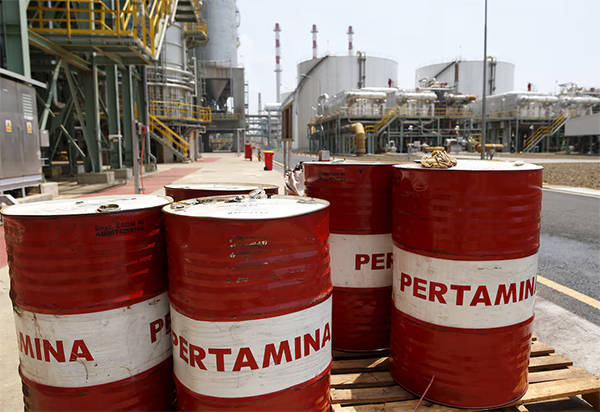
Core Viewpoint - Indonesia plans to build a network of small modular refineries to process crude oil from the US and domestic sources, aiming to reduce gasoline imports and fulfill trade agreements with the US [1][4]. Group 1: Project Overview - Indonesia's sovereign wealth fund Danantara is set to sign an $8 billion contract with US engineering firm KBR to construct 17 modular refineries [1]. - The agreement includes a commitment to purchase $15 billion in energy products from the US in exchange for reduced tariffs on Indonesian goods [1]. - The total value of Indonesia's oil and gas imports is projected to reach $36.28 billion in 2024 [1]. Group 2: Strategic Concerns - Analysts express skepticism about the shift to smaller refineries, noting that it contradicts the global trend towards larger facilities for economies of scale [4]. - Pertamina, Indonesia's state oil company, plans to invest $48 billion to upgrade six refineries and build large refining complexes to increase oil product output to 1.5 million barrels per day [4]. - Indonesia has not built a large refinery in the past 30 years, and most partnerships for these projects have been canceled, forcing Pertamina to proceed independently [4]. Group 3: Technical and Economic Considerations - Modular refineries are expected to be built faster and at lower costs compared to traditional facilities, providing a quick solution to reduce dependence on imported refined oil [5]. - However, the capacity of small refineries typically ranges from 50,000 to 150,000 barrels per day, which may not meet Indonesia's expanding petrochemical capacity goals [5]. - Concerns have been raised about the potential need for small vessels to import crude oil, which could significantly increase costs and expose Indonesia to fluctuations in US crude oil prices [6].

悍高集团20250818
2025-08-18 15:10
Summary of Han Gao Group Conference Call Company Overview - Han Gao Group operates in the home hardware industry, focusing on three main categories: basic hardware, storage hardware, and kitchen & bathroom hardware [4][5]. Market Potential - The basic hardware market share is less than 5%, with a market potential of approximately 50-60 billion RMB. Revenue is expected to grow from 1.2 billion to 12 billion RMB [2][6]. - In the storage hardware sector, Han Gao's market share is close to 10%, with potential to increase to 20%, contributing an additional 2 billion RMB in revenue [2][6]. - The total transaction value of home building materials in China for 2023 is 120 billion RMB, with storage hardware expenditures around 8 billion RMB [2][7]. Competitive Landscape - Han Gao faces competition from numerous unlisted companies such as Baolong and Dongtai, particularly in the basic hardware sector [10]. - The company has established a strong competitive position in the storage hardware market, while its presence in the kitchen & bathroom hardware market remains limited [12]. Revenue Growth and Projections - Future revenue projections indicate that Han Gao could achieve a total revenue of 140 billion RMB from basic and storage hardware combined [6][24]. - The company has experienced a compound annual growth rate (CAGR) of 27% in revenue and 57% in profit over the past few years [15]. Production and Cost Efficiency - Han Gao plans to increase production capacity by 250,000 square meters, resulting in a total capacity increase of approximately 60%. This will lead to reduced manufacturing and transportation costs, enhancing operational efficiency [3][18]. - The company’s current OEM ratio is below 30%, and as revenue grows, this ratio is expected to decrease, improving gross margins [9]. Sales Channels - The sales distribution includes 66% from direct sales, 13% from e-commerce platforms, and 12% from cloud business models, with approximately 10% from large B2B clients [17]. Brand and Marketing Strategy - Significant investment in brand store development has positively influenced consumer purchasing behavior and contributed to revenue growth [11]. - Han Gao has built a comprehensive channel system that includes offline direct sales, e-commerce, and cloud business, creating a differentiated competitive advantage [16]. Industry Characteristics - Home building materials exhibit semi-customization features, leading to complex supply chain management and strong brand attributes. This complexity impacts competition significantly [8][9]. Future Outlook - The company is expected to reach a revenue target of 150 billion RMB, with net profit margins between 15% to 20%, potentially achieving a market valuation of 500 to 600 billion RMB [24].
亚马逊(AMZN.US)VS沃尔玛(WMT.US):谁是赢家
智通财经网· 2025-08-16 02:21
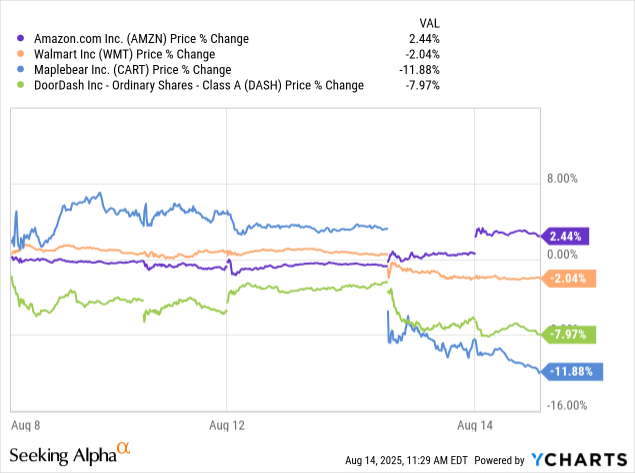
Core Viewpoint - Amazon's announcement of expanding its same-day delivery service for fresh groceries to over 1,000 cities and plans to reach over 2,300 by the end of 2025 is a significant positive development for the company, while competitors like Instacart, Walmart, and DoorDash are facing negative market reactions [1][3][6]. Group 1: Amazon's Growth and Market Position - Amazon's scale economy allows for further growth potential, with AWS revenue increasing by 18% year-over-year to $30.87 billion, exceeding expectations [1]. - The online grocery market in the U.S. has a penetration rate of only 15%, indicating substantial growth opportunities as this figure is expected to rise [7]. - Amazon's monthly active user base exceeds 310 million, with over 80% located in the U.S., providing a strong foundation for its online grocery market expansion [7]. Group 2: Competitive Landscape - Walmart faces increased pressure from Amazon's aggressive expansion, which may lead to price wars and rising costs, impacting profitability in the e-commerce sector [3][6]. - Walmart's recent decision to open its shopper data to multiple advertising platforms enhances its ability to attract advertisers and compete with Amazon's advertising business, which grew by 23% year-over-year to $15.69 billion [3][6]. - Despite challenges, Walmart's membership program showed double-digit growth in the last quarter, indicating potential resilience [3]. Group 3: Valuation and Investment Outlook - Amazon's stock has underperformed compared to competitors this year, with a gain of approximately 4.4%, while DoorDash and Walmart saw increases of about 50% and 11.8%, respectively [8]. - Analysts maintain a "strong buy" rating for Amazon, citing its favorable risk-reward ratio and potential for rebound due to its diversified business model [10]. - Valuation metrics indicate that Amazon has a more favorable growth trajectory compared to Walmart, with lower forward P/E ratios and PEG ratios, suggesting that investors are paying a premium for Walmart without corresponding growth [12][14].


欧洲“科技列车”为何失速?
Jing Ji Ri Bao· 2025-08-16 00:59
Core Insights - Europe has historically been a leader in technology but is now lagging behind in emerging fields like AI, electric vehicles, and semiconductor manufacturing, with the focus shifting to the US and China [1][2] Group 1: Factors Contributing to Europe's Technological Lag - Europe's industrial tradition, while valuable, acts as an invisible ceiling that limits the development of new economic models and innovation [2] - The conservative capital ecosystem in Europe restricts innovation, as companies must demonstrate profitability early to attract funding, leading to a lack of financial support for startups [3] - The complex market structure in Europe, characterized by multiple sovereign nations with diverse languages, cultures, and regulations, complicates cross-border business expansion and increases operational costs [5][6] Group 2: Cultural and Regulatory Challenges - The European cultural emphasis on stability and gradual reform creates a cautious approach to new technologies, which can hinder innovation and entrepreneurship [6] - Strict regulatory frameworks, such as the General Data Protection Regulation (GDPR), while protecting privacy, also impose barriers to innovation by slowing down the pace of technological application [6] Group 3: Recognition and Response to Challenges - European leaders have acknowledged the strategic shortfalls in key technology sectors and are planning increased investments in areas like AI and semiconductor manufacturing [7] - The need for profound cultural, institutional, and market changes is critical for Europe to regain its technological edge, balancing stability with a spirit of innovation [7]
亚马逊VS沃尔玛:谁是赢家
美股研究社· 2025-08-15 11:29
Core Viewpoint - Amazon's announcement of expanding its same-day delivery service for fresh groceries to over 1,000 cities, with plans to reach over 2,300 by the end of 2025, is a significant positive development for the company, while competitors like Instacart, Walmart, and DoorDash face negative market reactions [1][3]. Group 1: Amazon's Growth and Market Position - Amazon's scale economy allows for further growth potential, with AWS revenue increasing by 18% year-over-year to $30.87 billion, exceeding expectations [1]. - The online grocery market in the U.S. has significant growth potential, with fresh groceries accounting for approximately 43% of retail sales, but only 15% of that being online sales [7]. - Amazon's active user base exceeds 310 million, with over 80% located in the U.S., providing a strong foundation for its online grocery market expansion [7]. Group 2: Competitive Landscape - Walmart faces increased pressure from Amazon's competitive strategies, which may lead to price wars and rising costs, impacting profitability in the digital space [3]. - Walmart's recent decision to cancel its exclusive partnership with The Trade Desk opens its shopper data to multiple advertising platforms, enhancing its advertising revenue potential [4]. - Despite Walmart's strong brand recognition in fresh groceries and a broad customer base, it is more susceptible to macroeconomic uncertainties compared to Amazon [8]. Group 3: Financial Metrics and Valuation - Amazon's forward-looking valuation metrics indicate a more favorable risk-reward ratio compared to Walmart, with Amazon's stock showing potential for rebound after underperforming [11]. - Amazon's forward non-GAAP P/E ratio is 34.01, while Walmart's is 38.51, suggesting that investors are paying a higher premium for Walmart despite its slower growth prospects [12][14]. - The PEG ratio for Amazon stands at 1.89, significantly lower than Walmart's 4.86, indicating that Amazon's growth trajectory aligns better with its valuation [14].

AI应用:从落地范式与护城河构建潜析AI应用投资机会
2025-08-13 14:52
Summary of AI Application Investment Opportunities Industry Overview - The AI application market is experiencing a nonlinear explosion in commercialization, similar to the value leap from L2 to L3 in smart driving, leading to a reshaping of market dynamics [1][2] - Currently, AI applications are in their early stages, monetizing through fragmented single points [1] Core Insights and Arguments - The global AI application market has begun monetization, with expectations for domestic markets to initiate in the second half of the year [1][5] - Large model technology enables human-like intelligence, facilitating economies of scale through pre-training and post-training dual drivers for commercialization [1][5][6] - The importance of post-training is increasing, enhancing the autonomous learning capabilities of large models [1][6] - In the short term, focus should be on growth stocks and rapid deployment capabilities in early-stage AI applications [1][7] - As AI progresses to advanced assistance stages, attention should shift to companies' competitive moats and long-term growth stability [1][7] Key Trends and Developments - The development of large model technology has led to two significant changes: achieving human-like intelligence and realizing economies of scale [6] - The transition from customized models to unified multimodal large models improves efficiency and application capabilities [6] - Investment opportunities in AI applications should prioritize sectors like AI plus video and military intelligence for initial explosions, and AI plus education and smart driving for secondary explosions [3][12][13] Important but Overlooked Content - The evolution of smart driving from L1 to L5 stages provides critical insights for AI applications, indicating a shift from low penetration rates to market expansion and concentration around leading companies [3][4] - In the large model era, the role of models and data is crucial; public data makes models the core competitive advantage, while private data emphasizes the importance of data volume as a moat [8] - Vertical integration companies are expected to thrive in the large model era, with data barriers creating opportunities for smaller giants in specific industries [9][10] Future Outlook - The future of large model applications will focus on application capabilities rather than just intelligence enhancement, with significant potential for large-scale monetization [11] - The next generation of large models will benefit from unified architectures and multimodal understanding, particularly in sectors like military intelligence and education [12][13]
2025年我国快递业务量突破1000亿件
Xin Hua Wang· 2025-08-12 05:43
新华社权威恒 国家邮政局监测数 截至7月9F 新华社北京7月10日电(记者叶昊鸣)记者10日从国家邮政局了解到,根据国家邮政局监测数据显示,截至7月9日,2025年我国快递业务量突破1000亿 件,比2024年达到千亿件提前35天。 据了解,今年第1000亿件快递为一台从广东中山发往江苏常州的"以旧换新"家用空调。 我国快递业务量已连续5年突破1000亿件。国家邮政局有关负责人表示,今年千亿件的更快诞生,凸显了我国消费市场规模不断扩大、电商渗透率持续 攀升。快递"规模经济"效应继续放大,对产业拉动和经济带动能力不断提升。 今年以来,我国持续加力实施扩内需、促消费政策,对消费品以旧换新政策进行品类扩围。 这名负责人表示,为更好促进以旧换新政策落地显效,邮政快递业构建起高效便捷的一体化服务体系,数百万从业人员共同努力,不断优化用户体验, 将为降低社会物流成本、推动资源节约型社会建设贡献力量。 【纠错】 【责任编辑:王雪】 2025年我国快i 比2024年提前 ...

CHINA TOWER CORP(788.HK):STEADY EARNINGS GROWTH FROM TWO-WING BUSINESS
Ge Long Hui· 2025-08-06 19:38
Core Viewpoint - The company reported an 8% year-over-year earnings growth in 1H25, with a 21.6% increase in interim dividend, aligning with market expectations. The EBITDA margin showed steady growth despite a slowdown in the incumbent tower business, indicating the company's strong capabilities in developing new businesses with respectable margins [1][2]. Financial Performance - Earnings for 1H increased by 8% YoY to RMB5.76 billion, representing 46% of the estimated earnings for 2025. The tower business (excluding DAS) experienced a slight decline of 0.5% YoY in 2Q25, despite a 3% increase in the number of tenants and a 0.6% increase in tenancy ratio, suggesting cost savings for telecom operators due to lower energy costs [2][5]. - The EBITDA margin improved by 0.4 percentage points YoY in 2Q25 to 69%, reflecting management's efforts in controlling operating expenses and the economies of scale achieved in the company's two-wing business [4]. Business Segments - Both Trans-sector site applications and Energy operations maintained double-digit revenue growth in 1H25, with the two-wing business contributing 14% to the group's revenue, marking an 18.4% YoY increase. DAS also achieved a 9% YoY revenue growth in 2Q25, covering 13.85 billion sqm of building area, along with 527 km of subway coverage and 1,036 km of high-speed railway tunnel coverage [3]. Management Outlook - Management anticipates that full-year earnings for 2025 will maintain high single-digit growth, with a dividend payout ratio not lower than 76%. The interim dividend was raised by 21.6% YoY to RMB0.1325 per share, significantly outpacing the earnings growth for the same period [5].
当资本褪去,民营体检行业陷入规模化陷阱
晚点LatePost· 2025-08-06 04:18
Core Viewpoint - The article discusses the transformation of the private health examination market in China, highlighting the shift from a "scale is king" approach to a more constrained growth model due to increasing operational costs and competitive pressures [4][5]. Market Overview - The health examination market in China has evolved significantly since 2018, with major players like Aikang Guobin and Meinian Health facing new challenges [5]. - The market size grew from 749 billion CNY in 2014 to approximately 2,922 billion CNY in 2023, with the number of health examinations increasing from 373 million to 492 million [6]. Competitive Landscape - The period around 2015 was marked by intense competition among major private health examination providers, with significant capital investment aimed at rapid expansion [7]. - Aikang Guobin and Meinian Health both experienced substantial growth in the number of examination centers, with Aikang expanding from 45 centers in 2014 to 110 in 2017, and Meinian growing from 263 centers in 2016 to 599 in 2019 [7][8]. Financial Performance - Aikang's revenue increased from 2 billion USD in 2014 to 5.6 billion USD in 2018, but its net profit margin fell from 11% to -3% during the same period, indicating rising operational pressures [15]. - Meinian's financial structure also showed a declining trend in profitability, although it managed to optimize results through acquisitions of well-performing centers [17]. Operational Challenges - The industry faces increasing operational costs due to heightened competition, leading to a potential decline in average revenue per center and overall profitability [13][19]. - The reliance on B-end clients, primarily large companies, creates a dependency that may misalign with the core service of health screening, resulting in operational pressures for both large and small examination centers [19]. Future Outlook - The article suggests that the capital enthusiasm for the health examination sector is waning, which may hinder further expansion and intensify competition among existing players [13][19].