量化大数据

Search documents
监管再出重拳,调整还要延续?
Sou Hu Cai Jing· 2026-02-14 20:07
Core Insights - Recent market fluctuations have prompted regulatory bodies to implement self-regulatory measures to maintain fair trading practices and market order [1] - The core drivers of price changes are often overlooked, with many investors focusing solely on surface-level news and price movements [1] - Quantitative data tools reveal multiple trading behaviors that contribute to price volatility, challenging the conventional understanding of market dynamics [1] Group 1: Four Core Trading Behaviors - Quantitative analysis identifies four core trading behaviors that correspond to different market states: 1. "Bullish Dominance": Increased participation in buying activities [3] 2. "Profit Taking": Increased activities focused on realizing existing gains [3] 3. "Bearish Dominance": Decreased participation in buying activities [3] 4. "Short Covering": Increased participation from previously cautious investors [3] Group 2: Characteristics of Profit Taking Behavior - The prevalence of "Profit Taking" behavior during price increases indicates a shift in market dynamics rather than a simple upward push [5] - This behavior often appears hidden, as it coincides with rising prices, leading many to misinterpret it as normal market consolidation [5] - Quantitative data can accurately capture these subtle behavioral changes, helping to avoid cognitive biases [6] Group 3: Significance of Short Covering Behavior - "Short Covering" behavior typically emerges during market panic, signaling a potential reversal despite falling prices [9] - This behavior indicates that previously cautious funds are beginning to enter the market, serving as a key indicator of structural change [12] - Continuous "Short Covering" suggests that panic has been absorbed, marking a transition towards a more positive market sentiment [14] Group 4: Value of Quantitative Data - In a complex market environment driven by emotions, quantitative data provides an objective view of real trading behaviors, free from subjective biases [14] - By analyzing behaviors such as profit taking and short covering, market participants can anticipate changes in trading structures and make more rational decisions [14] - This data-centric investment approach offers a new pathway for investors to understand market dynamics amidst volatility [14]


春晚成了比拼舞台,上市公司谁能胜出?
Sou Hu Cai Jing· 2026-02-14 10:54
Group 1 - The core idea is that data-driven approaches, similar to how Kuaishou utilizes big data for the Spring Festival Gala, can transform investment decision-making by focusing on the behavior of institutional funds rather than just stock price fluctuations [1][2][14] - The concept of "institutional inventory" is highlighted as a key indicator in quantitative big data, reflecting the activity level of institutional funds; its presence indicates active participation, while its absence suggests a decline in participation willingness [2][6] - The relationship between stock price movements and institutional fund participation is emphasized, where a lack of institutional support leads to downward price trends, akin to a Spring Festival Gala losing audience interaction [6][10] Group 2 - Quantitative models have the ability to separate different trading behaviors, allowing for precise identification of fund behavior patterns, which traditional investment methods struggle to achieve [8][10] - The importance of capturing behavioral signals early is discussed, as it enables investors to make more informed decisions, similar to how Kuaishou anticipates user content needs for the Spring Festival [8][13] - The value of quantitative big data lies in its ability to convert abstract fund intentions into visible behavioral characteristics, helping investors establish stable decision-making logic without relying on subjective guesses [10][14] Group 3 - The article illustrates that maintaining awareness of institutional fund behavior can help investors remain composed during market fluctuations, as demonstrated by cases where active institutional participation led to price recoveries despite apparent volatility [13][14] - The overarching trend is the shift towards data-driven investment strategies, which allows ordinary investors to move away from anxiety over price predictions and develop a more objective understanding of market dynamics [14]

北交所IPO提速,数据还原资金逻辑
Sou Hu Cai Jing· 2026-02-14 05:35
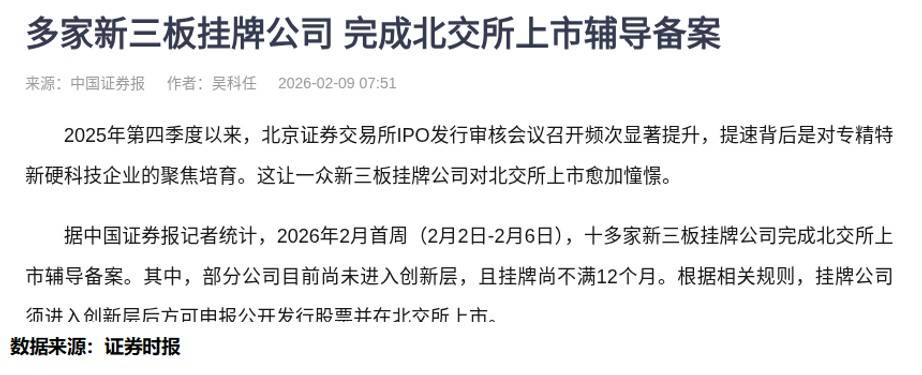
Group 1 - The core viewpoint of the article highlights the increasing frequency of IPO reviews at the Beijing Stock Exchange (BSE), with many specialized and innovative "little giant" companies shifting their listing plans from the Shanghai and Shenzhen stock exchanges to the BSE, indicating a positive cycle of quality enterprise aggregation, liquidity improvement, institutional empowerment, and performance realization [1] - The article emphasizes that for ordinary investors, understanding the underlying dynamics of market movements is crucial, as relying solely on news can lead to impulsive decisions or anxiety about missing opportunities [1] - It suggests that quantitative big data can help investors discern the true trading behaviors of institutional investors, providing an objective analysis that can replace subjective speculation [1] Group 2 - Institutional inventory is a key indicator of the activity level of large funds, reflecting whether institutional investors are actively participating in trading, rather than just the volume of buying or selling [3] - The article illustrates that even during significant price adjustments, the persistence of institutional inventory indicates ongoing participation from large funds, which can lead to subsequent price rebounds [6] - A lack of institutional inventory during a price rebound suggests that the rebound may not be sustainable, as it indicates a lack of ongoing support from institutional investors [9] Group 3 - The article discusses how fluctuations in stock prices can often lead to panic among investors, but the presence of active institutional inventory can signal that these adjustments are merely short-term volatility [9] - It warns that rebounds without institutional support are risky, as they are often driven by short-term sentiment rather than solid backing from large funds [13] - The importance of focusing on the core attitudes of institutional funds rather than being swayed by news is emphasized as a strategy for navigating market adjustments [16]
软银推进IPO,看懂机构早布局
Sou Hu Cai Jing· 2026-02-13 15:43
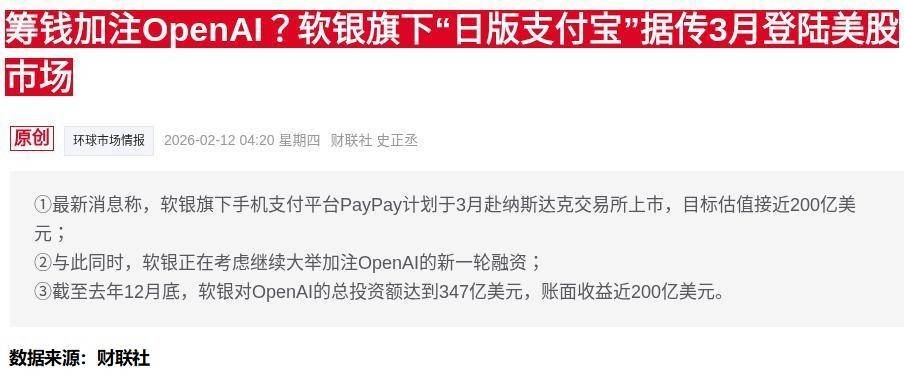
Group 1 - The core point of the article highlights the importance of recognizing early signs of capital movement in the market, particularly before major projects are officially launched [1] - The PayPay IPO is mentioned as a significant event, with a target market value exceeding 3 trillion yen, indicating a strategic move by SoftBank to invest in the AI sector [1] - The article emphasizes that ordinary investors can leverage quantitative big data to track capital movements, thus reducing the information gap traditionally held by large investors [10] Group 2 - Prior to the official launch of major projects like the Yaxia Hydropower Station, there are often signs of capital activity, as evidenced by the trading behavior of leading companies in the sector [2] - The article notes that multiple companies within the same sector exhibit similar patterns of early capital involvement, suggesting a broader trend rather than isolated incidents [4] - The significance of actual capital participation is underscored, as companies with low institutional engagement show lackluster performance, while those with active capital involvement tend to perform better [8] Group 3 - The article discusses how investors may misinterpret market fluctuations, mistaking them for a lack of opportunity, when in fact, institutions may be locking in positions [6] - It is highlighted that not all companies in related sectors will perform well; the key determinant is the level of institutional capital participation [8] - The use of quantitative data systems is presented as a method to clarify market conditions and guide investment decisions, allowing investors to follow the real actions of capital [10]

美联储迎来灵魂拷问,数据拆解涨跌逻辑
Sou Hu Cai Jing· 2026-02-13 09:05
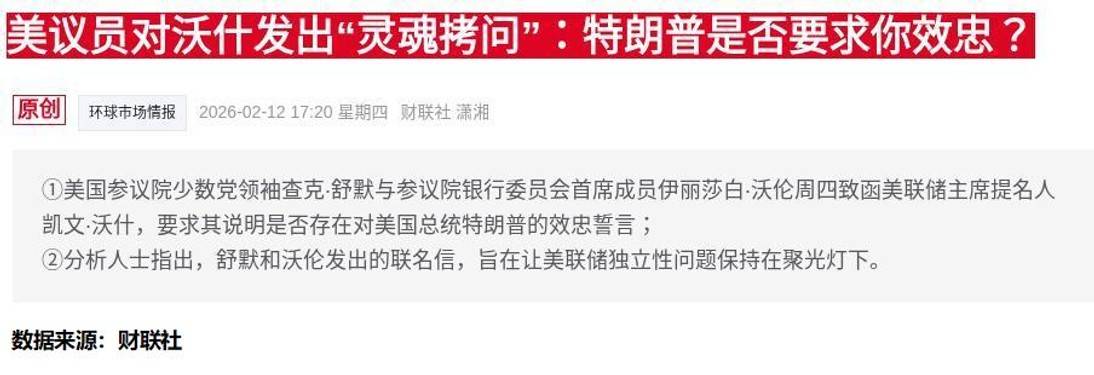
Group 1 - The article discusses the emotional traps investors face when reacting to news, particularly regarding the Federal Reserve's nominations and the subsequent market reactions [1][3] - It highlights the tendency of investors to make impulsive decisions based on market fluctuations driven by news and emotions, often leading to buying high and selling low [1][3] - The piece emphasizes the importance of quantitative data in understanding market behavior, suggesting that it can help investors see beyond surface-level price movements to the underlying trading actions [5][9] Group 2 - Quantitative data can reveal the true nature of market movements, distinguishing between genuine market reactions and those artificially created to disrupt investor behavior [5][7] - The article illustrates how different stocks can appear to be reacting similarly to market events, but their underlying trading dynamics can be vastly different, affecting future performance [7][9] - It advocates for a shift from emotion-driven investment decisions to a data-driven approach, which can provide clearer insights into market trends and participant behaviors [11][12]
企业调改阵痛下,数据窥破资金踪迹
Sou Hu Cai Jing· 2026-02-12 17:22
Core Viewpoint - The article emphasizes the importance of tracking institutional fund behavior rather than merely focusing on profit and loss figures or strategic statements from companies, suggesting that true market movements are driven by underlying fund participation rather than just event-driven narratives [1]. Group 1: Event-Driven Market Characteristics - The energy market in 2025, influenced by geopolitical conflicts, is identified as a classic event-driven case, with the market attributing price movements solely to these events [3]. - Prior to the conflict, institutional fund activity indicated a sustained engagement, which did not immediately affect stock prices, highlighting a divergence between fund behavior and price movements [5]. Group 2: Cross-Sector Fund Behavior - Observations across different sectors reveal a consistent pattern where institutional fund activity precedes market attention, indicating that price movements often lag behind fund participation [7]. - In the sports sector during the summer of 2025, stock prices began to rise as market interest grew, but key fund signals had already emerged earlier in the market cycle [7]. Group 3: Signals During Market Fluctuations - Institutional fund participation can lead to prolonged price stagnation, which may be overlooked by average investors, as seen in the dye sector at the beginning of 2026 [8]. - The commercial space sector saw active fund participation before it became a market focus, with price stability contrasting with active fund engagement [10]. Group 4: Challenges of Fundless Themes - Not all thematic concepts lead to upward price movements; a commercial space sector stock experienced a decline despite rising sector interest due to a lack of sustained fund participation [12]. - The absence of active institutional engagement in a stock, even during periods of low price, indicates a lack of foundational support for price increases, reinforcing that themes alone cannot drive market performance [12]. Group 5: Data-Driven Investment Insights - The article advocates for a data-driven approach to understanding market dynamics, focusing on fund behavior rather than subjective interpretations of events or themes [12]. - Establishing a data-driven investment perspective is crucial for investors to navigate the complexities of the market and identify reliable investment signals [12].
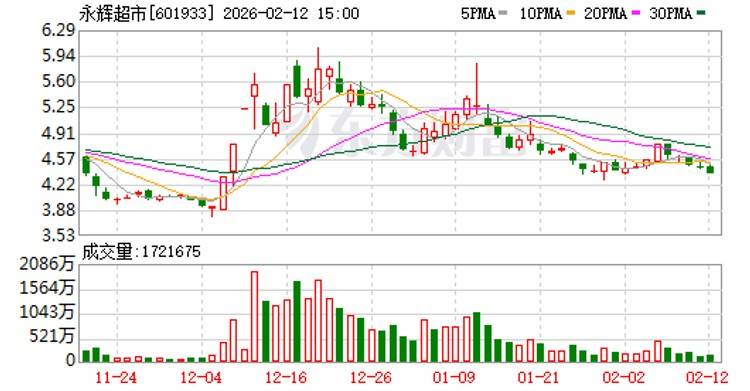
AI硬件掀涨潮,个股调整藏玄机
Sou Hu Cai Jing· 2026-02-12 08:41
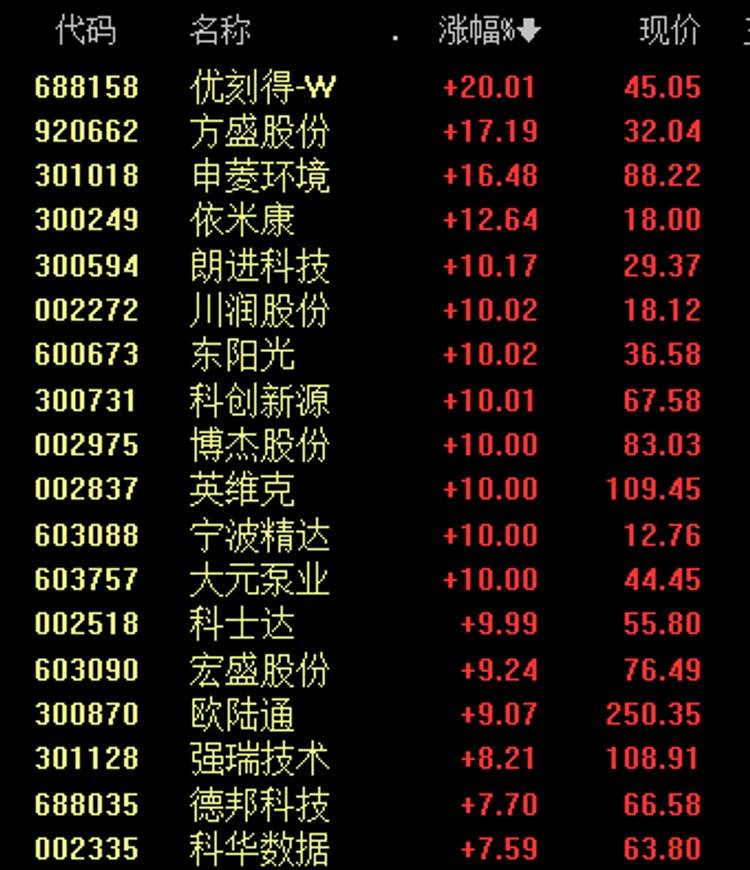
Core Insights - The market is experiencing a stark contrast, with AI hardware-related sectors showing strong performance while commercial aerospace stocks face significant adjustments [1] - Major companies like Google and Amazon are increasing capital expenditures by hundreds of billions, driving up the demand for AI computing power [1] - Investors often follow trends without understanding the underlying capital participation, leading to poor decision-making [1] Group 1: Market Performance - AI hardware stocks, including liquid-cooled servers and CPO-related companies, are seeing collective gains [1] - Specific stocks such as 优刻得-W (up 20.01% to 45.05), 方盛股份 (up 17.19% to 32.04), and 申菱环境 (up 16.48% to 88.22) are highlighted for their significant price increases [2] - The adjustment in commercial aerospace stocks has resulted in a sealed order exceeding 2.3 billion, surprising many investors [1] Group 2: Institutional Participation - The concept of "institutional inventory" is introduced as a measure of institutional trading activity, indicating whether large funds are actively participating in the market [2][4] - Stocks with declining institutional inventory often experience weak performance, as seen in past market fluctuations [4][6] - Continuous and active participation from institutional investors is crucial for maintaining upward momentum in stock prices [6][10] Group 3: Emotional Trading and Quantitative Data - Emotional responses to market fluctuations can lead to poor investment decisions, such as panic selling during downturns [8] - Utilizing quantitative data to analyze institutional inventory can help investors maintain their positions during volatility, leading to better long-term outcomes [8][10] - The importance of objective data over subjective emotions is emphasized, advocating for a shift towards quantitative analysis in investment strategies [10]
猪价回暖,节后靠消费股撑起大A?
Sou Hu Cai Jing· 2026-02-11 16:29
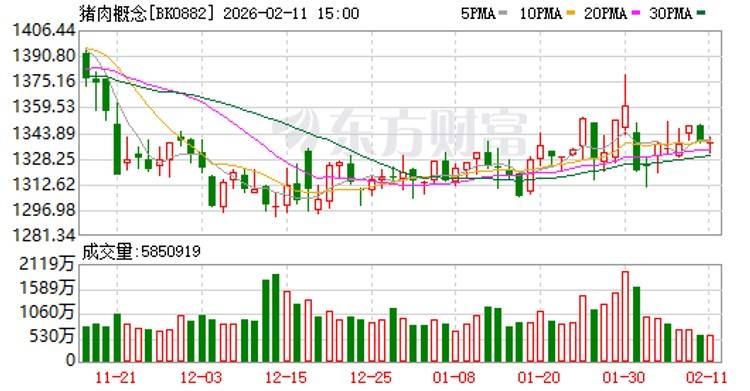
Core Viewpoint - The pork industry is experiencing capacity regulation as a norm, with mixed performance in output among leading companies, and prices remain at the bottom of the industry cycle, leading to a focus on cost reduction rather than relying on price fluctuations for profit [1] Group 1: Industry Performance - Leading pork companies show varied output results, with some experiencing year-on-year growth while others face month-on-month declines [1] - Despite a slight recovery in pork prices after a prolonged downturn, the overall market remains weak, with experts predicting narrow price fluctuations in the future [1] Group 2: Investment Insights - The reliance on traditional indicators such as earnings growth can lead to misleading conclusions, as demonstrated by contrasting performances of stocks with similar positive earnings forecasts [3][6] - The "institutional inventory" data, which reflects the trading activity of large funds, is crucial for understanding market dynamics, as stocks with active institutional participation tend to perform better [5][11] Group 3: Market Behavior - Even in the face of negative news, stock prices can rise if institutional investors remain engaged, highlighting the importance of understanding institutional sentiment over mere earnings reports [13] - The concept of "institutional inventory" serves as a tool to gauge market sentiment, indicating that active participation from large funds can lead to more stable price movements [14]
消费板块财报亮眼增长,看穿资金真实状态
Sou Hu Cai Jing· 2026-02-11 08:43
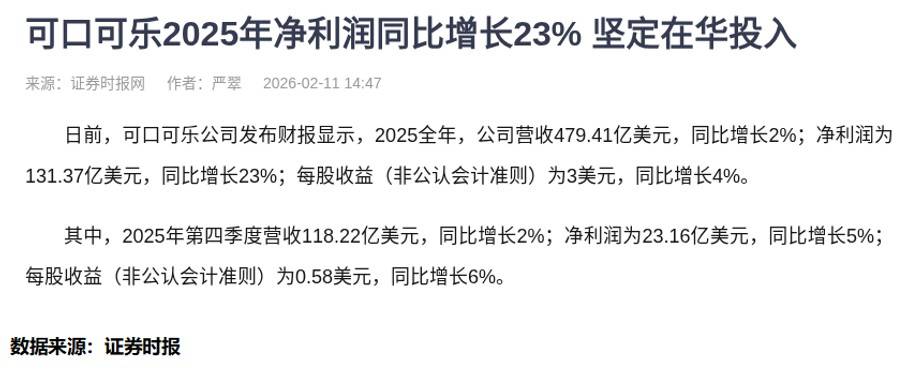
Group 1 - The core point of the article highlights the importance of understanding the true state of institutional capital participation rather than reacting impulsively to news events [1] - Coca-Cola has reported a significant increase in profits and has invested heavily in building smart factories across China, from Shaanxi to Hainan, indicating a strategic expansion in production capacity [1] Group 2 - The article introduces a quantifiable system for assessing the participation levels of institutional capital, categorized into four levels: Level 1 indicates active participation, Level 2 indicates reduced activity (institutional lock-up), Level 3 shows minimal participation, and Level 4 indicates no active involvement [3] - The concept of "silent status" is discussed, where fluctuations in stock performance may not indicate problems but rather reflect the quiet state of institutional capital, which can be analyzed through quantitative data [5] Group 3 - The article emphasizes the distinction between meaningful fluctuations driven by institutional activity and "ineffective fluctuations" where there is no real institutional involvement, helping investors avoid wasting time on unproductive stocks [7][9] - It is noted that many stocks may appear to fluctuate but are primarily in Level 3 or Level 4, indicating a lack of institutional interest, which can mislead investors if they rely solely on surface-level observations [9] Group 4 - The article concludes that ordinary investors do not need to compete with institutional capital in terms of scale; instead, they can utilize tools to understand institutional behavior, thereby making informed decisions without being swayed by market emotions [11] - The focus should be on identifying stocks with genuine institutional interest rather than chasing news, allowing for a more stable and long-term investment strategy [11]
金价涨跌反复,多维视角看清本质
Sou Hu Cai Jing· 2026-02-10 09:12
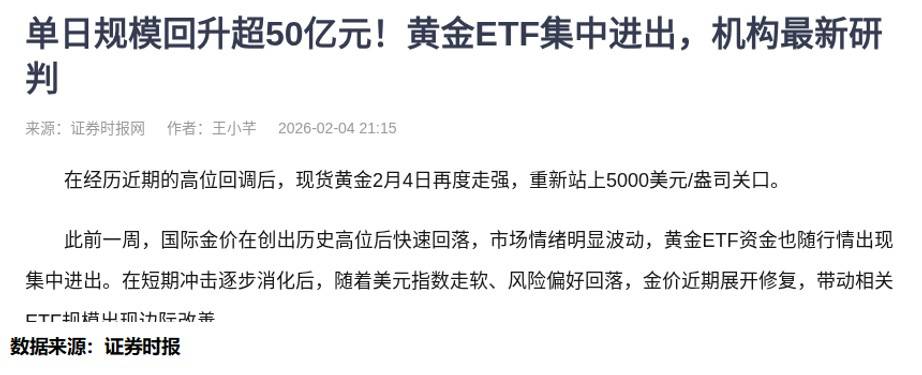
近期国际黄金市场上演了一波惊心动魄的"过山车"行情,先是伦敦金价刷新历史高点逼近5600美元/盎司,随即单日暴跌逾9%失守5000美元关口,紧接着又 在美元指数走软、全球风险偏好回落的带动下强势反弹,重新站上关键点位。伴随金价的剧烈波动,黄金ETF规模也同步出现"大进大出"的极端表现,单日 规模增减动辄数十亿甚至上百亿,市场情绪的起伏与资金的博弈态势一览无余。不少普通投资者被这波行情打了个措手不及,要么在暴跌时慌不择路离场, 要么在反弹时仓促追高入场,到头来发现自己始终踩不准节奏,陷入被动。其实,行情的波动从来不是单一消息或价格涨跌能完全解释的,想要跳出这种被 动局面,我们需要从资金、行为、概率等多个维度重新审视市场,而量化大数据就是帮我们打开多维视角、建立理性认知的核心工具。 一、从资金维度看:ETF波动背后的博弈信号 黄金ETF规模的大幅波动,表面上是对金价涨跌的直接反应,实则是不同资金群体博弈的直观体现。机构投资者往往会借助行情波动调整配置节奏,而普通 投资者更易被短期涨跌带动情绪,做出情绪化决策。就像2025年6月,三只分属游戏、证券、无人驾驶不同赛道的个股,在同一天出现调整后,第三个交易 日集体涨停 ...