
金融开放

Search documents
上海市委常委、常务副市长吴伟:以更高水平对外开放,集聚全球投资
Zhong Guo Jing Ying Bao· 2025-11-12 02:14
Core Viewpoint - The Shanghai International Investor Conference emphasizes the theme of "Value Leading, Open Empowerment - New Opportunities for International Capital Investment and Mergers and Acquisitions" [1] Group 1: Financial Environment and Opportunities - Shanghai aims to enhance market vitality through higher quality reforms and innovations, improving the effectiveness of financial services for the real economy [1] - The city is focused on attracting global investment by creating a market-oriented, law-based, and international business environment [1] - There is a commitment to better coordinate openness and security, participating in international financial regulatory exchanges to strengthen financial risk prevention capabilities [1] Group 2: Support for Financial Institutions - Shanghai will create more market and development opportunities for domestic and foreign financial institutions, enterprises, and talents [1] - The city extends a warm welcome to institutions to establish and develop their businesses in Shanghai, contributing to the construction of an international financial center [1]
第八届进博会丨“持续与中国各方携手”——聆听虹桥论坛的开放合作声音
Xin Hua She· 2025-11-07 00:43
Group 1 - The importance of open cooperation for global prosperity is emphasized, with calls for strengthening collaboration across the entire industrial chain and addressing challenges like climate change [1][3] - China is actively supporting Africa's infrastructure, industrialization, and digital development, establishing a foundation for sustainable growth through connectivity [1][3] - The resilience of the multilateral trade system is highlighted, with China's commitment to not seeking new special and differential treatment in WTO negotiations, showcasing its determination for reform [1][3] Group 2 - The collaboration between Chinese and foreign enterprises is strengthening, with companies like Louis Dreyfus Group benefiting from Chinese banking support to enhance trade efficiency and reduce market risks [2][4] - A report from Renmin University suggests that future trade security should address micro, meso, and macro levels, advocating for a new global governance system through innovation and collaboration [3] - The need for effective intellectual property enforcement is stressed, requiring cooperation among stakeholders to create a balanced enforcement mechanism for global innovators and consumers [3] Group 3 - Financial reforms in China are aimed at facilitating cross-border trade and investment, with a focus on creating a modern, inclusive, and accessible financial ecosystem [4] - The Chinese Ministry of Commerce calls for enhanced communication and cooperation among countries to maintain the multilateral trade system and build resilient global supply chains [4] - China is committed to expanding imports of quality products and services, leveraging its large market to drive global economic growth and provide new opportunities for development [4]
香港交易所港股通业务专题培训成功举办
Xin Lang Cai Jing· 2025-11-05 08:09
Core Viewpoint - The event held on October 30 aimed to enhance the understanding of the Hong Kong financial market's interconnectivity mechanisms among Shenzhen's fund industry, with 75 participants from 28 institutions attending the training session supported by the Hong Kong Stock Exchange [1][3]. Group 1: Training Session Details - The training invited representatives from the Hong Kong Stock Exchange to discuss key topics such as the Hong Kong securities market and trading mechanisms, recent optimization measures, and future planning [3]. - Important subjects covered included the optimization of the fee structure for Hong Kong securities market transactions, the inclusion of ETFs in the interconnectivity qualified securities, and trading arrangements during adverse weather conditions [3]. - A Q&A session addressed inquiries from institutional representatives regarding the scope of stocks eligible for the Hong Kong Stock Connect, the range of ETFs supported, order types allowed, and adjustments to the minimum price fluctuation [3]. Group 2: Industry Implications - The interconnectivity mechanism is a significant milestone in China's financial market opening, serving as a top-level design for national financial openness [5]. - The Shenzhen fund industry plans to leverage the Hong Kong Stock Connect and other interconnectivity channels to expand cross-border investment and actively explore overseas markets [5]. - The initiative aims to accelerate the pace of opening up and continuously enhance the internationalization level of the industry [5].



金融监管总局副局长周亮:持续深化内地与香港互联互通
Zhong Guo Zheng Quan Bao· 2025-11-04 22:37
Group 1 - The core viewpoint emphasizes the need for increased financial openness and cooperation between mainland China and Hong Kong, aligning with international standards and responding to the financial industry's demands in Hong Kong and Macau [1] - The Financial Regulatory Bureau plans to deepen financial cooperation with Hong Kong, enhancing its status as an international financial center through high-level financial openness and regulatory collaboration [1][3] - The initiative includes supporting mainland insurance companies to issue catastrophe bonds in Hong Kong, which will provide new investment products and enhance the market's offerings [2] Group 2 - The collaboration will focus on five key areas: technology finance, green finance, inclusive finance, pension finance, and digital finance, leveraging Hong Kong's strengths in innovation and intellectual property protection [3] - The regulatory framework will be improved to balance risk prevention and development, ensuring high-quality financial growth in both regions while addressing external risks [3] - The Financial Regulatory Bureau aims to enhance the financial service convenience in the Greater Bay Area and support mainland enterprises in international expansion through comprehensive financial services [2][3]
金融监管总局副局长周亮: 持续深化内地与香港互联互通
Zhong Guo Zheng Quan Bao· 2025-11-04 20:20
Group 1 - The core viewpoint emphasizes the need for increased financial openness and cooperation between mainland China and Hong Kong, aligning with international standards and responding to the financial industry's demands in Hong Kong [1] - The Financial Regulatory Bureau plans to deepen financial cooperation with Hong Kong, enhancing its status as an international financial center through high-level financial openness and regulatory collaboration [1][3] - The issuance of catastrophe bonds by mainland insurance companies in Hong Kong is supported, which aims to enrich investment options in the Hong Kong market and bolster its role as an international risk management center [2] Group 2 - There is a focus on enhancing cooperation in various financial sectors, including technology finance, green finance, inclusive finance, pension finance, and digital finance, leveraging Hong Kong's advantages in innovation and intellectual property protection [3] - The regulatory framework will be improved to balance risk prevention and development promotion, ensuring high-quality financial development in both regions while maintaining financial security [3] - The initiative includes supporting banks and insurance institutions in Hong Kong to provide comprehensive financial services for mainland enterprises, facilitating their international expansion [2]
金融监管总局副局长周亮:不断提升内地对港澳金融开放水平
Shang Hai Zheng Quan Bao· 2025-11-04 19:09
Core Insights - The financial cooperation between mainland China and Hong Kong is expected to see significant development opportunities, with a focus on integrating Hong Kong into the national development framework and enhancing its status as an international financial center [1][2]. Group 1: Financial Cooperation and Development - The financial regulatory authority aims to deepen cooperation between mainland China and Hong Kong, leveraging Hong Kong's advantages to strengthen its international financial center status [1]. - Hong Kong's capital market has seen the largest IPO scale globally from January to October this year, and it accounts for over 75% of various cross-border financial mechanisms [1]. - The regulatory authority plans to steadily expand high-level financial openness, aligning with international trade rules and enhancing financial access for Hong Kong and Macau [1][2]. Group 2: Role of Hong Kong in Financial Services - Hong Kong is positioned as a "super connector" for the mainland, facilitating the issuance of catastrophe bonds and insurance-linked securities by mainland insurance companies [2]. - The authority emphasizes enhancing financial service convenience in the Greater Bay Area and supporting banks and insurance institutions in providing comprehensive financial services for mainland enterprises [2]. Group 3: Areas of Collaboration - There is a focus on strengthening cooperation in technology, green finance, inclusive finance, pension finance, and digital finance between mainland China and Hong Kong [2]. - The authority aims to leverage Hong Kong's strengths in technology innovation and intellectual property protection to support the development of digital currency and electronic payment systems [2]. Group 4: Regulatory Cooperation and Risk Management - Strengthening regulatory cooperation is essential to prevent financial risks while promoting development, with an emphasis on improving the financial regulatory cooperation mechanism between mainland China and Hong Kong [3]. - The goal is to balance risk prevention and development, ensuring the high-quality development of the financial sectors in both regions while maintaining financial security and stability [3].
三大金融管理部门集中在港发声
Bei Jing Shang Bao· 2025-11-04 16:13
Core Insights - The International Financial Leaders Investment Summit held in Hong Kong on November 4, 2023, gathered around 300 international financial leaders to discuss the latest developments in China's economic and financial landscape, as well as measures to enhance Hong Kong's status as an international financial center [1][3]. Group 1: Financial Cooperation and Development - The Financial Regulatory Administration aims to deepen financial cooperation between mainland China and Hong Kong, promoting Hong Kong's integration into national development and enhancing its international financial center status [3][5]. - There is a focus on steadily expanding high-level financial openness, aligning with international trade rules, and responding to the financial needs of Hong Kong and Macau [3][4]. - The initiative includes enhancing connectivity between mainland and Hong Kong financial markets, supporting the issuance of catastrophe bonds by mainland insurance companies in Hong Kong, and improving financial services in the Greater Bay Area [3][4]. Group 2: Financial Innovation and Risk Management - Emphasis is placed on collaboration in technology finance, green finance, inclusive finance, pension finance, and digital finance, leveraging Hong Kong's strengths in innovation and intellectual property protection [4][5]. - The People's Bank of China is committed to strengthening the offshore RMB market in Hong Kong and enhancing cross-border payment services through financial technology innovations [6]. - The China Securities Regulatory Commission (CSRC) is focused on risk prevention and regulatory strengthening while promoting high-quality development and enhancing cross-border investment facilitation [7]. Group 3: International Engagement - The CSRC welcomes more international institutions and long-term capital to engage in business in China, aiming for mutual development and win-win outcomes [7]. - The summit serves as a platform for discussing macroeconomic trends, trade, and digital developments, highlighting opportunities and risks in various financial markets and asset classes [1].

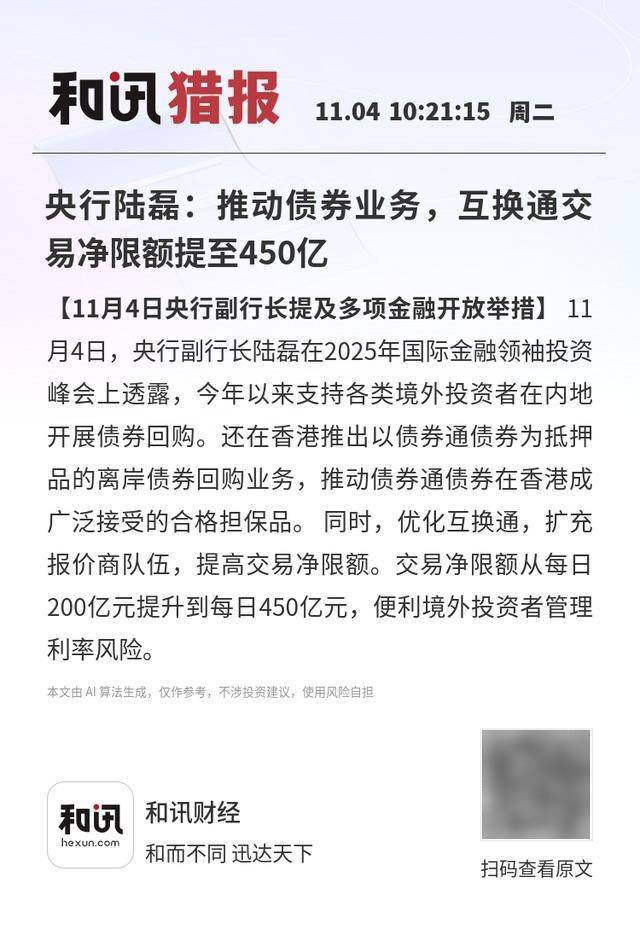
央行陆磊:推动债券业务,互换通交易净限额提至450亿
Sou Hu Cai Jing· 2025-11-04 02:44
Core Insights - The People's Bank of China (PBOC) is implementing multiple financial opening measures to support foreign investors in the domestic bond market [1][2] - The PBOC has introduced offshore bond repurchase agreements in Hong Kong, using bonds from the Bond Connect as collateral, enhancing their acceptance as qualified collateral [1][2] - The swap connect has been optimized, expanding the number of market makers and increasing the trading net limit from 20 billion to 45 billion yuan, facilitating foreign investors in managing interest rate risks [1][2]
"十五五"规划信号清晰,人民币国际化表述强化
Di Yi Cai Jing Zi Xun· 2025-10-29 08:23
Group 1 - The "14th Five-Year Plan" emphasizes the importance of expanding high-level opening-up, particularly in financial openness and the internationalization of the Renminbi [1][2] - The plan aims to enhance the capital account opening level and establish a self-controlled cross-border payment system for the Renminbi [1][2] - The report from China International Capital Corporation (CICC) highlights that financial openness will play a crucial role in addressing the imbalance between China's financial strength and real economy [1][3] Group 2 - The State Administration of Foreign Exchange (SAFE) has outlined a roadmap for steadily expanding high-level institutional opening in the foreign exchange sector, promoting the internationalization of the Renminbi and high-quality capital account opening [2] - The People's Bank of China (PBOC) aims to enhance the international functions of the Renminbi in pricing, payment, investment, financing, and reserve [2] - The cross-border payment system for the Renminbi (CIPS) has shown significant growth, processing 8.22 million transactions worth 175 trillion yuan in 2024, marking a year-on-year increase of 24% and 43% respectively [2] Group 3 - The Renminbi has become the largest currency for cross-border payments in China and ranks among the top three currencies for trade financing and payments globally [3] - The "15th Five-Year Plan" suggests that the current international landscape presents a favorable opportunity for promoting the internationalization of the Renminbi [3] - CICC's report identifies three main directions for financial openness: facilitating safe and efficient outbound capital, bringing in advanced overseas financial expertise, and leveraging the Hong Kong market to support these initiatives [3]
“十五五”规划信号清晰,人民币国际化表述强化
Di Yi Cai Jing· 2025-10-29 08:20
Group 1 - The "14th Five-Year Plan" emphasizes the importance of expanding high-level opening-up, particularly in financial openness and the internationalization of the Renminbi [1][2] - The plan aims to enhance the capital account opening level and establish a self-controlled cross-border payment system for the Renminbi [1][2] - The report from China International Capital Corporation (CICC) highlights that financial openness will play a crucial role in addressing the imbalance between China's financial strength and real economy [1][3] Group 2 - The State Administration of Foreign Exchange (SAFE) has outlined a roadmap for steadily expanding high-level institutional opening in the foreign exchange sector, promoting the internationalization of the Renminbi [2] - The People's Bank of China (PBOC) aims to enhance the international functions of the Renminbi in pricing, payment, investment, financing, and reserves [2] - The cross-border payment system for the Renminbi (CIPS) has shown significant growth, processing 8.22 million transactions worth 175 trillion yuan in 2024, marking a 24% and 43% year-on-year increase respectively [2] Group 3 - The Renminbi has become the largest currency for cross-border payments in China and ranks among the top three currencies for trade financing and payments globally [3] - The "15th Five-Year Plan" suggests that the current international landscape presents a favorable opportunity for promoting the internationalization of the Renminbi [3] - CICC's report identifies three main directions for financial openness: facilitating safe and efficient outbound capital, bringing in advanced overseas financial expertise, and leveraging the Hong Kong market [3]