
防沙治沙

Search documents
(活力中国调研行)绿进沙退的阿拉善答卷
Zhong Guo Xin Wen Wang· 2025-08-27 07:01
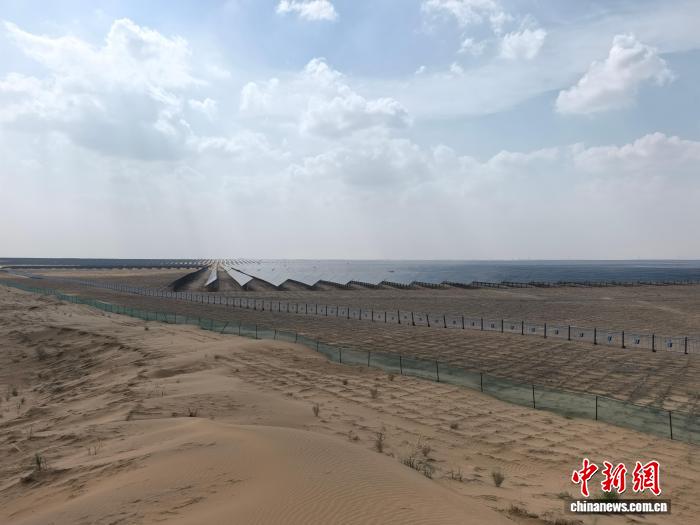
Core Viewpoint - The ecological restoration project in Alxa League, Inner Mongolia, has successfully transformed the "Yellow" landscape into "Green," significantly reducing sand erosion and improving local livelihoods [1][2][3]. Group 1: Ecological Restoration Efforts - The ecological restoration project at the "Yama Nose" area began in 2022 and is set to be completed in 2024, with significant challenges faced during the planting process [1]. - The vegetation coverage in the "Yama Nose" area has increased from less than 5% to over 35%, resulting in a reduction of 90,000 tons of sediment entering the Yellow River annually [1]. - Approximately 1,856 kilometers of desert forest and grassland borders have been established in Alxa League, increasing the forest coverage rate from 2.96% to 8.42% [2]. Group 2: Economic Impact on Local Communities - Local herders have begun participating in afforestation efforts, leading to improved living conditions and reduced sandstorms [2]. - Farmers and herders involved in the forestry industry have exceeded 30,000, with an average annual income increase of 30,000 to 50,000 RMB per household [3]. - The presence of construction teams has revitalized local businesses, including small restaurants and supermarkets, contributing to the economic growth of the region [3]. Group 3: Innovative Approaches in Sand Control - The Tengger "Shagao" New Energy Base utilizes innovative methods for sand control, including biodegradable sandbags made from cassava and corn starch, which help stabilize the area [2]. - The combination of solar panels and vegetation planting creates a dual benefit of energy generation and ecological restoration [2].

中国第二大内流河,原地复活了?
Hu Xiu· 2025-08-27 02:06
Core Viewpoint - The Heihe River, China's second-largest inland river, has seen its length increase from over 500 kilometers to nearly 1000 kilometers over the past 20 years, highlighting significant environmental recovery efforts [1] Group 1: River Characteristics - The Heihe River is located across the Qinghai, Gansu, and Inner Mongolia provinces, serving as a crucial water source for millions of people [1] - The river faced severe challenges, including periods of complete drying up in its lower reaches, indicating a critical environmental situation [1] Group 2: Recovery Efforts - The revival of the Heihe River over the past two decades has been attributed to substantial water resource management and various afforestation and desertification control projects, including the "Green Belt Action" initiative [1] - The combination of sufficient water supply and community-driven environmental projects has played a vital role in the river's restoration [1]
为全球绿色发展作出“上合贡献”
Ren Min Ri Bao· 2025-08-26 03:32
Group 1: Green Development Consensus - The Shanghai Cooperation Organization (SCO) member states share a consensus on protecting the ecological environment and promoting green development [1] - China has strengthened cooperation with other SCO member countries in the field of green development, contributing to sustainable economic and social development [1] Group 2: Ecological Cooperation and Innovations - A "Photovoltaic + Cotton Water and Fertilizer Integration" demonstration area has been established in Uzbekistan, significantly increasing cotton yields by over 200% through Chinese irrigation technology [2] - China and Uzbekistan have signed an ecological governance agreement to address the ecological crisis of the Aral Sea [2] - The China-Mongolia Desertification Prevention Cooperation Center is actively involved in Mongolia's "Billion Trees Plan" [2][3] Group 3: Renewable Energy Initiatives - The Akmolinsk Wind Power Project in Kazakhstan has a total installed capacity of 221 MW, providing 843 million kWh of green electricity annually, reducing CO2 emissions by 686,600 tons [4] - SCO countries contribute half of the global renewable energy installed capacity, with a total of 2.31 billion kW by the end of 2024, which is 14.5 times that at the organization's inception [4][5] Group 4: Biodiversity Protection - China is actively promoting biodiversity protection and has collaborated with SCO member states to protect species like the snow leopard [6] - The number of snow leopards in Pakistan is increasing due to cooperative efforts among SCO countries [6] Group 5: Coral and Marine Ecosystem Protection - Chinese enterprises have implemented innovative designs for artificial breakwaters in Sri Lanka, creating suitable conditions for coral growth and enhancing marine biodiversity [7] - The construction of the Hunutlu Power Plant in Turkey prioritized ecological protection, ensuring the natural breeding of endangered sea turtles [7] Group 6: Overall Green Cooperation - China and other SCO countries are collaborating on various green initiatives, including desertification prevention, clean energy cooperation, and rare species protection, to promote regional ecological improvement and global environmental governance [8]
黄沙之上,汇聚涓滴绿意
Xin Hua She· 2025-08-24 23:05
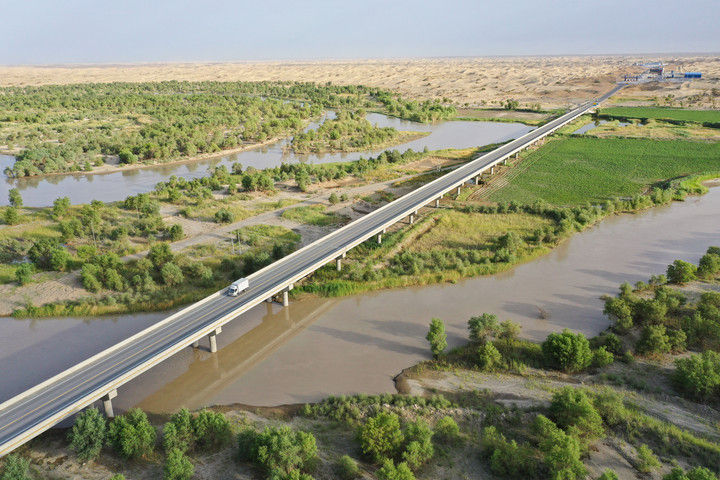
Core Viewpoint - The article highlights the ecological transformation and resilience of the southern Xinjiang region, emphasizing the importance of trees and green spaces in combating desertification and supporting local livelihoods [2][8][13]. Geographic and Ecological Overview - Southern Xinjiang is located between the Tianshan Mountains and the Kunlun Mountains, encompassing five administrative regions: Kashgar, Hotan, Aksu, Kizilsu, and Bayingolin [2]. - The region features diverse landscapes where different types of trees thrive, such as the resilient Populus euphratica in the desert and walnut trees in agricultural areas [2]. Historical Context - The article references historical figures like Zuo Zongtang, who played a significant role in the development and afforestation of Xinjiang during times of conflict, symbolizing the enduring spirit of the region [4][6]. Environmental Challenges - Wind and sandstorms pose significant challenges to the local population, with the phenomenon referred to as "down soil" indicating the severity of dust accumulation even on clear days [6]. Afforestation Efforts - Since 1978, over 70 million acres of trees have been planted in the "Three-North" shelter forest program, with a recent completion of a 3,046-kilometer green protective belt around the Taklamakan Desert [8]. - The article notes the successful cultivation of over 260 species of plants for desertification control, contributing to the establishment of green belts along desert highways [11]. Economic Impact - The unique climatic conditions of southern Xinjiang have fostered the growth of various fruits, with the apple industry in Aksu and the jujube brand from Hotan gaining national and international recognition [13]. - The development of a comprehensive transportation network has facilitated the distribution of local agricultural products, enhancing economic opportunities for residents [13].
呵护绿饭碗 擦亮金名片(连线评论员)
Ren Min Ri Bao· 2025-08-17 22:01
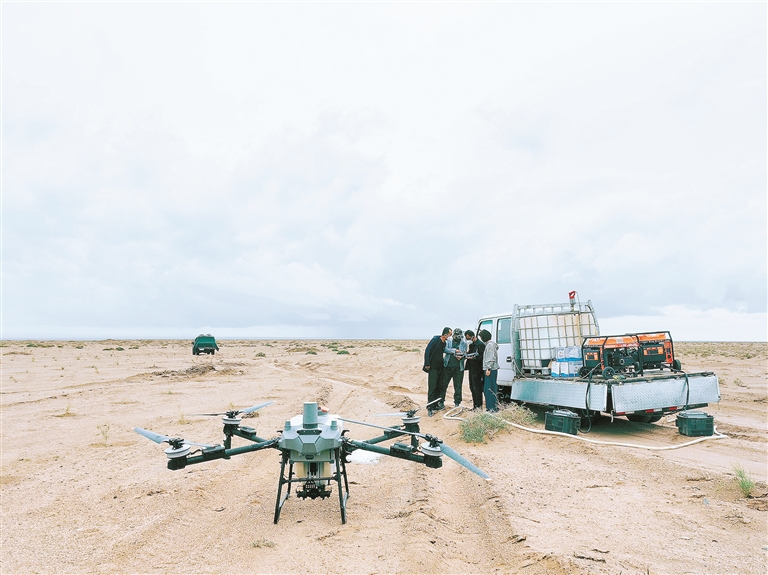
Core Viewpoint - Inner Mongolia has successfully completed a 1,856-kilometer desertification prevention and control green belt, showcasing a comprehensive approach to combating desertification through innovative technologies and collaborative efforts [1][2]. Group 1: Technological and Institutional Innovations - The region has enhanced innovation awareness by exploring suitable afforestation techniques for arid areas, such as aerial seeding and new planting methods, while promoting mechanized and intelligent sand control technologies [1][2]. - Institutional innovations include the establishment of a desertification prevention fund and a collaborative mechanism for regional management, which creates a robust framework for combating desertification [1][2]. Group 2: Systematic and Collaborative Approaches - A systematic view is emphasized, where desertification prevention requires multi-regional cooperation, leading to agreements with neighboring provinces for joint efforts in combating desertification [2]. - The establishment of a comprehensive network for desertification control reflects a shift from isolated efforts to integrated strategies, enhancing the effectiveness of ecological governance [2][3]. Group 3: Community Involvement and Economic Integration - Community participation is identified as a vital driving force, with mechanisms established to encourage public investment and involvement in desertification control initiatives [3]. - The integration of ecological protection with economic development is highlighted, where protecting ecological resources is seen as a pathway to achieving high-quality economic growth [3][4]. Group 4: Commitment to Sustainable Development - Inner Mongolia is committed to integrating ecological protection into its overall development strategy, ensuring that green development principles are embedded in all aspects of economic and social progress [4]. - The region aims to balance ecological preservation with economic benefits, contributing to a sustainable and beautiful China [4].
正风反腐在身边·记者百县行丨沙海植绿
Zhong Yang Ji Wei Guo Jia Jian Wei Wang Zhan· 2025-08-03 00:37
Core Viewpoint - The article highlights the efforts and challenges faced by local herders in Inner Mongolia's Alxa Right Banner in combating desertification through tree planting, particularly focusing on the role of the "Three-North" shelter forest program initiated by the government [2][3]. Group 1: Environmental Initiatives - The Alxa Right Banner is a critical area for the "Three-North" shelter forest program, aimed at combating desertification and enhancing ecological security in China [2][3]. - Since the 1970s, local communities have engaged in afforestation, grass planting, and sand fixation to expand desert control efforts [2][3]. - The government has emphasized the importance of these initiatives for national ecological safety and sustainable development [2][3]. Group 2: Community Involvement - Local herders, such as Ma Fenmei, have dedicated years to planting trees in harsh desert conditions, demonstrating resilience and commitment to environmental restoration [3][4]. - The local government has mobilized farmers and herders to participate actively in tree planting, creating a collective effort to combat desertification [4][5]. - The "work-for-relief" model has been implemented to incentivize local communities, allowing them to contract tree planting projects, thereby increasing their income [4][5]. Group 3: Government Support and Oversight - The Alxa Right Banner's disciplinary inspection and supervision agencies have prioritized the "Three-North" project, focusing on quality, progress, and integrity in project execution [3][4]. - Regular monitoring and supervision of funding for public welfare forests and "work-for-relief" wages have been established to ensure timely and accurate disbursement of funds [5][6]. - As of now, the government has ensured the payment of 4.834 million yuan in overdue project funds, safeguarding the rights of local farmers [6].
内蒙古阿拉善:沙海中的绿色家园
Ren Min Wang· 2025-08-01 01:52
Core Viewpoint - The article highlights the unique geographical and ecological features of Alxa League in Inner Mongolia, emphasizing its transformation from a harsh desert environment to a region with sustainable living conditions and rich biodiversity [1][5][9]. Geographical Features - Alxa League covers an area of 270,000 square kilometers, characterized by deserts and oases that support human habitation [1]. - The region is home to three major deserts: Badain Jaran, Tengger, and Ulan Buh, which are interconnected by roads and railways, facilitating transportation [3]. Environmental Conditions - Wind and sand are constant challenges for residents, particularly during winter and spring when strong winds carry sand [5]. - The architecture in Alxa is adapted to these conditions, featuring low buildings with thick walls and small, sealed windows to enhance insulation and protect against sand [5]. Biodiversity and Natural Resources - Alxa League contains 602 lake basins and 75 large lakes, with each lake covering over 1 square kilometer, particularly abundant in the Badain Jaran Desert [7]. - The region also boasts 450,000 acres of natural poplar forests, one of the last three remaining in the world, which turn golden in autumn, attracting tourists [8]. Conservation Efforts - A significant achievement in environmental management is the completion of a 1,856-kilometer sand control belt, marking a historic shift towards sustainable land use after 40 years of efforts [9]. - The area has seen nearly 10 million acres of desertification control, leading to a successful "people retreating from sand" initiative [9].

青春植新绿 大漠绘丹青
Zhong Guo Zi Ran Zi Yuan Bao· 2025-07-25 06:29
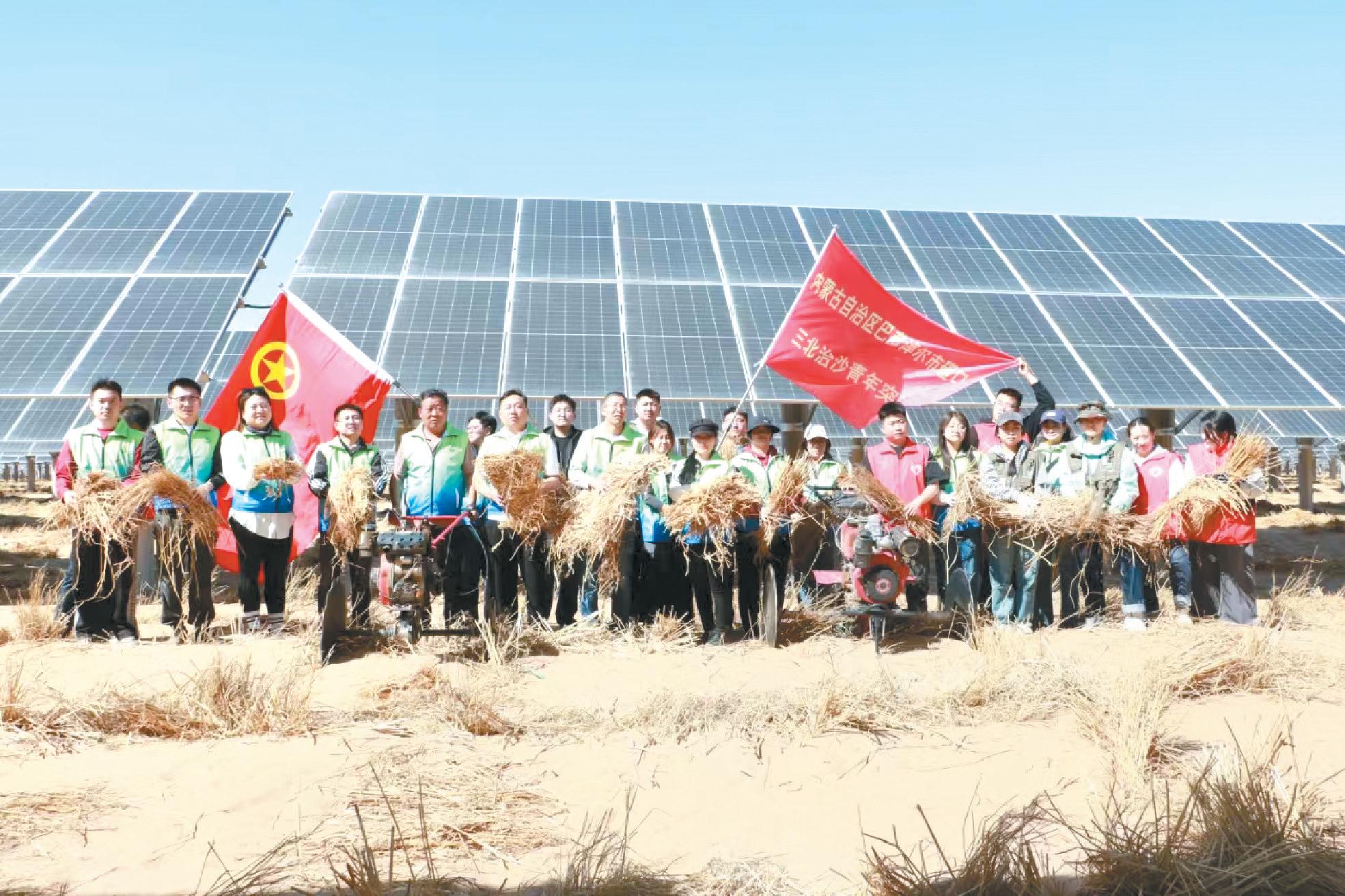
Core Viewpoint - The article highlights the efforts of the youth sand control team in Inner Mongolia's Ulan Buh Desert, showcasing their successful initiatives in desertification control and ecological restoration, which have transformed the region into a greener landscape while ensuring food security and local livelihoods [3][5][10]. Group 1: Historical Context and Achievements - The Ulan Buh Desert has been a significant environmental challenge, contributing over 70 million tons of sediment to the Yellow River annually, threatening its stability [3]. - Since 1950, the local government has led a persistent campaign against desertification, resulting in the establishment of a 308-mile protective forest belt by 1959, which has been crucial in halting the eastward expansion of the desert [5][6]. - The youth sand control team has been recognized for their contributions, receiving the 2025 China Youth May Fourth Medal Collective award [3]. Group 2: Technological Innovations and Modern Approaches - Recent advancements include the development of cold storage techniques for seedlings, allowing for year-round planting and significantly improving survival rates [9]. - The integration of modern technologies such as drones, remote sensing, and big data analysis has shifted sand control strategies from traditional methods to more efficient, technology-driven approaches [9]. - The establishment of a new "308 Locking Edge Forest Belt" combines engineering, shrub planting, and protective measures to create a modern "green wall" against desert encroachment [9]. Group 3: Economic and Ecological Synergies - The introduction of a "photovoltaic + ecological governance" model has enabled the dual use of land for solar energy production and ecological restoration, enhancing both economic and environmental outcomes [11][12]. - The local economy has benefited from the development of various ecological industries, with over 90 enterprises engaged in desert management and related activities, generating an annual output value exceeding 1 billion yuan [12]. - The cultivation of medicinal plants and other sustainable practices has created new income opportunities for local residents, contributing to rural revitalization [12]. Group 4: Research and Development - The China Forestry Science Research Institute's Desert Forestry Experimental Center plays a vital role in assessing and optimizing desert ecosystems, focusing on the selection and breeding of drought-resistant tree species [14][15]. - The center has introduced various tree species and developed methods to enhance their survival in harsh desert conditions, contributing to the overall biodiversity and ecological health of the Ulan Buh Desert [15]. - Continuous research efforts have led to significant improvements in forest coverage, increasing from 0.04% at the founding of New China to 39.1% today, marking a substantial ecological transformation [14].
多措治理 联防联治 扩绿增收阿拉善盟:坚决打赢打好河西走廊—塔克拉玛干沙漠边缘阻击战
Nei Meng Gu Ri Bao· 2025-07-23 02:20
Core Viewpoint - The Alxa League is committed to establishing a northern demonstration base for desertification prevention and control, focusing on comprehensive management of desertified land in the region where the Badain Jaran and Tengger deserts meet, aiming to strengthen ecological security in northern China [1][2][3]. Group 1: Project Overview - The Jiukoshu desertification control project has completed a management area of 418,300 acres, including 140,400 acres of artificial afforestation and grass planting, and 125,300 acres of engineering sand fixation [1]. - The Alxa League plans to complete a total ecological construction task of 3,253,500 acres by 2024, with a focus on the "He-Ta" area, which includes 9 key projects with an investment of 3.085 billion yuan [2][3]. - By 2025, the league aims to fill the gaps in desert edge protection and implement targeted management measures for different desert overflow areas [2][3]. Group 2: Collaborative Efforts - The Alxa League emphasizes joint prevention and control, forming a collaborative governance model with neighboring regions, and has established deep ecological governance cooperation mechanisms with areas like Wuwei City in Gansu Province [3][4]. - The league is implementing 7 joint prevention and control projects in the Mongolian-Gansu border area, with a construction task of 1,188,700 acres [4]. Group 3: Economic and Social Impact - The league promotes a model of "work for relief" to engage local farmers and herders in project construction, successfully employing over 15,454 laborers [4]. - The ecological construction is expected to enhance local livelihoods, with over 800 households benefiting from the development of specialty sand industries, leading to an annual income increase of 20,000 to 50,000 yuan per person [6]. Group 4: Future Plans - The Alxa League aims to further develop a connection mechanism involving government guidance, enterprise leadership, and local participation to enhance cross-border joint prevention and control efforts [6]. - The league is determined to accelerate project construction to support green development and contribute to ecological security in northern China [6].
内蒙古锡林郭勒 沙漠腹地绽放生态繁花
Jin Rong Shi Bao· 2025-07-22 02:41
Core Insights - The article highlights the proactive measures taken by the People's Bank of China in Xilin Gol League to promote green finance and support desertification control efforts in the region [1][2][4] Group 1: Financial Support for Desertification Control - The People's Bank of China in Xilin Gol League has established a "financial desertification control" service team to provide comprehensive support to local enterprises, including product introduction and specialized credit support [2] - A total of 12 million yuan in loans has been provided to local companies like Inner Mongolia Guohua Landscape Greening Co., Ltd., enabling the cultivation of over 10 million saplings for desertification control [2] - As of the first quarter of 2025, the total loan balance for ecological protection and restoration in the league reached 2.043 billion yuan, with 585 million yuan specifically for ecological restoration projects [2] Group 2: Green Transformation in Agriculture - The introduction of a new feeding model in Sunite Left Banner has improved the ecological environment and increased the income of local herders, supported by credit from Postal Savings Bank [3] - The People's Bank of China has developed a "green finance + desertification control + credit linkage + industrial revitalization" model to assist herders in transitioning to more sustainable practices [3] - By the end of May, 24 banners and 127 villages had received credit support, benefiting over 2,760 herding households [3] Group 3: Support for Under-forest Economy - The promotion of under-forest planting of medicinal herbs like red peony has been identified as a method to prevent soil erosion and combat desertification [4] - The People's Bank of China has facilitated a 4 million yuan low-interest loan to support the expansion of red peony cultivation to over 5,000 acres [4] - As of the first quarter of 2025, the loan balance for ecological agriculture and forestry in the league reached 480 million yuan, with an additional 9.3417 million yuan in new loans during the year [4] Group 4: Product Innovation in Financial Services - The introduction of specialized financial products such as "Windbreak and Desertification Control Loan" has been instrumental in supporting local projects [6] - The People's Bank of China has guided local financial institutions to innovate and launch various financial products to support ecological governance [6] - The use of the "Agricultural Bank Smart Chain" app has enabled precise financial support for ecological restoration projects, including a 6.1 million yuan loan for forest land restoration [6]
