贸易保护主义

Search documents
芯片突发!商务部出手
Zhong Guo Ji Jin Bao· 2025-09-13 13:03
Core Viewpoint - The Ministry of Commerce of China has initiated anti-dumping investigations against imported analog chips from the United States and has also launched a discrimination investigation regarding U.S. measures affecting China's integrated circuit sector, citing violations of WTO rules and harm to Chinese enterprises' legitimate rights [1][4]. Group 1: Anti-Dumping Investigation - The anti-dumping investigation was initiated following an application from the domestic semiconductor industry, in accordance with Chinese laws and WTO regulations [2]. - The investigation covers general interface and gate driver chips imported from the U.S., with evidence indicating a 37% increase in import volume and a 52% decrease in import prices from 2022 to 2024, adversely affecting domestic product sales [2][6]. - The investigation period is set from January 1, 2024, to December 31, 2024, with the industry damage assessment period from January 1, 2022, to December 31, 2024 [6][19]. Group 2: Discrimination Investigation - The Ministry of Commerce has decided to launch a discrimination investigation against U.S. measures in the integrated circuit sector, which are seen as discriminatory and harmful to China's high-tech industries [4][21]. - The investigation will examine various U.S. measures since 2018, including tariffs and restrictions on exports of integrated circuit products and manufacturing equipment to China [21][22]. - The investigation period is also set to begin on September 13, 2025, with a typical duration of three months, extendable under special circumstances [24].

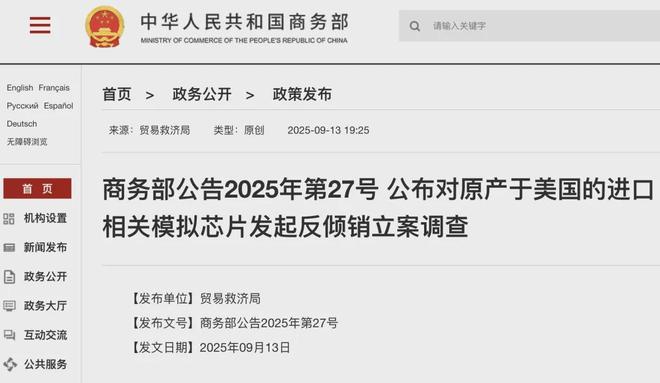
事关芯片!商务部刚刚宣布,立案调查!
券商中国· 2025-09-13 12:23
Core Viewpoint - The Ministry of Commerce of China has initiated anti-discrimination investigations against the U.S. measures in the integrated circuit sector and anti-dumping investigations on imported analog chips from the U.S. [1][3][16] Group 1: Anti-Discrimination Investigation - The Ministry of Commerce announced the initiation of an anti-discrimination investigation against U.S. measures related to integrated circuits, citing evidence of discriminatory practices against China [3][4]. - The investigation will focus on U.S. tariffs and restrictions imposed on Chinese products since 2018, particularly in the integrated circuit sector [4][6]. - The investigation is set to begin on September 13, 2025, and will typically last for three months, with the possibility of extension under special circumstances [8][33]. Group 2: Anti-Dumping Investigation - The Ministry of Commerce has also launched an anti-dumping investigation into imported analog chips from the U.S., following a formal request from the Jiangsu Semiconductor Industry Association [16][17]. - The investigation period for dumping will cover January 1, 2024, to December 31, 2024, while the injury investigation will span from January 1, 2022, to December 31, 2024 [17]. - The scope of the investigation includes certain analog integrated circuits, specifically those using 40nm and above process technology [20][21]. Group 3: U.S. Export Control Measures - The U.S. has placed multiple Chinese entities on an export control "entity list," which has raised concerns regarding the impact on various sectors, including semiconductors and biotechnology [2][35]. - The Chinese government has criticized the U.S. for its unilateral and bullying practices, asserting that such actions undermine global supply chains and distort the market [35].

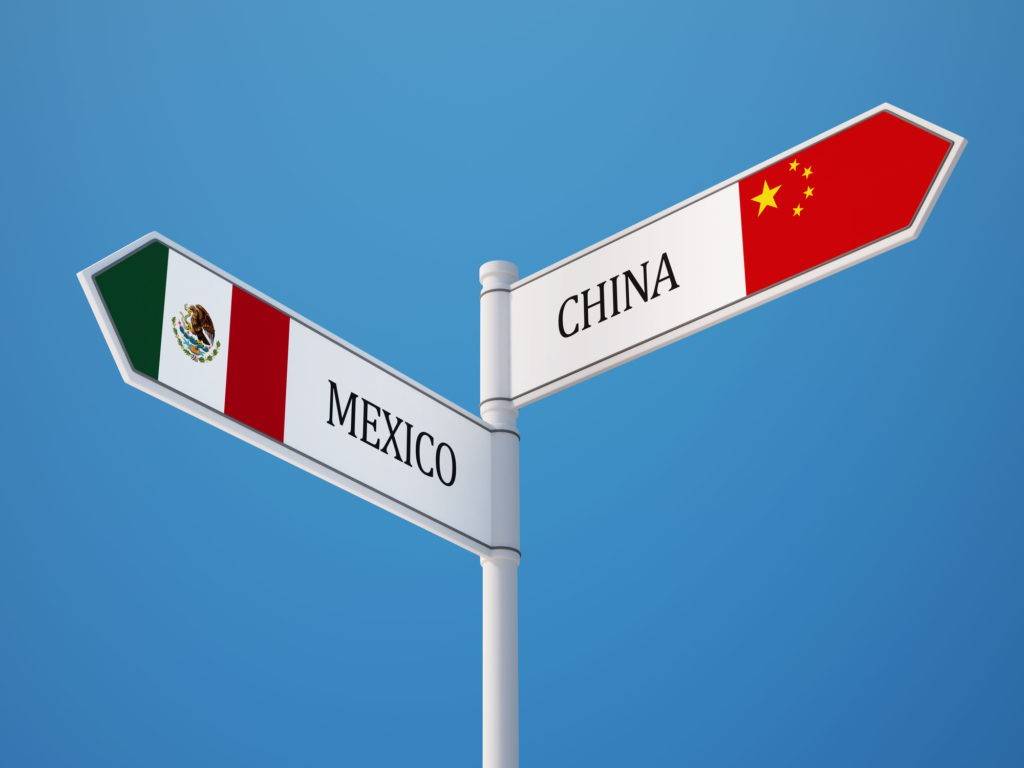
墨西哥拟对中国汽车加征关税,比亚迪和特斯拉或蒙受最大损失
Guan Cha Zhe Wang· 2025-09-13 11:55
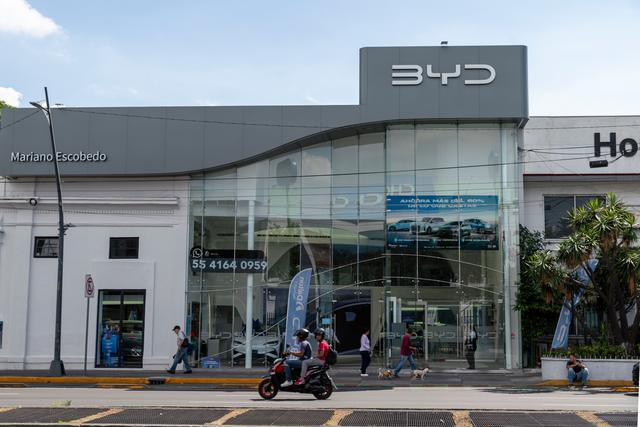
Core Viewpoint - The Mexican government's proposal to impose tariffs of up to 50% on imports from countries without free trade agreements with Mexico could significantly impact the electric vehicle market, particularly affecting companies like BYD and Tesla, while benefiting traditional U.S. automakers such as General Motors, Ford, and Stellantis [1][3]. Group 1: Tariff Proposal and Impact - The proposed tariff will primarily affect electric vehicles manufactured in China and sold in Mexico, potentially hindering the growth of the electric vehicle market in Mexico [1]. - The Mexican Congress is expected to approve the proposal due to the ruling party's majority, which could reshape the automotive market in North America [1][3]. - The Mexican Electric Vehicle Association indicated that tariffs on Chinese electric vehicles have already increased from 0% to 15% last year, with a potential rise to 50% [1][3]. Group 2: Company-Specific Developments - Tesla's plans for a factory in northern Mexico have been stalled due to economic pressures and uncertainties, which would have created up to 6,000 jobs [3]. - BYD has seen explosive growth in sales since entering the Mexican market at the end of 2023, selling approximately 40,000 vehicles in 2024, accounting for nearly half of all electric and plug-in hybrid vehicle sales in Mexico [5]. - The sales of Tesla's Model 3 and Model Y in Mexico are currently sourced from its Shanghai factory, indicating a shift in strategy due to the proposed tariffs [3][5]. Group 3: Industry Reactions and Global Context - The Canadian Automotive Parts Manufacturers Association noted that the new tariff policy could favor U.S. automakers by making it easier for them to compete against BYD [5]. - China's Ministry of Foreign Affairs expressed opposition to unilateral and protectionist measures, emphasizing the importance of mutual benefits in China-Mexico economic cooperation [5].


中国反制的时间点,让美国人感到胆寒,中方等待的时机已经来了
Sou Hu Cai Jing· 2025-09-13 10:39
Core Viewpoint - The U.S. soybean market is facing a severe crisis due to a lack of orders from China, which has historically been a major buyer, leading to significant price drops and financial distress for American farmers [2][3]. Group 1: U.S. Soybean Market Impact - In 2025, U.S. soybean exports to China have dropped to zero orders, a stark contrast to previous years when China would typically purchase 10% to 20% of U.S. soybean production during harvest season [2]. - The price of soybeans has plummeted to around $8 per bushel, causing storage issues and financial strain for farmers who are now considering bankruptcy [2]. - The trade policies initiated by the Trump administration, including tariffs on Chinese goods, have led to a significant reduction in U.S. soybean exports to China, from over 30 million tons at its peak to less than 15 million tons [2][3]. Group 2: Shift to Brazilian Soybeans - In 2025, Brazil has become the primary supplier of soybeans to China, with exports reaching 42.26 million tons from January to July, compared to the U.S.'s 1.657 million tons during the same period [3]. - China's imports of soybeans from Brazil hit a record 10.39 million tons in July 2025, marking a 13.92% year-on-year increase [3]. - The U.S. has lost significant market share in the soybean sector, with Brazil now accounting for 71% of China's soybean imports, while the U.S. has been relegated to a minimal role [5]. Group 3: Broader Trade Implications - The ongoing trade tensions have not only affected soybeans but also U.S. beef exports to China, which saw a 17% decline in the first half of 2025, dropping to $752.5 million, the lowest since 2023 [5]. - The U.S. agricultural sector is facing a financial cliff, with farmers urging the government to change trade policies as they struggle to cope with the fallout from tariffs and trade disputes [5][7]. - The overall trade dynamics are shifting, with China diversifying its import sources and the U.S. struggling to regain its previous market position, indicating a long-term decline in U.S. market share [9][10].
德国巴伐利亚州副州长最新涉华表态:保护主义非解决之道,欢迎中国投资
Huan Qiu Wang· 2025-09-13 08:45
Core Viewpoint - Despite the current tensions in EU-China relations, Bavaria continues to welcome Chinese investments, emphasizing the importance of economic resilience and self-sufficiency without resorting to protectionism [1][3]. Investment Opportunities - In 2024, Chinese investments in Bavaria are expected to reach record levels, with approximately 500 Chinese companies operating in the region, creating thousands of jobs [3]. - Bavaria, as the headquarters for major automotive companies like BMW and Audi, is positioned as a key location for Chinese automotive firms to establish production bases in Europe [3]. Trade Relations - The Deputy Governor criticized the EU's anti-subsidy tariffs on electric vehicles imported from China, arguing that such measures are not the correct solution [3]. - There is a call for negotiations between the EU and China to reach a WTO-compliant resolution, avoiding tariff impositions [3].

美议员访华示好,特朗普却逼欧盟对华加税,欧洲作何选择?
Sou Hu Cai Jing· 2025-09-13 07:48
Group 1 - The article highlights the contradictory actions of the U.S. government, where President Trump is seeking assistance from the EU to impose tariffs, indicating a shift from unilateralism to a more collaborative approach [1][4][10] - The potential impact of a 100% tariff on U.S. companies like Ford and Apple is significant, with Ford's vehicle prices potentially doubling, leading to a drastic reduction in market share in China [12][14] - European companies, particularly in the automotive and luxury goods sectors, are expressing strong opposition to U.S. tariffs, emphasizing their deep integration with the Chinese market [51][53] Group 2 - The article discusses the rising global trade tariffs, which have reached their highest levels in 15 years, and the implications of a trade war involving over $750 billion in trade [10][49] - The response from emerging markets like China and India is proactive, as they seek to diversify their trade partnerships and reduce reliance on the U.S. [29][33] - The article notes that multinational companies are planning to reconfigure their supply chains to mitigate risks associated with trade tensions, with 41% of companies indicating plans to do so within 18 months [53][55]
墨西哥对美国屈服,将对中国加征50%关税?别把中国提醒当软弱
Sou Hu Cai Jing· 2025-09-13 07:48
Core Viewpoint - Mexico's President announced a significant trade policy adjustment, imposing punitive tariffs of up to 50% on imports from China, Russia, and some Asian countries starting in 2026, which is perceived as a response to U.S. pressure [2][5] Group 1: Trade Policy Impact - The tariff adjustment will affect over 1,400 product categories, including automotive, textiles, steel, plastics, and furniture [2] - The automotive industry will be particularly impacted, with tariffs on Chinese light vehicles potentially rising from 15% to 50%, affecting brands like SAIC and Chery [2] - Mexico's trade with China reached $109.426 billion in 2024, making China Mexico's second-largest trading partner [5] Group 2: Economic Consequences - The Mexican Chinese Chamber of Commerce warned that the 50% tariff could lead to increased domestic prices, with an estimated 8.2% rise in annual household expenditures [6] - The policy could hinder Mexico's transition to renewable energy, especially in the electric vehicle supply chain [6] - It may undermine Mexico's competitive advantage as a manufacturing hub in North America, prompting foreign companies to reassess their investment plans [6] Group 3: Geopolitical Context - The U.S. has been applying pressure on multiple trade partners to challenge China, indicating a strategy to create a trade encirclement [8] - This tactic mirrors previous U.S. strategies during the Trump administration, aiming to create a perception of isolation for China [10] - Mexico faces a strategic choice between being a pawn in great power competition or pursuing an independent trade policy [12]
美媒悟了:买中国货有利国安啊,谁会跟最大客户过不去?
Guan Cha Zhe Wang· 2025-09-13 07:45
Core Argument - The article argues that banning Chinese drones under the guise of national security is detrimental to the U.S. economy and ultimately threatens national security itself [1][5]. Group 1: Economic Impact of Banning Chinese Drones - The article highlights that the ban on Chinese drones, such as those produced by DJI, will harm U.S. businesses that rely on these products, leading to job losses and reduced productivity [3][4]. - An example is provided of nuWay Ag, a company that has had to lay off employees due to the inability to procure enough DJI drones, which are essential for their operations [3][4]. - The article emphasizes that importing foreign products, like Chinese drones, enhances the productivity and living standards of Americans, contradicting the protectionist stance of the U.S. government [4][5]. Group 2: National Security Implications - The article posits that no country would attack its most important customer, suggesting that trade relationships contribute to national security [1][5]. - It argues that the Trump administration's protectionist policies weaken the U.S. economy, which is crucial for maintaining a strong national defense [5][6]. - The article concludes that the ban on Chinese drones could lower the costs for China to engage in hostile actions against the U.S. by reducing their economic ties [5][6]. Group 3: Critique of U.S. Government's Position - The article criticizes the U.S. government's lack of evidence for claims regarding the national security risks posed by Chinese imports, labeling these assertions as unfounded [6]. - It points out that the U.S. is significantly reliant on Chinese components for drone technology, indicating a gap in domestic production capabilities [6]. - The article suggests that if the ban is enforced, U.S. companies may resort to illegal means to obtain drones and parts, ultimately burdening American consumers with higher costs [6].

塔亚尼表示将于10月8日在米兰举办中意政府间委员会
Shang Wu Bu Wang Zhan· 2025-09-12 16:33
Core Insights - The EU-Mercosur free trade agreement is a significant step in strengthening bilateral economic relations and is crucial for Italy's goal of achieving €700 billion in exports by 2027 [2] - Italy's relationship with China remains vital, with plans for a government committee meeting on October 8 in Milan to discuss bilateral political and economic issues [2] - The COVID-19 pandemic has highlighted the need for supply chain diversification, with Latin America playing a key role in reducing strategic dependencies for the EU [2] Group 1 - The EU-Mercosur free trade agreement is seen as a strategic and political move amid rising trade protectionism, particularly from the US [2] - Italy aims to enhance cooperation with China, recognizing it as an important partner and supply source [2] - The meeting on October 8 will address various political and economic topics between Italy and China [2] Group 2 - The diversification of supply chains is emphasized as essential for economic security, with Latin American countries being significant in the EU's trade strategy [2] - Agreements with countries like Chile and Andean nations are expected to help reduce the EU's strategic dependencies in critical areas [2]
WTO总干事证实美国平均关税18.4%,全球贸易面临压力测试|全球贸易观察
Di Yi Cai Jing· 2025-09-12 10:33
Group 1 - WTO analysis indicates that approximately 72% of global goods trade still operates under basic "Most Favored Nation" tariff conditions, a decrease from 80% at the beginning of the year, and this percentage may continue to decline [1][4] - The global goods trade volume is projected to grow by 0.9% this year, which is significantly lower than the pre-tariff prediction of 2.7%, but an improvement from the April forecast of a 0.2% contraction [3] - The average actual tariff rate in the U.S. has risen to 17.4%, the highest level since 1935, due to new tariffs implemented this year [6] Group 2 - The global trade system is undergoing a stress test, with the U.S. facing economic downturn risks, and the growth rate is expected to slow down to 1.2%-1.3% in the third and fourth quarters from over 3% in the second quarter [6][7] - The U.S. economy's slowdown is largely seen as temporary compared to other developed economies, but risks remain, including potential further depreciation of the dollar and a slowdown in productivity growth [7] - The new tariff policies are expected to reduce the openness of the U.S. economy, with projections indicating a 1.7 percentage point decrease in the share of goods exports in GDP by 2030 compared to earlier forecasts [7]