高端制造

Search documents
近十年最强权益基金榜单来了!华商新趋势优选456%回报居首,大成高鑫A成TOP30唯一百亿基金
Xin Lang Ji Jin· 2025-08-21 09:58
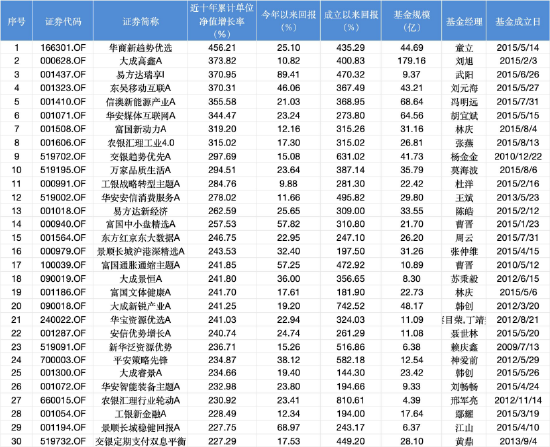
Core Insights - The A-share market has reached a ten-year high, drawing attention to equity funds, with over 90% of the 1,053 equity funds showing positive returns over the past decade [1][5] Fund Performance - The top-performing fund over the past ten years is Huashang New Trend Preferred, with a total return of 456.21%, showcasing the fund manager's excellent stock selection and risk control abilities [2] - Dachen Gaoxin A ranks second with a return of 373.82% and is the only fund in the top 30 with a scale exceeding 100 billion, indicating strong long-term performance [2] - Yifangda Ruixiang I ranks third with a return of 370.95%, demonstrating significant short-term performance with an 89.41% return this year [2] - Other notable funds include Dongwu Mobile Internet A, Xin'ao New Energy Industry A, and others, all exceeding 315% returns over the past decade [2][3] Fund Types and Strategies - Flexible allocation funds dominate the top rankings, with six out of the top ten funds employing flexible asset allocation and industry rotation strategies [3] - Ordinary stock and mixed equity funds also performed well, with Dachen Gaoxin A and Xin'ao New Energy Industry A making it to the top ten [4] Fund Characteristics - The top-performing funds exhibit diversity in scale, with both large funds like Dachen Gaoxin A and smaller funds under 1 billion [4] - Most top funds were established in 2015, coinciding with a market low that allowed for significant growth potential [4] - The funds reflect current industry trends, focusing on sectors like new energy, technological innovation, and high-end manufacturing, aligning with China's economic transformation [4] Company Research and Investment Strategy - The performance of funds from companies like Fuguo Fund, Dachen Fund, and Huashan Fund indicates strong overall research and investment capabilities [5] - Long-term investment, selecting excellent fund managers, and understanding different strategy characteristics are crucial for achieving good investment returns [5] - The public fund industry is expected to continue leveraging its professional advantages to create stable long-term returns for investors as market reforms progress [5]

2025《财富》中国科技50强榜单揭晓:华为、DeepSeek等入选
Sou Hu Cai Jing· 2025-08-21 07:46
8月21日,《财富》杂志发布了2025年中国科技50强榜单,华为投资控股有限公司、深度求索(DeepSeek)、宁德时代新能源科技股份有限公司等多家科 技企业入选。该榜单涵盖人工智能、新能源、生物医药、高端制造等多个前沿领域。 据《财富》介绍,在技术迭代与市场需求的交汇中,中国公司们正在以强大的执行力推动科技落地。在大模型领域,它们避开空泛的概念炒作,聚焦金 融、医疗等垂直领域的模型优化,提高效率;它们通过优化关节灵活性与续航能力,让机器替代人类进入高危、高强度作业场景;它们研发更高效、清洁 的能源,让人类与自然更和谐相处。 除上述公司外,阿里巴巴、腾讯、比亚迪、字节跳动等知名科技企业也跻身该榜单。值得注意的是,不少新兴科技公司如宇树科技、稀宇科技、玻色量子 等同样凭借在细分领域的创新表现获得认可。 | 北京字节跳动科技有限公司 | | --- | | 杭州宇树科技股份有限公司 | | 大疆创新 | | 石药控股集团有限公司 | | 联想集团有限公司 | | 京东方科技集团股份有限公司 | | 上海稀宇科技有限公司 | | 大族激光科技产业集团股份有限公司 | | 杭州云深处科技有限公司 | | 顺丰科技有限 ...




权益类基金发行、成立、建仓全链条提速
Zheng Quan Ri Bao· 2025-08-20 16:44
Core Viewpoint - The A-share market has shown strong performance, leading to increased investor confidence and accelerated fundraising activities in equity funds [1][3]. Group 1: Fundraising and Market Activity - Multiple equity funds have completed fundraising ahead of schedule, indicating high investor demand, with some funds raising their target amounts in just one day [2][3]. - The recent trend shows that over 60 equity funds have been established since August, with many new funds experiencing significant net asset value (NAV) growth shortly after inception [3][4]. Group 2: Fund Management and Investment Strategy - Fund managers are actively increasing their equity positions, with average stock holdings reaching high levels; ordinary equity funds have an average equity position of approximately 91.41% [4]. - The rapid deployment of capital by fund managers reflects a positive outlook on market conditions, which is expected to attract more incremental funds into the equity market [4]. Group 3: Market Outlook and Sector Focus - The market is currently driven by increased liquidity, with a preference for technology and small-cap stocks expected to outperform in the short term [5]. - Future investment strategies should focus on sectors with positive fundamental changes driven by policy, particularly technology, consumption, high-end manufacturing, and pharmaceuticals [6].

东兴证券晨报-20250820
Dongxing Securities· 2025-08-20 10:26
Economic News - The Ministry of Industry and Information Technology held a meeting on August 19 to discuss the photovoltaic industry, emphasizing the importance of regulating competition and promoting sustainable development [1] - The European Union plans to prepare a new round of sanctions against Russia by September, aiming to support Ukraine [1] - Shanghai's government released an implementation plan to accelerate the development of "AI + manufacturing," targeting the integration of AI technology into the manufacturing sector [1] - The People's Bank of China announced the latest Loan Prime Rate (LPR) on August 20, with the 5-year LPR remaining at 3.5% and the 1-year LPR at 3% [1] - The 24th meeting of special representatives on the China-India border issue was held in New Delhi, resulting in a 10-point consensus [1] - Hainan released a new management method for high-demand talent enjoying personal income tax preferential policies, optimizing the previous version [1] Company Insights - Apple has entered large-scale production of the iPhone 17, with Foxconn ramping up hiring at its Zhengzhou factory [6] - DeepSeek upgraded its online model to version 3.1, expanding context length to 128k [6] - NIO announced a price reduction of 20,000 yuan for its 100 kWh battery pack, effective August 19, which will lower the price of vehicles equipped with this battery [6] Market Analysis - The report indicates a gradual strengthening of a slow bull market, with the market breaking through the 3400-point level and showing increased trading activity [9] - The report suggests that the market is expected to target the 4000-point level, with a transition from a virtual to a real economy, providing a foundation for the slow bull market [10] - The focus for investment should be on large technology sectors, particularly in AI, robotics, and innovative pharmaceuticals, as these areas are expected to drive future growth [11] Company Performance - Daya Co. reported a 4.19% decrease in revenue for the first half of 2025, but achieved a net profit of 0.42 billion yuan, compared to a loss in the previous year [21] - The company’s gross profit increased by 30% in the first half of 2025, with a gross margin rising to 7.74% [22] - The company is investing approximately 1.485 billion yuan in a production base in Morocco, which is expected to enhance its international competitiveness and reduce shipping costs [24] - The company plans to achieve an integrated energy supply model by 2026, combining solar, wind, and biomass energy [25] Industry Trends - The lithium battery equipment industry is expected to see significant growth, driven by the demand for electric vehicles and energy storage solutions [34] - The report highlights the advantages of dry electrode technology over traditional wet methods, predicting a shift towards this technology in the future [38] - The overall market for solid-state battery equipment is projected to grow significantly, with a compound annual growth rate of 70% from 2024 to 2029 [37]
新雷能(300593):25H1业绩承压 静待花开
Xin Lang Cai Jing· 2025-08-20 08:35
Core Viewpoint - The company reported a revenue of 552 million in H1 2025, reflecting a year-on-year growth of 12.93%, but faced a net loss of 95 million, which is a 39.82% increase in losses compared to the previous year, indicating short-term profit pressure despite revenue improvement [1] Revenue and Profit Analysis - H1 2025 revenue improved with a year-on-year growth of 12.93%, reaching 552 million, but the net loss expanded to 95 million, a 39.82% increase in losses year-on-year [1] - The gross margin decreased to 39.10%, down 3.78 percentage points year-on-year, indicating weakened profitability [1] - Revenue from power, electric drive, and motor products was 501 million, accounting for 90.71% of total revenue, with a gross margin of 37.42%, which is the lowest for the historical period [1] - Other business revenue increased by 50.93% to 51 million, representing 9.29% of total revenue [1] - Overseas business revenue dropped to 24 million, a decrease of 44.72% year-on-year, with its share of total revenue falling from 18.42% in 2023 to 4.37% [1] Quarterly Performance - In Q2 2025, revenue was 319 million, showing a year-on-year increase of 10.29% and a quarter-on-quarter increase of 36.62%, reflecting a recovery in downstream demand [2] - The net loss for Q2 2025 was 51 million, with losses expanding by 74.35% year-on-year and 17.52% quarter-on-quarter [2] Cost and Expense Management - The expense ratio in H1 2025 decreased by 3.10 percentage points year-on-year but remained high at 54.30%, further compressing profits [2] - Financial expense ratio increased to 2.98%, primarily due to increased loan scale, interest, and reduced deposit interest [2] - Accounts receivable management improved, with accounts receivable decreasing by 0.22% compared to the end of 2024, marking seven consecutive quarters of reduction [2] R&D and Capacity Expansion - The company has increased R&D investments since the second half of 2023, focusing on integrated circuits, data centers, motor drives, commercial satellites, and energy storage, which may lead to future growth [3] - The production capacity for communication and server power supplies has been expanded by nearly 50%, with new projects expected to double the capacity for special power supplies by October 2025 [3] Investment Outlook - The company is expanding its application areas for special power supplies into low-orbit satellites, servers, and new energy sectors, enhancing its competitive position [3] - Forecasted net profits for 2025-2027 are 45 million, 145 million, and 217 million respectively, with corresponding EPS of 0.08, 0.27, and 0.40, indicating positive marginal expectations [3]
新老产品齐上阵 公募基金抢抓建仓机遇
Shang Hai Zheng Quan Bao· 2025-08-19 19:25
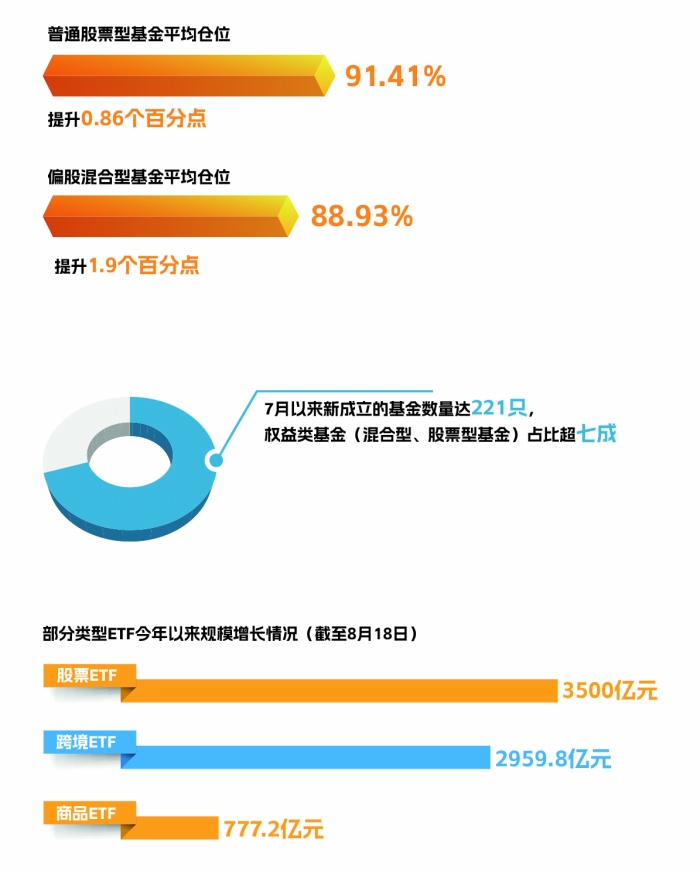
Group 1 - The core viewpoint indicates that public funds are increasing their market entry efforts, with active equity funds' stock positions reaching a high for the year [2][5] - Newly established funds are rapidly building positions, with many products achieving over 10% returns within approximately one month of establishment, capitalizing on market uptrends [2][3] - As of August 15, the average stock position of ordinary equity funds is approximately 91.41%, an increase of 0.86 percentage points from August 8, while the average position of equity hybrid funds is about 88.93%, up by 1.9 percentage points [5] Group 2 - Several newly established funds have reported significant returns, with 10 products achieving over 5% returns since inception, and 4 of these exceeding 11% [3][4] - The Invesco Great Wall Growth Mixed Fund, established on June 27, has achieved a return of 18.61% since inception, while other funds like the Harvest Growth Win Mixed Fund and the E Fund Growth Progress Mixed Fund have returns of 14.4% and 13.13%, respectively [3] - Fund managers are optimistic about the market outlook, as the rapid building of positions in new funds reflects confidence in future market performance [4][5] Group 3 - Public funds are focusing on growth sectors, particularly increasing allocations in the telecommunications industry, which has seen the most significant accumulation over the past three months [5] - There is a noted decrease in allocation to the consumer sector, with the food and beverage industry's allocation reaching a low point in recent years [5] - Institutions maintain an optimistic outlook for the market, anticipating a steady recovery in the economic fundamentals and a revaluation of Chinese assets [5]
海能达(002583):短期承压蓄势,复苏拐点可期
CMS· 2025-08-19 10:32
Investment Rating - The investment rating for the company is "Add" [4] Core Views - The company reported a revenue of 2.259 billion yuan for the first half of 2025, a year-on-year decrease of 17.50%, and a net profit attributable to shareholders of 93.58 million yuan, down 42.37% year-on-year [1] - The company is a global leader in specialized communication and solutions, focusing on public safety, emergency, energy, transportation, and commercial sectors, aiming to enhance communication devices and solutions [7] - The company is expected to turn profitable in 2025, with projected net profits of 542 million yuan, 719 million yuan, and 860 million yuan for 2025, 2026, and 2027 respectively, reflecting growth rates of 798%, 33%, and 20% [7] Financial Data and Valuation - Total revenue is projected to grow from 56.53 billion yuan in 2023 to 87.11 billion yuan in 2027, with a compound annual growth rate (CAGR) of 12% [3][13] - The company is expected to achieve a net profit margin of 7.9% in 2025, increasing to 9.9% by 2027 [14] - The price-to-earnings (PE) ratio is projected to improve from -58.9 in 2023 to 26.6 in 2027 [14] Business Strategy - The company is optimizing its supply chain strategy and focusing on high-end manufacturing, particularly in the fields of new energy vehicles, robotics, and server applications [7] - The company has established a sales network in over 120 countries and regions, enhancing its global market presence [7] Shareholder Information - The major shareholder is Chen Qingzhou, holding a 39.2% stake in the company [4]

顺威股份2025年上半年归母净利润同比增长38.59%
Zheng Quan Ri Bao Zhi Sheng· 2025-08-19 09:11
Core Viewpoint - The company, Guangdong Shunwei Precision Plastic Co., Ltd., reported steady growth in its operating performance for the first half of 2025, driven by favorable national policies and strong market demand in the air conditioning and automotive sectors [1][2]. Group 1: Financial Performance - In the first half of 2025, the company achieved operating revenue of 1.584 billion yuan, a year-on-year increase of 14.27% [1]. - The net profit attributable to shareholders reached 56.56 million yuan, reflecting a year-on-year growth of 38.59% [1]. Group 2: Market Drivers - The growth in revenue is attributed to the continuation and optimization of the "old-for-new" policy by the government, alongside sustained high temperatures boosting air conditioning demand [1]. - The acquisition of Jiangsu Junwei Precision Components Technology Co., Ltd. in July 2024 has enabled the company to leverage its operational management capabilities to enhance the automotive parts business [1]. Group 3: Technological Advancements - The company has received CNAS laboratory accreditation for its low-pressure fan system laboratory, enhancing its competitive edge in high-end manufacturing [2]. - As of June 30, 2025, the company holds 676 valid intellectual property rights and collaborates with leading research institutions and universities [2]. - The company has developed a replicable 5G smart manufacturing model, achieving efficient control in manufacturing, quality, and delivery [2]. Group 4: Future Outlook - The company aims to continue leveraging its advantages to expand into high-end manufacturing and new energy vehicle components, optimizing its industrial layout and enhancing business diversification [2].

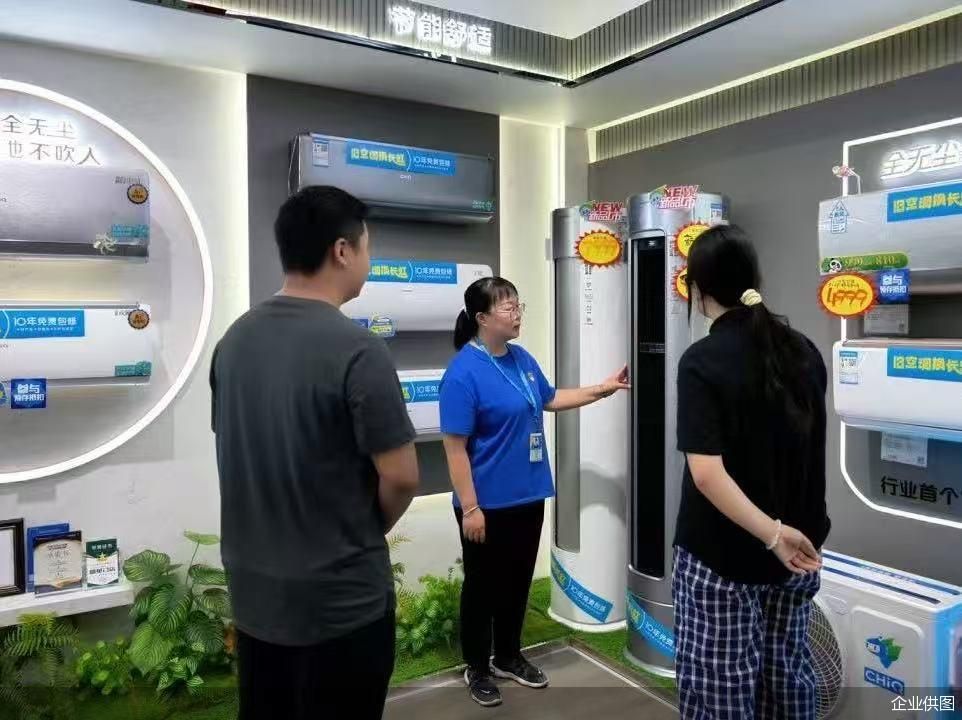
以旧换新政策显效 前7月北京家电消费增6.9%
Bei Jing Shang Bao· 2025-08-18 16:16
Economic Overview - In the first seven months of 2025, Beijing's economy showed overall stability, with industrial production and fixed asset investment maintaining growth, and the consumer market recovering under policy support [1][2] - The total retail sales of consumer goods reached 767.43 billion yuan, a decrease of 4.2% year-on-year, while the total market consumption increased by 0.7% [3] Industrial Production - The industrial added value above designated size grew by 6.1% year-on-year, with significant growth in key sectors such as computer, communication, and other electronic equipment manufacturing at 24.2%, and automotive manufacturing at 11.5% [1] - Strategic emerging industries and high-tech manufacturing added value increased by 17.2% and 9.5% respectively, with lithium batteries and new energy vehicles seeing production increases of 2.6 times and 1.5 times [1] Fixed Asset Investment - Fixed asset investment (excluding rural households) grew by 10.8% year-on-year, with the primary industry investment increasing by 68.3%, secondary industry by 10.5%, and tertiary industry by 10.7% [2] - Investment in high-tech industries remained active, with a growth rate of 58.7% in the first seven months [2] Consumer Market Dynamics - The "old-for-new" policy stimulated the consumer market, particularly in household appliances and audio-visual equipment, which saw a retail sales increase of 6.9%, up 2.3 percentage points from the first half of the year [3] - Service consumption, driven by information services, transportation, and cultural entertainment, grew by 4.6%, becoming a key engine for consumption growth [3] Employment and Industry Development - The policies not only stimulated consumption but also promoted the development of logistics and recycling industries, creating more job opportunities [4]
“以旧换新”政策显效 1—7月北京家电消费增长6.9%
Bei Jing Shang Bao· 2025-08-18 13:46
Economic Overview - Beijing's economy showed overall stability in the first seven months of 2025, with industrial production and fixed asset investment maintaining growth, and the consumption market recovering under policy support [2][3]. Industrial Production - The industrial added value for large-scale enterprises increased by 6.1% year-on-year, with significant growth in the computer, communication, and electronic equipment manufacturing sector at 24.2% [3]. - The automotive manufacturing sector grew by 11.5%, while the pharmaceutical manufacturing sector saw a decline of 9.3% [3]. - High-tech manufacturing and strategic emerging industries reported added value growth of 9.5% and 17.2%, respectively, with lithium batteries and new energy vehicles seeing production increases of 2.6 times and 1.5 times [3]. Fixed Asset Investment - Fixed asset investment (excluding rural households) rose by 10.8% year-on-year, with equipment purchase investment growing by 80.3% [4]. - Infrastructure investment increased by 4.3%, while real estate development investment decreased by 9.9% [4]. - High-tech industry investment remained active, growing by 58.7% [4]. Consumption Market - Total market consumption increased by 0.7%, with service consumption growing by 4.6%, driven by information services and entertainment sectors [5]. - Retail sales of consumer goods totaled 767.43 billion yuan, a decline of 4.2%, but home appliances and audio-visual equipment sales rose by 6.9% due to the "old for new" policy [5][6]. Price Levels - Consumer prices in Beijing decreased by 0.3% year-on-year, with food prices down by 1.8% and non-food prices down by 0.1% [7]. - Prices for clothing, housing, and other services saw slight increases, while healthcare and transportation prices experienced declines [7].