商业航天

Search documents
山西证券研究早观点-20260206
Shanxi Securities· 2026-02-06 04:03
Market Overview - The domestic market indices showed mixed performance, with the Shanghai Composite Index closing at 4,075.92, down 0.64%, and the Shenzhen Component Index at 13,952.71, down 1.44% [4][5] - During the period from January 26 to February 1, the A-share average daily trading volume increased by 11.27% to 3.11 trillion yuan, while the margin trading balance reached 2.72 trillion yuan [8] Industry Insights - The financial sector is highlighted as a key area for investment, with a focus on building a strong financial nation and improving the investment value of the sector [6][8] - The defense and military industry is entering a new growth phase, driven by geopolitical tensions and advancements in commercial aerospace, with significant opportunities expected in 2026 [9][10] Company Analysis: Ecovacs (科沃斯) - Ecovacs is projected to improve its profitability, with expected earnings per share (EPS) of 2.98 yuan, 3.49 yuan, and 4.05 yuan for 2025-2027, corresponding to price-to-earnings (PE) ratios of 24.0x, 20.5x, and 17.7x respectively [11] - The company anticipates a substantial increase in net profit for 2025, estimated between 1.7 billion to 1.8 billion yuan, representing a year-on-year growth of 110.9% to 123.3% [13] - Ecovacs showcased new products at CES, including various service robots, indicating a strategic shift towards multi-category offerings and full-scenario service robots [10][13] Industry Commentary: Eli Lilly - Eli Lilly's Tirzepatide has become the top prescription drug in the U.S., with projected revenues of $65.18 billion in 2025, marking a 45% increase [14] - The company is expanding its clinical pipeline, focusing on cardiovascular benefits and obesity treatments, with significant growth expected from its oral GLP-1 agonist, Orforglipron [14][16]
商业航天利好不断,航空航天ETF(159227)持续获资金布局
Xin Lang Cai Jing· 2026-02-06 03:37
Core Viewpoint - The aerospace industry is experiencing positive momentum with significant investments and developments in commercial space, driven by advancements in technology and military trade expectations [1][2]. Group 1: Market Performance - The CN5082 aerospace industry index shows mixed performance among its constituent stocks, with Changyingtong leading at a 5.37% increase, while Beimo Gaoke is the biggest loser [1]. - The Aerospace ETF (159227) is currently priced at 1.46 yuan, reflecting active trading with a turnover rate of 6.18% and a transaction volume of 2.12 billion yuan [1]. Group 2: Investment Trends - There has been a net inflow of 1.05 billion yuan into the Aerospace ETF over the past five trading days, averaging a daily net inflow of 21.08 million yuan [1]. - The commercial space sector is attracting capital despite market fluctuations, indicating strong investor interest [1]. Group 3: Future Outlook - Shanxi Securities highlights increasing expectations for military trade, with a significant number of rocket launches planned by the end of 2025 and accelerated deployment of satellite internet [1]. - The year 2026 is projected to be pivotal for the aerospace industry, with multiple new medium and large rockets set for their inaugural flights and advancements in reusable technology [1]. - The commercial aerospace sector is anticipated to enter a period of explosive growth as capacity constraints are effectively addressed [1]. Group 4: ETF Composition - The Aerospace ETF closely tracks the CN5082 index, covering critical segments such as aerospace equipment, satellite navigation, and new materials, with commercial aerospace concepts accounting for 70% of its weight [2]. - The top ten holdings include industry leaders like Aerospace Development, China Satellite, and AVIC [2].
独家|刚刚,开年最大商业航天融资来了
投中网· 2026-02-06 02:38
Core Viewpoint - The article highlights the rapid financing activity in the commercial aerospace sector, particularly focusing on Shanghai Xingsi Semiconductor, which has secured nearly 1.5 billion yuan in strategic financing, marking it as the largest financing in the commercial aerospace field for 2026 so far [4][5]. Group 1: Financing Details - Shanghai Xingsi Semiconductor completed multiple rounds of strategic financing, totaling nearly 1.5 billion yuan, with participation from various state-owned and market-oriented funds [4][5]. - The financing process was notably swift, with some state-owned investors completing the entire process from project initiation to funding in just one month, described as the fastest in history [5][6]. - The enthusiasm from state-owned capital is attributed to the long-term relationships established with the company over the past few years, as well as the certainty surrounding the commercial aerospace sector [6][7]. Group 2: Company Background and Market Position - Founded in October 2020, Shanghai Xingsi Semiconductor focuses on the research and development of 5G/6G communication technology and has achieved significant milestones, including the successful development of its first 5G eMBB baseband chip [10][11]. - The company has faced challenges in the past, including a down round in its B financing, where the pre-financing valuation dropped to approximately 3 billion yuan from 5 billion yuan, reflecting the tough market conditions for chip companies [11][12]. - Despite these challenges, the company has pivoted towards low-orbit satellite internet communication, positioning itself to benefit from the upcoming commercial aerospace boom [13][15]. Group 3: Technological Advancements and Future Prospects - Shanghai Xingsi Semiconductor is well-positioned in the 5G/6G NTN satellite communication chip market, which is expected to be a significant beneficiary of the commercial aerospace trend [15][16]. - The company has made substantial progress in technology, achieving a global first with a smartphone capable of satellite video calls based on the 5G NTN standard [16]. - Collaborations with major smartphone manufacturers and automotive companies indicate a strong commercial outlook, with the potential for significant market growth in consumer electronics and automotive sectors [17][18].

商业航天概念回暖巨力索具13天7板
Cai Jing Wang· 2026-02-06 02:15
Group 1 - The commercial space industry is experiencing a partial recovery, with companies like Giant Lifting Equipment seeing significant stock performance, achieving 7 trading limits in 13 days [1] - Other companies in the sector, such as Zhonghuan Hailu, Tianma New Materials, Xinwei Communication, Shenjian Co., and Goldwind Technology, also saw stock increases, with Zhonghuan Hailu rising over 10% [1] - Elon Musk, during an appearance on the Dwarkesh Podcast, stated that running AI in space will be the most cost-effective option, potentially occurring within 30 to 36 months [1]


卫星ETF鹏华(563790)涨近1%,马斯克称太空将成为AI部署的最廉价选择
Xin Lang Cai Jing· 2026-02-06 02:11
Group 1 - The core viewpoint of the article highlights the potential for AI in space operations to become the most cost-effective solution within the next 30 to 36 months, as stated by Elon Musk during a podcast appearance [1] - Shanxi Securities predicts a surge in the commercial aerospace sector by the end of 2025, driven by a rapid increase in rocket launches and satellite internet deployment, with multiple new medium to large rockets expected to debut in 2026 [1] - The China Satellite Industry Index (931594) saw a 0.82% increase, with notable stock performances from companies such as Changjiang Communication (+10.01%), Xinwei Communication (+6.91%), and Hailanxin (+4.07%) [1] Group 2 - As of January 30, 2026, the top ten weighted stocks in the China Satellite Industry Index (931594) include Aerospace Electronics, China Satellite, and Zhenlei Technology, collectively accounting for 64.36% of the index [2]
极光星通完成A4轮近3亿元融资,指数资本继续担任财务顾问
Sou Hu Cai Jing· 2026-02-06 02:10
Core Insights - Beijing Aurora Star Technology Co., Ltd. has completed a Series A4 financing round, raising nearly 300 million RMB, with participation from multiple investors including Beijing Information Industry Fund and Yuekai Capital [1][10] - The funds will primarily be used for the R&D iteration of next-generation space laser communication products, automation production line construction, and upgrading on-orbit technology verification capabilities [1][5] Company Development - Aurora Star aims to provide affordable and high-quality space laser communication products, focusing on the construction of integrated optical communication network infrastructure [2] - The company has established a fully autonomous technology system covering various aspects and has launched multiple types of spaceborne, airborne, and ground laser communication terminals [2] - Current production capacity stands at 200 units, with 12 terminals already operating in orbit, and an expected delivery of over 100 units by 2026, with capacity expansion to 800 units [2] Technological Advancements - In 2025, the company achieved significant advancements in core technology iteration and engineering applications, launching a third-generation laser communication terminal that enhances reliability and stability [2][4] - The company has made breakthroughs in key performance indicators, including rapid link establishment and ultra-high-speed inter-satellite communication, filling domestic gaps in on-orbit verification [4] Manufacturing and Delivery Capabilities - The company has completed small-scale batch deliveries of dozens of units and reduced the overall production testing cycle to 120 days [4] - Automation production line construction is accelerating, transitioning laser communication terminals from research prototypes to standardized industrial products [4] Market Position and Future Outlook - The financing round is seen as a significant event in the domestic space laser communication sector, providing strong momentum for the company to advance its technology from "maturity" to "standardization" [10] - The company is positioned to play a crucial role in the construction of future satellite internet and integrated information networks, with a focus on enhancing engineering mass production capabilities and accelerating delivery rhythms [7][10] - The commercial space industry in China is entering a phase of standardized, high-quality development, supported by government initiatives and capital market optimizations [4][5]

又一家企业冲击上市!老板是乐清90后
Sou Hu Cai Jing· 2026-02-06 02:10
Core Viewpoint - Hangzhou Yijia 3D Printing Technology Co., Ltd. (referred to as "Yijia Additive") is a key supplier of core manufacturing equipment in the commercial aerospace sector, leveraging its large-scale metal 3D printing capabilities to secure a competitive position in a trillion-yuan market and is preparing for an IPO on the Sci-Tech Innovation Board [1][3]. Group 1: Company Overview - Yijia Additive focuses on the research, production, and sales of industrial-grade additive manufacturing (3D printing) equipment [1]. - The company has applied for an IPO on the Sci-Tech Innovation Board, aiming to raise 1.205 billion yuan for expansion in metal 3D printing, industrialization projects, and R&D center construction [3]. Group 2: Financial Performance - The financial data disclosed in the prospectus indicates a clear growth trajectory, with revenue projected to increase from 247 million yuan in 2022 to 471 million yuan in 2024, representing a compound annual growth rate (CAGR) of 38.06% [3]. - The company has led three national key R&D projects organized by the Ministry of Science and Technology [3]. Group 3: Technological Advancements - Yijia Additive holds over 130 authorized patents, including 50 invention patents and 45 software copyrights, and has participated in formulating 14 national and industry standards [4]. - The company has successfully addressed three major industry challenges in powder bed metal 3D printing technology, enhancing manufacturing efficiency and reducing costs, which aligns with the stringent requirements of commercial aerospace [4]. Group 4: Market Position and Expansion - Yijia Additive's solutions have been deeply integrated with leading commercial aerospace companies such as Blue Arrow Aerospace, Tianbing Technology, and others [4]. - The company has established subsidiaries in Germany and the United States, expanding its product reach to multiple countries and regions, thereby creating a global service network [4]. Group 5: Future Prospects - Industry insiders believe that the capital market's support will amplify Yijia Additive's technological and market advantages, enabling it to capture the lucrative opportunities in the trillion-yuan commercial aerospace market [5].
单笔最大融资,北京、广州投了国内激光通信黑马
3 6 Ke· 2026-02-06 01:46
Group 1 - Elon Musk has announced plans to deploy and operate up to 1 million satellites and has acquired xAI to integrate AI with commercial space, marking a significant development in the industry [1] - The Chinese National Space Administration has established a Commercial Space Administration and released a plan for high-quality and safe development of commercial space from 2025 to 2027, indicating a systematic approach to industry growth [1] - The plan includes launching over 10,000 low-orbit satellites between 2026 and 2030, accelerating market maturity [1] Group 2 - Beijing Aurora Starlink Technology Co., Ltd. has completed a Series A4 financing round, raising nearly 300 million RMB, setting a record for the largest single financing in China's space laser communication sector [2] - The funds will be used for the R&D of next-generation space laser communication products, automation production line construction, and upgrading on-orbit technology verification capabilities [2] Group 3 - The founder of Aurora Starlink, Wu Shaojun, transitioned from a stable career in aerospace research to entrepreneurship, recognizing the historic opportunity in commercial space [3] - The company aims to provide affordable and effective space laser communication products, facilitating the construction of a space-based communication network [5] Group 4 - Aurora Starlink's technology team comprises experts from prestigious institutions, enhancing its competitive edge in the laser communication market [4] - The company has developed a full autonomous technology system covering all aspects of laser communication product R&D and production capabilities [6] Group 5 - The competition in the laser communication field has shifted from pure research to commercial viability, with Aurora Starlink positioned to capitalize on the growing demand for laser communication technology [4][6] - The company has launched multiple satellite terminal products and is focusing on high-value starborne applications, with over 80% of resources dedicated to satellite-based solutions [7] Group 6 - Local governments are increasingly investing in commercial space, with various regions establishing funds and policies to support the industry, indicating a strategic focus on space technology [9][10] - Beijing's investment fund is actively supporting Aurora Starlink, recognizing the strategic importance of space laser communication for national infrastructure [10]
财富通每日策略-20260206
Dongguan Securities· 2026-02-06 01:43
Market Performance - The Shanghai Composite Index closed at 4075.92, down by 0.64% (-26.29 points) [2] - The Shenzhen Component Index closed at 13952.71, down by 1.44% (-203.56 points) [2] - The CSI 300 Index closed at 4670.42, down by 0.60% (-28.26 points) [2] - The ChiNext Index closed at 3260.28, down by 1.55% (-51.24 points) [2] - The STAR 50 Index closed at 1432.52, down by 1.44% (-20.95 points) [2] - The Beijing Stock Exchange 50 Index closed at 1507.29, down by 2.03% (-31.28 points) [2] Sector Performance - The top-performing sectors included Beauty Care (3.21%), Banks (1.57%), and Food & Beverage (1.31%) [3] - The worst-performing sectors included Non-ferrous Metals (-4.57%), Electric Power Equipment (-3.41%), and Coal (-2.22%) [3] - Concept sectors showing strength included Horse Racing (1.89%) and Duty-Free Shops (1.33%) [3] - Concept sectors underperforming included BC Battery (-5.18%) and Lead Metal (-4.14%) [3] Market Outlook - The market experienced a weak adjustment with all major indices closing lower, particularly the ChiNext Index [4] - Consumer sectors showed resilience with significant activity in Food & Beverage, Retail, and Tourism [4] - The financial sector strengthened in the afternoon, while commodities like Non-ferrous Metals and Oil & Gas faced declines [4] - The overall market sentiment indicated more stocks declining than rising, with over 3700 stocks down [6] Economic Indicators - The total trading volume in the Shanghai and Shenzhen markets was 2.18 trillion, a decrease of 304.8 billion from the previous trading day [6] - Industrial profits for large-scale industrial enterprises are projected to grow by only 0.6% in 2025, below GDP growth [6] - The People's Bank of China emphasized support for key sectors like technology innovation and small to medium enterprises [5] Risks - Potential risks include unexpected declines in the overseas economy and prolonged high interest rates affecting domestic liquidity [7] - Trade tensions between China and the U.S. could further pressure domestic exports [7]
滚动更新丨A股三大指数集体低开,中药板块表现活跃
Di Yi Cai Jing· 2026-02-06 01:37
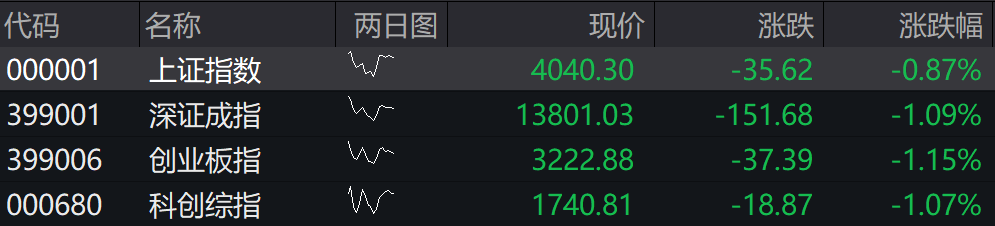
Market Overview - The gold and base metal sectors are experiencing a decline, while the semiconductor and computing hardware supply chains continue to drop [1] - The A-share market opened lower, with the Shanghai Composite Index down 0.87%, the Shenzhen Component Index down 1.09%, and the ChiNext Index down 1.15% [2][3] Sector Performance - The precious metals sector continues its downward trend, with companies like Hunan Silver, Xinyi Silver, and Shengda Resources hitting the daily limit down [1] - The Chinese medicine sector is active, with companies such as Te Yi Pharmaceutical and Panlong Pharmaceutical hitting the daily limit up, and Biotech Valley rising over 15% [1] - The oil and gas, chemical, and coal sectors are among the hardest hit, showing significant declines [3] Individual Stock Movements - Jiangfeng Electronics saw a slight increase of 0.09% after resuming trading, as the company plans to acquire control of Kaide Quartz [3] - The Hang Seng Index opened down 1.97%, with the Hang Seng Tech Index dropping 2.42%, and major tech stocks like Baidu and Alibaba falling over 3% [5][6]