
AGI

Search documents
张一鸣久违现身 大佬纷纷杀回一线
智通财经网· 2025-10-11 10:33
Core Insights - Zhang Yiming, the founder of ByteDance, has returned to the public eye by co-founding the Xu Hui Zhichun Innovation Center, focusing on cutting-edge computer and AI technology innovation, open-source tools, and talent cultivation [1][2] - The center aims to nurture innovative talent with active thinking, passion, resilience, and a long-term perspective, addressing the underutilization of potential in many individuals [1] - Zhang's return is significant as it marks his first public appearance since stepping down as CEO in 2021, drawing considerable attention from the industry [1][2] Company Developments - After stepping down, Zhang Yiming distanced himself from the spotlight, focusing on learning and exploring new ideas, particularly in the AI sector [2] - ByteDance has been a key player in the AI landscape, with its AI application "Doubao" achieving over 1.57 billion monthly active users as of August, marking a year-on-year growth of 864.35% [3] - The company has launched several advanced AI models, including the Doubao 1.6 series, which features enhanced capabilities for complex reasoning and adaptive thinking [3][4] Investment and Future Plans - ByteDance plans to invest over $12 billion in AI infrastructure by 2025, doubling its capital expenditure from 2024 [4][5] - The company is not only focusing on AI applications but is also committed to foundational research in AGI (Artificial General Intelligence) through projects like "Seed Edge" [4][5] - This strategic investment indicates ByteDance's ambition to become a major player in the AI era, potentially reshaping the competitive landscape of the industry [5] Industry Context - The return of Zhang Yiming aligns with a broader trend of internet leaders re-engaging with the industry amid the AI revolution, as seen with other founders like Liu Qiangdong and Jack Ma [6] - The emphasis on AI by these leaders suggests a significant shift in the competitive dynamics of the Chinese internet sector, with a focus on effective commercialization of AI applications [6]
张一鸣久违现身,大佬纷纷杀回一线
Hua Er Jie Jian Wen· 2025-10-11 09:12
Core Insights - Zhang Yiming, the founder of ByteDance, has returned to the public eye by co-founding the Xu Hui Zhichun Innovation Center, focusing on cutting-edge computer and AI technology research, open-source tools, and talent cultivation [1][2] - The center aims to nurture innovative talent with active thinking and resilience, emphasizing independent thought and practical experience [1] - Zhang's return is significant as it marks his first public appearance since stepping down as CEO in 2021, drawing considerable attention from the industry [1][2] Company Developments - After stepping down, Zhang Yiming distanced himself from the spotlight, focusing on learning and exploring new ideas, particularly in AI, which has become a critical factor for internet companies [2] - ByteDance has been a key player in the AI space, with its app Doubao achieving over 1.57 billion monthly active users, reflecting a 864.35% year-on-year growth [3] - The Doubao model family continues to evolve, with the release of the Doubao 1.6 series, which includes advanced capabilities for reasoning and complex task handling [3][4] Investment and Future Directions - ByteDance plans to invest over $12 billion in AI infrastructure by 2025, doubling its capital expenditure from 2024, focusing on building computing centers and developing DPU chips [4] - The return of industry leaders like Zhang Yiming, Liu Qiangdong, and Jack Ma indicates a renewed focus on AI, potentially reshaping the competitive landscape of the Chinese internet sector [5] - The emphasis on commercializing AI applications highlights the need for companies to deliver cost-effective and user-friendly solutions to succeed in the evolving market [5]
AI吞掉网文流量,底层作者正被「无声清退」
3 6 Ke· 2025-10-11 05:28
Core Viewpoint - The rise of AI-generated content is causing significant disruption in the literary industry, leading to protests from human authors against the unauthorized use of their works for AI training and the encroachment of AI on their creative space [1][21][25] Group 1: Author Protests and Legal Actions - Notable authors, including Grady Hendrix and Jennifer Robertson, have filed a collective lawsuit against Apple for allegedly using their works without permission to train the AI model OpenELM [1] - Over a thousand authors signed an open letter demanding publishers never release machine-generated books, emphasizing the importance of human emotional expression in literature [1][21] - In China, authors like Xiao Shen have reported instances of their works being replicated and modified by AI, leading to a sense of infringement and loss of income [2][3] Group 2: Impact on the Online Literature Industry - The influx of AI-generated content on platforms like Tomato Novel has surged dramatically, with new book releases increasing from 400 to 5606 in a year, a 13-fold increase [3][4] - Despite attempts by platforms to control AI content, the volume remains high, with nearly 2000 new books being released daily as of mid-September [3][4] - Authors are struggling to gain visibility and income as AI-generated works dominate the platform's traffic, leading to a decline in opportunities for new writers [4][5] Group 3: Author Experiences and Adaptations - Authors like Cang Shu have experienced a complete halt in their work's visibility on platforms, leading to a loss of income and forcing them to seek alternative avenues [4][5] - Some authors are transitioning to other creative fields, such as adapting their works into short dramas, in search of better financial stability [6][7] - The pressure to produce content has increased, with some authors reporting writing outputs significantly higher than average, yet still being overshadowed by AI capabilities [6][7] Group 4: AI's Evolving Capabilities - AI tools are becoming increasingly sophisticated, with capabilities to generate coherent and contextually relevant content, making it difficult for readers to distinguish between AI and human-written works [8][10] - The emergence of advanced AI writing tools has raised concerns about the future of the writing profession, as fully autonomous AI content generation could threaten traditional authorship [11][12] Group 5: Monetization and Market Dynamics - Individuals and teams are leveraging AI to produce large volumes of content quickly, with some reporting significant traffic and engagement on their AI-generated works [14][17] - The market for AI writing tools and courses is growing, with some users successfully monetizing AI-generated content through various platforms [18][19] - Despite the challenges posed by AI, platforms are currently siding with human authors, implementing measures to limit low-quality AI content while still allowing for some AI-assisted writing [21][25]
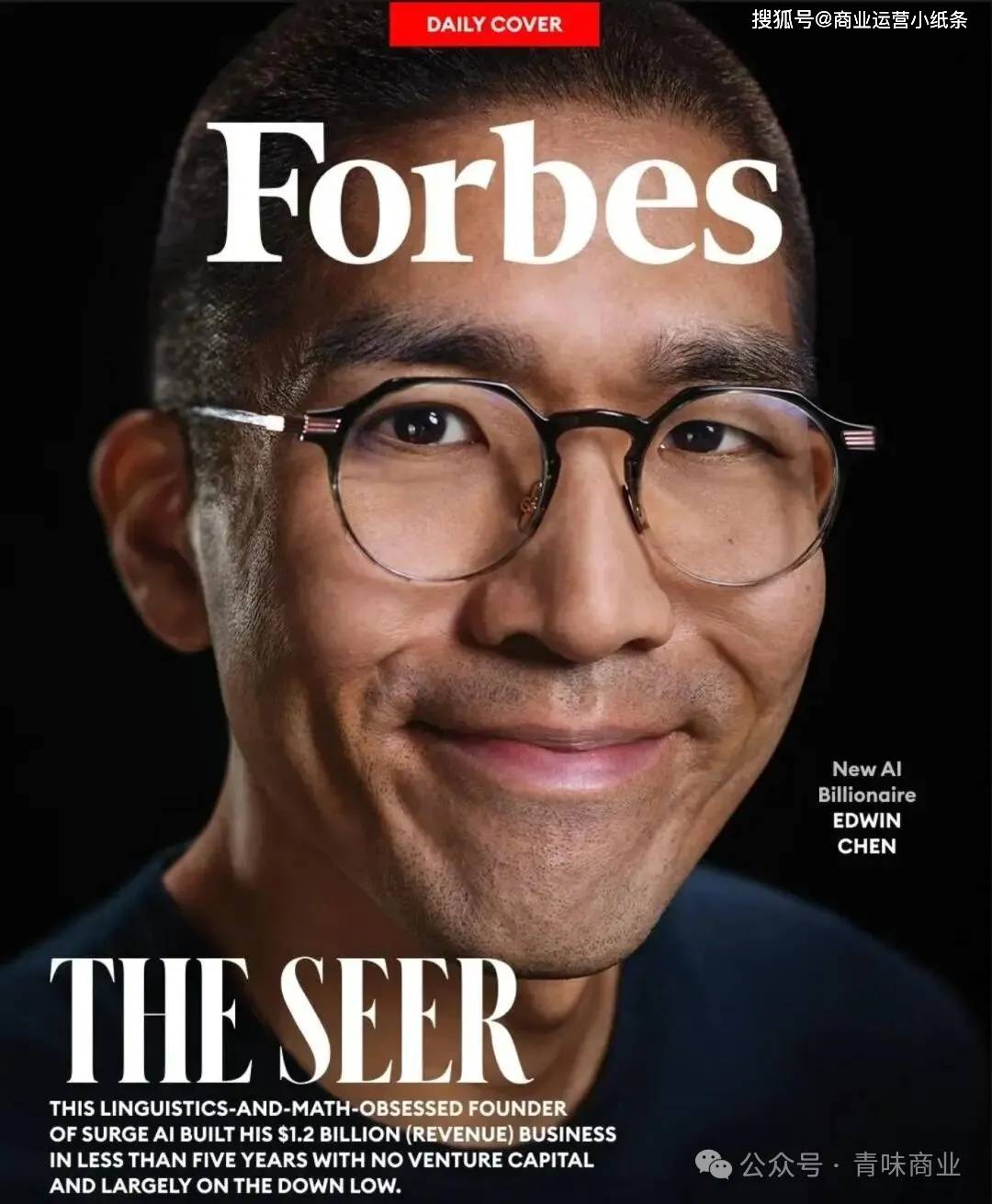
AI造富风暴中的“数据卖铲人”传奇:37岁华裔,登顶全球最年轻富豪
Sou Hu Cai Jing· 2025-10-11 01:35
Core Insights - Edwin Chen, a 37-year-old MIT graduate, has made headlines by debuting on the Forbes American Billionaires list with a net worth of $18 billion, thanks to his company Surge AI, which has reached a valuation of $24 billion in the AI data annotation sector [1][4][7] - Surge AI and Scale AI are positioned as key players in the AI industry, providing essential "data fuel" for algorithms, which is crucial for the development of advanced AI models like ChatGPT and Claude3 [4][6] Company Overview - Surge AI was founded by Edwin Chen in 2020 after he identified a significant gap in the data annotation market, particularly after a failed outsourcing attempt at Facebook [5][6] - The company has achieved remarkable growth, generating eight-digit revenue within 12 months of launching its first product, and has since secured contracts with major tech firms like OpenAI, Google, and Microsoft [6][10] Market Dynamics - The AI industry is experiencing a wealth creation surge, with data annotation companies like Surge AI benefiting from their unique positioning as "pick-and-shovel" providers in the AI gold rush [4][9] - The valuation of Surge AI has led to significant wealth accumulation for its founder, who holds 75% of the company's shares, highlighting the lucrative nature of the AI sector [7] Technological Advancements - Surge AI is developing advanced intelligent annotation systems capable of recognizing cultural nuances in over 200 languages and achieving extremely low error rates in medical image annotation [10] - The company is also working on cognitive annotation to enhance data with philosophical and ethical dimensions, setting it apart from competitors focused on basic classification tasks [10][11] Future Outlook - Despite warnings of a potential AI bubble, Edwin Chen remains focused on building a pathway to Artificial General Intelligence (AGI) through innovative data annotation solutions [11] - Surge AI's contracts emphasize the commercial value of data usage rights, indicating a shift towards viewing data as a critical asset in the evolving digital landscape [11]

X @Elon Musk
Elon Musk· 2025-10-10 06:26
YesΛI DRIVR (@AIDRIVR):FSD 14 feels more like AGI than any LLM ...
AI吞掉网文流量,底层作者正被“无声清退”|深氪lite
3 6 Ke· 2025-10-10 02:13
Group 1 - The core issue is the rising conflict between authors and AI-generated content, with authors feeling threatened by the unauthorized use of their works to train AI models [1][12][18] - A significant increase in AI-generated content has been observed on platforms like Tomato Novel, with new book releases skyrocketing from 400 to 5606 in one year, indicating a 1300% increase [4] - Authors are struggling to maintain visibility and income as AI-generated works flood the market, leading to a decline in their readership and revenue [5][6][21] Group 2 - The emergence of AI-assisted writing tools has allowed for rapid content production, with some authors able to generate up to 20,000 words daily, significantly impacting traditional writing practices [5][14] - Platforms are attempting to regulate AI content, but the effectiveness of these measures remains uncertain, as low-quality AI content continues to proliferate [18][21] - The market for AI-generated content is becoming lucrative, with some individuals successfully monetizing AI-written works, highlighting a shift in the industry dynamics [15][17] Group 3 - The backlash against AI content has led to collective actions from authors, including lawsuits and public protests against platforms that utilize AI in ways perceived as harmful to their rights [1][19] - Despite the challenges posed by AI, some authors still believe in the irreplaceability of human creativity, although the line between AI-generated and original content is becoming increasingly blurred [8][12][20] - The industry is witnessing a bifurcation, where established authors remain relatively unaffected while emerging writers face significant challenges due to the saturation of AI content [21]
腾讯研究院AI速递 20251010
腾讯研究院· 2025-10-09 16:01
Group 1: Generative AI Developments - Google DeepMind released the Gemini 2.5 Computer Use model, enabling AI to directly control user browsers for tasks like clicking and scrolling, achieving state-of-the-art performance in benchmarks, especially for multi-step and long-duration tasks [1] - Elon Musk's xAI launched the video generation model Imagine v0.9, which improves visual quality and audio generation, allowing users to create movie-like effects in under 20 seconds, although it still has limitations in text understanding and does not support Chinese [2] - Ant Group introduced and open-sourced the Ling-1T model with one trillion parameters, utilizing a self-developed MoE architecture, demonstrating exceptional performance in programming and mathematical reasoning tasks [3] Group 2: Image and Video Generation Technologies - Tencent launched Hunyuan Image 3.0 on the Yuanbao App, allowing users to generate content with unified styles through simple prompts, supporting various creative formats like comics and realistic photography [4] - Israeli startup AI21 Labs open-sourced the 3 billion parameter Jamba Reasoning model, designed for mobile use, outperforming competitors like Google's Gemma 3-4B in efficiency and context handling [5][6] Group 3: Scientific Achievements and Future Predictions - The 2025 Nobel Prize in Chemistry was awarded for contributions to metal-organic framework (MOF) materials, which can address environmental challenges by separating harmful substances and capturing water from the air [7] - Sam Altman described OpenAI's vision of a vertically integrated AGI empire, emphasizing the importance of AI in scientific discovery and predicting a significant role for AI in the next two years [8] Group 4: Robotics and Deployment Challenges - Figure, a company focused on humanoid robots, secured $1 billion in Series C funding, aiming for large-scale deployment in homes and businesses, highlighting the challenges of deployment over manufacturing in the robotics industry [9] - Experts predict that large-scale deployment in home settings will take at least 7-12 years, with commercial markets being more attractive in the short term [9] Group 5: AI Agent Development Insights - Google senior engineer Antonio Gulli published a book titled "Agent Design Patterns," summarizing 21 key design patterns in AI agent development, available for free online [10][11]

华尔街新“造王者”,OpenAI如何一言“指挥”美股?
Xin Lang Cai Jing· 2025-10-09 13:11
Core Insights - OpenAI is transitioning from a research lab to a comprehensive platform and ecosystem, aiming to become the "operating system" of the next computing era, supported by significant user growth and developer engagement [1][5]. Group 1: Platform Ambitions - OpenAI's strategy includes two main products, "Apps in ChatGPT" and "AgentKit," transforming ChatGPT into a robust application distribution and development platform [2][3]. - The introduction of a new Apps SDK allows developers to create fully functional applications within ChatGPT, enhancing user experience without leaving the chat interface [2][3]. - OpenAI is implementing an open standard called the Model Context Protocol (MCP) to facilitate seamless communication between models and external services, alongside a dedicated application directory for developers [3][4]. Group 2: Market Impact - OpenAI's new strategy has significantly influenced Wall Street, with the company unexpectedly becoming a major player in the stock market [5][6]. - A notable partnership with AMD involves a multi-billion dollar deal for high-performance AI chips, which includes a warrant allowing OpenAI to acquire up to 160 million shares of AMD, boosting AMD's stock price significantly [6][7]. - The market reaction extends to other companies mentioned during the conference, with stocks of partners like Figma and Expedia experiencing notable increases [7][8]. Group 3: Computational Challenges - OpenAI faces a critical shortage of computational power, leading to a global resource competition that has evolved into a capital-intensive "industrial arms race" [9][10]. - The company has established a $100 billion partnership with NVIDIA and a 6GW chip agreement with AMD to secure its supply chain and enhance bargaining power [10][11]. - OpenAI's extensive hardware investments signal a shift from a light-asset tech company to a capital-heavy industrial giant, with total infrastructure commitments exceeding $1 trillion [11]. Group 4: Financial Sustainability - OpenAI is projected to incur significant losses, with estimates suggesting up to $14 billion annually by 2026, raising questions about the sustainability of its business model [13][14]. - The "circular revenue" model, where NVIDIA invests in OpenAI to secure chip sales, has drawn scrutiny, with concerns about its long-term viability [12][14]. - The debate surrounding OpenAI's financial strategy reflects broader uncertainties in the AI investment landscape, with contrasting views on the potential for future value creation versus the risk of a market bubble [14][17].

突破!A股新一轮行情展开
Mei Ri Jing Ji Xin Wen· 2025-10-09 12:53
Group 1: OpenAI's Strategic Moves - OpenAI's CEO Sam Altman announced plans for "very aggressive infrastructure bets" to meet the future demand for AI models [1] - Altman indicated that more similar partnerships will be announced in the coming months, with collaborations with giants like NVIDIA, Oracle, and AMD being just the beginning [1] - The concept of an "AI closed-loop economy" is central to these initiatives, aiming to transform suppliers into stakeholders through innovative financing structures [1] Group 2: Market Reactions and Analysis - Morgan Stanley highlighted that the "circular financing" model is reshaping the AI industry chain but warned of potential risks if AI commercialization does not meet expectations [1] - Goldman Sachs expressed optimism, stating that the current AI market is driven by profits rather than speculation, with a median P/E ratio of about 27 times for seven major tech giants, significantly lower than the 52 times peak during the 2000 tech bubble [2] - Despite high market concentration and increased capital expenditure, Goldman Sachs noted that major players have ample cash flow and negative net debt ratios, indicating limited systemic risk [2] Group 3: Market Performance - The A-share market opened positively in October, with the Shanghai Composite Index surpassing 3900 points, marking a ten-year high [3] - The trading volume in the Shanghai and Shenzhen markets reached 26,532 billion, a significant increase of 4,718 billion from the previous trading day [3] - A total of 3,115 stocks rose while 2,186 stocks fell, indicating a generally bullish market sentiment [3] Group 4: Sector Insights - The non-ferrous metals sector saw significant gains, with over 20 stocks hitting the daily limit or rising more than 10% [4] - The performance of gold and copper stocks was particularly notable, with historical trends suggesting that other metal prices may follow gold in a bull market [4] - The recent surge in the non-ferrous sector indicates that the current bull market may have a longer duration, as it follows the gold market's upward trend [4] Group 5: Future Outlook - The U.S. has created a favorable environment for continuous interest rate cuts, which may catalyze an increase in non-ferrous metal prices [5] - The semiconductor sector showed strong performance but experienced a significant pullback, potentially due to market fluctuations related to key companies [5] - The human-robotics sector is entering a critical phase, with a focus on companies that can deliver substantial benefits and have deep institutional involvement [6]
Sam Altman:我承认我之前错了,AI 超级系统才是 OpenAI 真正想要的
Founder Park· 2025-10-09 12:37
Core Insights - OpenAI aims to build a powerful AI super system rather than a "super app," integrating cutting-edge research, large-scale infrastructure, and consumer products [4][12] - The company is focused on creating a personal AI subscription service that users can access across various platforms and potentially through dedicated hardware in the future [8][12] - OpenAI is actively investing in AI infrastructure and forming partnerships with companies like AMD and Oracle to support its ambitious research and development goals [19][20] Group 1: Product Strategy and Vision - OpenAI's vision includes a ubiquitous ChatGPT that integrates products, infrastructure, and hardware, with a focus on user experience and interaction [5][12] - The company believes that the future of interaction may involve AI-rendered dynamic video worlds, unlocking new possibilities for user engagement [7][29] - OpenAI is exploring various business models for its products, particularly Sora, which may involve per-use charges due to high production costs [30][31] Group 2: AI Infrastructure and Industry Collaboration - OpenAI is committed to aggressive investments in AI infrastructure, recognizing the need for collaboration with key industry players to support its growth [20][21] - The company sees its infrastructure as essential for both research and product development, emphasizing a vertically integrated technology stack [11][19] - OpenAI's partnerships with companies like AMD and Oracle are part of a broader strategy to enhance its capabilities and market position [19][20] Group 3: Future of AI and AGI - OpenAI is focused on the long-term goal of achieving AGI (Artificial General Intelligence) and believes that advancements in AI will lead to significant societal benefits [8][23] - The company is exploring the potential of AI to discover new knowledge, which could redefine its role in scientific research and innovation [39][40] - OpenAI anticipates that AI will increasingly take on scientific research tasks, potentially leading to groundbreaking discoveries in various fields [40]
