创新驱动发展

Search documents
新的一年, 以赤心 以坚毅 以行动
Xin Lang Cai Jing· 2025-12-31 16:59
Group 1 - The article reflects on the achievements and challenges faced by the country in 2025, highlighting the importance of innovation-driven development and high-quality growth amidst complex changes [1][2] - It emphasizes the collective efforts of ordinary individuals across various sectors, including manufacturing, research, and services, contributing to the nation's progress [1][2] - The narrative underscores the resilience and creativity of people in adapting to challenges, learning new skills, and seizing opportunities during times of uncertainty [2] Group 2 - The text encourages maintaining inner strength and authenticity in the face of external chaos, fostering confidence in national development and passion for personal pursuits [2] - It calls for proactive engagement in personal and professional growth, suggesting that small individual actions can collectively drive societal advancement [2] - The article concludes with a hopeful outlook for the future, urging individuals to contribute to both national development and personal growth through hard work and determination [3]
滨州首次评定年度科创成果 112个项目点亮发展新引擎
Xin Lang Cai Jing· 2025-12-31 12:48
Group 1 - The core viewpoint of the article highlights the announcement of 112 technological innovation achievements by the Binzhou Municipal Government for the year 2025, marking the first evaluation based on the newly established evaluation method [1][3] - The evaluation process included a rigorous assessment with nominations, formal reviews, expert evaluations, departmental consultations, and public announcements, ensuring a fair and authoritative outcome [3] - The results showcase three distinct characteristics of Binzhou's current technological innovation landscape, emphasizing the integration of technology and industry, the active role of enterprises in innovation, and the emergence of young talent in the field [1][2] Group 2 - The integration of technology and industry is evident, with 80% of the top achievements belonging to key sectors of the "5210N" modern industrial cluster, which includes high-end equipment, fine chemicals, high-end aluminum, intelligent textiles, food processing, and healthcare [1] - Enterprises played a significant role in the innovation process, leading or deeply participating in 65 out of the 112 achievements, which represents 58% of the total, indicating a shift towards collaborative innovation between enterprises, universities, and research institutions [2] - The establishment of a "Technology Youth Innovation Achievement" category aims to strengthen the reserve of young scientific talent, with 10 selected achievements coming from various sectors, showcasing the vibrant and cross-disciplinary innovation efforts of young researchers [2] Group 3 - The evaluation of technological innovation achievements is part of Binzhou's strategy to implement an innovation-driven development approach, aiming to stimulate social innovation vitality and enhance independent innovation capabilities [3] - The city plans to focus on the transformation of technological achievements by encouraging enterprises to increase R&D investment and by strengthening the technical transfer service system to optimize the innovation ecosystem [3] - The ultimate goal is to accelerate the transition of outstanding technological innovations from laboratories to production lines, transforming technical blueprints into market products [3]
海王生物新一届董事局履新 战略聚焦驱动高质量发展
Quan Jing Wang· 2025-12-31 07:41
Core Insights - The company has completed a new board election, marking a new development phase with a focus on enhancing sales margins, ensuring asset security, improving financing channels, and optimizing capital returns [1] - The company is transitioning from scale expansion to a profound transformation focused on quality and efficiency, demonstrating clear strategic vision and strong execution [1] Financial Performance - In the first three quarters of 2025, the company achieved operating revenue of 21.513 billion yuan, with significant investment gains of approximately 878 million yuan from the disposal of non-core and inefficient assets [1] - The overall cash flow remains robust, with positive operating cash flow per share, supporting strategic transformation and ongoing operations [1] Business Segments - The company focuses on three core sectors: pharmaceutical distribution, pharmaceutical manufacturing, and pharmaceutical research and development [2] - The pharmaceutical distribution segment has shown significant improvement, with medical device agency business generating revenue of 4.986 billion yuan in the first half of 2025, becoming a key growth driver [2] - The pharmaceutical manufacturing segment, while smaller in revenue, has a high profit potential with a gross margin of 36.14% in the first half of 2025, crucial for optimizing profit structure [2] Innovation and R&D - The company invested 31.68 million yuan in R&D in the first three quarters of 2025, with positive progress in its R&D pipeline, including the completion of Phase I clinical trials for the innovative drug HW130 injection [2] - The management emphasizes a focus on profitability, planning to exit low-margin businesses and concentrate resources on high-value areas to enhance overall profitability and asset return levels [2] Governance and Sustainability - The company has revised 26 internal management systems and improved the operation mechanism of committees led by independent directors, reinforcing internal controls and shareholder return systems [3] - Under the new board's leadership, the company is steadily advancing along the path of focusing on core business and enhancing quality and efficiency, injecting strong momentum for future development [3]

国家能源集团总经理助理康凤伟一行到访中国通号
Xin Lang Cai Jing· 2025-12-30 11:09
Group 1 - The core viewpoint of the meeting is the emphasis on deepening cooperation between China Communications and China Energy Group in areas such as smart railway transportation and low-altitude economy empowerment for railways [1][2] - China Communications has achieved positive progress in innovative cooperation with China Energy Group, particularly in heavy-load railway comprehensive scheduling and group operation [1][2] - Both parties aim to enhance their collaboration mechanisms, focusing on joint technology research, project construction, and talent sharing to build a new model for smart energy transportation [1][2] Group 2 - China Energy Group is implementing an innovation-driven development strategy, accelerating the digital and intelligent transformation of the transportation industry [1][2] - The visit included a tour of the train operation control system laboratory, where insights into the research capabilities and innovations in heavy-load railway operation control were shared [3]
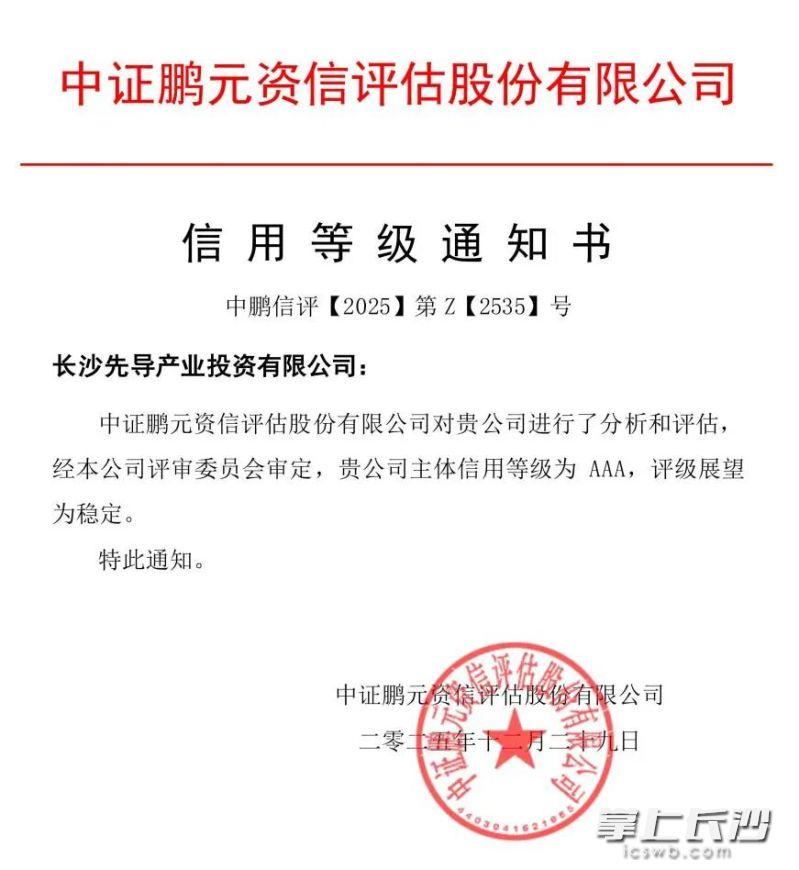
评级展望“稳定”!长沙先导产业投资有限公司获评AAA主体信用评级
Xin Lang Cai Jing· 2025-12-30 08:48
Group 1 - The core viewpoint of the news is that Changsha Xiandao Industrial Investment Co., Ltd. has been awarded an AAA credit rating by Zhongzheng Pengyuan Credit Rating Co., indicating its readiness to enter the bond market [1][4]. - The AAA rating reflects the recognition of Changsha Urban Development Group's transformation towards "entity-based, market-oriented, and technology-driven" operations [4]. - The establishment of a four AAA entity matrix, including the group headquarters, Changsha Urban Investment, Xiandao Holdings, and Xiandao Industrial Investment, demonstrates the comprehensive strength of the group [4][5]. Group 2 - The AAA rating for Xiandao Industrial Investment is a comprehensive affirmation of its asset quality, operational stability, risk management capabilities, and potential in the technology innovation sector [4]. - The company aims to focus on national innovation-driven development strategies and cultivate new productive forces in Hunan province, enhancing high-tech enterprise development and strategic emerging industry investments [5]. - The formation of the four AAA entities enhances the group's financing negotiation power and competitiveness in the capital market, providing sufficient capital support for major projects in urban renewal, industrial investment, and technological innovation [5].

辽宁设立科技信贷风险补偿资金池
Sou Hu Cai Jing· 2025-12-30 01:28
Core Viewpoint - The establishment of the provincial technology credit risk compensation fund pool aims to enhance financial support for technology-based enterprises, addressing their financing difficulties through a government-bank risk-sharing mechanism [1][2]. Group 1: Financial Mechanism - The core of the newly established technology credit risk compensation fund pool is the "government-bank risk-sharing" mechanism, where the government provides limited compensation for loan losses while banks bear the remaining risks [2]. - The provincial finance and science and technology departments have arranged special funds as initial risk compensation, with pilot regions matching funds on a 1:1 basis to build the fund pool [2]. - This design significantly reduces the risk expectations for financial institutions providing credit support to technology-based enterprises, enhancing their willingness to lend while strictly controlling risk exposure [2]. Group 2: Impact on Technology Innovation - The fund pool not only serves as an innovative financial tool but also optimizes the regional technology innovation ecosystem, signaling the government's strong support for technology innovation [3]. - It is expected to attract more venture capital and social capital into the technology innovation sector, forming a new pattern of "government guidance, financial leadership, market operation, and risk sharing" in technology finance [3]. - The first batch of pilot regions, management methods for the fund pool, and selection of cooperating institutions are currently being advanced in an orderly manner [3].
“这是一个重大任务”,如何落实推进(创新谈)
Ren Min Ri Bao· 2025-12-28 22:17
Core Viewpoint - The construction of three major international technology innovation centers in Beijing (Jing-Jin-Ji), Shanghai (Yangtze River Delta), and the Guangdong-Hong Kong-Macao Greater Bay Area is a significant strategic task aimed at enhancing the overall efficiency of the national innovation system and facilitating the flow of innovative resources [1][2]. Group 1: Strategic Importance - The establishment of these centers is a major task personally planned and promoted by General Secretary Xi Jinping, emphasizing its large scale and profound impact on international competition [1]. - The centers are expected to serve as critical points for innovation-driven development strategies, concentrating advantageous resources and enhancing the flow of innovative elements across a broader area [2]. Group 2: Regional Advantages and Collaboration - The expansion of the Beijing international innovation center to the Jing-Jin-Ji region and the Shanghai center to the Yangtze River Delta will accelerate the formation of China's primary sources of original innovation, with Beijing's research resources, Tianjin's manufacturing base, and Hebei's land and cost advantages playing key roles [2]. - Each region has distinct advantages: Jing-Jin-Ji focuses on original innovation breakthroughs, the Yangtze River Delta aims to enhance technology transfer and high-end industrial clusters, and the Greater Bay Area emphasizes cross-border collaborative innovation [2]. Group 3: Methodology and Implementation - The construction of the three centers requires adherence to the inherent laws of technological innovation, emphasizing patience and long-term investment rather than short-term metrics [3]. - There is a need for practical actions, including reforms in research management, talent evaluation, and the transformation of results, to promote a virtuous cycle among technology, industry, and finance [3]. - Maintaining strategic determination is crucial for the successful completion of this significant task, which will enhance the momentum for high-quality development and solidify the technological support for China's modernization [3].
力诺药包:积极回应市场关切,多维度展现转型决心与战略定力
Zheng Quan Shi Bao Wang· 2025-12-26 11:27
Group 1 - The company has undergone management adjustments, including the resignation of the former chairman and other board members, to align with new legal requirements and improve governance structure [1][2] - The management changes are seen as proactive adjustments to enhance governance and internal supervision, with experienced personnel being appointed to the board [1][3] - The company is focusing on high-tech pharmaceutical packaging solutions, indicating a strategic shift towards higher value-added products [2][3] Group 2 - The company is currently experiencing a "growing pain" period during its transformation, with a clear strategic focus on high-tech pharmaceutical packaging, which requires significant capital investment [2][3] - Despite short-term financial pressures, the company continues to invest in R&D and talent acquisition to maintain technological leadership and future growth potential [2][3] - Shareholder reductions are explained as normal market behavior, with specific reasons related to fund lifecycle and employee stock plan considerations [3][4] Group 3 - The company is expected to overcome short-term development bottlenecks and enhance profitability and market competitiveness as the market stabilizes and new capacities come online [4]

国家创投引导基金亮相 “航母级”耐心资本登场
Xin Lang Cai Jing· 2025-12-26 05:40
此外,记者注意到,国家创业投资引导基金有限公司董事长霍福鹏还有另外一个身份,就是国家发展改 革委创新驱动发展中心主任。按照国家发展改革委官网信息,该中心主要职责是为国家创新驱动发展和 数字经济发展提供研究和重大任务落实等服务和支撑。由此看,中心负责人同时担任首任国家创投引导 基金负责人,有望打通创新政策研究、重大任务落地与资本赋能的全链条,进而实现"政策-资本-产 业"高效协同,为创新驱动发展与新质生产力培育提供更加丝滑顺畅的支撑。这场撬动新一轮科技创新 的大布局,你看明白了吗? (总台央视记者 吴昊 张艺瑾) 本文转自【央视新闻客户端】; 今天,被外界视为"航母级"的国家创业投资引导基金正式揭开面纱。基金将发挥中央资金引领带动作 用,广泛吸引地方政府、中央企业、金融机构、民间资本等多方参与,形成万亿资金规模。引导基金将 种子期、初创期、早中期企业作为投资重点,支持企业聚焦前沿领域开展原创性、颠覆性的技术攻关。 那么,哪些领域的科技企业最有可能受益?根据此前记者了解到的信息,人工智能、量子科技、氢能储 能等战略性新兴产业和未来产业将是基金关切的重点领域。 据了解,国家创业投资引导基金旗下的京津冀、长三角、粤港 ...
国家创投引导基金亮相,“航母级”耐心资本登场
Sou Hu Cai Jing· 2025-12-26 04:20
此外,记者注意到,国家创业投资引导基金有限公司董事长霍福鹏还有另外一个身份,就是国家发展改 革委创新驱动发展中心主任。按照国家发展改革委官网信息,该中心主要职责是为国家创新驱动发展和 数字经济发展提供研究和重大任务落实等服务和支撑。由此看,中心负责人同时担任首任国家创投引导 基金负责人,有望打通创新政策研究、重大任务落地与资本赋能的全链条,进而实现"政策-资本-产 业"高效协同,为创新驱动发展与新质生产力培育提供更加丝滑顺畅的支撑。这场撬动新一轮科技创新 的大布局,你看明白了吗? 来源:央视新闻客户端 作者: 吴昊 张艺瑾 今天,被外界视为"航母级"的国家创业投资引导基金正式揭开面纱。基金将发挥中央资金引领带动作 用,广泛吸引地方政府、中央企业、金融机构、民间资本等多方参与,形成万亿资金规模。引导基金将 种子期、初创期、早中期企业作为投资重点,支持企业聚焦前沿领域开展原创性、颠覆性的技术攻关。 那么,哪些领域的科技企业最有可能受益?根据此前记者了解到的信息,人工智能、量子科技、氢能储 能等战略性新兴产业和未来产业将是基金关切的重点领域。 据了解,国家创业投资引导基金旗下的京津冀、长三角、粤港澳大湾区三只区域基 ...