
制造强国

Search documents
计量、检测双业务赛道布局 天溯计量助力行业升级
Xin Hua Wang· 2025-10-11 02:05
Core Viewpoint - Shenzhen Tian Su Measurement and Testing Co., Ltd. is progressing towards its IPO, with a focus on enhancing its measurement calibration and testing services in response to national policies aimed at advancing the manufacturing measurement system by 2027 [1][12][14] Company Overview - Tian Su Measurement is a national, comprehensive independent third-party measurement and testing service provider, established in 2009, specializing in calibration, testing, and certification services across various sectors including biomedicine, automotive, new energy, and rail transportation [2][4] - The company has developed a wide service network with 1,417 calibration services across ten measurement calibration fields, and has established laboratories in multiple regions [4][7] Business Growth - The company has seen significant revenue growth from 5.97 billion CNY in 2022 to 8 billion CNY in 2025 (first half), with a compound annual growth rate (CAGR) of 15.75% from 2022 to 2024 [4] - The revenue from battery testing services has increased from 52.54 million CNY in 2022 to 113 million CNY in 2024, achieving a CAGR of 46.75% [4] Future Development Strategy - The company plans to establish a nationwide laboratory network consisting of 34 calibration laboratories and 8 testing bases to enhance its measurement and testing capabilities [5][11] - Future investments will focus on the Shenzhen headquarters measurement project, regional laboratory construction, and digital center development, with a total fundraising target of 424 million CNY [8][9][10] Innovation and R&D - Tian Su Measurement has invested a total of 107.87 million CNY in R&D from 2022 to the first half of 2025, with a focus on enhancing its technological capabilities and service quality [6][7] - The company holds 133 patents and has developed twelve core technologies that support various strategic emerging industries, reflecting its commitment to innovation [7][8] Industry Context - The measurement and testing industry is recognized as a strategic emerging industry in China, with government policies promoting its development and marketization [12][13] - The industry is experiencing a trend towards concentration, with larger institutions capturing a significant share of the market, indicating a favorable environment for companies like Tian Su Measurement [11][14]
工资分配向关键岗位、生产一线、急需紧缺技能人才倾斜 四川出台措施推动技能强企
Si Chuan Ri Bao· 2025-10-11 00:22
Core Viewpoint - The article discusses the implementation of the "demand for positions + skills training + skills evaluation + employment recommendation" project-based training model in Sichuan Province, aimed at enhancing the skills of the workforce and addressing the structural contradictions between the supply of high-skilled talent and the demands of industrial transformation. Group 1: Skills Training Initiatives - The Sichuan Provincial Human Resources and Social Security Department, along with nine other departments, has issued the "Several Measures for Strengthening Enterprises through Skills" to promote skills training for employees in the industrial chain [1][2] - The focus is on cultivating high-skilled talent, particularly in critical core technologies, with incentives such as salary supplements and innovative wage models [1][3] Group 2: Skills Ecosystem Development - The measures aim to create a skills ecosystem that integrates industry, education, training, evaluation, and employment, with regular updates on talent demand and vocational training needs [2] - Support will be provided for enterprises to establish skill talent cultivation platforms, including training bases and innovation studios [2] Group 3: Wage Distribution System - The article outlines plans to improve the wage distribution system for skilled talent, emphasizing collective wage negotiations and performance-based pay linked to skill levels [3] - Enterprises are encouraged to establish special funds for talent development, focusing on critical high-skilled positions and implementing tailored compensation strategies for exceptional talent [3]
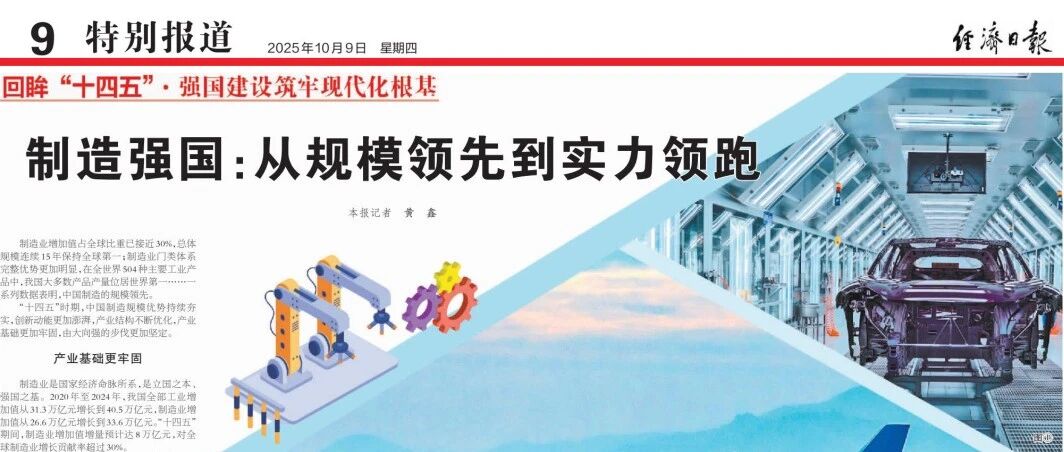
【回眸“十四五”】制造强国:从规模领先到实力领跑
Jing Ji Ri Bao· 2025-10-10 00:48
Core Insights - China's manufacturing value added accounts for nearly 30% of the global total, maintaining the world's largest scale for 15 consecutive years, with most of the 504 major industrial products produced in China ranking first globally [1][2] Manufacturing Scale and Growth - From 2020 to 2024, China's total industrial value added is projected to grow from 31.3 trillion yuan to 40.5 trillion yuan, while manufacturing value added is expected to increase from 26.6 trillion yuan to 33.6 trillion yuan, contributing over 30% to global manufacturing growth [2] - The annual growth rates for equipment manufacturing and high-tech manufacturing value added are projected at 7.9% and 8.7%, respectively, with their shares in regulated industrial output rising to 34.6% and 16.3% [2] Innovation and Technology - R&D expenditure for large-scale manufacturing enterprises exceeds 1.6% of revenue, with over 570 industrial companies listed among the global top 2500 in R&D investment [2] - Significant advancements in key technology areas such as artificial intelligence and quantum communication have been achieved, with notable projects like "Chang'e" and "Beidou" demonstrating China's innovation capabilities [2] Supply Chain Resilience - The resilience of industrial and supply chains has been enhanced through the implementation of high-quality development actions and the engineering of key technologies, leading to breakthroughs in industries like integrated circuits and medical equipment [3][4] - By 2024, the quality compliance rate of manufacturing products is expected to reach 93.93%, reflecting improvements in reliability and stability of core components and materials [3] Digital Transformation - The integration of digital technologies into manufacturing has accelerated, with over 340 influential industrial internet platforms established, connecting more than 100 million devices and serving nearly 4 million enterprises [7] - The number of intelligent factories has surpassed 7000, with a robot density of 470 units per 10,000 people, significantly exceeding the global average [7] Green Transformation - China's industrial sector is advancing towards carbon reduction, pollution control, and green growth, with renewable energy generation capacity increasing by 20 percentage points [8][9] - The recycling of resources such as waste steel and waste copper is projected to exceed 400 million tons by 2024, with significant advancements in green manufacturing practices [9][10]
【回眸“十四五”】制造强国:从规模领先到实力领跑
中汽协会数据· 2025-10-09 07:04
Core Viewpoint - The article emphasizes the continuous strengthening of China's manufacturing sector during the "14th Five-Year Plan" period, highlighting its global leadership in manufacturing scale, innovation, and green transformation efforts [5][6][13]. Manufacturing Scale and Growth - China's manufacturing value added is projected to grow from 26.6 trillion yuan to 33.6 trillion yuan from 2020 to 2024, contributing over 30% to global manufacturing growth [6][5]. - The manufacturing sector's global share is nearing 30%, maintaining the world's largest scale for 15 consecutive years [3][5]. Innovation and Technological Advancement - R&D expenditure for large-scale manufacturing enterprises exceeds 1.6% of their revenue, with over 570 companies listed among the global top 2500 in R&D investment [6]. - Key technological advancements have been made in areas such as artificial intelligence and quantum communication, with notable achievements in space exploration and satellite navigation [6]. Industrial Upgrading and Digital Transformation - The average annual growth rates for equipment manufacturing and high-tech manufacturing value added are 7.9% and 8.7%, respectively, with their shares in the industrial sector rising to 34.6% and 16.3% [6]. - The digital transformation of manufacturing is being accelerated, with over 3.5 million enterprises benefiting from industrial internet platforms that connect more than 1 billion devices [11][12]. Green Transformation and Sustainability - The share of renewable energy in total power generation has increased by 20 percentage points, and energy consumption per unit of industrial value added is continuously decreasing [13][14]. - The number of national green factories has reached 6,430, and the green manufacturing system is being enhanced to support low-carbon industrial processes [14][15]. Resilience of Supply Chains - The resilience of industrial supply chains is being strengthened through the implementation of high-quality development actions and the engineering of key technologies [7][8]. - The quality compliance rate of manufacturing products is expected to reach 93.93% in 2024, reflecting improvements in product reliability and longevity [7].

四川成都市市场监管系统转理念探索服务发展新路径
Zhong Guo Zhi Liang Xin Wen Wang· 2025-09-26 04:34
Core Insights - Chengdu's market regulation system is implementing a "service-oriented regulation" approach to promote high-quality industrial development, exemplified by the opening of the Jianzhou New City Testing and Inspection Industrial Park [1][2] - The system has established a collaborative mechanism involving government, enterprises, and research institutions to address key issues faced by businesses, resulting in over 400 resolved requests with a problem-solving rate of 96.78% [1][2] Group 1: Service Model Transformation - The service model has evolved from "single-point response" to "systematic solutions," focusing on key concerns of local governments and enterprises [2] - The "Five Ones" development model (one park, one policy, one platform, one fund, one alliance) has been introduced to enhance collaboration among various stakeholders [2] Group 2: Industry-Specific Solutions - The establishment of a joint inspection laboratory for small and micro food enterprises has reduced operational costs by 77%, providing comprehensive testing services [2] - A collaborative effort with China Agricultural University aims to reduce meat product dry loss by 0.3%, potentially increasing annual efficiency by over 2 million yuan [3] Group 3: Cross-Regional Collaboration - A cross-level collaboration mechanism has been set up to address complex issues faced by enterprises, such as patent disputes and financing challenges [4][5] - The "Quality Credit Financing+" model has facilitated nearly 1.2 billion yuan in loans for businesses, demonstrating the effectiveness of quality assurance in securing financing [5] Group 4: Comprehensive Support Framework - The market regulation system is providing full lifecycle support for enterprises through policy, platform, and technical assistance, enhancing operational efficiency [6] - A green food inspection service platform has been created to lower testing costs by approximately 50%, streamlining the inspection process [6] Group 5: Future Directions - The Chengdu market regulation system plans to expand its service scope and institutional innovations to further support industrial development [7] - The "three-dimensional empowerment" model aims to replicate successful experiences across various sectors, contributing to the construction of the Chengdu-Chongqing economic circle [7]
经典重温 | “十五五”:产业破局与重构 ——“十五五”规划研究系列之三(申万宏观·赵伟团队)
申万宏源宏观· 2025-09-25 16:03
Core Insights - The article discusses the importance of industrial structure adjustment in China's 14th and upcoming 15th Five-Year Plans, emphasizing the shift from focusing on the ratio of the three industries to prioritizing technological innovation and R&D investment [3][5][28]. Group 1: Industrial Structure Adjustment in Five-Year Plans - Industrial structure adjustment is a crucial component of China's Five-Year Plans, serving as a key means to achieve core objectives [3][16]. - The focus of industrial structure adjustment has evolved from the ratio of the three industries to a greater emphasis on technological innovation and R&D investment [5][28]. - The 14th Five-Year Plan has introduced specific targets for R&D expenditure and digital economy core industries, reflecting a shift towards more refined and precise planning [5][28]. Group 2: Trends in Industrial Structure Adjustment - The direction of industrial structure adjustment has transitioned from emphasizing the three industries' ratios to focusing on technological innovation [5][28]. - The importance of the service sector has increased, with a notable shift from finance and real estate to information technology and production services [6][47]. - The 15th Five-Year Plan is expected to continue supporting technological innovation and address issues such as supply-demand mismatches and "involution" in the manufacturing sector [7][8][22]. Group 3: Key Areas of Focus in the 15th Five-Year Plan - The 15th Five-Year Plan is likely to prioritize emerging industries such as artificial intelligence, marine economy, and commercial aerospace [7][22]. - There is an anticipated increase in the emphasis on service industry development, particularly in enhancing service consumption and trade [8][26]. - The plan may also focus on improving the quality and efficiency of service industries, aligning with the broader economic development goals [8][49].
工信部部长李乐成主持召开创新企业家座谈会
Zheng Quan Shi Bao Wang· 2025-09-24 05:06
Core Viewpoint - The meeting emphasized the importance of entrepreneurs in driving innovation and industrial development, aligning with the directives of President Xi Jinping regarding the enhancement of the entrepreneurial ecosystem [1] Group 1: Entrepreneurial Development - The Minister of Industry and Information Technology, Li Lecheng, highlighted the need for entrepreneurs to deeply study and implement the important speeches and directives of President Xi Jinping [1] - Entrepreneurs are encouraged to embody the spirit of excellent entrepreneurship, focusing on strengthening and expanding their businesses while adhering to laws and regulations [1] Group 2: Industrial Transformation - Companies are urged to focus on their core businesses, enhance real industries, and emphasize value creation through specialized and innovative development paths [1] - There is a call for accelerating the transformation towards high-end, intelligent, and green industries to improve quality, efficiency, and core competitiveness [1] Group 3: Technological Innovation - The meeting stressed the importance of being pioneers in technological advancements, particularly in original, frontier, and disruptive technologies [1] - Companies are encouraged to integrate technological innovation with industrial innovation, positioning themselves as leaders in this integration [1] Group 4: Social Responsibility and Collaboration - Entrepreneurs are reminded to maintain their original intentions and serve society by fostering excellent corporate culture and enhancing industry self-discipline [1] - There is an emphasis on resisting irrational competition and promoting collaboration across the industry chain, while also advancing internationalization efforts [1] - The goal is to shift from "Chinese speed" to "Chinese quality" and from "Chinese products" to "Chinese brands" [1]
大韩商工会议所报告:过去十年,中企营收增速6倍于韩企
Huan Qiu Shi Bao· 2025-09-23 23:02
Group 1 - The growth rate of Chinese enterprises over the past decade is more than six times that of South Korean enterprises, with the number of Chinese companies in the "Global 2000" increasing from 180 to 275, a growth of 52.7%, while South Korean companies decreased from 66 to 62, a decline of 6.1% [1][2] - In terms of revenue, South Korean "Global 2000" companies saw a modest increase of 15%, from $1.5 trillion to $1.7 trillion, while Chinese companies experienced a dramatic 95% increase, rising from $4 trillion to $7.8 trillion, indicating that the revenue growth rate of Chinese companies is 6.3 times that of South Korean companies [2][3] - The report highlights that the leading industries driving growth differ significantly between countries, with China and the US primarily relying on information technology and artificial intelligence, while South Korea's growth is mainly from manufacturing and finance sectors [2][3] Group 2 - The report suggests that the South Korean government has been insufficient in supporting its enterprises, with only 0.04% of small businesses growing into medium-sized enterprises and 1% to 2% of medium-sized enterprises becoming large ones, indicating a need for policy adjustments to foster disruptive startups [3] - China's growth is attributed to its focus on emerging industries such as electric vehicles, batteries, semiconductors, and artificial intelligence, which has led to the emergence of world-class companies and a robust enterprise ecosystem [3][4] - The stark contrast in growth between China and South Korea is rooted in differences in market size and industrial policies, with China benefiting from the largest single consumer market and strong strategic support for key industries, leading to significant competitive advantages [4]
四部门发文“力挺”能源装备高质量发展 从六方面部署13项重点任务
Zheng Quan Ri Bao Wang· 2025-09-22 13:11
Core Viewpoint - The "Guiding Opinions on Promoting High-Quality Development of Energy Equipment" emphasizes the importance of enhancing R&D investment and innovation in state-owned enterprises to support the development of a new energy system and manufacturing power in China [1][3]. Group 1: Key Tasks for Energy Equipment Development - Accelerate the transformation and upgrading of energy exploration and development equipment, focusing on safe and efficient coal development and the effective development of unconventional and aging oil and gas fields [1]. - Improve the quality and efficiency of energy conversion equipment, targeting fossil energy generation and renewable energy equipment [2]. - Promote the large-scale application of energy storage equipment, emphasizing the development of a safe and efficient energy storage technology system [2]. - Strengthen technological breakthroughs in energy transmission equipment, focusing on power, coal, oil, and natural gas transmission [2]. - Advance the digital and intelligent upgrade of energy equipment, covering the entire process from extraction to transmission [2]. - Foster the green and high-end development of energy equipment, including recycling and remanufacturing initiatives [3]. Group 2: Measures for Implementation - The guiding opinions propose measures to optimize the industrial innovation ecosystem, including enhancing the role of enterprises, strengthening industrial platform construction, and encouraging the application of first sets of equipment [3]. - Emphasis on utilizing re-loans and fiscal interest subsidies to expand long-term loans in the manufacturing sector, supporting large-scale equipment updates and technological transformations in key energy areas [3].
宝丰能源:以新时代使命担当 引领现代煤化工高质量发展
Zheng Quan Shi Bao Wang· 2025-09-22 09:48
Core Viewpoint - The modern coal chemical industry plays a crucial role in ensuring national energy security while facing challenges of green transformation under the "dual carbon" goals during the "14th Five-Year Plan" period [1][2]. Industry and Company Research Industry Positioning - The modern coal chemical industry is strategically important for energy security in China, particularly in the context of high dependence on oil imports. The industry aims to replace oil with coal for producing high-end chemical materials [2]. - The industry is undergoing a transformation to enhance self-sufficiency and reduce reliance on imported high-end chemical products [2]. Company Initiatives - Baofeng Energy has established the largest and most complete modern coal chemical industrial cluster in China, located in Ningxia and Inner Mongolia, which produces over 100 types of chemical products [2]. - The company’s annual production capacity of 5.2 million tons of polyolefins can replace nearly 30 million tons of oil imports and over 5 million tons of high-end polyolefins imports, addressing supply issues in the industry [2]. Technological Advancements - Baofeng Energy focuses on domestic innovation to overcome reliance on imported high-end equipment, achieving 23 core technologies and equipment that meet international standards [3][4]. - The company has set global records in several production metrics, including the largest scale of coal-to-olefins single plant and the highest capacity for coal gasification [3]. Green Development - The company has pioneered a "green hydrogen coupling" model, integrating clean energy into coal chemical production to reduce carbon emissions [6]. - Baofeng Energy's solar-powered hydrogen production project generates high-purity green hydrogen, which is used to produce green methanol and other products, thus addressing the industry's carbon footprint [6]. Digital Transformation - The company is leveraging AI, big data, and IoT technologies to enhance operational efficiency and safety in production processes [7]. - Baofeng Energy has developed an AI-based coal blending platform that optimizes raw material ratios, leading to reduced costs and improved efficiency [7]. Social Responsibility - Baofeng Energy has contributed significantly to local economies through tax payments and job creation, with a total tax contribution of 10.918 billion yuan and over 7,000 new jobs created from 2021 to 2024 [8]. - The company has also engaged in extensive charitable activities, providing financial support to students in need, with a total donation of 5.038 billion yuan [8]. Future Outlook - The modern coal chemical industry is moving towards greener, smarter, and higher-end development, with Baofeng Energy aiming to become a global supplier of new materials [9].
