
半导体国产化

Search documents
募资3亿加码半导体赛道!创达新材IPO抢占国产封装材料新蓝海
Sou Hu Cai Jing· 2025-12-15 08:56
Core Viewpoint - The company aims to capitalize on the domestic semiconductor and new energy vehicle industries by raising 300 million yuan through an IPO on the Beijing Stock Exchange to enhance its semiconductor packaging materials production capacity and R&D capabilities [1] Group 1: Investment Projects and Capacity Expansion - The core project of the fundraising is the construction of a production line for 12,000 tons of key supporting materials for semiconductor packaging, with an investment of 200 million yuan in Mianyang, Sichuan [3] - Upon reaching full production, the new line will add 6,000 tons of epoxy molding compounds, 4,000 tons of liquid epoxy and epoxy film packaging materials, and 2,000 tons of silicone packaging materials, with increases of 54% and 35% in epoxy molding and liquid epoxy packaging materials capacity respectively compared to 2024 [3] - The project is strategically positioned to meet the growing demand in the semiconductor and new energy vehicle markets, allowing the company to seize market opportunities ahead of competitors [3] Group 2: Market Demand and Growth Potential - The global semiconductor packaging materials market is projected to reach 24.6 billion USD in 2024 and exceed 26 billion USD in 2025, with domestic market growth outpacing the global average [4] - The domestic new energy vehicle sales are expected to reach 12.866 million units in 2024, a year-on-year increase of 35.5%, driving significant demand for electronic packaging materials [4] - The company’s products have entered the supply chains of leading automotive companies such as BYD, with the automotive electronics sector projected to account for 24.80% of revenue in 2024, becoming a key growth driver [4] Group 3: Strategic Location and Synergy - The company has established a collaborative development framework with production bases in Wuxi, Jiangsu, and Mianyang, Sichuan, covering the entire supply chain from R&D to production and sales [5] - The Sichuan-Chongqing region has developed a complete industrial chain for integrated circuits, attracting major industry players, which enhances the company’s strategic positioning [5] - The establishment of subsidiaries in Shenzhen for sales and in Chengdu for new product R&D supports a nationwide layout, optimizing production capacity and reducing logistics costs [5]


2026全球半导体设备:关注存储超级周期、先进逻辑和国产化机会
2025-12-15 01:55
Summary of Key Points from Conference Call Records Industry Overview - The global semiconductor market is expected to accelerate growth in 2026, with the memory sector projected to grow nearly 40%, and the overall market size approaching $1 trillion. The semiconductor equipment market is anticipated to grow by 12%, with China’s market growing by 2% [1][3][5]. Core Insights and Arguments - **Memory Sector Growth**: The memory sector is expected to enter a super cycle in 2026, with a total growth rate of approximately 40%, driven by a 20% increase in both volume and price. DRAM expansion is strong, while NAND expansion is focused on existing capacity. Key timelines for Samsung's HBM4 and NAND expansion are critical [1][6]. - **AI Chip Development Bottlenecks**: CoWoS (Chip on Wafer on Substrate) remains a bottleneck for AI chip development. The demand for EUV lithography machines is expected to rise due to advancements in 2nm technology and Samsung's 1C technology [1][5][16]. - **Capital Expenditure Trends**: Major players like TSMC, Samsung, SK Hynix, and Micron are expected to continue significant capital expenditures, which will drive industry demand. SMIC and Hua Hong Group in mainland China are also at high investment levels [1][9]. - **Chinese Semiconductor Localization**: The localization rate of China's semiconductor industry is steadily increasing, reaching approximately 23% by Q3 2025, and expected to approach 30% by the end of 2026. Companies like Northern Huachuang, Zhongwei, and Tuojing Technology are likely to benefit from this trend [1][7][19]. Additional Important Insights - **Performance of Semiconductor Equipment**: The semiconductor equipment market is projected to grow by 12% in 2026, with a significant increase in capacity for back-end equipment expected to rise by 50-60% by the end of 2026. The front-end equipment sector is also expected to see growth due to rising demand for EUV lithography [1][5][13]. - **Valuation of Memory Sector**: The memory sector saw an average increase of 166% in 2025, with a reasonable valuation expected in 2026, with a PE ratio of 12 and a PB ratio of 2.8. Samsung's entry into Nvidia's HBM4 supply chain could significantly enhance its valuation [4][10][11]. - **Market Dynamics in China**: The Chinese semiconductor equipment market was valued at $12.6 billion in Q3 2025, with a 1% year-over-year growth. The localization rate is expected to rise to 29% by 2026, indicating strong domestic demand for advanced processes and memory expansion [18][19]. Conclusion - The semiconductor industry is poised for significant growth, particularly in the memory sector, with strong capital investments and increasing localization in China. Key players and technologies in both front-end and back-end equipment markets will be crucial for future developments and investment opportunities.
Rapidus新增获得20余家日本企业出资
日经中文网· 2025-12-12 07:45
金融机构当中,包括现有股东三菱UFJ银行在内的3大银行和日本政策投资银行将最多合计出资250亿日 元。从地方银行来看,除了Rapidus工厂所在的北海道的北洋银行和北海道银行之外,千叶银行、肥后 银行和北陆银行也在就出资进行协调。3大银行除出资之外,还将在2027年度以后提供最多2万亿日元规 模的贷款。 Rapidus已完成第一阶段的民间资金筹集 股东达到约30家企业,Rapidus将完成2025年度获得1300亿日元民间投资的目标…… 力争实现最近端半导体国产化的Rapidus将获得20多家企业投资。除本田、佳能和京瓷等之外,千叶银 行等也将加入股东行列。预计索尼集团等现有股东也将追加出资。股东达到约30家企业,Rapidus将完 成2025年度获得1300亿日元民间投资的目标。日本半导体产业的重振体制正在完善。 Rapidus最早2025年内与各家企业正式达成协议,2026年3月前获得出资。各家企业的出资额预计在5亿 ~200亿日元左右。此外,也有正在谈判的企业,出资企业数和合计出资额今后有可能增加。 新出资的实业公司除了佳能、京瓷、富士胶片控股和牛尾电机等半导体制造设备与零部件供应企业之 外,还有精工爱 ...

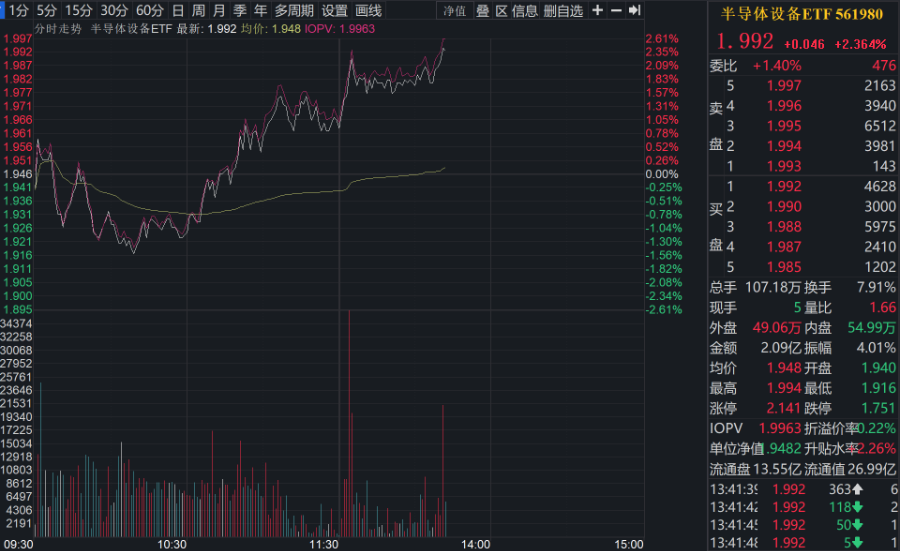
半导体设备ETF(561980)午后拉涨2.36%,成分股拓荆科技、天岳先进大涨超9%
2 1 Shi Ji Jing Ji Bao Dao· 2025-12-12 06:28
Core Insights - The semiconductor equipment industry is experiencing a rebound, with the semiconductor equipment ETF (561980) rising by 2.36% and achieving a transaction volume exceeding 200 million [1] - According to WSTS, the global semiconductor market is projected to grow significantly, reaching approximately $975.46 billion by 2026, with a year-on-year growth of 26.3% [2] Investment Themes - Three key investment themes in the semiconductor equipment sector are identified: 1) Expansion of advanced processes related to AI; 2) Supercycle in memory; 3) Increase in domestic production rates in the Chinese market [3] AI-Related Growth - WSTS forecasts a 37.1% revenue growth for logic semiconductors (led by GPUs) in 2025, marking it as a primary growth driver for the semiconductor industry [4] - The anticipated increase in the number of GPUs, along with the rise of ASICs like TPUs and advanced GPUs, is expected to drive a new round of equipment expansion [4] Memory Market Supercycle - The global memory market is expected to grow by 39.4% in 2026, surpassing the 27.8% growth rate of 2025 [5] - DRAM and NAND demand are projected to increase significantly, with DRAM demand expected to rise by 26% and NAND by 21% in 2026 [5] Domestic Market Growth in China - The combined revenue of semiconductor equipment companies in China is projected to reach $14.5 billion in 2025, reflecting an 8% year-on-year increase, with a domestic production rate of 22% [6] - The Chinese market is expected to grow by 2% in 2026, reaching $51 billion, with an anticipated increase in domestic production rates to 29% [6] ETF Performance - The semiconductor equipment ETF (561980) tracks the CSI semiconductor index, which has shown significant performance, with a year-to-date increase of 55.56% and a maximum increase of over 80% [7]

昆仑芯势头强劲!华尔街看好百度:有望复制谷歌AI逆袭之路
Hua Er Jie Jian Wen· 2025-12-12 03:33
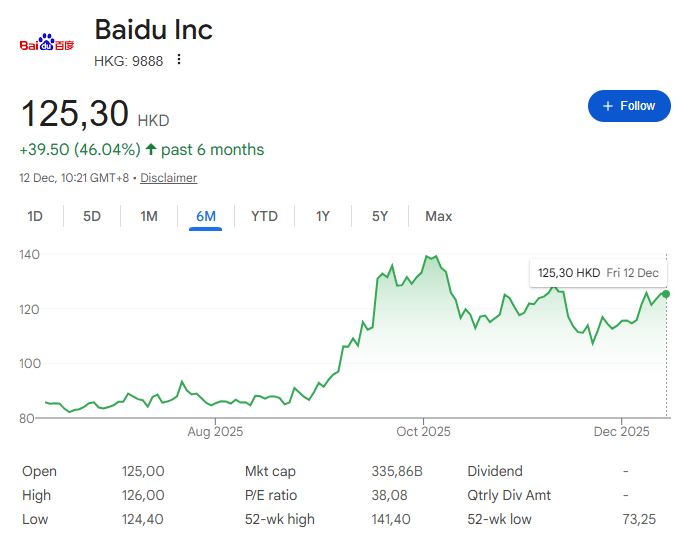
Core Viewpoint - Baidu is regaining favor on Wall Street as expectations rise for the IPO of its chip subsidiary Kunlun, which analysts believe will unlock potential value and allow Baidu to replicate Alphabet's success in the AI sector [1][3] Group 1: Market Response - Capital markets have reacted positively, with Goldman Sachs and Macquarie Securities indicating that Kunlun's potential IPO is a key step for Baidu to "unlock value" [1] - Since late August, Baidu's average target price in Hong Kong has increased by approximately 60%, ranking third among constituents of the Hang Seng Tech Index during the same period [1] - Baidu's stock has risen by 45% due to the news of Kunlun receiving orders from state-owned China Mobile and the anticipated spin-off [1] Group 2: Shift in Market Sentiment - Analysts note a fundamental shift in market sentiment, with investors previously overlooking Baidu's vertical integration progress across chips, cloud architecture, and application layers [3] - The surge in demand for application-layer inference is driving a boom in the domestic chip market, prompting investors to reassess Baidu's valuation logic despite ongoing pressures in its advertising business [3] Group 3: Valuation Reconstruction - Analysts on Wall Street believe Baidu's valuation framework is transitioning from a focus on internet advertising to hard tech assets [4] - Non-advertising businesses, including chips and autonomous driving, are expected to become the dominant factors determining Baidu's valuation [5] - Macquarie estimates that Baidu's 59% stake in Kunlun is valued at approximately $16.5 billion, accounting for about 30% of its target valuation [5] Group 4: Revenue Growth Expectations - Macquarie forecasts that Kunlun's revenue will double to around $1.4 billion next year, positioning it alongside Cambricon, which has been dubbed "China's Nvidia" [6] - Goldman Sachs further breaks down Kunlun's value potential, suggesting that its valuation could range from $3 billion to $11 billion based on Cambricon's current price-to-sales multiples [6] - Kunlun is expected to exceed 3.5 billion yuan in revenue by 2025 and achieve breakeven [6] Group 5: Strategic Advantages in Domestic Market - Kunlun is facing unique strategic opportunities amid the macro narrative of semiconductor localization, with domestic semiconductor stocks outperforming internet stocks due to policy support [7] - Analysts highlight Kunlun's specific advantages over domestic competitors, as Cambricon faces capacity bottlenecks and Huawei is under external restrictions, providing Kunlun with favorable market expansion opportunities [7] - Baidu Cloud is positioned to offer competitively priced AI model inference and training alternatives, especially as access to high-end chips from Nvidia remains uncertain [7]
早盘直击|今日行情关注
申万宏源证券上海北京西路营业部· 2025-12-10 02:31
Market Overview - After regaining the 3900-point level, the A-share market has returned to a phase of low-volume consolidation, with mixed performances across indices. The ChiNext Index continues to show upward momentum, while the Shanghai Composite Index and the Sci-Tech 50 Index have experienced slight pullbacks. Overall trading volume has decreased compared to Monday, reflecting a decline in investor enthusiasm as the year-end approaches, leading to a general trend of low-volume fluctuations [1] Future Outlook - As the year-end approaches, a cautious market sentiment prevails, with fluctuations around the 4000-point level potentially preparing the market for a new upward phase. The market has established conditions for further upward expansion following a period of sideways movement since October. A recovery in the supply-demand situation for the manufacturing sector in 2026 is likely, which could lead to a significant rebound in the earnings growth of A-share listed companies. Key focus areas for November include the impact of the 14th Five-Year Plan on industries, event-driven dynamics in the technology sector, and price increases driven by anti-involution trends, which are expected to catalyze multiple sectors and support a continued upward trend in the market [1] Sector Highlights - In December, sectors benefiting from dividends and price increases are expected to outperform, with short-term attention on banking, public utilities, coal, and non-ferrous metals. Technology will remain a key focus in 2026, with particular attention on AI, lithium batteries, military industry, and robotics. Specific areas of interest include: 1. The established trend in AI hardware, with a continued increase in token usage for major AI models, indicating a peak in AI applications by 2026, presenting opportunities for high growth in AI hardware and the transition from quantitative to qualitative changes in AI applications [2] 2. The trend of robot localization and integration into daily life is expected to continue into 2026, with robot products expanding from humanoid robots to quadrupedal and functional robots, creating recurring opportunities in sensors, controllers, and dexterous hands [2] 3. The trend towards semiconductor localization remains strong, with a focus on semiconductor equipment, wafer manufacturing, semiconductor materials, and IC design [2] 4. The military sector is expected to see a continued recovery in orders by 2026, with many sub-sectors such as ground equipment, aviation equipment, and military electronics showing signs of bottoming out as Q3 report declines narrow [2] 5. The innovative drug sector is entering a recovery phase after nearly four years of adjustment, with positive net profit growth for four consecutive quarters since Q3 2024, and an anticipated turning point in fundamentals by 2025, continuing an upward trend into 2026 [2]

全球半导体扶持政策转向
日经中文网· 2025-12-08 02:43
Group 1 - The policy to attract semiconductor manufacturing back to the U.S. officially started after 2022, but there are now delays in the construction of new factories in both Europe and the U.S. due to weak semiconductor demand, except for AI semiconductors [2][10] - The EU is shifting its support focus from attracting foreign companies to funding R&D for domestic firms, with discussions on a budget framework in the trillions of yen [2][4] - The EU Commission is proposing amendments to the European Semiconductor Act and is collecting opinions from industry groups, with a request for a budget of €20 billion to be announced by spring 2026 [4] Group 2 - The EU will prioritize support for regional semiconductor giants like ASML and Infineon Technologies, focusing on R&D and building a domestic semiconductor supply chain in the medium to long term [5] - The U.S. has seen delays in new factory openings, with the Trump administration injecting approximately $8.9 billion into Intel and planning to renegotiate support policies from the Biden administration [7][9] - Weak demand for semiconductors, particularly in personal computers, smartphones, and automotive sectors, is leading companies to scale back new investments to avoid a supply-demand imbalance [10]

早盘直击|今日行情关注
申万宏源证券上海北京西路营业部· 2025-12-05 02:37
Market Overview - A-shares continue to maintain a low-volume consolidation pattern after failing to break through the 3900-point mark, with trading volume shrinking to below 1.6 trillion [1] - As the year-end approaches, investor enthusiasm for trading has decreased, leading to a general trend of low-volume fluctuations in the market [1] - The market is expected to remain in this state for the next few weeks, with a focus on the 4000-point level as a potential preparation for upward movement [1] Future Outlook - The market is currently in a cautious atmosphere as year-end approaches, but the repeated fluctuations around the 4000-point mark may indicate preparation for a new upward phase [1] - The manufacturing sector is expected to see improved supply and demand conditions in the second half of 2026, which could lead to a significant rebound in the earnings growth of A-share listed companies [1] - Key focus areas for November include the impact of the 14th Five-Year Plan on industries, event-driven factors in the technology sector, and price increases driven by anti-involution trends, which may catalyze multiple sectors and support a continued upward trend in the market [1] Sector Highlights - In December, sectors benefiting from dividends and price increases are expected to outperform, with short-term attention on banks, public utilities, coal, and non-ferrous metals [2] - Technology remains the main focus for 2026, with particular attention on AI, lithium batteries, military industry, and robotics after a phase of adjustment [2] - The trend of AI hardware continues to solidify, with increasing token usage for major AI models indicating a peak in AI applications by 2026, presenting opportunities for high growth in AI hardware [2] - The domestic production of robots and their integration into daily life is a confirmed trend for 2026, with opportunities arising in sensors, controllers, and dexterous hands as robot products evolve [2] - The semiconductor industry is expected to continue its domestic production trend, with a focus on semiconductor equipment, wafer manufacturing, materials, and IC design [2] - The military industry is anticipated to see a recovery in orders by 2026, with many sub-sectors showing signs of bottoming out as third-quarter earnings declines continue to narrow [2] - The innovative drug sector is entering a harvest period after nearly four years of adjustment, with positive net profit growth expected to continue into 2026 [2]

早盘直击|今日行情关注
申万宏源证券上海北京西路营业部· 2025-12-03 02:26
Market Overview - The A-share market struggled to maintain the 3900-point level, experiencing weak fluctuations and a decline in trading volume to approximately 1.6 trillion yuan, indicating low market sentiment [1] - As the year-end approaches, investor participation has decreased, leading to a shrinking trading volume and a cautious market atmosphere [1] - The market is expected to remain in a consolidation phase for the next few weeks, with potential upward movement as conditions improve [1] Future Outlook - The market is anticipated to experience fluctuations around the 4000-point level, which may prepare for a new upward phase [1] - Key focus areas for November include the impact of the 14th Five-Year Plan on industries, event-driven dynamics in the technology sector, and price recovery driven by anti-involution trends [1] Sector Highlights - In December, sectors benefiting from dividends and price increases are expected to outperform, with short-term attention on banking, public utilities, coal, and non-ferrous metals [2] - Technology remains a primary focus for 2026, with particular attention on AI, lithium batteries, military industry, and robotics [2] - The trend of AI hardware is solidifying, with increasing token usage in major AI models, indicating a peak in AI applications by 2026 [2] - The domestic production of robots is expected to expand, with opportunities arising in sensors, controllers, and dexterous hands as the market evolves [2] - The semiconductor industry is moving towards domestic production, with a focus on semiconductor equipment, wafer manufacturing, materials, and IC design [2] - The military sector is expected to see a recovery in orders, with signs of bottoming out in the performance of various military sub-sectors [2] - The innovative drug sector is entering a recovery phase after nearly four years of adjustment, with positive net profit growth expected to continue into 2026 [2]

探路者6.78亿元并购构筑技术护城河 “感知+显示”芯片矩阵形成
Zheng Quan Ri Bao Wang· 2025-12-02 13:26
Core Insights - The acquisition of 51% stakes in Shenzhen Betel Electronic Technology Co., Ltd. and Shanghai Tongtu Semiconductor Technology Co., Ltd. for approximately 678 million yuan marks a strategic shift for the company from an outdoor consumer brand to an "intelligent interactive technology platform" [1][2] - This move aims to build a unique ecological moat combining "outdoor scenarios + smart chips" [1] Group 1: Acquisition Details - The acquisition targets two high-barrier segments: Betel focuses on human-computer interaction and biometric recognition, holding the largest market share in fingerprint sensors for smart locks and security [1][2] - Shanghai Tongtu, with its RISC-V architecture-based display bridge SoC chips, also ranks first in its niche market, extending its capabilities to AI scenarios such as facial and vehicle detection [1][2] Group 2: Financial Commitments - Betel's profit commitments for 2026 to 2028 are set at no less than 33.7 million yuan, 47.7 million yuan, and 68.6 million yuan, totaling 150 million yuan [2] - Shanghai Tongtu has a similar profit commitment of 150 million yuan for the same period, providing clear growth expectations for the listed company [2] Group 3: Business Synergies - Betel's products complement the existing G2 Touch subsidiary, allowing for product bundling and a complete solution for overlapping customer bases [2] - Shanghai Tongtu's video compression and display technologies will enable the development of high-value chips in collaboration with the group's subsidiaries, expanding the application areas into multimedia, smart driving, and machine vision [2][3] Group 4: Strategic Importance - This strategic acquisition is a significant move for the company amid global innovation in smart terminals and the trend of semiconductor localization [3] - By integrating Betel's and Shanghai Tongtu's core technologies, the company strengthens its capabilities in smart sensing and image processing, establishing a complete technology chain from basic chips to system solutions [3]
