扩大高水平对外开放

Search documents
扩大高水平对外开放的生动实践(国际观澜)
Ren Min Ri Bao· 2025-11-11 22:40
Group 1 - The core message emphasizes China's commitment to providing 100% zero-tariff treatment on products for all least developed countries that have diplomatic relations with China, showcasing China's role in promoting global development and shared prosperity [1][2] - China has maintained its position as Africa's largest trading partner for 16 consecutive years, with a 10.8% increase in imports from African countries in the third quarter of this year [1] - The zero-tariff policy is a specific measure under China's broader strategy to expand high-level opening-up and is expected to enhance trade liberalization and economic globalization, contributing to global prosperity [2] Group 2 - The "14th Five-Year Plan" emphasizes expanding high-level opening-up and creating win-win cooperation, with zero-tariff policies being a concrete initiative to achieve these goals [2] - The introduction of zero-tariff measures is expected to enrich the Chinese market with diverse products, such as Ugandan coffee and Nepalese spices, while also promoting the development of related domestic industries [2]
我看“十五五”|余淼杰:更新夕阳技术 传统产业可变成朝阳产业
Bei Ke Cai Jing· 2025-11-11 07:09
Group 1 - The core viewpoint of the article emphasizes the importance of the "14th Five-Year Plan" in guiding China's economic and social development, focusing on high-quality growth, technological self-reliance, and deepening reforms [1][4][7] - The "14th Five-Year Plan" outlines seven main goals aimed at building a prosperous, democratic, civilized, harmonious, and beautiful socialist modern country [8][9] - The plan highlights the need for a clear guiding ideology, maintaining economic construction as the center, and prioritizing high-quality development [5][6] Group 2 - The plan introduces six principles for economic and social development, addressing the questions of "for whom" and "relying on whom" [6] - It emphasizes the importance of supply and demand coordination, advocating for a unified national market and the integration of investment in goods and people [13][14] - The plan stresses that prices should be determined by the market, promoting a unified talent market and balanced labor market [15] Group 3 - Innovation is identified as the primary driving force, with a focus on enhancing high-level technological self-reliance and leading new productive forces [16] - Specific measures include increasing the proportion of basic research in R&D spending, with a target of 2.68% for R&D expenditure intensity by 2024 [17] - The plan addresses the long-term nature of the US-China competition, advocating for a proactive approach to expand high-level opening-up [19] Group 4 - The plan signals a shift in focus from innovation-driven development to building a modern industrial system and strengthening the real economy [20][21] - It emphasizes the need to optimize and upgrade traditional industries, recognizing that there are no sunset industries, only sunset technologies [21] - The Northeast region is highlighted for its potential in achieving comprehensive revitalization, with a focus on balancing development and security [22][24] Group 5 - The plan suggests that investing in people is crucial for enhancing human capital and talent dividends, while also recognizing the need for continued investment in physical infrastructure [26][27] - A dynamic balance between investing in people and material resources is essential for maximizing development potential and improving the well-being of the populace [27]


国务院批复同意新郑综保区扩区 系中部地区首个成功扩区的综保区
He Nan Ri Bao· 2025-11-10 23:12
Core Insights - The State Council has officially approved the expansion of the Zhengzhou Xinzheng Comprehensive Bonded Zone, making it the first successful expansion of a bonded zone in Central China [1][2] - Since its establishment in 2010, the Xinzheng Comprehensive Bonded Zone has consistently ranked among the top three bonded zones in China in terms of import and export value, contributing approximately 50% to Henan's foreign trade [1][2] Summary by Sections Expansion Approval - The expansion of the Xinzheng Comprehensive Bonded Zone is a key measure to enhance regional capabilities and achieve high-quality development, addressing the urgent need for more development space due to land saturation [2] Economic Impact - In the first nine months of 2025, the bonded zone achieved an import and export value of 299.76 billion yuan, a year-on-year increase of 29.3%, accounting for 46.6% of the province's total import and export scale [2] - The contribution rate of the bonded zone to the province's import and export added value reached 66.86% [2] Industry Development - The Xinzheng Comprehensive Bonded Zone has established six major industrial systems, including bonded processing, bonded logistics, and cross-border e-commerce, with over 150 registered enterprises driving more than 200 supporting enterprises [2] - The expansion will provide more development space for high-end manufacturing and new materials industries, promoting innovations in customs and tax supervision [2] Strategic Goals - The zone aims to leverage policy advantages and the combined effects of bonded zones and logistics hubs to create an innovative development model integrating bonded operations, ports, and logistics [2] - The initiative is aligned with the goals set forth in the 20th National Congress of the Communist Party of China, focusing on expanding high-level opening-up [2]
“为实现中华民族伟大复兴贡献华侨华人力量” ——中共二十届四中全会擘画“十五五”发展蓝图引发海外华侨华人热议
Ren Min Ri Bao· 2025-11-10 22:19
Core Points - The Fourth Plenary Session of the 20th Central Committee of the Communist Party of China approved the "15th Five-Year Plan" proposal, providing more certainty for China's economic and social development in the coming period [1][2] - Overseas Chinese communities express pride in China's achievements during the "14th Five-Year Plan" period, highlighting the significant progress made in various sectors, including high-end manufacturing and artificial intelligence [2][3] Group 1: Achievements and Developments - The "14th Five-Year Plan" period has seen China elevate its economic, technological, and comprehensive national strength, marking a solid step towards modernization [2][3] - China has established the world's largest and fastest-growing renewable energy system, with over 40% of global renewable energy patents, enhancing cooperation opportunities with countries like the UAE [3][4] - The transition from "Made in China" to "Intelligent Manufacturing in China" has instilled pride among overseas Chinese, as it contributes to local infrastructure and industry upgrades in regions like Africa [4][5] Group 2: Future Goals and Opportunities - The "15th Five-Year Plan" outlines major goals for economic and social development, which are seen as encouraging and motivating for overseas Chinese communities [3][4] - The plan emphasizes the construction of a modern industrial system and the expansion of high-level opening-up, which is expected to provide new opportunities for overseas Chinese investments [4][6] - There is a strong belief that China's focus on high-quality development and security will lead to sustainable growth, fostering international cooperation in areas such as digital economy and green transformation [4][5]
扩大更高水平对外开放 绘就合作发展新图景
Zheng Quan Shi Bao· 2025-11-10 18:34
Core Viewpoint - China emphasizes the importance of "openness" as a fundamental national policy and a hallmark of Chinese-style modernization, aiming to expand high-level opening-up in response to complex global changes and uncertainties [1][2]. Group 1: High-Level Opening-Up - The "15th Five-Year Plan" outlines actions to enhance openness through four key areas: expanding autonomous opening, promoting trade innovation, increasing bilateral investment cooperation, and high-quality Belt and Road Initiative construction [1]. - The focus on stabilizing and expanding institutional opening is crucial during the "15th Five-Year" period [2]. Group 2: Trade Innovation and Growth - China has maintained its position as the world's largest goods trader for eight consecutive years, leveraging its industrial chain advantages and diversified market layout [3]. - The plan includes fostering trade innovation by balancing goods and services trade, expanding both exports and imports, and supporting traditional trade sectors while transitioning to new growth drivers [3]. Group 3: Service Trade Development - The service sector is identified as a key area for future market access and opening, with plans to expand pilot programs in telecommunications, biotechnology, and foreign-funded hospitals [2]. - Global service trade is projected to grow at a moderate pace, with a forecasted increase of 4.6% in 2025, outpacing goods trade growth of 0.5% [4][5]. Group 4: Investment and Economic Strategy - The concept of "Chinese economy" is evolving to include "Chinese people economy," emphasizing the importance of national income and global resource allocation capabilities [6]. - The plan aims to expand bilateral investment cooperation, enhance the environment for foreign investment, and improve overseas service systems for Chinese enterprises [6][7]. Group 5: Belt and Road Initiative - The Belt and Road Initiative is highlighted as a significant avenue for trade and investment, with a focus on strengthening mutual trust and benefit with partner countries [7]. - Recommendations include enhancing debt sustainability management and localizing operations to ensure shared benefits from resource development projects [7].
中信建投黄凌: 聚焦服务国家大局 打造国际一流投行
Zhong Guo Zheng Quan Bao - Zhong Zheng Wang· 2025-11-10 11:07
Core Viewpoint - The securities industry must align its strengths with national strategies to achieve high-quality development, focusing on core competitiveness and comprehensive strength in the journey towards becoming a first-class investment bank [1][6]. Group 1: Key Strategies for High-Quality Development - Emphasizing high-level technological self-reliance to accelerate the construction of a modern industrial system, creating a virtuous cycle among technology, finance, and industry [2]. - Focusing on people-centered approaches to promote common prosperity, utilizing high-quality financial services to optimize income distribution and address development imbalances [2]. - Leveraging high-level openness to build a new development pattern, ensuring mutual connectivity and institutional alignment in the internationalization of the financial industry [2]. - Utilizing digital transformation to empower high-quality development, enhancing data management and compliance to support real financing and trading needs [3]. Group 2: Serving National Strategies - The securities industry must prioritize "technology finance" to inject financial resources into high-level technological self-reliance, with significant funding directed towards strategic emerging industries [4]. - Promoting inclusive finance to support common prosperity by providing flexible financial tools for startups and small enterprises, while also assisting residents in long-term asset allocation [4]. - Deepening digital finance to contribute to the construction of a financial powerhouse and a digital China, emphasizing the importance of digital transformation for core competitiveness [5]. Group 3: Strategic Positioning for Investment Banking - Securities firms should focus on core business and clarify strategic positioning to enhance competitiveness and strength in the pursuit of becoming a first-class investment bank [6]. - Developing a "value investment bank" by balancing functionality and profitability, integrating various financial services to create greater value for the economy and society [6]. - Establishing a "smart investment bank" by advancing digital strategies and incorporating new technologies to optimize decision-making and customer service [6]. - Creating a "new quality investment bank" that innovates in business models and management to enhance competitiveness and lead industry development [6].

刚刚,外汇局发布!33433亿美元!
Jin Rong Shi Bao· 2025-11-07 13:14
Group 1 - As of October 2025, China's foreign exchange reserves reached 33,433 billion USD, an increase of 4.7 billion USD from the end of September, representing a growth rate of 0.14% [1] - The rise in foreign reserves is attributed to the combined effects of asset price changes and exchange rate fluctuations, with the dollar index increasing by 2.1% to 99.8 in October [1] - The Federal Reserve's interest rate cuts have led to a rise in dollar-denominated global bond indices by 0.8% and the S&P 500 index by 2.3%, while the Nikkei index surged by 16.6%, reaching a historical high [1] Group 2 - The recent guidelines from the Central Committee emphasize the importance of "expanding high-level opening up," highlighting the commitment to reform and development through openness [2] - In promoting trade innovation, there is a focus on market diversification, optimizing goods trade, and cultivating new growth points, with exports expected to play a stabilizing role in cross-border capital flows [2] - The guidelines also stress the need for orderly cross-border layout of industrial and supply chains, establishing a foundation for the basic balance of international payments in capital projects [2]
10月末中国外汇储备达33433亿美元
Zhong Guo Xin Wen Wang· 2025-11-07 13:07
Core Points - As of the end of October 2025, China's foreign exchange reserves reached $33,433 billion, an increase of $47 billion from the end of September, representing a growth rate of 0.14% [1][2] - The gold reserves stood at 74.09 million ounces, and when calculated in Special Drawing Rights (SDR), the foreign exchange reserves amounted to 24,612.45 billion SDR [1] - The increase in foreign exchange reserves is attributed to the monetary policies and expectations of major economies, as well as macroeconomic data, leading to a stronger US dollar index and a general decline in non-dollar currencies [1][2] Economic Insights - The US dollar index rose by 2.1% to 99.8, marking a new high since August, which contributed to the positive valuation effect on global financial assets [1] - The recent guidelines from the Central Committee emphasize the importance of high-level opening up, which reflects a commitment to reform and development through openness [2] - The focus on trade innovation includes promoting market diversification, optimizing and upgrading goods trade, and fostering new growth points, indicating that exports will play a stabilizing role in cross-border capital flows [2] Investment Environment - The State Administration of Foreign Exchange (SAFE) highlighted the stability and potential of the Chinese economy, suggesting that the conditions for maintaining a stable foreign exchange reserve scale remain unchanged [2] - The approach to foreign investment includes ensuring both access and operational facilitation, which is expected to lay a foundation for the basic balance of international payments in capital projects [2]
稳扎稳打,扩大高水平对外开放(今日谈)
Ren Min Ri Bao· 2025-11-06 22:11
Core Viewpoint - The Hainan Free Trade Port is set to officially launch its full island closure, showcasing China's commitment to high-level opening-up and international cooperation [1] Group 1: Development of Hainan Free Trade Port - The construction of the Hainan Free Trade Port reflects China's broader strategy for extensive and deep international openness [1] - The initiative aligns with the goals set forth in the 20th Central Committee's fourth plenary session, emphasizing the importance of expanding high-level openness and creating win-win cooperation [1] Group 2: Strategic Goals and Implementation - The focus is on maintaining a steady approach to expanding institutional openness, with a scientific and orderly arrangement of the pace and progress of opening-up [1] - This strategy is expected to form a "new engine" for high-quality development in the region [1] Group 3: Future Outlook - An open China is anticipated to lead changes in the development landscape and move towards a brighter future [1] - The call to action emphasizes the importance of determination and seizing opportunities at this critical moment [1]
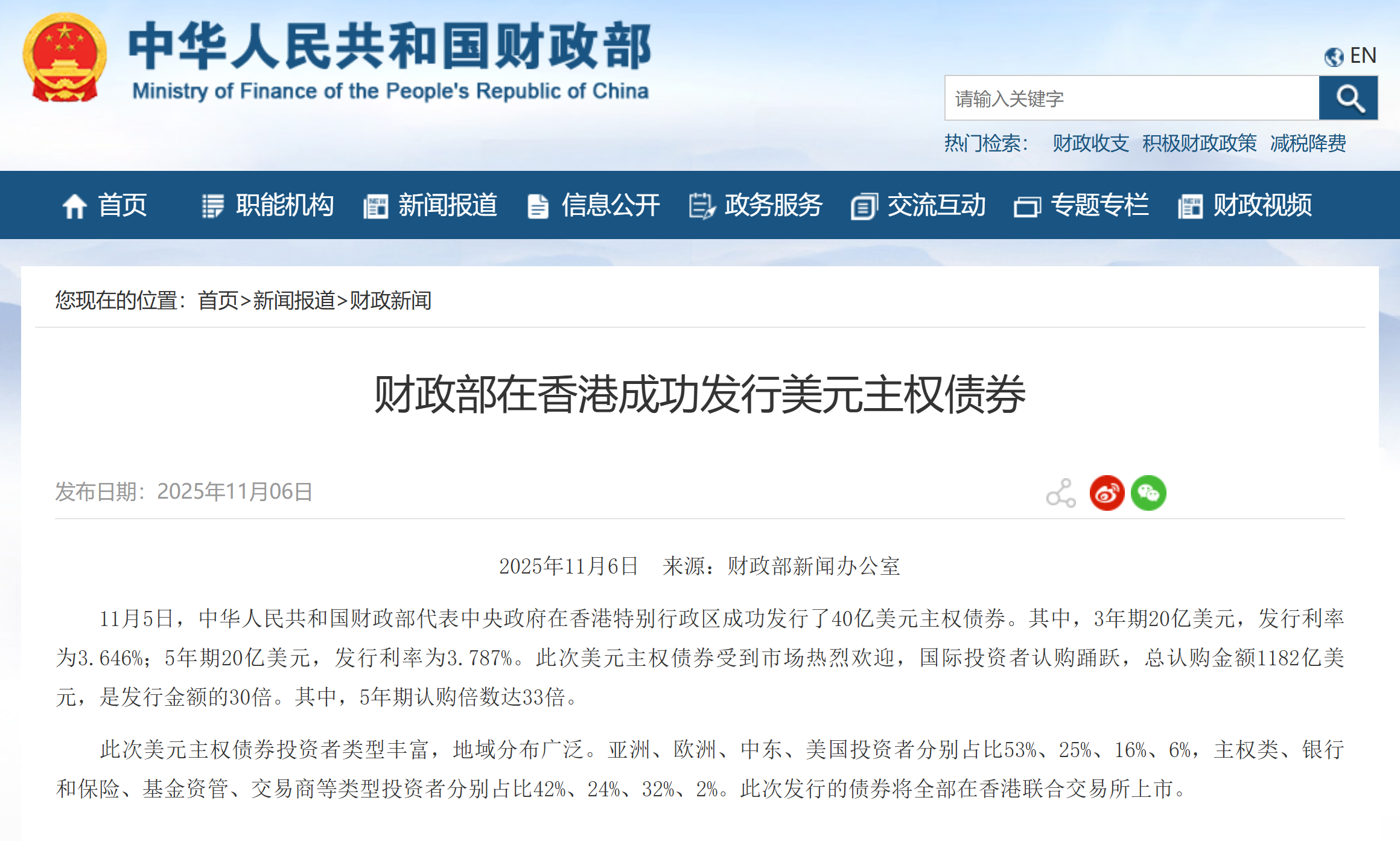
30倍认购!财政部在港发行40亿美元主权债券,投资热情高涨
Guo Ji Jin Rong Bao· 2025-11-06 09:04
Core Points - The Ministry of Finance of the People's Republic of China successfully issued $4 billion in sovereign bonds in Hong Kong, with a strong market response and a total subscription amount of $118.2 billion, indicating a subscription multiple of 30 times the issuance amount [1] - The bonds included $2 billion with a 3-year maturity at an interest rate of 3.646% and $2 billion with a 5-year maturity at an interest rate of 3.787% [1] - The issuance reflects international investors' confidence in China's economic growth potential, as highlighted by the diverse investor base and geographical distribution [3] Investor Composition - The investor types were varied, with 53% from Asia, 25% from Europe, 16% from the Middle East, and 6% from the United States [3] - The types of investors included sovereign entities (42%), banks and insurance companies (24%), fund management (32%), and dealers (2%) [3] Market Impact - The issuance is part of a broader strategy to deepen China's interaction with global capital markets and provide diverse asset allocation options for international investors [4] - It also supports the development of Hong Kong as an international financial center and enhances the depth and breadth of its bond market [4] - The issuance is seen as a continuation of the Ministry of Finance's efforts to establish a more comprehensive yield curve in the offshore market, providing a benchmark for Chinese enterprises issuing dollar bonds abroad [4]