
港股市场

Search documents
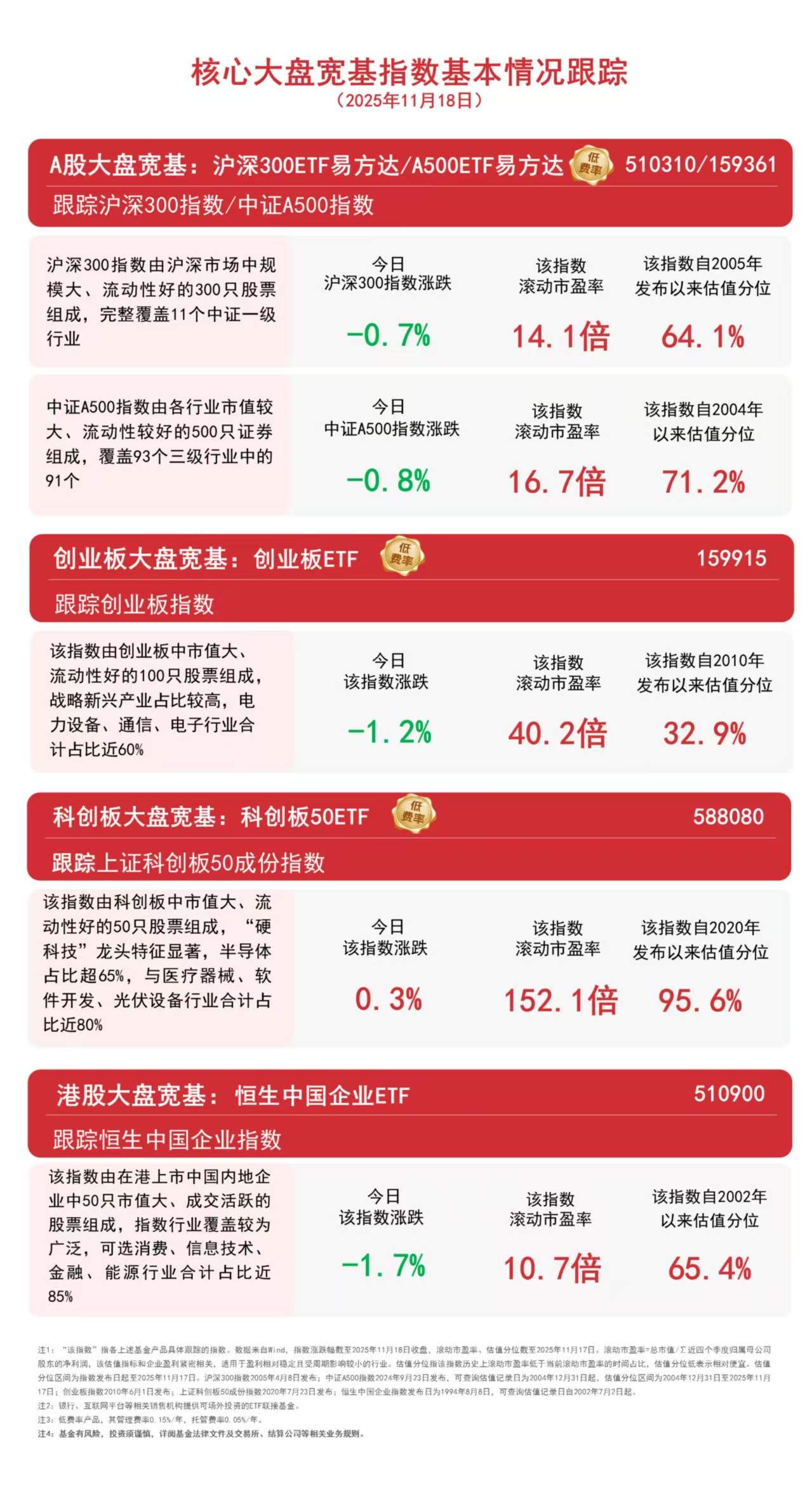
大盘全天震荡调整,持续关注A500ETF易方达(159361)、沪深300ETF易方达(510310)配置价值
Mei Ri Jing Ji Xin Wen· 2025-11-18 13:38
Market Overview - The A-share market experienced a day of volatility with all three major indices continuing to decline, while sectors such as AI applications and software development saw gains, and sectors like batteries, coal, and steel faced losses [1] - The CSI A500 index fell by 0.8%, the CSI 300 index decreased by 0.7%, and the ChiNext index dropped by 1.2%, while the STAR Market 50 index rose by 0.3% [1] - The Hang Seng Index also saw a significant pullback, with major sectors including finance, internet, and innovative pharmaceuticals collectively declining, although the semiconductor sector showed some localized activity [1] Index Performance - The CSI 300 index, composed of 300 large and liquid stocks from the Shanghai and Shenzhen markets, recorded a decrease of 0.7% with a rolling P/E ratio of 14.1 times [3] - The CSI A500 index, which includes 500 stocks with larger market capitalization and liquidity, fell by 0.8% and has a rolling P/E ratio of 16.7 times [3] - The Hang Seng China Enterprises Index, tracking 50 large and actively traded mainland Chinese companies listed in Hong Kong, declined by 1.7% with a rolling P/E ratio of 10.7 times [7]

港股开盘 | 恒生指数低开1.52% 科网股领跌 华虹半导体(01347)跌近4%
智通财经网· 2025-11-14 01:43
Market Overview - The Hang Seng Index opened down 1.52%, with the Hang Seng Tech Index falling 2.22%, led by declines in tech stocks such as Hua Hong Semiconductor down nearly 4%, Alibaba down over 3%, and Tencent Holdings down over 1% post-earnings [1] - Despite recent adjustments, the foundation for a bull market in Hong Kong stocks remains intact, with expectations of a "volatile upward trend" rather than a rapid increase [1][2] Investment Strategy - A barbell strategy is recommended, focusing on stable value assets, particularly H-shares with high AH premium, as a long-term base, while also considering growth assets in high-prosperity sectors [1] - The internet and high dividend sectors are highlighted as areas of interest, with the internet sector's valuation entering an attractive range after prolonged adjustments [2][4] Valuation Insights - The Hang Seng Internet Technology Index's latest PE ratio is 21.45, placing it in the 16.09% historical low range, indicating significant valuation recovery potential [2][3] - Hong Kong stocks are currently below the average PE ratio of the past decade, making it one of the cheapest markets in the Asia-Pacific region outside of ASEAN [5] Market Sentiment and Future Outlook - The market is expected to focus on policy implementation and interest rate trends, with potential for a rebound in the Hong Kong market if U.S. interest rates confirm a downward trend and domestic economic recovery signals become clearer [2] - Analysts maintain a cautiously optimistic view on the market's mid-term trajectory, despite short-term volatility, due to strong fundamentals and ongoing policy support [2][3][4]


公募基金港股持仓 聚焦高成长性资产
Zheng Quan Ri Bao· 2025-11-12 23:12
Group 1 - Public funds have significantly increased their allocation to Hong Kong stocks, with the investment market value reaching 1.362211 trillion yuan by the end of Q3 2025, a 43.09% increase from 951.985 billion yuan at the end of Q2 2025 [1] - The market value of equity and index funds in Hong Kong stocks reached 1.231653 trillion yuan and 701.284 billion yuan, reflecting increases of 45.02% and 73.07% respectively [1] - The surge in public fund holdings in Hong Kong stocks indicates a structural transformation in asset allocation, driven by the attractiveness of technology and value stocks [1] Group 2 - The influx of funds into Hong Kong ETFs is attributed to three main reasons: valuation advantages compared to A-shares, the convenience and low cost of ETF trading, and risk diversification benefits [2] - The top Hong Kong stocks that public funds increased their holdings in include SenseTime-W, Alibaba Health, China Biologic Products, and others, primarily in the information technology and healthcare sectors [2] - A total of 38 cross-border ETFs attracted a net inflow of 49.561 billion yuan in Q3, with a year-to-date net inflow of 72.642 billion yuan as of November 12 [2]



解码南向资金累计净买入首破5万亿港元 港股定价权增强 市场正循环显现
Zheng Quan Shi Bao· 2025-11-12 18:58
Core Viewpoint - The continuous inflow of southbound funds into the Hong Kong stock market has reached a record high, indicating a significant transformation in market liquidity and activity, driven by strategic allocation needs from mainland investors seeking undervalued assets and high-quality stocks [1][2][4]. Group 1: Market Performance - As of November 10, southbound funds have net inflows of 66.54 billion HKD, bringing the total for the year to 1.305 trillion HKD, and cumulative inflows since the launch of the Hong Kong Stock Connect have surpassed 5 trillion HKD [2][3]. - Major indices in the Hong Kong market, including the Hang Seng Index, Hang Seng Tech Index, and Hang Seng China Enterprises Index, have all seen year-to-date increases of over 30%, ranking among the top global markets [2]. Group 2: Factors Driving Inflows - The influx of southbound funds is driven by five key factors: valuation discounts compared to A-shares, demand for technology leaders and high-dividend assets in a declining domestic interest rate environment, improved connectivity mechanisms, long-term investment needs from insurance and public funds, and global liquidity easing expectations [3][4]. - The phenomenon of "asset scarcity" is also noted, where abundant funds are seeking quality assets, leading to increased southbound investments in the Hong Kong market [4]. Group 3: Market Dynamics and Trends - Southbound funds accounted for approximately 34.64% of the total trading volume in the Hong Kong market in 2024, a significant increase from previous years [5]. - The market capitalization held by southbound funds is around 6.21 trillion HKD, representing 12.93% of the total market, with insurance and public funds making up over 40% of this capital [6]. Group 4: Future Outlook - The Hong Kong market is expected to benefit from a "positive cycle" as more mainland companies list in Hong Kong, attracting further capital inflows and enhancing liquidity [7]. - Despite significant gains this year, the valuation of the Hong Kong market remains attractive compared to global peers, providing further incentives for mainland investors to allocate capital southward [8].
港股午评:恒生指数涨0.63%,恒生科技指数跌0.41%
Xin Lang Cai Jing· 2025-11-12 04:09
Core Viewpoint - The Hong Kong stock market showed mixed performance with the Hang Seng Index rising by 0.63% while the Hang Seng Tech Index fell by 0.41% [1] Market Performance - The Hong Kong stock market closed with the Hang Seng Index up by 0.63% and the Hang Seng Tech Index down by 0.41% [1] - The Hong Kong Tech ETF (159751) remained flat, while the Hang Seng Hong Kong Stock Connect ETF (159318) increased by 1.04% [1] Sector Performance - The container and packaging sector, along with the life sciences tools sector, saw significant gains [1] - The building products sector, as well as the semiconductor products and equipment sector, experienced notable declines [1] Individual Stock Performance - Wanhua Media surged over 114% [1] - BeiGene rose by 7.7%, while Mixue Group increased by 4.99% [1] - Kelun-Bio gained 4.89%, China Resources Mixc Lifestyle rose by 4.38%, JD Health increased by 4.31%, and China Resources Land rose by 4.12% [1] - Fuyao Glass fell by 6.82%, and GCL-Poly Energy dropped by 10.56% [1] - Shanghai Auntie rose by 16.16%, and Brainstorm Cell Therapeutics-B increased by 11.01% [1]
今年以来南向资金累计 净流入已超1.3万亿港元
Zhong Guo Zheng Quan Bao· 2025-11-11 22:10
Core Viewpoint - Southbound capital has significantly increased its inflow into the Hong Kong stock market, with a cumulative net inflow exceeding 1.3 trillion HKD this year, marking a record high since the launch of the Stock Connect program [1][2]. Group 1: Southbound Capital Inflow - As of November 11, 2023, the net inflow of southbound capital through the Stock Connect reached 44.67 billion HKD, bringing the total for the year to 13,098.17 billion HKD, which is over 1.6 times the 8,078.69 billion HKD recorded in the same period of 2022 [1][2]. - The cumulative net inflow since the launch of the Stock Connect has surpassed 50 trillion HKD, setting a new record for the program [2]. Group 2: Holdings and Market Value - As of November 10, 2023, southbound capital held 5,573.90 billion shares, an increase of 908.52 billion shares from the beginning of 2023, with a total market value exceeding 6.3 trillion HKD, up from 3.6 trillion HKD at the start of the year [2]. - The financial, information technology, and consumer discretionary sectors have the highest market values held by southbound capital, amounting to 15,762.36 billion HKD, 13,100.89 billion HKD, and 9,018.37 billion HKD respectively [2]. Group 3: Individual Stock Holdings - Major individual stock holdings include Tencent Holdings at over 650 billion HKD, Alibaba Group at over 340 billion HKD, and several banks such as China Construction Bank and China Mobile, each exceeding 260 billion HKD [3]. - The most significant increases in holdings this year have been in China Construction Bank, with an increase of 71.41 billion shares, followed by other major banks [3]. Group 4: Investment Opportunities - Analysts highlight three main investment opportunities in the Hong Kong stock market: cyclical stocks benefiting from rising downstream commodity prices, defensive dividend stocks due to decreased market risk appetite, and stocks positioned for overseas expansion [4][5]. - The market is characterized by structural performance and significant sector rotation, with expectations of increased inflows from public funds and insurance capital [4].
今年以来南向资金累计净流入已超1.3万亿港元
Zhong Guo Zheng Quan Bao· 2025-11-11 20:09
Core Viewpoint - Southbound capital is increasingly becoming a key driver for the restructuring of liquidity and optimization of valuation in the Hong Kong stock market, with significant inflows recorded this year [1][3]. Group 1: Southbound Capital Inflows - As of November 11, 2023, southbound capital through the Stock Connect recorded a net inflow of 44.67 billion HKD, bringing the total net inflow for the year to over 1.3 trillion HKD, which is an increase of over 1.6 times compared to the same period in 2022 [1]. - The cumulative net inflow of southbound capital since the launch of the Stock Connect has surpassed 5 trillion HKD, setting a new record since the inception of the mutual market access mechanism [1]. Group 2: Holdings and Market Value - As of November 10, 2023, the number of shares held by southbound capital reached 5,573.90 billion shares, an increase of 908.52 billion shares from the beginning of 2023, with a total market value exceeding 6.3 trillion HKD, up 2.7 trillion HKD from early 2023 [2]. - The sectors with the highest market value held by southbound capital include Financials (15,762.36 billion HKD), Information Technology (13,100.89 billion HKD), and Consumer Discretionary (9,018.37 billion HKD) [2]. Group 3: Investment Opportunities - Analysts suggest focusing on three main investment directions in the Hong Kong stock market: cyclical stocks benefiting from rising commodity prices due to supply-demand changes, defensive dividend stocks as market risk appetite declines, and stocks positioned for overseas expansion benefiting from favorable policies [4]. - The investment style of southbound capital emphasizes quality and sustainability of earnings growth, favoring large-cap companies with moderate growth and high return on equity (ROE), while also showing an increased preference for high-dividend stocks [3].
大盘震荡调整,关注A500ETF易方达(159361)、沪深300ETF易方达(510310)等产品布局机会
Mei Ri Jing Ji Xin Wen· 2025-11-11 05:49
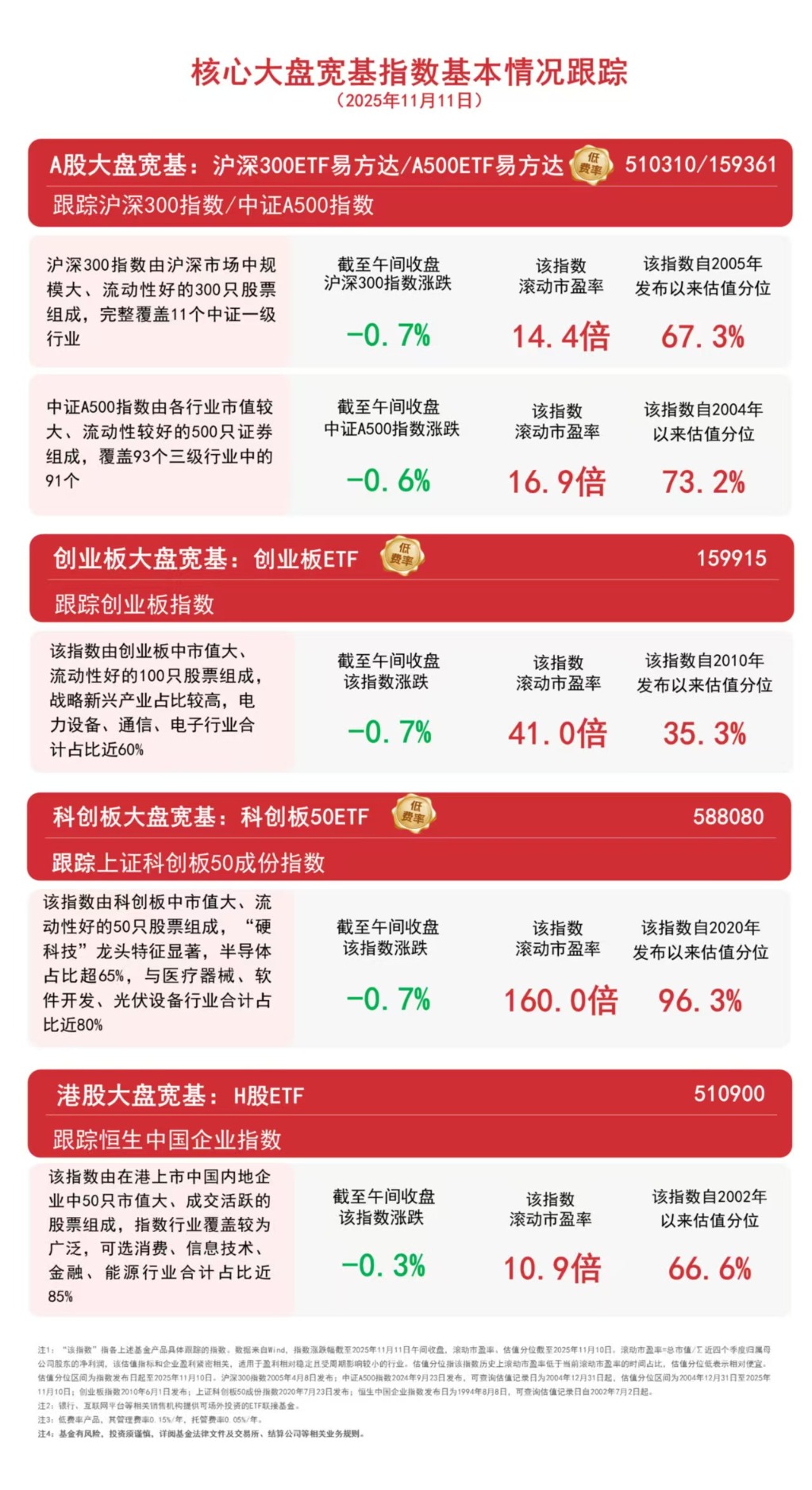
Market Overview - The A-share market experienced a collective adjustment with nearly 3,000 stocks in the market showing gains. The leading sectors included cultivated diamonds, photovoltaic equipment, battery chemicals, and non-ferrous metals, while sectors such as coal mining, insurance, liquor, AI corpus, computing hardware, and securities saw declines [1] - The Hong Kong stock market also faced a pullback, with construction materials, steel, and real estate sectors rising against the trend, while technology and pharmaceutical stocks generally retreated [1] Index Performance - The CSI 300 Index fell by 0.7% at midday, with a rolling price-to-earnings (P/E) ratio of 14.4 times, placing it in the 67.3% valuation percentile since its inception in 2005 [2] - The CSI A500 Index decreased by 0.6% at midday, with a rolling P/E ratio of 16.9 times, corresponding to a 73.2% valuation percentile since its launch in 2004 [2] - The ChiNext Index, which tracks 100 large-cap stocks in the ChiNext market, dropped by 0.7% at midday, with a rolling P/E ratio of 41.0 times, placing it in the 35.3% valuation percentile since its inception in 2010 [2] - The STAR Market 50 Index, which includes 50 large-cap stocks from the STAR Market, also fell by 0.7% at midday, with a rolling P/E ratio of 160.0 times, corresponding to a 96.3% valuation percentile since its launch in 2020 [2] Hong Kong Market Index - The Hang Seng China Enterprises Index, which consists of 50 large-cap and actively traded stocks listed in Hong Kong, declined by 0.3% at midday, with a rolling P/E ratio of 10.9 times, placing it in the 66.6% valuation percentile since its inception in 2002 [4]
中国银河证券:市场风险偏好趋于谨慎 港股或延续震荡走势
Zhi Tong Cai Jing· 2025-11-10 00:55
Core Viewpoint - The Hong Kong stock market is expected to continue its volatile trend as year-end approaches, with a cautious risk appetite among investors. Key sectors to watch include cyclical stocks benefiting from rising downstream commodity prices, dividend stocks for defensive strategies, and sectors positively impacted by improving China-US trade relations [1][4]. Market Performance - During the week of November 3 to November 7, the Hong Kong stock market showed mixed results, with the Hang Seng Index rising by 1.29%, while the Technology Index fell by 1.20%, and the State-Owned Enterprises Index increased by 1.08% [2]. - Among the primary sectors, Energy, Financials, and Utilities saw the highest gains, with increases of 6.02%, 3.45%, and 3.14% respectively. Conversely, Healthcare, Consumer Discretionary, and Information Technology experienced declines of 3.05%, 1.80%, and 0.77% respectively [2]. Liquidity Analysis - The average daily trading volume on the Hong Kong Stock Exchange was HKD 230.53 billion, a decrease of HKD 49.99 billion from the previous week. The average short-selling amount was HKD 29.46 billion, down by HKD 2.08 billion, with short-selling accounting for 12.79% of the trading volume, an increase of 1.6 percentage points [2]. - Cumulative net inflow from southbound funds reached HKD 38.68 billion, an increase of HKD 11.19 billion compared to the previous week [2]. Valuation and Risk Appetite - As of November 7, the Hang Seng Index had a Price-to-Earnings (PE) ratio of 11.87 and a Price-to-Book (PB) ratio of 1.23, reflecting increases of 1.81% and 1.87% respectively, positioning it at the 85% and 88% percentile levels since 2019. The Hang Seng Technology Index had a PE of 22.69 and a PB of 3.30, at the 28% and 69% percentile levels respectively [3]. - The risk premium for the Hang Seng Index was calculated at 4.32%, which is -1.86 standard deviations from the 3-year rolling mean, placing it at the 6% percentile since 2010 [3]. Investment Outlook - Internationally, the U.S. Supreme Court raised questions about the legality of Trump's tariffs, leading to expectations of potential tariff reductions. In October, U.S. private sector employment increased by 42,000, significantly exceeding the expected 30,000 [4]. - Domestically, China's total goods trade value in October was CNY 3.7 trillion, a 0.1% increase, with exports at CNY 2.17 trillion (down 0.8%) and imports at CNY 1.53 trillion (up 1.4%) [4]. - The market is advised to focus on cyclical stocks due to changing supply-demand dynamics, dividend stocks for defensive positioning, and sectors benefiting from improved China-US trade relations [4].

A股本周小幅反弹,A500ETF易方达(159361)、沪深300ETF易方达(510310)助力布局核心资产
Sou Hu Cai Jing· 2025-11-07 11:19
Market Overview - A-shares experienced a volatile rebound this week, with the Shanghai Composite Index briefly surpassing 4000 points [1] - The Shanghai and Shenzhen 300 Index rose by 0.8%, the CSI A500 Index increased by 0.7%, the ChiNext Index grew by 0.6%, the STAR Market 50 Index saw a marginal increase of 0.01%, and the Hang Seng China Enterprises Index climbed by 1.1% [1][3] Sector Performance - Leading sectors included lithium battery electrolyte, phosphorus chemical, photovoltaic inverters, and charging piles, which saw significant gains [1] - Conversely, sectors such as innovative drugs, CRO (Contract Research Organization), software, and diversified finance experienced declines [1] Index Details - The CSI A500 Index consists of 500 securities with large market capitalization and good liquidity, covering 91 out of 93 tertiary industries [4] - The ChiNext Index is composed of 100 stocks from the ChiNext board, with a high proportion in strategic emerging industries, particularly in power equipment, communication, and electronics, which together account for nearly 60% [4] - The STAR Market 50 Index includes 50 stocks from the STAR Market, prominently featuring "hard technology" leaders, with semiconductors making up over 50% and combined with medical devices and photovoltaic equipment, accounting for nearly 75% [4] - The Hang Seng China Enterprises Index includes 50 large-cap, actively traded stocks of mainland Chinese companies listed in Hong Kong, with a broad industry coverage where consumer discretionary, information technology, finance, and energy sectors together represent nearly 85% [4] Performance Metrics - The rolling P/E ratios for the indices are as follows: Shanghai and Shenzhen 300 Index at 14.3 times, CSI A500 Index at 16.8 times, ChiNext Index at 41.4 times, STAR Market 50 Index at 163.9 times, and Hang Seng China Enterprises Index at 10.7 times [3] - The rolling P/E ratio percentiles indicate that the CSI A500 Index is at 66.9%, ChiNext Index at 36.4%, STAR Market 50 Index at 96.6%, and Hang Seng China Enterprises Index at 65.6% [3] Historical Performance - Year-to-date performance shows the Shanghai and Shenzhen 300 Index up by 18.9%, CSI A500 Index up by 22.0%, ChiNext Index up by 49.8%, STAR Market 50 Index up by 43.2%, and Hang Seng China Enterprises Index up by 27.1% [7] - Over the past three years, the Shanghai and Shenzhen 300 Index has increased by 24.8%, while the Hang Seng China Enterprises Index has risen by 65.4% [7]
