
经济社会发展全面绿色转型

Search documents
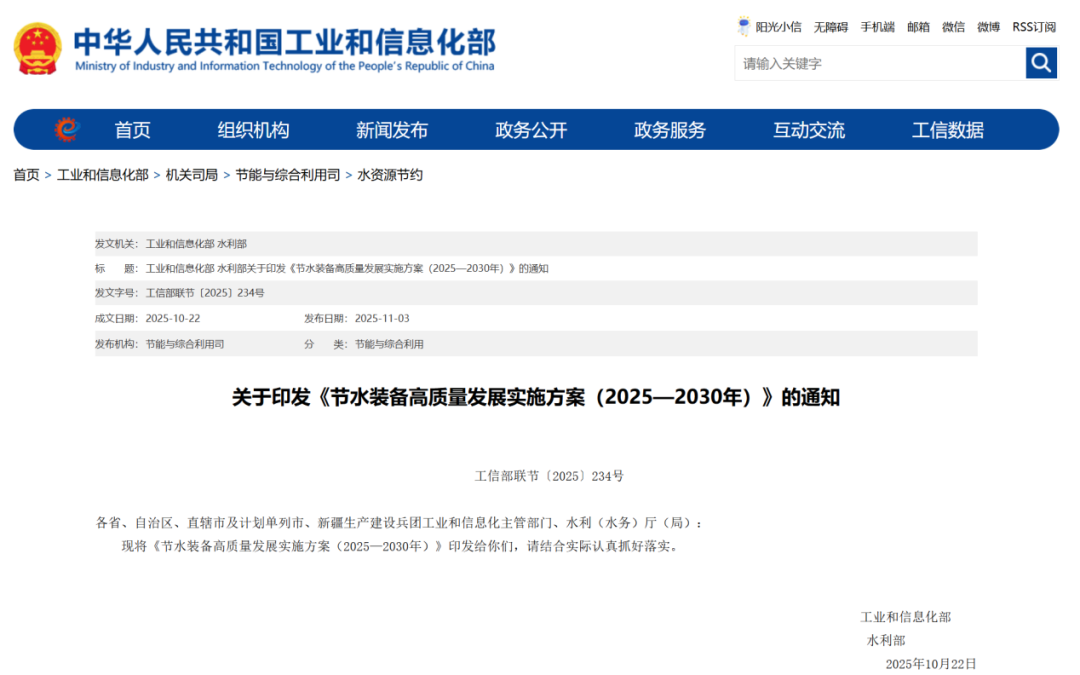
两部门:到2027年培育一批节水装备龙头企业和制造业单项冠军
Yang Shi Xin Wen· 2025-11-03 12:13
Core Viewpoint - The Ministry of Industry and Information Technology and the Ministry of Water Resources jointly released the "Implementation Plan for High-Quality Development of Water-Saving Equipment (2025-2030)" to enhance the competitive advantage of the water-saving equipment industry chain and promote the efficient use of water resources, facilitating a comprehensive green transformation of economic and social development [1] Summary by Relevant Sections Development Goals - By 2027, breakthroughs in key water-saving equipment will be achieved, a more robust standard system for water-saving equipment will be established, and a number of leading water-saving equipment enterprises and specialized "little giant" companies will be cultivated [1] - By 2030, a comprehensive, technologically advanced water-saving equipment system will be constructed, with continuous enhancement in the supply capacity of high-performance, high-efficiency, and high-reliability water-saving equipment [1] Key Focus Areas - The plan emphasizes addressing high water consumption in general equipment during production processes, focusing on the development of supply, usage, and recycling equipment, as well as the digital transformation of these areas [1] - It identifies critical components, materials, and processes that require breakthroughs in water-saving equipment, aiming for a collaborative industry chain that integrates material research and development, equipment manufacturing, and system integration [1] Historical Context and Achievements - Over the past decade, the industrial water consumption has maintained a "zero growth" while supporting an average industrial economic growth of 5.7%, with the water consumption per ten thousand yuan of industrial added value decreasing by over 50% during the same period [1]
大消息!刚刚,两部门发布
Zhong Guo Ji Jin Bao· 2025-11-03 08:20
Core Viewpoint - The implementation of the "High-Quality Development Implementation Plan for Water-Saving Equipment (2025-2030)" aims to accelerate the high-quality development of water-saving equipment, promoting the efficient use of water resources and facilitating a comprehensive green transformation of economic and social development [1][32]. Summary by Sections Overall Requirements - The plan emphasizes the importance of water-saving equipment as a strategic resource for national economic and social development, aiming to enhance independent innovation and supply capabilities in water-saving technologies [8][9]. - By 2027, breakthroughs in water-saving equipment for key areas such as supply, usage, and recycling are expected, with a focus on developing core technologies with independent intellectual property rights [3][10]. Key Tasks - **Supply**: Enhance technological innovation in water supply equipment, focusing on high-precision, high-flow, low-energy, and pollution-resistant filtration devices [4][37]. - **Usage**: Improve the water-saving efficiency of key water-using equipment, targeting areas like washing, cooling, and irrigation [5][38]. - **Recycling**: Overcome technical bottlenecks in wastewater recycling equipment, focusing on intelligent membrane separation and integrated salt separation and evaporation crystallization devices [5][38]. - **Digital Transformation**: Promote the digital transformation of the water-saving equipment industry, enhancing intelligent manufacturing levels and creating smart water-saving application scenarios [5][38]. Policy Support - The plan includes measures to increase policy support, such as implementing large-scale equipment updates and exploring the establishment of a water-saving industry fund to encourage financial institutions to develop "water-saving loans" [5][30]. - It aims to provide multi-faceted support for water-saving equipment manufacturers and key water-using enterprises, enhancing innovation capabilities and international competitiveness [6][30]. Technological Focus Areas - The plan outlines specific technological focus areas, including: - **Water Supply**: Development of advanced filtration and softening equipment [4][11]. - **Water Usage**: Innovations in washing and cooling equipment, including high-efficiency recovery systems [5][16]. - **Wastewater Recycling**: Advancements in membrane separation and deep processing of concentrated wastewater [5][21]. - **Smart Manufacturing**: Integration of AI and IoT technologies in water-saving equipment manufacturing [25][29]. Implementation and Future Steps - The Ministry of Industry and Information Technology will work with the Ministry of Water Resources to implement the plan, focusing on policy, standards, innovation, and talent development [39][40]. - Continuous efforts will be made to enhance the standardization of water-saving equipment and promote international cooperation in advanced water-saving technologies [30][31].

擘画中国高质量发展新图景(环球热点)
Ren Min Ri Bao Hai Wai Ban· 2025-10-31 21:20
Core Viewpoint - The recent approval of the "Proposal for the 15th Five-Year Plan for National Economic and Social Development" by the 20th Central Committee of the Communist Party of China outlines a roadmap for high-quality development over the next five years, emphasizing the importance of modernization and addressing both opportunities and challenges in the current environment [1][2]. Group 1: Economic and Social Development Goals - The main goals for the "15th Five-Year" period include achieving significant results in high-quality development, enhancing technological self-reliance, deepening reforms, improving social civilization, raising living standards, advancing ecological construction, and strengthening national security [1][2][4]. Group 2: Open Cooperation and International Engagement - The proposal emphasizes the need to expand institutional openness, maintain a multilateral trade system, and promote international cooperation, indicating a commitment to sharing opportunities and fostering mutual development with other countries [6][7][8]. - It highlights the importance of aligning with international high-standard economic and trade rules, requiring the establishment of a legal framework that supports transparency and fairness in foreign investment and intellectual property [7][8]. Group 3: Green Transformation and Sustainable Development - The proposal calls for a comprehensive green transformation of economic and social development, focusing on achieving carbon peak and carbon neutrality, and promoting a new energy system [9][10]. - It emphasizes the need for coordinated efforts in reducing carbon emissions, pollution control, and enhancing green development momentum, integrating environmental governance with economic growth [10][11]. - The plan outlines specific strategies for structural adjustments in energy and industry, advocating for the prioritization of non-fossil energy and the implementation of comprehensive carbon management policies [11].

王沪宁:深化经济体制改革 推动高质量发展
Xin Hua Wang· 2025-10-31 00:31
Core Viewpoint - The article emphasizes the importance of deepening economic reforms and promoting high-quality development as central themes for China's 15th Five-Year Plan, focusing on overcoming systemic obstacles and enhancing innovation [2][5]. Group 1: Significance of Economic Reforms - Economic reforms are crucial for driving development, as highlighted by the integration of development and reform, which provides strong momentum for high-quality growth [3][4]. - The transition from high-speed growth to high-quality development has led to profound changes in development concepts, models, and goals [3][4]. Group 2: Key Tasks and Major Measures - The 15th Five-Year Plan outlines seven key areas for reform, including building a modern industrial system, enhancing innovation capabilities, and promoting balanced development [6][8]. - Emphasis is placed on strengthening the real economy and ensuring that technological innovations are effectively integrated into industries [7][8]. Group 3: Focus on Domestic Market and High-Level Opening - The plan stresses the importance of expanding domestic demand and creating a new development pattern that enhances the internal circulation of the economy [9][11]. - It advocates for high-level opening-up to foster international cooperation and competitiveness, particularly in response to global economic challenges [11]. Group 4: Agricultural and Regional Development - The article highlights the need for coordinated urban-rural development and the modernization of agriculture to enhance domestic circulation [12]. - It calls for reforms that promote regional economic coordination and optimize spatial development [12]. Group 5: Green Transformation and Ecological Development - The plan outlines the necessity for a comprehensive green transformation of the economy, emphasizing ecological sustainability and the integration of environmental considerations into economic planning [13]. Group 6: Implementation of Reform Decisions - The article stresses the importance of adhering to the correct political direction and coordinating reform tasks effectively to achieve the goals set for the 15th Five-Year Plan [14][15]. - It highlights the need for innovative exploration and practical measures to ensure the effectiveness of reforms [15].
王沪宁:深化经济体制改革 推动高质量发展
Ren Min Ri Bao· 2025-10-31 00:31
Core Viewpoint - The article emphasizes the importance of deepening economic reforms and promoting high-quality development during the "15th Five-Year Plan" period, focusing on overcoming institutional barriers and enhancing innovation as key drivers for sustainable growth [2][5]. Group 1: Significance of Economic Reform - Economic reform is identified as a crucial driver for development, with historical context provided on its role in achieving rapid economic growth and social stability in China [3]. - The integration of development and reform is highlighted, indicating that progress in one necessitates advancement in the other, particularly in the context of transitioning to high-quality development [3][4]. Group 2: Key Tasks and Major Initiatives - The "Suggestions" outline seven key areas for reform, including the establishment of a modern industrial system, enhancement of innovation capabilities, and the construction of a robust domestic market [6][9]. - Emphasis is placed on the need for reforms that support the transformation of traditional industries and the cultivation of emerging sectors, ensuring a balanced and sustainable economic structure [7][8]. Group 3: Specific Reform Areas - The article details specific reform areas such as: - Strengthening the real economy and optimizing traditional industries while fostering new and future industries [7]. - Accelerating self-reliance in technology and enhancing the national innovation system to boost productivity [8]. - Expanding domestic demand and improving consumption capabilities through targeted reforms [9]. - Enhancing the socialist market economy by balancing government and market roles [10]. - Promoting high-level openness to create a competitive and cooperative international environment [11]. - Advancing rural modernization and regional economic coordination to ensure balanced development [12]. - Fostering a green transformation in economic and social development to build a sustainable future [13]. Group 4: Implementation of Reforms - The article stresses the importance of adhering to the correct direction in implementing reforms, ensuring alignment with the overarching goals of the "Suggestions" [14]. - Coordination and collaboration among various regions and departments are essential for the successful execution of reform tasks [15]. - Encouragement of innovative approaches and practical solutions tailored to specific challenges is highlighted as a means to ensure effective reform outcomes [15].
王沪宁发表署名文章
财联社· 2025-10-31 00:19
Core Viewpoint - The article emphasizes the importance of deepening economic system reforms to promote high-quality development, aligning with the spirit of the 20th Central Committee's Fourth Plenary Session [3][4]. Group 1: Significance of Economic Reforms - Reform as a driving force for economic development is a valuable experience formed through long-term practice, crucial for China's rapid economic growth and social stability [4]. - The integration of development and reform is highlighted, indicating that progress in one necessitates progress in the other, providing strong momentum for high-quality development [4][5]. Group 2: Key Tasks and Major Measures - The "15th Five-Year Plan" focuses on high-quality development, addressing systemic obstacles and promoting deep reforms [6]. - Seven key areas for reform are outlined, including: 1. **Modern Industrial System**: Strengthening the real economy and enhancing the application of technological innovations [8]. 2. **Technological Self-Reliance**: Emphasizing innovation across various dimensions to enhance national innovation capabilities [9]. 3. **Domestic Market Development**: Expanding domestic demand and improving consumption and investment mechanisms [10]. 4. **Market Economy System**: Enhancing the role of the market in resource allocation while ensuring effective government intervention [11]. 5. **High-Level Opening Up**: Promoting international cooperation and trade while maintaining a strong domestic economy [12]. 6. **Rural Modernization**: Fostering urban-rural integration and enhancing rural development [13]. 7. **Green Transformation**: Advancing ecological civilization and promoting sustainable development [14]. Group 3: Implementation of Reform Decisions - Emphasis on maintaining the correct direction in implementing the reform decisions outlined in the "Suggestions" [15]. - Coordination and planning are essential for achieving the goals set by the 20th Central Committee's Third Plenary Session, with a focus on completing tasks by 2029 [15][16]. - Encouragement of innovative exploration in reform implementation, ensuring that measures are tailored to specific local conditions [16].

学习贯彻党的二十届四中全会精神 “十五五”任务书⑤丨加快经济社会发展全面绿色转型 建设美丽中国
He Nan Ri Bao· 2025-10-30 23:41
Group 1: Water Management and Ecological Protection - The article emphasizes the importance of water management and ecological protection in the context of China's modernization and the 14th Five-Year Plan, highlighting the need for a modern water network and efficient water resource utilization [2] - The provincial water authority plans to implement 97 major projects to enhance the water network, ensuring better water resource allocation and management [3] - The focus is on the "Five Water Governance" strategy, which includes water environment, ecology, resources, safety, and culture, aimed at contributing to the modernization of the Central Plains [2][3] Group 2: Flood Control and Climate Resilience - The article discusses the need to enhance flood control responsibilities and improve responses to climate change, particularly extreme weather events, through a comprehensive flood prevention system [4] - It highlights the implementation of various engineering and non-engineering measures to strengthen flood defense capabilities [4] Group 3: Ecological Restoration and Green Development - The article outlines the successful ecological restoration efforts in the Henan province, transforming previously damaged mining areas into green spaces, which has led to significant ecological and economic benefits [5][6] - The province has secured 4 billion yuan in national funding for major ecological protection and restoration projects, covering an area of 1.8 million acres [5] - The integration of ecological restoration with economic development is emphasized, showcasing how restored areas can enhance local livelihoods through the cultivation of economic crops [6]

十五五规划建议全文点评:政策点评:增强发展信心,指明发展方向
Dongxing Securities· 2025-10-29 02:35
Core Insights - The 15th Five-Year Plan outlines clear goals for economic and social development, aiming for a per capita GDP that reaches the level of moderately developed countries by 2035, with a focus on maintaining reasonable economic growth and synchronizing income growth with economic growth [4] Economic Development Goals - The plan emphasizes the importance of enhancing the financial sector, aiming to build a strong financial nation and improve the inclusiveness and adaptability of capital markets, while supporting emerging industries [4] - It highlights the need for a robust domestic market and increased consumer spending, proposing actions to stimulate consumption and enhance residents' purchasing power [6] Industry Development Highlights - The plan identifies key areas for industrial development, including the reinforcement of traditional industries and the acceleration of strategic emerging industries such as new energy, aerospace, and advanced manufacturing [5] - It promotes a dual approach of upgrading traditional industries while fostering new growth points in emerging sectors, creating a strategic framework for balanced development [5] Investment Recommendations - The release of the plan is expected to boost market confidence and provide clear investment directions, particularly in the technology sector, which is identified as a core focus of the plan [7] - Other sectors such as cyclical industries, new energy, and military industry are also highlighted as having strong growth potential, suggesting active allocation in these areas [7] - The consumer sector is anticipated to see a turnaround in the coming quarters, presenting opportunities for strategic investments [7]
韩斌:坚定不移走生态优先绿色发展之路
Jing Ji Ri Bao· 2025-10-29 00:09
Core Viewpoint - China's economy has shifted from a phase of rapid growth to a stage of high-quality development, emphasizing the importance of balancing economic growth with ecological protection to enhance long-term national competitiveness [1] Group 1: Theoretical Framework - The concept of ecological priority and green development reflects the evolution of Marxist thought regarding the relationship between humans and nature, emphasizing a dialectical unity between production and ecology [2] - This approach diverges from the traditional Western model of development, which often prioritizes capital and materialism, advocating for a new productive force that aligns economic activities with the ecological system's capacity [2] Group 2: Reflection on Traditional Development Models - The previous development model, characterized by high input, high consumption, and high pollution, is unsustainable and has led to resource shortages and environmental degradation [3] - The shift towards ecological priority and green development aims to reconcile economic growth with environmental protection, moving from a focus on resource exploitation to a balanced approach that fosters innovation and ecological restoration [3] Group 3: Adapting to New Conditions - As China enters a high-quality development phase, there is a growing demand from the public for a better ecological environment, necessitating a unified approach to high-quality development and improved living standards [4] - The government emphasizes the importance of ecological protection and improvement, aiming to create a pleasant environment that meets the public's aspirations for a better life [4] Group 4: Practical Exploration and Achievements - The Chinese government has implemented comprehensive reforms to promote ecological priority and green development, contributing to global sustainable development [5] - Key policies have been established to enhance the institutional framework for green development, including the establishment of a national carbon market and promoting low-carbon transformation [6] Group 5: Comprehensive Green Transformation - The transition to a comprehensive green transformation involves adjustments in industrial structure, energy optimization, and changes in production and lifestyle [7] - Significant progress has been made in developing green industries, with a focus on renewable energy and reducing reliance on traditional fossil fuels, leading to a decrease in carbon emissions per unit of GDP [7] Group 6: Goals and Continuous Progress - The 20th National Congress has set forth important directives for accelerating comprehensive green transformation and building a beautiful China, emphasizing the integration of green development into all aspects of economic and social development [8] - There is a strong focus on enhancing ecological protection and restoration, addressing structural and systemic pressures on the environment [8] Group 7: Urban and Rural Green Development - Urban and rural construction is a critical aspect of building a beautiful China, with efforts to address issues of sustainability and livability in urban areas [9] - In rural development, improving public infrastructure and promoting sustainable agricultural practices are key to enhancing resource utilization and environmental quality [9] Group 8: Carbon Neutrality Goals - The government aims to achieve carbon peak by 2030 and carbon neutrality by 2060, establishing stringent carbon emission reduction targets and enhancing carbon management systems [10] - A comprehensive approach to carbon emissions will be implemented, focusing on energy structure, resource efficiency, and ecosystem carbon sinks [10]
中国环境保护产业协会党委书记、会长郭承站: 产业护航美丽中国建设
Jing Ji Ri Bao· 2025-10-26 22:07
Core Viewpoint - The 20th Central Committee's Fourth Plenary Session emphasizes the importance of "building a beautiful China" as a major goal for the 14th Five-Year Plan, highlighting the need for comprehensive green transformation in economic and social development [1] Group 1: Policy and Direction - The session outlines the requirement to accelerate the comprehensive green transformation of economic and social development, providing guidance for modernizing the national governance system and enhancing governance capabilities [1] - The ecological protection industry is identified as a crucial support for achieving green development, with a focus on high-quality development during the 14th Five-Year Plan period [1] Group 2: Development Strategies - Emphasis on innovation-driven development, including increased R&D investment and overcoming technological bottlenecks to promote high-end, intelligent, and green development in the ecological protection industry [1] - The need for industrial collaboration is highlighted, advocating for deep integration of the ecological protection industry with sectors such as new energy, new materials, and intelligent manufacturing to expand development space [1] Group 3: International Cooperation - The ecological protection industry is encouraged to actively participate in international environmental protection cooperation, enhancing exchanges with international organizations, governments, and enterprises [1] - There is a call to introduce and absorb advanced international environmental protection technologies and management experiences, contributing to global environmental protection efforts with Chinese wisdom and solutions [1]