绿色化

Search documents
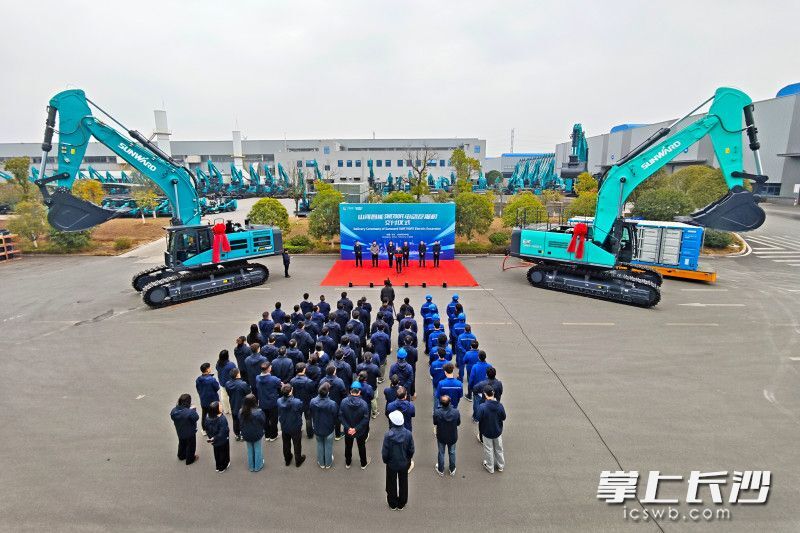
矿山圈“绿巨人”来了,山河智能交付大型拖电挖掘机
Chang Sha Wan Bao· 2026-02-04 10:46
Core Insights - The SWE700FE large electric crawler hydraulic excavator has been delivered and will be used in a major mining project in Inner Mongolia, marking a significant step in the electrification and greening of construction machinery by the company [1][3]. Group 1: Product Features - The SWE700FE is designed for small to medium-sized mining and ultra-long tunnel operations, with energy costs expected to decrease by over 35% compared to diesel models, and maintenance costs reduced by more than 70% [3]. - The excavator features a dual power system that allows it to connect to an external energy source for fixed operations and switch to its own battery for mobility, providing nearly one hour of travel time without interruption [3]. Group 2: Technological Advancements - The machine operates on an 800V high-voltage direct current platform, which reduces current loss and enhances energy efficiency [5]. - It is equipped with a proprietary control system developed by the company, enabling real-time coordination between electric control, motors, and external power supply for smoother and more efficient operation [5]. Group 3: Future Outlook - The company aims to continue its "pioneering innovation" strategy in the fields of new energy and intelligence, with plans to launch more advanced and high-performance equipment [5]. - To date, the company has developed over a hundred electric equipment models, creating a diverse and complete family of electric products, including electric excavators ranging from 1 ton to 70 tons, which are popular both domestically and internationally [5].


打造更宜居更美丽的幸福城区典范
Xin Lang Cai Jing· 2026-02-04 08:13
Group 1 - The core message emphasizes the need for Shanghai to implement the important speech by General Secretary Xi Jinping and to promote overall industrial system upgrades, aiming to create a more livable and beautiful urban area in Huangpu [1] - The city aims to expand domestic demand as a strategic foundation, striving to become a world-class consumption destination and enhance consumer experiences while driving economic growth [2] - During the "14th Five-Year Plan," the city successfully achieved its economic and social development goals, and now it is crucial for Huangpu to lead in consolidating and expanding economic stability [2] Group 2 - The focus is on building a modern industrial system centered around advanced manufacturing, with an emphasis on smart, green, and integrated development [2] - There is a strong commitment to enhancing people's livelihoods by addressing urgent public concerns and advancing urban renewal projects [2] - The city plans to leverage cultural resources and strengthen talent support to foster a youth-friendly development environment [2]
消费“新”图景丨补贴超1500万台!“新国补”落地首月市场活力迸发
Xin Hua Wang· 2026-02-04 06:01
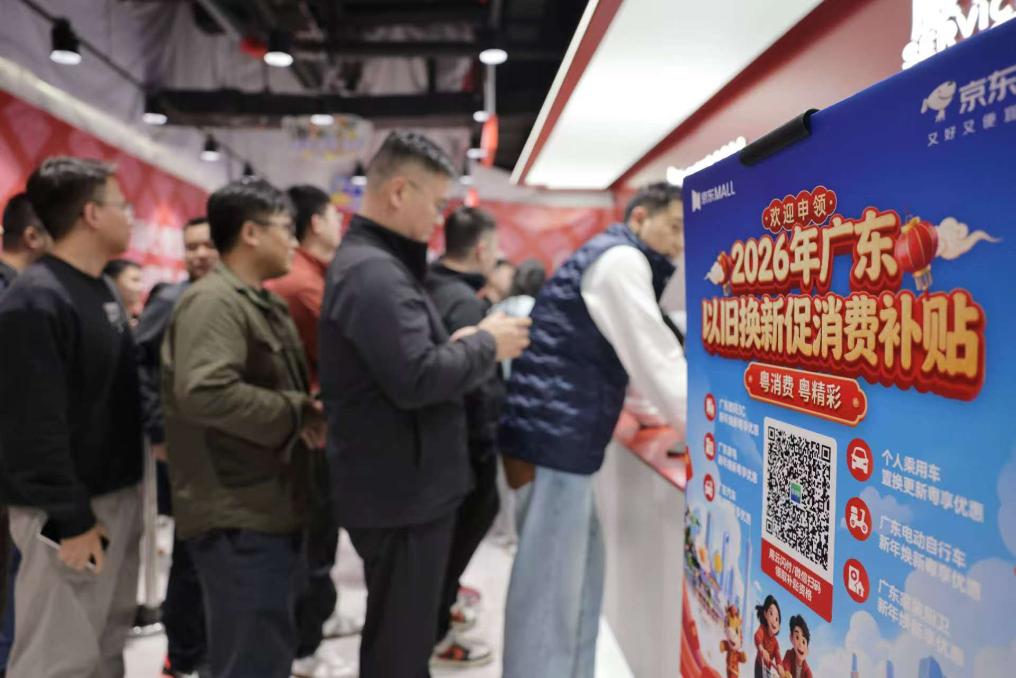
Group 1 - The "old-for-new" policy for consumer goods such as automobiles, home appliances, digital, and smart products is being actively implemented in 2026, with significant effects observed since the optimization of the subsidy policy [1] - In January, sales of six categories of home appliances and four categories of digital and smart products exceeded 15 million units, generating nearly 59 billion yuan in sales [1] - The "New National Subsidy" policy has accelerated consumer demand for upgrades, positively interacting with industrial transformation and expanding the consumption market [1] Group 2 - In the automotive sector, the combination of national subsidies, manufacturer discounts, and store promotions has attracted many consumers to make purchases [3] - The national subsidy policy in the home appliance sector focuses on products with first-level energy efficiency or water efficiency standards, promoting consumption upgrades towards low-carbon and green transitions [7] - Sales of first-level energy-efficient water heaters and televisions have increased by 35.7% and 28.9% year-on-year, respectively [7] Group 3 - In the digital and smart products sector, smart glasses have been included in the subsidy range for the first time, achieving sales of 7.197 million yuan [7] - The smart glasses market is experiencing explosive growth, with predictions indicating that the shipment volume in China will reach 4.5 million units in 2026, representing a year-on-year increase of 77% [7] - The "New National Subsidy" policy is driving a new wave of consumption in smart wearables, represented by smart glasses and smartwatches [7] Group 4 - The acceleration of market renewal reflects not only the concentrated effects of policies but also the inherent momentum of China's economy, illustrating a vibrant picture of "Chinese manufacturing" benefiting households [9]
透过税收看制造强国建设丨财金纵横
Xin Lang Cai Jing· 2026-02-04 05:06
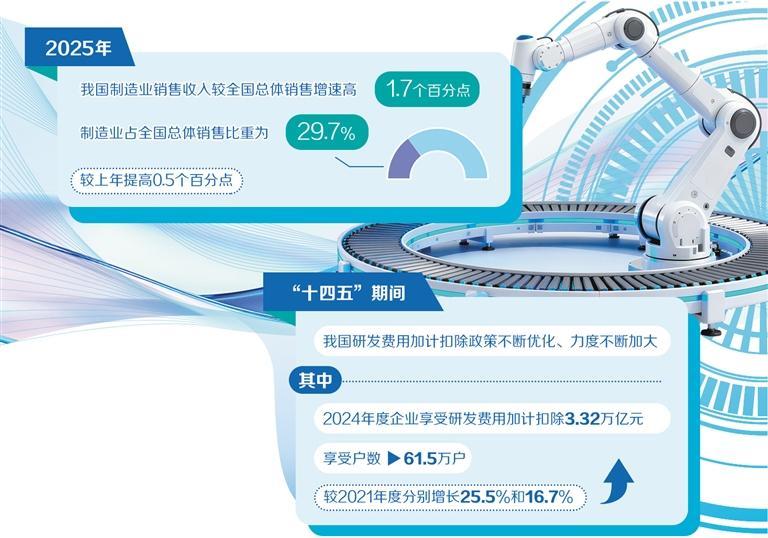
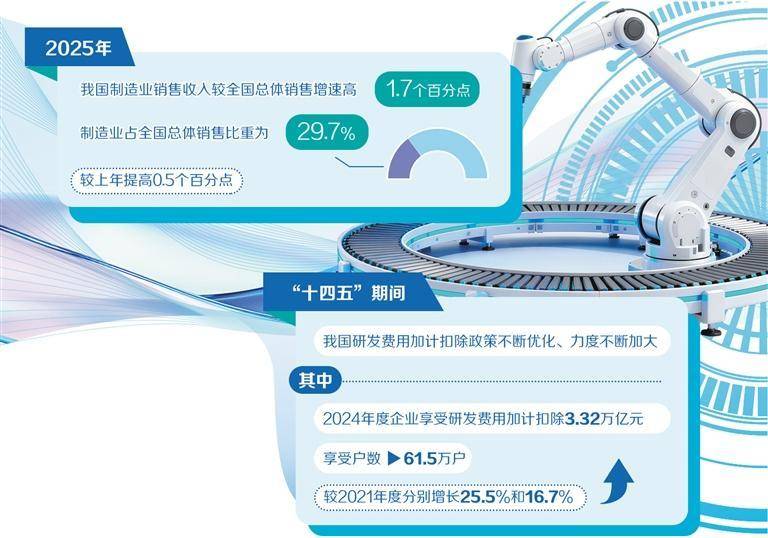
Core Insights - The manufacturing sector in China is expected to see a sales revenue growth rate that exceeds the national average by 1.7 percentage points by 2025, with its share of total sales rising to 29.7% [3] - The transition towards intelligent, green, and integrated manufacturing is accelerating, highlighting the sector's role as an economic stabilizer [3] Intelligent Upgrade - By 2025, the procurement of automation and digital equipment by manufacturing enterprises is projected to increase by 11.3% and 10% year-on-year, respectively [3] - The sales revenue of the intelligent equipment manufacturing sector is expected to grow by 28.1%, with industrial robots and special operation robots seeing year-on-year growth of 17.4% and 42.1% [3] Tax Incentives and Support - Tax policies are being tailored to support the intelligent, green, and integrated development of the manufacturing sector, focusing on technological innovation and reducing R&D costs [4] - The R&D expense deduction policy is being optimized, with an expected deduction of 3.32 trillion yuan for 2024, benefiting 615,000 enterprises, marking increases of 25.5% and 16.7% from 2021 [5] Green Development - The sales revenue of the new energy vehicle industry is projected to grow at an annual rate of 49.5%, while clean energy generation is expected to grow by 13.9% annually during the 14th Five-Year Plan period [6] - By 2025, the new energy vehicle manufacturing sector is anticipated to grow by 14.3%, and the clean energy generation sector's revenue is expected to increase by 17.3%, accounting for 38.5% of total electricity production revenue [6] Digital Integration - The sales revenue of the digital product manufacturing sector is expected to grow by 9.4% year-on-year, with manufacturing enterprises' procurement of digital technologies increasing by 10.4% [9] - The automotive industry is set to enhance its digital transformation, with policies aiming for significant improvements in smart manufacturing capabilities by 2027 and overall digital development by 2030 [9] Local Tax Administration Initiatives - Local tax authorities are implementing tailored services to support green and low-carbon initiatives, including customized tax incentive packages for enterprises [7] - Collaborative platforms between tax and environmental departments are being established to enhance compliance and streamline tax reporting processes [8] Future Directions - Continued focus on intelligent, green, and integrated manufacturing is essential, with a need for targeted support based on regional industrial characteristics [10] - The integration of compliance guidance and risk prevention into tax services is crucial for enhancing the competitiveness of manufacturing enterprises [10]
全力推动产业体系整体跃升 龚正参加黄浦代表团联组审议 要求打造更宜居美丽幸福城区典范
Jie Fang Ri Bao· 2026-02-04 02:02
Core Viewpoint - The article emphasizes the importance of implementing the strategic directives from Xi Jinping's inspection of Shanghai, focusing on innovation and development to enhance the overall industrial system and improve the quality of life in Huangpu District [1][2]. Group 1: Economic Development - The city successfully completed its economic and social development goals last year, marking a satisfactory conclusion to the 14th Five-Year Plan [2]. - Huangpu is expected to take a leading role in consolidating and expanding the positive economic momentum, particularly in the context of the new 15th Five-Year Plan [2]. Group 2: Consumer Market Expansion - The strategy focuses on expanding domestic demand, aiming to establish Huangpu as a world-class consumer destination by enhancing consumption experiences and promoting new consumption dynamics [2]. - There is an emphasis on innovative promotional methods to effectively convert consumption into economic growth [2]. Group 3: Industrial Transformation - Shanghai aims to accelerate the construction of a modern industrial system centered on advanced manufacturing, with Huangpu expected to lead in this transformation [2]. - The strategy includes strengthening traditional industries while developing new growth sectors, particularly through technology and cultural empowerment [2]. Group 4: Social Welfare and Urban Development - The government is committed to enhancing public welfare and addressing urgent community needs, focusing on urban renewal and the development of park cities [2]. - There is a strong emphasis on meeting the diverse and quality demands of citizens, ensuring that social welfare initiatives are prioritized [2].
透过税收看制造强国建设
Sou Hu Cai Jing· 2026-02-03 23:08
Core Insights - The manufacturing sector in China is expected to see a sales revenue growth rate that exceeds the national average by 1.7 percentage points by 2025, with its share of total sales rising to 29.7% [2] - The acceleration of intelligent, green, and integrated development in manufacturing is highlighted as a key focus for future growth [3][6] Intelligent Upgrading - By 2025, the procurement of automation and digital equipment by manufacturing enterprises is projected to increase by 11.3% and 10% year-on-year, respectively [3] - The sales revenue of the intelligent equipment manufacturing sector is expected to grow by 28.1%, with industrial robots and special operation robots seeing increases of 17.4% and 42.1% [3] - Tax incentives are being utilized to support the intelligent transformation of manufacturing, with a focus on technology innovation and reducing R&D costs [4][5] Green Development - The sales revenue of the new energy vehicle manufacturing sector is projected to grow by 14.3% year-on-year by 2025, while the clean energy generation sector is expected to see a 17.3% increase [6] - The share of clean energy generation in total electricity production revenue is anticipated to rise to 38.5%, an increase of 6.9 percentage points since 2021 [6] Digital Integration - The sales revenue of the digital product manufacturing sector is expected to grow by 9.4% year-on-year by 2025, with a 10.4% increase in the procurement of digital technologies by manufacturing enterprises [9] - The automotive manufacturing sector is set to enhance its digital capabilities significantly by 2027, with a focus on improving smart manufacturing maturity [9] - Tax authorities are enhancing digital services to improve compliance and efficiency in tax reporting for manufacturing enterprises [10][11]
宝丽迪:公司始终深耕化纤母粒行业
Zheng Quan Ri Bao Wang· 2026-02-03 12:16
Core Viewpoint - The company, Baolidi (300905), is committed to deepening its focus on the chemical fiber masterbatch industry, emphasizing innovation in product development aligned with functional, green, and diversified strategic directions [1] Group 1: Product Development and Strategy - The company is actively engaged in the research and development of new products that are closely aligned with its strategic focus on functionality, sustainability, and diversification [1] - The company has successfully expanded into new fields such as membrane applications and plastics while continuing to deepen its presence in traditional areas of strength [1] Group 2: Market Position and Growth - Through continuous investment in research and development, collaboration with academic institutions, and proactive market promotion, the company aims to consolidate its leading position in industry technology [1] - The company is also focused on actively exploring new growth opportunities to enhance its market presence [1]
671亿元!江苏省战新母基金第四批产业专项基金启动
FOFWEEKLY· 2026-02-03 10:14
Core Viewpoint - The establishment of the fourth batch of industry-specific funds by Jiangsu's strategic emerging industry mother fund, totaling 671 billion yuan, marks a significant step in promoting the integration of technological and industrial innovation in the province [1][3]. Group 1: Fund Overview - The fourth batch consists of four funds with a total scale of 671 billion yuan, aimed at fostering new productive forces in Jiangsu [1]. - The Long Triangle Venture Capital Guidance Fund, with a scale of 551 billion yuan, is one of the first three regional funds established under the national venture capital guidance fund [3]. - The provincial enterprise industry-specific fund includes two funds totaling 110 billion yuan, and a municipal industry-specific mother fund of 10 billion yuan [5]. Group 2: Investment Focus - The funds will primarily target sectors such as biomedicine, new energy, integrated circuits, artificial intelligence, robotics, low-altitude economy, new power, and aerospace [7]. - The Jiangsu New Energy (Guoxin) Industry Special Fund has a total scale of 50 billion yuan, with an initial phase of 10 billion yuan, focusing on the new energy sector and related strategic emerging industries [10]. - The Lianyungang Security Industry Special Mother Fund, initiated by Lianyungang Financial Holding Group, focuses on the entire security industry chain, including high-end equipment manufacturing and artificial intelligence [13]. Group 3: Key Characteristics - The fourth batch of industry-specific funds exhibits three main characteristics, including significant leverage effects, focusing on key investment areas, and enhancing the core competitiveness of industries [14][16][18]. - The funds aim to attract more capital and quality project resources to support the integration of technological and industrial innovation in Jiangsu [17].
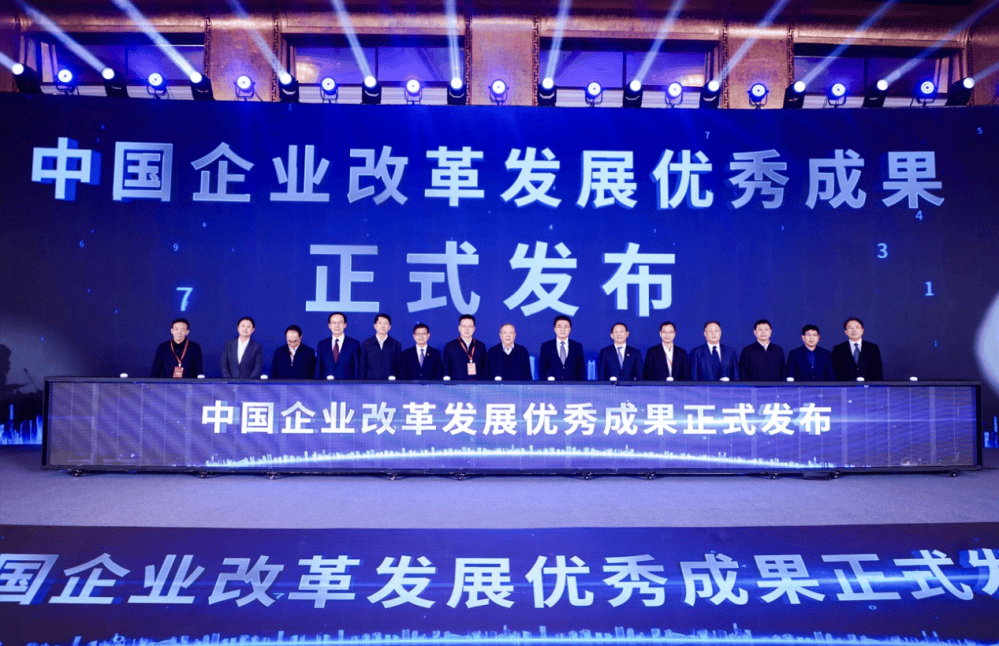
京东“业采融合”入选2025中国企业改革发展优秀成果,助力政企采购数智化升级
Sou Hu Cai Jing· 2026-02-03 07:52
Core Insights - The annual meeting of the China Enterprise Reform and Development Research Association highlighted the importance of enterprise reform and upgrading industrial chains, with JD's government and enterprise business receiving recognition for its innovative practices in digital and intelligent supply chain integration [1][3] Group 1: Awards and Recognition - JD's government and enterprise business won the first prize in the "Excellent Achievements in China's Enterprise Reform and Development" for its project on "Digital Intelligence Driving 'Business-Purchase Integration'" among 716 submissions [1][3] - JD is the only private enterprise to receive both the special award and first prize in this evaluation, which is guided by the State-owned Assets Supervision and Administration Commission and supported by various national departments [3] Group 2: Industry Challenges and Opportunities - The current economic landscape in China is characterized by structural optimization and transformation, facing challenges such as insufficient collaborative efficiency in supply chains and the need for enhanced risk resilience [3][4] - The integration of intelligent, green, and collaborative development presents significant opportunities for the industry, with JD emphasizing the need for breaking down barriers between business and procurement systems [4] Group 3: Business Model and Strategy - JD's "Business-Purchase Integration" concept aims to transform procurement from a "cost center" to a "strategic value center," facilitating deeper collaboration between procurement and core business functions [4] - The company is committed to supporting small and medium-sized enterprises (SMEs) and promoting high-quality development through its digital procurement solutions and services [5][7] Group 4: Service Reach and Impact - JD's government and enterprise business serves over 8 million government and enterprise clients, including more than 30,000 large clients, covering over 90% of the Fortune Global 500 companies in China [7] - The business has significantly aided numerous specialized and innovative "little giant" enterprises in achieving digital procurement upgrades, contributing to cost reduction and efficiency improvements across various sectors [7]

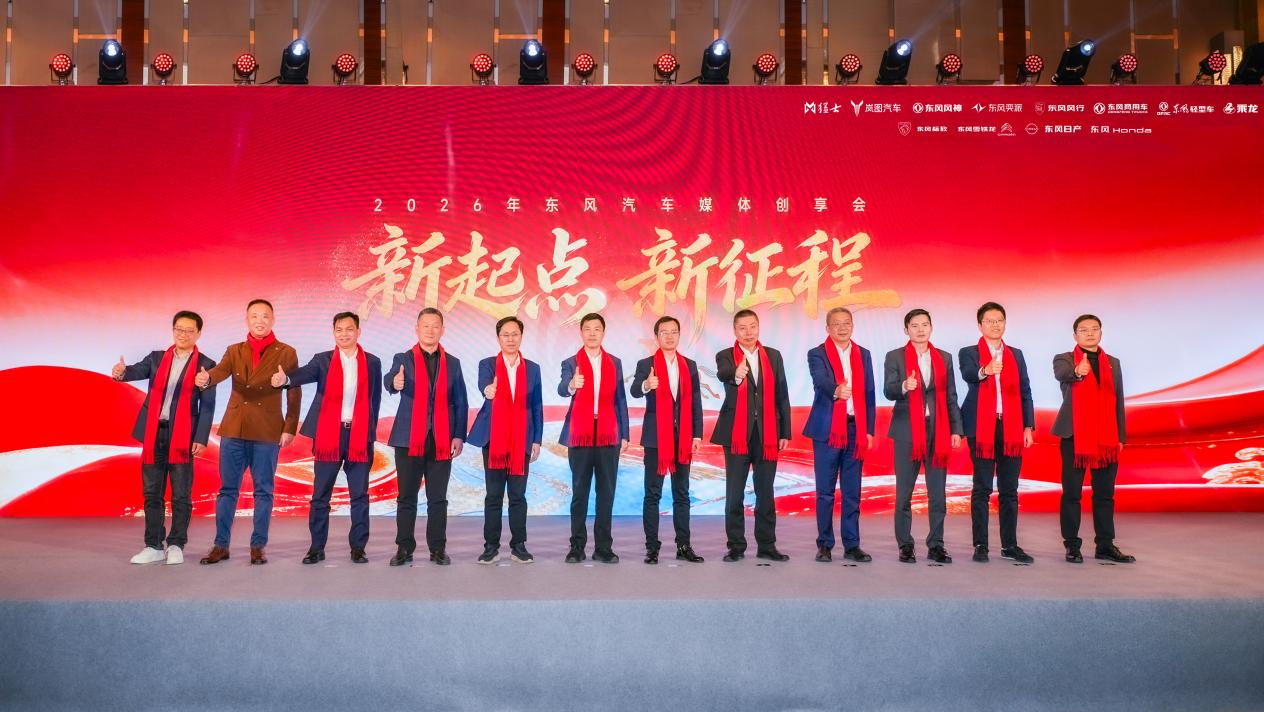
东风汽车发布2026年战略目标 计划全年销售325万辆
Yang Shi Wang· 2026-02-02 13:52
Core Insights - Dongfeng Motor Group is transitioning from an "investment phase" to a "harvest phase," with a focus on achieving a virtuous cycle of scale and efficiency, as evidenced by a 21% year-on-year increase in new energy vehicle sales to 1.05 million units in 2025 [3] - The company has set an overall sales target of 3.25 million units for 2026, including 1.7 million new energy vehicles and 600,000 exports, while emphasizing smart, green, and integrated development [4] Group 1: Strategic Development - The "One Dongfeng" strategy aims to synergize various business segments for growth [1] - Dongfeng's R&D investment intensity reached 7.9% in 2025, highlighting a commitment to core technology development [4] - The company has launched several key technologies, including the high-end MCU chip DF30 and the Mahle hybrid engine with over 48% thermal efficiency [4] Group 2: Product and Brand Planning - Dongfeng is set to unveil the co-created "Yijing" brand with Huawei in March, alongside new models from various brands, including the U series from Dongfeng Mengshi and the high-end models from Dongfeng Lantu [5] - The company plans to introduce a new generation of Mahle power systems and the T200 intelligent driving system, with large-scale applications expected [4] Group 3: Internal Reforms and Future Directions - Dongfeng will enhance internal reforms by granting more autonomy to frontline business units to improve market responsiveness [6] - The focus on technological innovation will serve as the core engine for the company's growth, aiming to elevate the Chinese automotive industry to a new level of high-quality development [6]