货币政策调控

Search documents
加力实施增量政策!央行最新发声
Zheng Quan Shi Bao· 2025-06-27 12:04
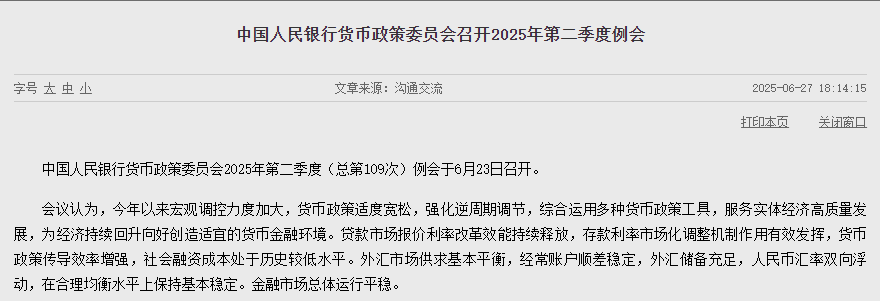
Core Viewpoint - The People's Bank of China (PBOC) has acknowledged a more complex and severe external environment, indicating a weakening global economic growth momentum and increasing trade barriers, while also highlighting domestic challenges such as insufficient demand and persistent low prices [1][3]. Monetary Policy Adjustments - The meeting suggested increasing the intensity of monetary policy adjustments, enhancing the foresight, targeting, and effectiveness of these policies, and flexibly managing the implementation pace based on domestic and international economic conditions [3][4]. - The PBOC has shifted its stance on the real estate market from "promoting stabilization" to "continuing to consolidate stability," emphasizing the need to revitalize existing housing and land stocks [3][4]. Interest Rate and Financing - The meeting recommended strengthening the guidance of central bank policy rates and improving the market-based interest rate transmission mechanism, aiming to lower overall financing costs [4]. - The PBOC has implemented a comprehensive reduction in various structural policy tool rates, including those for agriculture and small enterprises, as well as for carbon reduction and technological innovation [6]. Structural Policy Focus - The meeting emphasized the need to effectively utilize existing policies while actively implementing new policies to stimulate domestic demand, stabilize expectations, and invigorate economic growth [6]. - There is a call for more structural tools in monetary policy to support domestic demand expansion and facilitate economic restructuring and industrial upgrading [6].

加力实施增量政策!央行最新发声
证券时报· 2025-06-27 11:50
Core Viewpoint - The external environment is becoming increasingly complex and severe, with the global economic growth momentum shifting from "weak" to "diminishing" compared to the first quarter of 2025, highlighting rising trade barriers and persistent low domestic prices as new challenges [1] Monetary Policy Adjustments - The meeting suggested increasing the intensity of monetary policy adjustments, enhancing its foresight, targeting, and effectiveness, while flexibly managing the implementation strength and pace based on domestic and international economic conditions [3][4] - The central bank's previous recommendation for "timely reserve requirement ratio and interest rate cuts" has been implemented in the second quarter, with a focus on stabilizing employment, enterprises, markets, and expectations [3] Structural Policy Tools - Since the second quarter, the central bank has comprehensively reduced the interest rates of various structural policy tools, including long-term tools for supporting agriculture and small enterprises, as well as temporary tools for carbon reduction and technological innovation [6] - The meeting emphasized the need to effectively utilize existing policies while actively implementing new policies to stimulate domestic demand, stabilize expectations, and invigorate the economy [6][8] Support for Key Areas - The meeting highlighted the importance of supporting technological innovation and boosting consumption, particularly in key areas such as "two heavies" and "two news," while exploring regular institutional arrangements to maintain capital market stability [8] - Experts noted that future monetary policy should increasingly adopt structural tools to support domestic demand expansion and facilitate economic structural transformation and industrial upgrading [8]
【申万固收|深度】存款准备金制度改革去向何方——【货币政策知识点】深度研究之二
申万宏源研究· 2025-06-18 01:38
Historical Evolution of Deposit Reserve System - The deposit reserve system originated in the early 18th century in the UK, evolving from spontaneous interbank clearing needs to a legal risk buffer mechanism in the early 19th century in the US [5][21] - In China, the system was officially established in 1984 when the People's Bank of China began exercising central bank functions, with significant reforms occurring in 1998 to enhance the payment and clearing functions of reserve deposits [5][10] - Since 2015, China's reserve requirements have been assessed using an average method, providing important liquidity management buffers for banks [5][10] International Comparisons and Practices - Internationally, central banks like the Federal Reserve and the European Central Bank have adopted various reserve management practices, including accepting cash reserves and implementing tiered reserve requirements [13][47] - The experience of developed countries shows a trend of lower legal reserve requirements and higher excess reserves compared to China, which currently operates under a framework of structural liquidity shortage [8][13] Future Directions of Deposit Reserve System Reform - Conditions for breaking the 5% experience lower limit for reserve requirements are gradually maturing, with necessary institutional arrangements in place to support the transition [6][14] - The shift from quantity-based monetary policy to price-based policy is a prerequisite for relaxing the legal reserve requirement system, indicating a potential future direction for reform [6][14] Regulatory Functions and Macro-Prudential Management - The deposit reserve system has evolved to include differential reserve requirements and macro-prudential assessments, enhancing the ability to manage systemic financial risks [5][34] - The introduction of the macro-prudential assessment framework in 2016 marked a significant shift in focus from narrow credit growth to broader credit metrics, integrating various financial indicators into the regulatory framework [34][37] Implications for the Bond Market - If the reform of the reserve requirement system is implemented, it may lead to short-term benefits for the bond market, including increased liquidity and potential for larger fund releases during rate cuts [14] - However, the long-term impact on the bond market may be neutral, as the transition to price-based control could diminish the influence of reserve adjustments on market dynamics [14]

申万期货品种策略日报:国债-20250509
Shen Yin Wan Guo Qi Huo· 2025-05-09 05:33
Report Summary 1. Report Industry Investment Rating No information provided. 2. Core Viewpoints - The prices of treasury bond futures generally rose, with the yield of the 10 - year treasury bond active bond falling to 1.627%. The central bank's open - market operation had a net injection of 1586 billion yuan, and previous double - cuts (lowering the deposit reserve ratio by 0.5 percentage points and the 7 - day reverse repurchase operating rate by 10bp) pushed short - term bond interest rates to decline and the market liquidity to loosen [3]. - The Fed kept the federal funds rate unchanged as expected. The UK and the US reached an agreement on tariff trade agreement terms, and the EU announced a retaliatory list of 95 billion euros of US goods. The yield of US treasury bonds rebounded. China decided to contact the US, and the focus will be on the progress of the negotiations [3]. - Affected by external shocks and seasonal changes, the manufacturing prosperity level declined in April, and the real estate market is not yet stable. It is expected that the central bank will increase the intensity of monetary policy regulation, and the market liquidity is expected to remain loose, which will continue to support short - term treasury bond futures prices. The current long - short spread is at a historical low, and the compression space is limited. If the tariff negotiation makes progress, the volatility of long - term treasury bond futures prices may increase [3]. 3. Summary by Relevant Catalogs Futures Market - **Price and Yield Changes**: On the previous trading day, treasury bond futures prices generally rose. For example, the T2506 contract rose 0.19%, and the yields of key - term treasury bonds in China generally declined. The 10Y treasury bond yield declined 1.28bp to 1.63% [2]. - **Position and Volume Changes**: The position of T2506 increased, while some contracts had position decreases and increases. For example, the position of TS2506 decreased by 3076, and that of TS2509 increased by 3615 [2]. - **Arbitrage Situation**: The IRR of CTD bonds corresponding to the main contracts of treasury bond futures was at a low level, and there were no arbitrage opportunities [2]. Spot Market - **Short - term Market Interest Rates**: Short - term market interest rates generally declined. SHIBOR 7 - day interest rate declined 6.7bp, DR007 interest rate declined 6.62bp, and GC007 interest rate declined 7.1bp [2]. - **Key - Term Treasury Bond Yields**: The yields of China's key - term treasury bonds generally declined, and the long - short (10 - 2) treasury bond yield spread was 15.53bp [2]. Overseas Market - **Key - Term Treasury Bond Yields**: On the previous trading day, the 10Y US treasury bond yield rose 11bp, the 10Y German treasury bond yield declined 3bp, and the 10Y Japanese treasury bond yield rose 2.5bp [2]. Macro News - **Central Bank Operation**: On May 8, the central bank carried out a 1586 - billion - yuan 7 - day reverse repurchase operation with a net injection of 1586 billion yuan [3]. - **International Relations**: China and Russia deepened their strategic partnership, and China and the US will conduct tariff negotiations. The UK and the US reached a tariff trade agreement on some items, and the UK central bank cut interest rates [3]. - **Domestic Policies**: The financial regulatory authority established a mechanism to support small and micro - enterprise financing, and the balance of private enterprise credit loans increased year - on - year [3].
21社论丨保持流动性充裕,支持经济回升向好
21世纪经济报道· 2025-05-08 00:44
Core Viewpoint - The Chinese government has introduced a comprehensive financial policy package aimed at stabilizing the market and expectations, promoting high-quality economic development in response to global economic uncertainties [1][2]. Group 1: Financial Policy Measures - The financial policy package includes measures such as timely reductions in reserve requirement ratios (RRR) and interest rates, with a focus on structural measures to achieve high-quality development [2][4]. - The RRR will be lowered by 0.5 percentage points, providing approximately 1 trillion yuan in long-term liquidity to the market [2]. - The policy interest rate will be reduced by 0.1 percentage points, with the 7-day reverse repurchase rate decreasing from 1.5% to 1.4%, expected to lead to a similar decline in the Loan Prime Rate (LPR) [2]. Group 2: Support for Consumption and Innovation - The central bank will temporarily lower the reserve requirement ratio for auto finance and leasing companies from 5% to 0%, establishing a 500 billion yuan "service consumption and elderly re-loan" to support automotive consumption and service sectors [3]. - An additional 300 billion yuan will be allocated for technology innovation and transformation loans, along with the creation of risk-sharing tools for technology innovation bonds [3]. - The central bank will also increase the re-loan quota for agricultural and small enterprises by 300 billion yuan to support lending to rural and small private businesses [3]. Group 3: Real Estate and Stock Market Stability - The central bank will reduce the personal housing provident fund loan interest rate by 0.25 percentage points to support housing demand [3]. - The China Securities Regulatory Commission (CSRC) will support the Central Huijin Investment Ltd. in stabilizing the stock market, while expanding the pilot scope for insurance funds' long-term investments [4]. - The CSRC has announced an action plan to promote the high-quality development of public funds, aiming to attract more long-term capital into the market [4].

社论丨保持流动性充裕,支持经济回升向好
2 1 Shi Ji Jing Ji Bao Dao· 2025-05-07 17:45
Group 1 - The core viewpoint of the news is that China is implementing a comprehensive financial policy package to stabilize the market and expectations amid global economic uncertainties [1][2] - The financial policy package includes measures such as appropriate reductions in reserve requirements and interest rates, aimed at supporting technological innovation, expanding consumption, and stabilizing foreign trade [1][2] - The People's Bank of China (PBOC) is expected to lower the reserve requirement ratio by 0.5 percentage points, providing approximately 1 trillion yuan in long-term liquidity to the market [2][3] Group 2 - In terms of supporting consumption, the PBOC will reduce the reserve requirement ratio for auto finance and leasing companies to 0%, and establish a 500 billion yuan loan facility for service consumption and elderly care [3] - The PBOC will also increase the loan quota for technological innovation and transformation by 300 billion yuan, and create risk-sharing tools for technology innovation bonds [3] - To stabilize the real estate market, the PBOC will lower the personal housing provident fund loan interest rate by 0.25 percentage points, supporting the housing needs of families [3][4] Group 3 - The China Securities Regulatory Commission (CSRC) will support the Central Huijin Investment Company in stabilizing the stock market, and plans to approve an additional 60 billion yuan for insurance funds to invest long-term [4] - The CSRC has released an action plan to promote the high-quality development of public funds, encouraging long-term capital to enter the market [4] - A series of liquidity support policies demonstrate the central government's commitment to maintaining stock market stability amid global economic uncertainties [4]
重磅消息!央行宣布降准0.5个百分点,释放1万亿资金!专家:未来仍有下调余地【附企业贷款及个人贷款分析】
Qian Zhan Wang· 2025-05-07 11:42
降准后,银行的资金成本降低,进而能够推动企业融资成本的下降。这不仅有助于企业扩大生产规模、进行 技术创新和转型升级,还能增强企业的竞争力,特别是对于中小微企业来说,能够更好地满足其资金需求, 促进实体经济的健康发展。 银行业代表企业贷款发放工商银行规模最大:从银行业代表企业的业绩来看,2022年前三季度工商银行发放 贷款及垫款金额、吸收存款金额均为最高,分别为22.30万亿元、30.09万亿元。 (图片来源:摄图网) 图表7:2022年中国银行业代表性企业贷款发放、存款吸收情况(单位:亿元) | 公司名称 | 发放贷款及垫款金额(亿元) | 吸收存款金额(亿元) | | --- | --- | --- | | 工商银行 | 223024.50 | 300915.01 65 | | 建设银行 | 202107.86 | 247916.00 | | 农业银行 | 185976.23 | 248906.97 | | 中国银行 | 169775.48 | 199591.34 | | 交通银行 | 70463.35 | 78878.13 | | 邮储银行 | 69152.78 | 122650.45 | | 招商银行 ...

申万期货品种策略日报:国债-20250506
Shen Yin Wan Guo Qi Huo· 2025-05-06 06:22
| | | | | 申银万国期货研究所 唐广华(从业资格号:F3010997;交易咨询号:Z0011162) tanggh@sywgqh.com.cn 021-50586292 | | | | | | | --- | --- | --- | --- | --- | --- | --- | --- | --- | --- | | | | TS2506 | TS2509 | TF2506 | TF2509 | T2506 | T2509 | TL2506 | TL2509 | | | 昨日收盘价 | 102.366 | 102.628 | 106.100 | 106.385 | 109.000 | 109.145 | 120.76 | 121 | | | 前日收盘价 | 102.332 | 102.592 | 106.070 | 106.345 | 109.120 | 109.245 | 120.98 | 121.24 | | | 涨跌 | 0.034 | 0.036 | 0.030 | 0.040 | -0.120 | -0.100 | -0.220 | -0.240 | | | 涨跌幅 | 0.03% | 0 ...
申万期货品种策略日报:国债-20250425
Shen Yin Wan Guo Qi Huo· 2025-04-25 03:31
| | | | | 申银万国期货研究所 唐广华(从业资格号:F3010997;交易咨询号:Z0011162) tanggh@sywgqh.com.cn 021-50586292 | | | | | | | --- | --- | --- | --- | --- | --- | --- | --- | --- | --- | | | | TS2506 | TS2509 | TF2506 | TF2509 | T2506 | T2509 | TL2506 | TL2509 | | | 昨日收盘价 | 102.368 | 102.590 | 106.020 | 106.315 | 108.770 | 108.920 | 119.26 | 119.52 | | | 前日收盘价 | 102.402 | 102.608 | 106.165 | 106.420 | 108.970 | 109.100 | 119.4 | 119.6 | | | 涨跌 | -0.034 | -0.018 | -0.145 | -0.105 | -0.200 | -0.180 | -0.140 | -0.080 | | | 涨跌幅 | -0.0 ...
央行释放积极信号,银行板块有望延续平稳向上走势,分红更高,波动率更低的泰康香港银行指数(A类:006809;C类:006810)备受关注
Jie Mian Xin Wen· 2025-03-24 07:17
Group 1 - The central bank has signaled a positive outlook, suggesting that the banking sector is likely to continue its stable upward trend, with the Taikang Hong Kong Banking Index (Class A: 006809; Class C: 006810) gaining significant attention due to higher dividends and lower volatility [1][2] - As of March 21, 2025, the Taikang Hong Kong Banking Index has shown strong performance with a cumulative increase of over 16% since the beginning of the year [1] - The HK Banking Index consists of only 20 constituent stocks, including major banks and specialized small and medium-sized banks, such as China Construction Bank, HSBC Holdings, Industrial and Commercial Bank of China, and Bank of China, providing significant advantages in dividend yield, valuation, volatility, and industry representation [1] Group 2 - On March 18, 2025, the People's Bank of China held its first quarter monetary policy committee meeting, suggesting an increase in the intensity of monetary policy adjustments and a more flexible approach based on domestic and international economic conditions [2] - The meeting emphasized the need to prevent excessive exchange rate fluctuations and to stabilize the real estate market, while also aiming to reduce the overall financing costs in society [2] - Citic Securities noted that the core message from the central bank remains one of moderate easing, with a focus on accelerating the resolution of interest rate policy bottlenecks and enhancing structural policy tools for technology innovation, consumption, and foreign trade [2]