
大模型

Search documents
Agent到底对CPU带来怎样的需求
2026-01-23 15:35
Summary of Conference Call Notes Industry and Company Involved - The discussion revolves around the demand for CPUs driven by the increasing number of Agents in AI systems, focusing on the implications for CPU usage and performance in AI applications. Core Points and Arguments - **Increased Demand for CPUs**: The rise in the number of Agents significantly increases the demand for CPUs, as each Agent requires substantial computational resources for data processing and logical scheduling [1][4] - **Virtual Machine Technology Changes**: Current AI clusters emphasize hardware resource binding, requiring virtual machines to start within 1 second and maintain a resident state, which escalates the need for high-performance CPUs [1][5] - **CPU Load Factors**: The core factors affecting CPU load include the duration and frequency of tasks. Long-duration tasks (2-4 hours) have a more significant impact on CPU load compared to short, frequent tasks [1][6] - **Memory Management Needs**: The development of large models necessitates more CPUs for memory scheduling, particularly with DRAM and SSD storage, which involves complex data communication [2][15] - **Agent Task Complexity**: AG tasks impose a heavy load on CPUs, with token consumption during processing being significantly higher than user input, leading to increased computational demands [1][11] - **Future CPU Usage Growth**: CPU usage growth is expected to be between linear and exponential, potentially doubling or quadrupling in the next few years, depending on the complexity of long-term tasks [2][12] - **Deepseek and Anagram Technologies**: These technologies enhance computational efficiency by offloading some calculations to CPUs, reducing GPU burden and improving query efficiency [1][10] - **CPU vs. GPU**: While CPUs can support smaller language models, GPUs remain essential for complex tasks in AI servers, indicating that CPUs are not a complete substitute for GPUs in high-demand scenarios [2][12][18] - **Agent Support by CPU Cores**: A single CPU core can support 2-5 Agents, but this number decreases for complex tasks, highlighting the need for more cores to handle increased workloads [2][13] - **Market Supply and Alternatives**: Despite the tight supply of CPUs, established vendors like Intel and AMD maintain a competitive edge due to their stable ecosystems, while newer architectures are still in development [2][22] Other Important but Potentially Overlooked Content - **Impact of High Concurrency**: In high-concurrency situations, even optimized simple tasks can place significant demands on CPUs, especially during peak usage times [2][19] - **Challenges in Performance Optimization**: As user scale increases, the effectiveness of CPU performance optimizations may diminish, with potential performance gains dropping during peak usage [2][20] - **General Computing vs. AI Servers**: General computing servers focus on storage integration, while AI servers prioritize GPU capabilities, indicating a divergence in design and application [2][21] - **Future Trends in General Computing Servers**: The maturity of general computing servers suggests a continued reliance on established platforms like Intel and AMD, particularly in cloud technology [2][23]
赛意信息:公司是华为首批“盘古大模型”合作伙伴
Zheng Quan Ri Bao Wang· 2026-01-23 11:41
Group 1 - The company, Saiyi Information (300687), has established a deep cooperative relationship with Huawei, becoming one of the first partners for Huawei's "Pangu Model" [1] - The collaboration focuses on exploring the application of the Pangu Model in various scenarios, including quality inspection, production scheduling, and supply chain optimization within the manufacturing industry [1]

争夺AI制高点,谷歌和Anthropic必有一战
美股研究社· 2026-01-23 10:55
Core Viewpoint - Anthropic is aggressively seeking a $25 billion funding round to enhance its competitive edge in the AI programming tools market, where developer experience and agent capabilities are becoming crucial [5][43]. Group 1: Anthropic's Position and Strategy - Anthropic's Claude Code holds a 52% market share in the AI programming tools sector, demonstrating its dominance over competitors [5]. - The company has developed Cowork, a desktop application that allows Claude to access user files and execute complex tasks, expanding its application beyond mere programming [22][25]. - Anthropic's revenue growth is significant, with projected annual revenue increasing from $1 billion in 2025 to $15.2 billion in 2026, indicating a 15-fold growth rate [45][46]. Group 2: Google's Competitive Landscape - Google is positioned as a challenger in the AI programming space, with its Antigravity tool set to launch in late 2025, which emphasizes agent-first design [6][8]. - Antigravity's adoption rates are reportedly lower than established tools like Cursor and GitHub Copilot, indicating a struggle to gain traction in the developer community [13][14]. - Despite its resources, Google's full-stack advantages have not translated into competitive strength in the programming tools market [20][26]. Group 3: Hardware and Infrastructure - Anthropic has secured a deal to purchase nearly 1 million Google TPU v7 chips for $42 billion, which will provide over 1GW of computing capacity [30][31]. - The TPU v7 offers significant cost and performance advantages over NVIDIA GPUs, with a 30-44% reduction in total ownership costs and a nearly 10-fold performance increase compared to its predecessor [33][34]. - This partnership allows Anthropic to reduce dependency on NVIDIA and ensures a stable supply chain for its AI model training needs [38][39]. Group 4: Investment and Market Dynamics - Anthropic's valuation is projected to reach $350 billion following its upcoming funding round, a significant increase from $61.5 billion in March 2024 [43]. - The investment landscape is shifting, with firms like Sequoia Capital diversifying their bets across multiple AI companies, indicating a belief in a multi-winner scenario in the AI sector [50][52]. - The capital-intensive nature of AI development is creating high barriers to entry, with only companies capable of securing substantial funding able to compete effectively [53][54]. Group 5: Future Outlook - The competition between Google and Anthropic is characterized by different strategic focuses, with Google leveraging its infrastructure and Anthropic concentrating on developer tools [59][60]. - The battle for dominance in AI programming tools is critical, as developers are key to shaping the future of software production [61].



国产AI算力生态持续完善,产业资本化趋势加速,港股通互联网ETF易方达(513040)等产品受市场关注
Mei Ri Jing Ji Xin Wen· 2026-01-23 06:31
Group 1 - The core viewpoint of the news highlights Alibaba's advancement in its AI chip business, Pingtouge, which is moving towards independent operations and potential IPO after internal restructuring, indicating significant progress in AI foundational technology layout [1] - The AI chip business, combined with Alibaba's applications in large models and cloud computing, provides a differentiated advantage in computational efficiency and scalability [1] - Analysts suggest that this movement reflects a broader trend among leading internet companies in Hong Kong, accelerating towards an integrated system of "model-computing-application-ecosystem," with AI transitioning from application-level narratives to foundational infrastructure and core technological capabilities [1] Group 2 - The Hang Seng Tech Index consists of the 30 largest stocks related to technology themes listed in Hong Kong, focusing on sectors like semiconductors, robotics, software, internet, and smart driving; the China Securities Hong Kong Internet Index focuses on internet platform companies with a high proportion of AI applications [2] - Both indices have rolling price-to-earnings ratios around 25 times, positioned at the 35.7% and 31.3% percentiles since their inception [2] - The ETFs tracking these indices, E Fund (513040) and Hang Seng Tech ETF (513010), have attracted approximately 1.5 billion yuan in net inflows this year, benefiting investors looking to package leading companies in the industry [2]
港股速报|港股高开反弹 阿里涨超3% 泡泡玛特大涨7%
Mei Ri Jing Ji Xin Wen· 2026-01-23 05:57
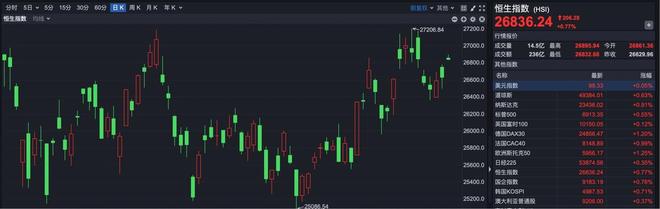
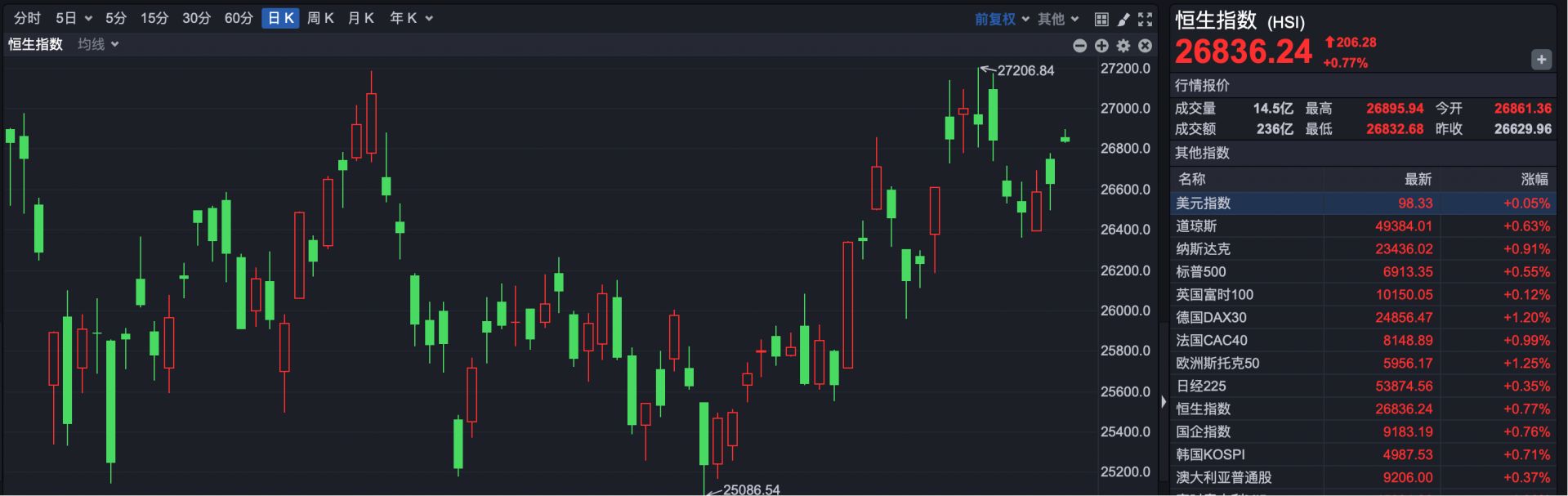
Market Overview - The Hong Kong stock market continued its rebound, with the Hang Seng Index opening at 26,861.36 points, up 231.40 points, a rise of 0.87% [1] - The Hang Seng Tech Index opened at 5,817.51 points, increasing by 55.07 points, a gain of 0.96% [2] Company Highlights - Alibaba Group (HK09988) saw its stock rise over 3% in early trading [4] - Alibaba has reportedly decided to support its chip subsidiary, Pingtouge, for an independent listing, although the specific timeline remains unclear [5] - Pop Mart (HK09992) experienced a significant increase, with its stock rising over 7% [5] Sector Performance - New consumption concept stocks showed strength, with Lao Pu Gold rising by 6.60% and Guoquan increasing by 3.55% [7] - The release of Pop Mart's Valentine's Day limited series has led to some hidden items being priced at nearly 7 times their original value [7] - Tech stocks generally rose, with Xiaomi up over 3%, JD.com up over 2%, and Bilibili and Kuaishou each gaining over 1% [7] Market Outlook - Guolian Minsheng Securities maintains a positive outlook on the revaluation of AI in China, supported by a solid industrial catalyst timeline [8] - The release of DeepSeek V4 is anticipated during the Chinese New Year, potentially replicating last year's "Spring Festival offensive" [8] - Morgan Stanley predicts that as investors continue to favor growth stocks, the upward trend in both A-shares and Hong Kong stocks is likely to persist until the Lunar New Year, with Hong Kong stocks expected to outperform A-shares [8]


港股科技ETF(513020)涨超1%,港股科技龙头正加速推进AI与业务生态融合
Mei Ri Jing Ji Xin Wen· 2026-01-23 05:44
Group 1 - The core viewpoint is that Hong Kong's technology leaders are accelerating the integration of AI with their business ecosystems, with Alibaba and Tencent leading the charge in productization and application expansion [1] - Alibaba is leveraging its Qianwen platform to enhance product offerings in core scenarios such as e-commerce and transportation, while Tencent is using its WeChat ecosystem to lower development barriers for AI applications [1] - The growth momentum of Alibaba Cloud's overseas business is strong, and the recent performance of domestic semiconductor and hard tech companies listed in Hong Kong is robust, indicating a continued influx of quality tech firms to the Hong Kong market [1] Group 2 - The Hong Kong Stock Connect Technology Index has a higher allocation in sectors like new energy vehicles, innovative pharmaceuticals, and semiconductors compared to the Hang Seng Technology Index [2] - From the base date at the end of 2014 to the end of 2025, the cumulative return of the Hong Kong Stock Connect Technology Index is 224.25%, significantly outperforming the Hang Seng Technology Index, which has a return of 83.87% [2] - The Hong Kong Stock Connect Technology Index has consistently outperformed other indices, including the Shanghai-Hong Kong-Shenzhen Internet Index and the Hang Seng Healthcare Index [2]
港股速报 | 港股高开反弹 阿里涨超3% 泡泡玛特大涨7%
Mei Ri Jing Ji Xin Wen· 2026-01-23 05:28
Group 1 - The Hong Kong stock market continued its rebound, with the Hang Seng Index opening at 26,861.36 points, up 231.40 points, a rise of 0.87% [1] - The Hang Seng Tech Index opened at 5,817.51 points, increasing by 55.07 points, a gain of 0.96% [2] - Alibaba Group's stock (HK09988) rose over 3% in early trading, while its subsidiary, Pingtouge, is set to support an independent listing, although the specific timeline is unclear [3][5] Group 2 - Other new consumer concept stocks showed strength, with Pop Mart (HK09992) rising over 7%, and Lao Pu Gold increasing by 6.60% [5][7] - The technology sector saw a general increase, with Xiaomi up over 3%, JD.com up over 2%, and Bilibili and Kuaishou both rising over 1% [7] - J.P. Morgan predicts that the upward trend in A-shares and Hong Kong stocks will continue until the Lunar New Year, with Hong Kong stocks expected to outperform A-shares [8]
百度“文心5.0”正式版发布,两名年轻技术骨干公开亮相
Guan Cha Zhe Wang· 2026-01-23 03:07
Core Insights - Baidu has launched the official version of its native multimodal large model, Wenxin 5.0, which features 2.4 trillion parameters and utilizes a unified modeling technology for multimodal understanding and generation [1][4] - The model supports various types of information inputs and outputs, including text, images, audio, and video, positioning Baidu at the forefront of the global AI landscape [1][3] Model Architecture and Performance - Wenxin 5.0 employs a unified autoregressive architecture for native multimodal modeling, allowing for joint training of multiple data types within a single framework, enhancing feature integration and optimization [4] - The model's language and multimodal understanding capabilities have surpassed those of competitors like Gemini-2.5-Pro and GPT-5-High, securing a leading position in international evaluations [3] Technical Innovations - The model incorporates a large-scale mixture of experts structure with ultra-sparse activation parameters, maintaining strong performance while improving inference efficiency [8] - Baidu has developed several application models, including a voice token-based end-to-end synthesis model and real-time interactive digital human technology, which enhance user engagement and application versatility [12][11] Application and Industry Impact - Baidu's digital human generation technology has been successfully applied in live streaming and e-commerce, demonstrating the practical value of its models in real-world scenarios [13] - The Qianfan platform supports the deployment of Wenxin 5.0 and over 150 SOAT models, providing a comprehensive environment for enterprises to innovate and operate efficiently [15] Strategic Vision - Baidu aims to create a closed-loop ecosystem that integrates chips, intelligent cloud platforms, and models to empower various AI applications across industries, reflecting its commitment to advancing AI solutions [15]


黄仁勋谈AI的“五层蛋糕”;宇树科技澄清销量数据丨科技风向标
2 1 Shi Ji Jing Ji Bao Dao· 2026-01-23 02:57
Group 1: AI and Technology Developments - Huang Renxun, CEO of NVIDIA, described AI as the largest infrastructure construction in human history, emphasizing its role in driving job growth globally and categorizing it as a "five-layer cake" encompassing various sectors [2] - Elon Musk announced plans to sell the Optimus robot to the public by the end of next year, with expectations for the robot to perform more complex tasks by 2026 [3] - Alibaba's T-Head semiconductor subsidiary is reportedly planning to go public, leading to a surge in Alibaba's stock price [4] - Alibaba Cloud's Qwen3-TTS series of models has been open-sourced, offering advanced voice generation capabilities [6] - Baidu launched the Wenxin 5.0 model, which boasts 24 trillion parameters and excels in multimodal understanding and generation, positioning itself among the top global models [8] Group 2: Financial and Investment Activities - Yushu Technology clarified its sales data, reporting actual shipments of over 5,500 humanoid robots for 2025, emphasizing the distinction between actual sales and order numbers [5] - Zhaoyi Innovation plans to raise 500 million yuan through A-shares to increase capital for its subsidiaries, focusing on DRAM chip development [10] - Shanghai Suiyuan Technology has received approval for its IPO on the Sci-Tech Innovation Board, aiming to raise 6 billion yuan for product development and business expansion [11] - Blue Arrow Aerospace's IPO status has changed to "inquiry," as it focuses on developing liquid oxygen-methane engines and launch services [12] - Mingyang Smart Energy is planning to acquire 100% of Zhongshan Dehua Chip Technology, enhancing its capabilities in the photovoltaic sector [13] - Sunrise, an AI inference GPU chip company, announced nearly 3 billion yuan in financing within a year, aimed at next-generation GPU development [14][15] Group 3: Market Trends and Product Launches - Realme launched the Neo8 gaming smartphone, featuring a 165Hz display and a large battery, with plans for significant sales growth in 2025 [16]
机器人在这里变“聪明”
Da Zhong Ri Bao· 2026-01-23 02:02
Core Insights - The article discusses the advancements in the robotics industry, particularly focusing on the development of inspection robots equipped with intelligent systems that can perform tasks such as obstacle avoidance and data collection [1][2]. Group 1: Technological Advancements - The robotics industry is experiencing rapid growth, transitioning from basic mechanical capabilities to more sophisticated intelligent systems that can operate in complex environments [1]. - The development of robots involves enhancing their hardware with components like mechanical arms and cameras to improve their operational capabilities [2]. - Data collection and simulation training are crucial for robots to learn and adapt to real-world industrial scenarios, requiring a significant amount of high-quality training data [3]. Group 2: Training and Data Utilization - The training process for robots includes feeding them extensive simulated data, with examples indicating that tens of terabytes of data are used to refine their operational precision [3]. - Real-world testing environments are created to validate the robots' performance before deployment, ensuring they can handle various operational challenges [3]. - The accumulation of high-quality training data allows for cross-domain application, enhancing the robots' adaptability to different industrial scenarios [4]. Group 3: Market Dynamics and Industry Focus - The value generated by robots is more pronounced in niche sectors and small to medium enterprises, where specific pain points can be addressed effectively [6]. - The robotics industry is shifting its focus from storytelling to tangible metrics such as orders, deliveries, and repeat purchases, indicating a maturation of the market [6]. - Companies must continuously innovate in core components and structural design to maintain competitiveness and customer loyalty in the evolving robotics landscape [6][7]. Group 4: Regional Development Initiatives - Shandong province is actively supporting major technological initiatives in robotics, focusing on key components like controllers and operating systems [7]. - The establishment of comprehensive training facilities at various levels is planned to enhance the capabilities of local robotics companies [7].
