云计算

Search documents
生益科技签订高性能覆铜板项目投资意向协议 投资金额约45亿元
Zhi Tong Cai Jing· 2026-01-04 10:14
Core Viewpoint - The company has reached a cooperation intention with the Dongguan Songshan Lake High-tech Industrial Development Zone Management Committee to invest approximately 4.5 billion RMB in a high-performance copper-clad laminate project, addressing the growing demand in key technology sectors [1] Group 1: Investment and Project Details - The investment amount for the high-performance copper-clad laminate project is approximately 4.5 billion RMB [1] - The project aims to meet the strong global market demand for high-performance copper-clad laminates, which are essential for technologies such as AI, cloud computing, 6G communication, and smart automotive electronics [1] - The agreement was facilitated by the Dongguan municipal government, indicating local support for the project [1] Group 2: Strategic Importance - This project is considered a key strategic layout for the company's future development [1] - The initiative is expected to enhance the company's core competitiveness and market share in the copper-clad laminate sector [1] - The investment aligns with the company's development strategy and benefits all shareholders [1]

生益科技(600183.SH)签订高性能覆铜板项目投资意向协议 投资金额约45亿元
智通财经网· 2026-01-04 10:13
智通财经APP讯, 生益科技(600183.SH)发布公告,公司与东莞松山湖高新技术产业开发区管理委员会 (以下简称"松山湖管委会")经友好协商,并在东莞市政府同意推动公司万江老厂区地块收储工作,采用 一揽子解决方案的基础上,双方就公司投资建设高性能覆铜板项目的相关事项达成合作意向,签订《东 莞松山湖高新技术产业开发区项目投资意向协议》,意向投资金额约45亿元人民币,以满足高性能覆铜 板持续增长的需求。 公告称,项目是公司面向未来发展的关键战略布局,快速响应全球市场对高性能覆铜板的强劲增长需 求,持续为AI、云计算、6G通信、智能汽车电子等重要技术提供关键支撑,进一步提升公司核心竞争 力和产品市场占有率,符合公司发展战略及全体股东利益。 ...
生益科技拟45亿元投资建设高性能覆铜板项目
Bei Jing Shang Bao· 2026-01-04 10:03
生益科技表示,本项目是公司面向未来发展的关键战略布局,快速响应全球市场对高性能覆铜板的强劲 增长需求,持续为AI、云计算、6G通信、智能汽车电子等重要技术提供关键支撑,进一步提升公司核 心竞争力和产品市场占有率,符合公司发展战略及全体股东利益。本协议的履行对公司本年度的资产总 额、净资产和净利润等不构成重大影响。 公告显示,本项目投资不属于关联交易,也不构成《上市公司重大资产重组管理办法》规定的重大资产 重组。 北京商报讯(记者 马换换 王蔓蕾)1月4日晚间,生益科技(600183)披露公告称,公司与东莞松山湖 高新技术产业开发区管理委员会经友好协商,并在东莞市政府同意推动公司万江老厂区地块收储工作, 采用一揽子解决方案的基础上,双方就公司投资建设高性能覆铜板项目的相关事项达成合作意向,签订 《东莞松山湖高新技术产业开发区项目投资意向协议》,意向投资金额约45亿元,以满足高性能覆铜板 持续增长的需求。 ...
硅谷富翁去年股票套现超160亿美元:忙着结婚的贝索斯抛得最多
Xin Lang Cai Jing· 2026-01-04 08:52
另一家芯片公司博通也在去年12月传出高管出售股票的消息,其首席法律和公司事务官Mark David Brazeal出售了1254万美元的股票。过去一年中,博通的内部人士累计抛售了价值3.76亿美元的股票。 Meta、美光、Arista Networks等人工智能参与者同样也传出内部高管套现的消息。去年10月,还有消息 称OpenAI估值突破5000亿美元后,该公司员工套现了66亿美元的股票。 这些交易大部分是根据高管事先提交的交易计划进行的,而非一时冲动的决定。但这些内部人士的不断 减持仍引发了一些不安。 过去一年,美股纳斯达克指数屡创新高,而根本动力来自于投资者对人工智能基础设施、云计算和先进 网络技术的押注,不少公司的市值也在这股热潮中达到历史最高水平,但行业高管的抛售却暴露出他们 对公司未来缺乏信心。 来源:智通财经 智通财经1月4日讯(编辑 马兰)2025年是美股科技股继续上涨的一年,而在这一年中,科技业的亿万 富翁们也在不断将帐面财富转变为实际的现金。 据一份粗略分析,2025年共有超过160亿美元的科技股票套现,其中亚马逊创始人贝索斯是套现规模最 大的一位硅谷精英,他在去年6月和7月出售了累计25 ...


每经品牌100指数2025年报收1145点,成分股百度集团2026年“首秀”大涨9%
Sou Hu Cai Jing· 2026-01-04 07:34
Group 1: Market Overview - The A-share market ended 2025 with all major indices in the green, supported by multiple favorable factors such as the "15th Five-Year Plan" industrial guidance and loose overseas liquidity [1][3] - The "Everyday Brand 100 Index" achieved a 15.21% annual increase in 2025, closing at 1145.49 points, marking two consecutive years of gains [2][3] Group 2: Baidu Group Performance - Baidu Group's stock surged by 9.35% on January 2, 2026, with a weekly increase of 20.33%, following the announcement of its subsidiary Kunlun Chip's application for a Hong Kong IPO [4][5] - The Kunlun Chip, focused on AI chip development, is expected to enhance Baidu's asset value significantly if it achieves a high valuation upon listing [5] Group 3: AI Cloud and Smart Driving Growth - Baidu's AI cloud revenue grew by 21% year-on-year in Q3 2025, with AI infrastructure revenue increasing by 33% and AI accelerator infrastructure subscription revenue soaring by 128% [7][8] - The company's "萝卜快跑" (Roborun) service saw a significant increase in order volume, exceeding 310,000 orders in Q3 2025, reflecting a more than 200% year-on-year growth [6][8] Group 4: Economic Environment and Policy Support - The domestic economic environment showed resilience in exports, while the CPI continued to recover, although consumer and investment indicators remained weak [3] - The Central Economic Work Conference emphasized expanding domestic demand and fostering new growth drivers as key tasks for 2026, aiming for a strong start to the "15th Five-Year Plan" [3]

科大讯飞入股团好猫科技,后者含AI业务
Qi Cha Cha· 2026-01-04 02:31
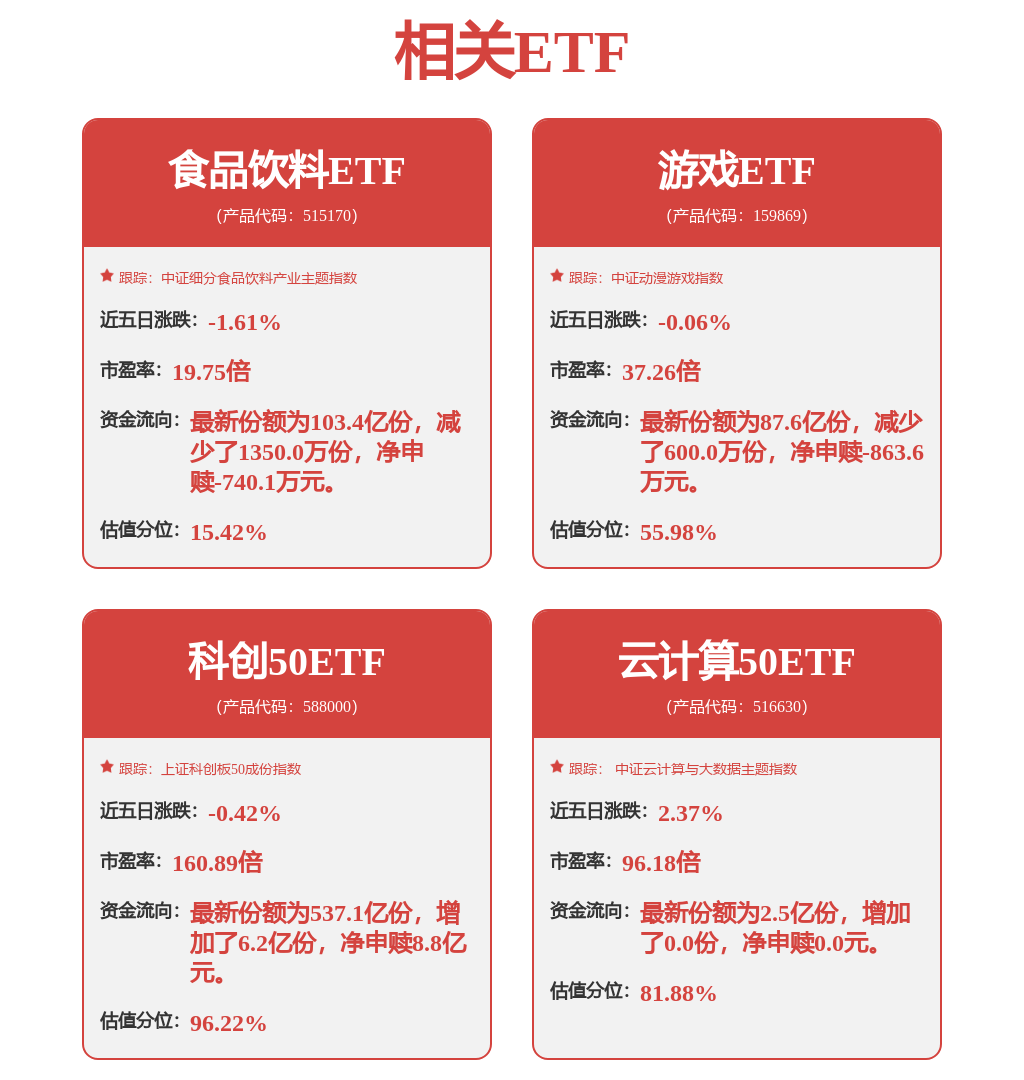
(原标题:科大讯飞入股团好猫科技,后者含AI业务) 个查查APP显示,近日,杭州团好猫科技有限公司发生工商变更,新增科大讯飞(002230)全资子公司安徽讯飞后创科技有限公司为股东。企查 查信息显示,该公司成立于2025年8月,法定代表人为胡旭,经营范围包含:人工智能行业应用系统集成服务;人工智能应用软件开发;工业互联 网数据服务:物联网技术研发等。 相关ETF 食品饮料ETF (产品代码: 515170) ★ 跟踪:中证细分食品饮料产业主题指数 沂五日涨跌: -1.61% 市盈率: 19.75倍 资金流向: 最新份额为103.4亿份,减 少了1350.0万份,净申 赎-740.1万元。 估值分位:15.42% 游戏ETF (产品代码:159869) ★ 跟踪:中证动漫游戏指数 近五日涨跌: -0.06% 市盈率: 37.26倍 资金流向: 最新份额为87.6亿份,减少 了600.0万份,净申赎-863.6 厅元。 估值分位: 55.98% 科创50ETF (产品代码: 588000) ★ 跟踪:上证科创板50成份指数 近五日涨跌: -0.42% 近五日涨跌: 2.37% 市盈率: 96.18倍 市盈率:16 ...


海南解决一批营商环境历史遗留问题
Hai Nan Ri Bao· 2026-01-04 01:06
二是"遏新增",强化问题源头防控和治理。积极构建促进企业高质量发展的统筹性服务机制和促进 企业全生命周期合规经营的服务机制。持续强化干部法规政策的学习培训,指导促进企业依法合规经 营,强化实质性决策合法性审查,提升政府依法行政水平。加强诚信政府建设,不断完善和推广政府合 同履约监管机制,从源头避免产生新的营商环境问题。 三是"治根本",持续推进"一个问题"到"一类问题"解决。利用大数据、云计算、人工智能等科技手 段,建立分析研判机制,聚焦破解制约企业行业高质量发展中的深层次矛盾、基础性问题和制度性障碍 等共性问题,定期形成"一类问题"专报,推动各市县和各职能部门举一反三,完善制度,补齐短板,实 现从"一个问题"到"一类问题"的解决。 四是"建机制",健全问题核实处置制度体系。贯彻落实《营商环境问题核实处置工作意见》,建立 健全营商环境问题核实处置制度机制。强化重大疑难复杂问题法治会诊机制运用,提升解决问题的法治 能力;健全涉企紧急诉求快速直通会商机制,搭建对企业紧急诉求联合会商处置的"快车道",推动问题 快速响应解决;建立园区营商环境问题高位推动"呼应"机制,形成对园区企业发展突出问题、历史遗留 问题的攻坚合 ...
美股异动|奥多比股价连续四天下滑背后折射市场多重考验
Xin Lang Cai Jing· 2026-01-03 04:00
在新年开端,奥多比(ADBE)股价继续下滑,1月2日下降了4.77%,这标志着连续四天的跌势,累计 下跌5.79%。这一波动引起了市场的广泛关注,也为投资者带来了不少困惑。 奥多比这家应用软件公司以其强大的产品和服务组合而闻名,面向创意专业人士、营销人员、知识工作 者等众多群体。然而,近日股价的疲软或许并不单单源于公司本身的运作情况。近期经济数据的披露以 及行业趋势的转变都可能对此产生影响。 来源:市场资讯 (来源:美股情报站) 对于投资者而言,面临这样的市场波动,保持灵活的投资策略尤为重要。那些关注长期增长的投资者或 许可以考量奥多比的市场地位和技术创新能力,以此作为关注点。而对短期投资者来说,市场的短期波 动提供了机会,但亦需承担相应的风险。 综上所述,奥多比的股价跌势受多种因素影响,包括全球经济环境变化、行业技术革新以及公司自身发 展的调整。投资者需综合考虑市场动向,以及公司在未来一段时间内可能采取的战略措施,以确保其投 资决策的合理性。 全球经济的波动通常会影响科技公司的股价。在最近的市场环境下,许多投资者开始关注宏观经济指 标,如就业数据、通货膨胀率及利率调整等。这些因素都会直接或间接影响到消费者及 ...

估值超百亿,存储芯片“小巨人”冲刺港交所
是说芯语· 2026-01-03 02:00
Core Viewpoint - The article highlights the rapid growth and competitive positioning of Hongxin Yu Electronics, a leading independent memory manufacturer in China, emphasizing its financial performance, product offerings, and industry trends [2][5][13]. Market Positioning - Hongxin Yu Electronics has quickly risen to become the second-largest independent memory manufacturer in China, focusing on embedded storage, solid-state drives, DRAM, mobile storage, and storage particles [3]. - The company has established stable partnerships with major industry players such as Transsion, OPPO, Xiaomi, vivo, TCL, Baidu, and Beidou Zhiliang [3]. Financial Performance - In 2024, the global storage product market revenue reached $1.2 billion (approximately 8.7 billion RMB), making Hongxin Yu the fifth-largest globally and the second-largest in China [5]. - The company's revenue for 2023, 2024, and the first nine months of 2025 was 8.781 billion RMB, 8.718 billion RMB, and 7.744 billion RMB, respectively, with net profits transitioning from a loss of 117 million RMB in 2023 to a profit of 483 million RMB in 2024 [6]. R&D Strength - Hongxin Yu's R&D capability is a core competitive advantage, with 70% of its workforce dedicated to research and development, totaling 856 out of 1,200 employees [8]. - The company holds over 700 patents in the storage field, including 347 authorized patents, with a significant number being invention patents [8]. Product Matrix - The product line includes embedded storage, mobile storage, and integrated circuit controllers, with embedded storage being the largest revenue contributor, accounting for 46.2% of total revenue in the first nine months of 2025 [10]. - Sales figures for major products in the first nine months of 2025 include 4.184 billion GB of embedded storage, 0.853 billion GB of solid-state drives, 4.949 billion GB of DRAM, and 0.037 billion GB of mobile storage [10]. Industry Layout - Hongxin Yu is headquartered in Shenzhen and has expanded its office space to five floors, leveraging local policies to enhance collaboration with leading companies in the smart terminal industry [12]. - The company plans to launch high-performance products such as PCIe SSD Gen5X4/Gen6X4 and automotive-grade eMMC [12]. Industry Cycle - The semiconductor industry is entering a strong upward cycle driven by AI demand and supply structure optimization, with the global storage chip market expected to evolve into an AI-driven "super cycle" by 2025 [13]. - The market is anticipated to show strong price performance in the second half of 2025, with DRAM and embedded storage prices rising significantly [13].

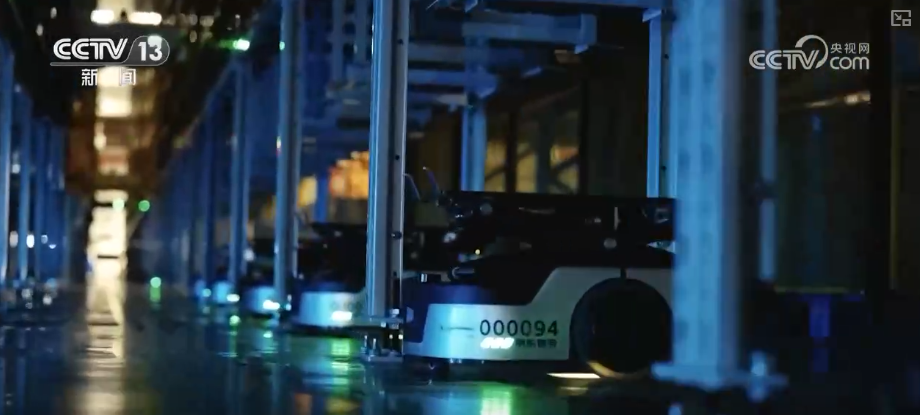
机器人“跑”起来助推物流“加速跑” 数万快递开启新年之旅抵达千家万户
Yang Shi Wang· 2026-01-02 10:33
Core Viewpoint - The logistics industry experiences a peak during the New Year holiday, with significant advancements in automation and efficiency in smart warehouses, exemplified by the operations in Beijing Daxing. Group 1: Warehouse Operations - The smart warehouse spans over 3,000 square meters and utilizes nearly 200 robots to handle over 30,000 packages daily, showcasing a fully automated process from storage to delivery [5][21] - The warehouse contains approximately 1 million items organized on 12-meter high shelves, demonstrating the scale and efficiency of automated logistics [5] - The role of the "smart warehouse operator" has been recognized as a new profession, highlighting the industry's shift towards automation and the need for skilled personnel [11] Group 2: Efficiency and Technology - The implementation of intelligent scheduling algorithms has increased logistics efficiency by two to three times compared to traditional methods [8] - Operators must possess knowledge in various technologies such as IoT, big data, AI, and cloud computing, along with skills in execution, optimization, and decision-making [22] - The surge in orders during peak times has led to a significant increase in operational demands, with current order volumes reaching two to three times the usual levels [15] Group 3: Problem-Solving and Maintenance - Operators act as "general practitioners" for the robots, requiring quick troubleshooting and adjustments to ensure smooth operations during high-demand periods [13] - Rapid response to equipment malfunctions is critical, as demonstrated by the swift repair of a malfunctioning robot, which was completed in under 15 minutes [19] - Continuous monitoring and adjustments are necessary to maintain optimal performance, ensuring timely delivery of packages [19][21]