
人民币国际化

Search documents
中信银行创新驱动跨境金融新生态
Jing Ji Ri Bao· 2025-12-02 22:03
Core Viewpoint - China is advancing the internationalization of the Renminbi with strong determination and unprecedented efforts, positioning itself as a key player in the global economy [1] Cross-Border RMB Services - CITIC Bank has achieved a cross-border RMB payment and receipt volume of 1,539.98 billion yuan by the end of 2024, a year-on-year increase of 24.1%, surpassing the national average growth rate by 1.6 percentage points [1] - The bank's cross-border RMB trade settlement amount reached 437.41 billion yuan, with a steady growth rate of 11.1% [2] - The balance of cross-border RMB loans increased by 194% to 38.54 billion yuan, supporting over a hundred enterprises in their international financing needs [2] Product Innovation - CITIC Bank launched the "Capital Treasure+" comprehensive solution to address diverse cross-border financing needs, integrating various financial services [3] - The bank assisted a renewable energy company in issuing 500 million yuan in offshore RMB bonds, enhancing the influence of the RMB in the international bond market [3] - The bank's cross-border dual-currency pool service manages an average daily position of 1 billion yuan, improving fund management efficiency for multinational corporations [3] Technological Advancements - CITIC Bank has achieved a milestone by directly connecting to the CIPS (Cross-Border Interbank Payment System), significantly reducing transaction costs for enterprises [5] - The bank plans to optimize its CIPS-related services and expand its network of participating banks, focusing on countries along the "Belt and Road" initiative [6] Market Expansion - CITIC Bank is actively developing cross-border RMB financial services tailored for the e-commerce sector, enhancing payment efficiency and risk management [7] - The bank's cross-border e-commerce RMB payment business reached a transaction scale of 18.1 billion yuan in 2024, a 65% year-on-year increase [8] Collaborative Ecosystem - The internationalization of the RMB requires collaboration among financial institutions, enterprises, and government bodies, and CITIC Bank is committed to building a cooperative cross-border financial ecosystem [9] - The bank aims to continue innovating its cross-border financial service models to contribute to the global application of the RMB [9]

——2026年度投资策略:牛市下半场,实物再通胀
Huachuang Securities· 2025-12-02 14:13
Group 1 - The report emphasizes a shift in investment strategy for Chinese assets from a short-term focus to a long-term perspective, driven by significant changes in long-term factors and a restructuring of the valuation system [2][15][32] - It highlights the advantages of RMB assets from a global perspective, including a stable fiscal environment, a complete industrial chain, a talent pool, and attractive valuations [2][3][15] - The report identifies key points for sustaining growth, focusing on economic construction and the expansion of the middle class, indicating a transition from low prices to a new phase of recovery [2][3][15] Group 2 - The report discusses a new macro paradigm characterized by a shift from quantity-driven growth to quality-driven growth, emphasizing efficient operations and high return on equity (ROE) [3][16] - It notes the completion of the transition from old to new economic drivers, with a decline in the real estate sector's drag on A-share ROE, and a focus on technology and manufacturing sectors [3][16] - The report mentions a change in the investment landscape, where equities are seen as a preservation tool rather than just a financing instrument, leading to improved asset quality and reduced volatility [3][16] Group 3 - The analysis predicts a "re-inflation" phase in the second half of the bull market, driven by improved liquidity, supply-side adjustments, and demand stimulation, with a projected net profit growth of 11.1% for non-financial A-shares in 2026 [4][17] - It outlines the expected performance of the stock market, with a neutral return of 7.8% and an optimistic scenario suggesting a 31.5% return, indicating a strong bullish sentiment [4][17] - The report emphasizes the importance of tracking service consumption subsidies and housing price stabilization as key demand drivers [4][17] Group 4 - The report advocates for a focus on growth quality factors and large-cap growth stocks, suggesting that high-quality growth will outperform pure cash dividends in the current market environment [5][18] - It identifies key sectors for investment, including finance, high-end manufacturing, electronics, and consumer goods, which are expected to lead the market upward [5][18] - The report highlights the importance of technology and cyclical sectors, as well as the potential for overseas expansion and the real estate consumption chain to drive future growth [5][18] Group 5 - The report recommends a diversified investment strategy focusing on four key areas: technology innovation, cyclical sectors, overseas expansion, and the real estate consumption chain [6][19] - It emphasizes the importance of identifying high-potential stocks, referred to as "ten-bagger" opportunities, and building a core portfolio of quality large-cap growth stocks [6][19] - The report suggests that the current market environment presents unique opportunities for investors to capitalize on structural transformations and growth potential [6][19]
金融珍珠港?俄打响第一枪,首发人民币主权债,人民币回归6时代?
Sou Hu Cai Jing· 2025-12-02 13:31
Core Viewpoint - The issuance of RMB-denominated sovereign bonds by Russia signifies a pivotal shift in the global financial landscape, challenging the dominance of the US dollar and marking the transition of the RMB from a transaction currency to a sovereign currency [1][3][10] Group 1: Implications of RMB Sovereign Bonds - Russia's decision to issue RMB bonds indicates a willingness to integrate the RMB into its sovereign credit system, reflecting a significant geopolitical and economic strategy rather than a mere necessity due to exclusion from Western financial systems [3][5] - The issuance is driven by the increasing volume of RMB in Russia due to energy trade settlements, creating a need for investment options for the surplus RMB held by Russian entities [3][5] - By establishing RMB-denominated sovereign debt, Russia aims to create a financial anchor for its de-dollarization efforts, solidifying the RMB's role within its financial system [5][7] Group 2: Strategic Considerations - The move is a strategic response to the understanding that US Treasury bonds are central to the global financial system, and by choosing the RMB, Russia seeks to access a financial channel that is less influenced by US control [5][8] - This action serves as a model for other countries outside the dollar system, demonstrating that it is possible to conduct trade and finance using the RMB, potentially encouraging similar moves by nations wary of the dollar's dominance [7][10] Group 3: Broader Financial Landscape - The issuance of RMB sovereign bonds represents a significant crack in the global currency structure, suggesting a shift from a dollar-centric system to a multi-currency framework [10] - The long-term implications of this shift could lead to the RMB becoming a foundational financial instrument for emerging economies, altering the dynamics of global finance [10]


中国银行原行长李礼辉: 数字人民币的国际化
Sou Hu Cai Jing· 2025-12-02 13:31
Core Viewpoint - The "2025 Shenzhen International Financial Conference" focuses on the theme of "Building a Financial Power and High-Level Opening Up in the Greater Bay Area," discussing the strategic path for China's financial development amid global economic changes [1]. Digital Currency Development - The digital RMB has undergone three phases since 2014: theoretical research, closed-loop pilot, and open pilot, gradually being promoted in daily life [3]. - The digital RMB features a centralized management and dual-layer operation model, ensuring reliable monetary policy transmission and efficient monetary control [3]. - It possesses both account and value characteristics, allowing for value transfer without the need for a bank account, thus reducing reliance on financial intermediaries [4]. Technological Infrastructure - The digital RMB employs a hybrid technical architecture that combines centralized and distributed systems, supporting high transaction volumes and continuous operations [4]. - It can load smart contracts, enabling programmability and automatic payment transactions based on agreed conditions [4]. - The digital RMB aims for greater internationalization, advanced digitization, and broader tool functionality, expanding its use beyond daily transactions to digital asset trading platforms [5][6]. Challenges and Strategic Responses - The digital RMB faces challenges from the U.S. financial hegemony and competition in the domestic mobile payment market [1][7]. - To counter U.S. monetary dominance, China aims to enhance the stability of the RMB, promote a multi-polar currency system, and establish a robust cross-border payment infrastructure [9][10]. - The digital RMB is positioned as a credible digital payment tool backed by national credit, aiming to compete with U.S. stablecoins [10]. Market Application and Expansion - In 2024, mobile payments in China reached 2,109.8 billion transactions, with a total transaction amount of 563.7 trillion yuan, dominated by Alipay and WeChat Pay [12]. - By mid-2025, the cumulative transaction amount of digital RMB is expected to reach 12.9 trillion yuan, with 3.16 billion transactions [12]. - The digital RMB will continue to expand its application scenarios, including personal payments, merchant payments, and cross-border transactions, while optimizing user experience and acceptance environments [12][13].

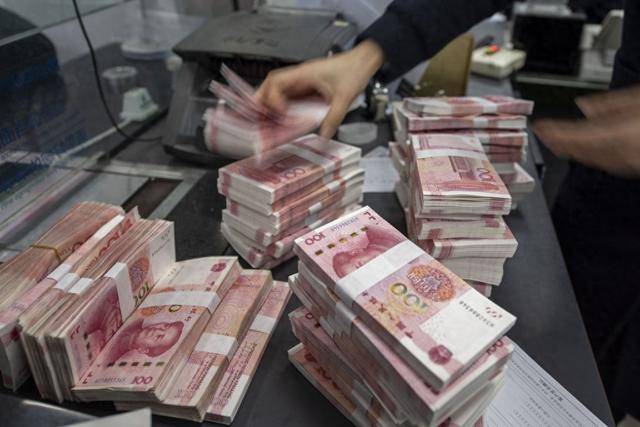
金融珍珠港?俄罗斯首发人民币主权债,人民币有望回归6时代?
Sou Hu Cai Jing· 2025-12-02 08:58
Core Viewpoint - Russia is issuing sovereign bonds denominated in RMB as a solution to being excluded from USD and EUR financing channels due to Western sanctions, while simultaneously benefiting from a significant trade surplus with China [1][7]. Group 1: Bond Issuance Details - The Russian Ministry of Finance announced the issuance of two tranches of federal government bonds denominated in RMB, with maturities of 3 to 7 years and a face value of 10,000 RMB per bond [3]. - The target coupon rates for the bonds are set between 6.25% and 6.5% for the 3.2-year tranche, and up to 7.5% for the 7.5-year tranche, with the final rates determined based on subscription results [5]. - Investors can purchase the bonds using either RMB or RUB, enhancing investment flexibility [5]. Group 2: Economic Context - The issuance is a strategic decision in response to an expanding budget deficit and the need for new financing avenues due to the cutoff from USD and EUR channels [7]. - Russia's trade surplus with China has surged, with a reported trade deficit of 19.106 billion USD for China against Russia in the first ten months, leading to a significant accumulation of RMB by Russian exporters [7]. Group 3: Global Trends in RMB Internationalization - Russia is not the first country to issue RMB-denominated sovereign bonds; other countries like the UK, South Korea, and Poland have previously done so, indicating a growing trend [9][11]. - The total issuance of RMB bonds by foreign governments reached a record 13 billion RMB this year, with offshore RMB bond issuance also seeing significant growth [11]. - The increasing demand for RMB borrowing among sovereign entities reflects a broader trend towards RMB internationalization and diversification of the global monetary system [13]. Group 4: Future Outlook - Analysts predict that the issuance of RMB sovereign bonds by Russia will serve as an important demonstration of RMB's internationalization and may contribute to a structural shift away from reliance on the USD [13]. - The global monetary landscape is expected to evolve towards a tripartite system dominated by the USD, stable EUR, and a more prominent RMB, particularly in commodity pricing [19][21].
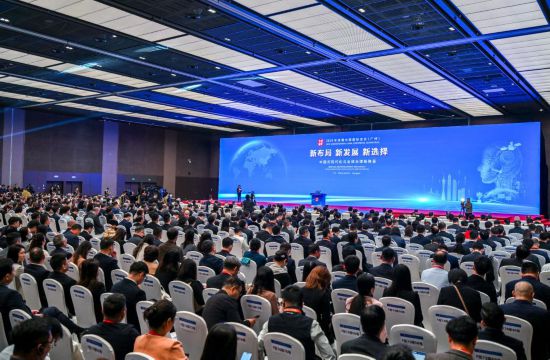
“读懂中国”国际会议:全球南方国家探寻中国式现代化机遇
Xin Hua She· 2025-12-02 08:39
Core Viewpoint - The "Understanding China" International Conference highlighted that China's development model offers a new option for modernization, particularly for global South countries, contrasting with traditional Western paths and injecting stability and positive energy into global development [1][2]. Group 1: Conference Overview - The conference took place from November 30 to December 2, 2025, in Guangzhou, focusing on the theme "New Layout, New Development, New Choices—Chinese-style Modernization and the New Pattern of Global Governance" [1]. - Over 800 participants attended, with approximately 70% from global South countries, indicating significant interest in China's development practices [1]. Group 2: Perspectives on China's Development Model - Former Ethiopian President Mulatu Teshome emphasized that China's development path, rooted in its national context, challenges the notion that modernization equates to Westernization, proving that countries can pursue modernization based on their own history and culture [2]. - Andrei Bezrukov, Chairman of the Valdai International Discussion Club, noted that China's transformation has improved the lives of millions and reshaped its role on the global stage [2]. Group 3: China's Role in Global Cooperation - The conference underscored China's pragmatic actions in international cooperation, with Erastus Mwencha, former Deputy Chairperson of the African Union Commission, highlighting China's significant contributions to multilateralism through initiatives like the Belt and Road [2]. - Malaysia's Ong Keng Yong pointed out that institutions like the Asian Infrastructure Investment Bank and the New Development Bank help bridge infrastructure gaps and meet growth demands of global South countries [3]. Group 4: Financial Contributions and Development Aid - China is committed to increasing resource investment in global development cooperation, with a reported upgrade of the Global Development and South-South Cooperation Fund to $4 billion, mobilizing over $23 billion for global South development initiatives [3]. - Since 1963, China has dispatched medical teams to 77 countries, with 30,000 personnel involved, establishing partnerships with 48 hospitals across 43 countries [3]. Group 5: Global Governance and Future Cooperation - Several foreign guests emphasized the interconnectedness of China's development with the future of global South countries, with former Egyptian Prime Minister Essam Sharaf stating that China's global governance initiative reflects the demands for justice and equality from the global South [5]. - Sri Lankan geopolitical strategist Rizwan noted that China's 14th Five-Year Plan addresses various aspects, including technological innovation and green development, which are crucial in the face of rising protectionism [5].
开创云南现代化建设新局面的金融实践 访中国人民银行云南省分行党委书记、行长李滔
Jin Rong Shi Bao· 2025-12-02 08:29
党的十八大以来,习近平总书记三次考察调研云南都对建设面向南亚东南亚辐射中心作出重要指示。 2025年3月,习近平总书记再次强调,云南区位条件独特,要积极推进高水平对外开放,建设面向南亚 东南亚辐射中心。近年来,云南持续壮大资源经济、园区经济、口岸经济,全省经济转型 成"形"起"势",经济社会发展取得开创性进展。今年是"十四五"规划收官之年,《金融时报》记者邀请 到中国人民银行云南省分行党委书记、行长李滔,介绍和解读金融支持云南现代化建设中的相关举措和 成效。 《金融时报》记者:东盟连续5年蝉联我国最大贸易伙伴,我国连续16年保持对东盟第一大贸易伙伴地 位。在支持云南建设我国面向南亚东南亚辐射中心方面,金融系统开展了哪些工作? 李滔:中国人民银行历来重视云南面向南亚东南亚特殊区位优势的发挥。2013年11月,中国人民银行牵 头11部委联合印发支持云桂两省(区)建设沿边金融综合改革试验区总体方案。五年试点期间,中国人 民银行牵头指导富滇银行在老挝设立老中银行,成为全国城市商业银行在境外设立的首家经营性机构, 目前已经发展为中老跨境金融合作的重要支点,在服务中老铁路建设、促进两国经济金融交往中发挥了 广泛作用。全国 ...
【中金外汇 · 年度展望】宽松交易或回归
Sou Hu Cai Jing· 2025-12-02 07:01
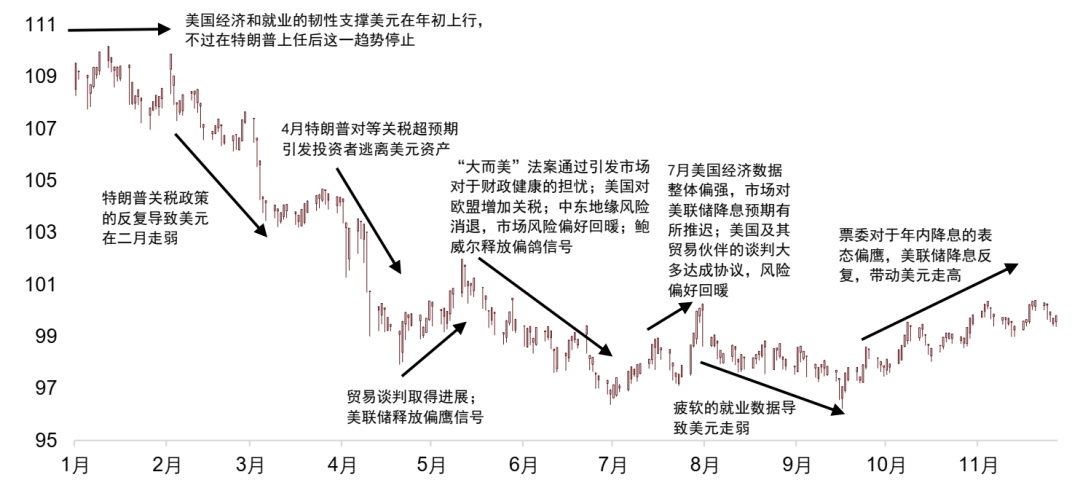
Summary of Key Points Core Viewpoint The global foreign exchange market has been significantly influenced by tariff expectations and fluctuations in the US dollar exchange rate since 2025. The dollar index experienced a notable decline in the first half of 2025, followed by stabilization in the latter half, with expectations of further movements in 2026 driven by interest rate differentials and changes in risk appetite. Group 1: 2025 Overview - The dollar index fell significantly in the first quarter of 2025 due to weaker-than-expected tariff policy advancements by the Trump administration, reversing the "Trump trade" [1] - In the second quarter, the dollar experienced a sharp decline driven by unexpected "reciprocal tariffs" and escalating US-China trade tensions, raising concerns about the US economic outlook and the stability of dollar assets [1][5] - The dollar stabilized in the third quarter as the US reached tariff agreements with major trading partners, alleviating market concerns about economic and financial stability [1][5] Group 2: 2026 Outlook - The narrowing of interest rate differentials and changes in risk appetite are expected to become the main themes in currency trading for 2026 [2][19] - The Federal Reserve's potential for more aggressive rate cuts compared to other non-US central banks may lead to a further decline in the dollar's volatility center [2][19] - The performance of different non-US currencies is likely to diverge, with the euro expected to lead due to improved economic growth dynamics in the Eurozone [3][19] Group 3: Renminbi (RMB) Dynamics - The RMB's exchange rate will be influenced by the dollar's performance and changes in US-China trade relations, with a stable exchange rate policy potentially impacting the RMB's trajectory [3][41] - The RMB is expected to appreciate moderately as the Fed's rate cuts narrow the interest rate differential between China and the US [3][41] - The resilience of the Chinese economy and financial markets under tariff pressures has reduced the impact of tariff risks on the RMB [3][41][64] Group 4: Currency Performance and Strategies - High-yield currencies from Latin America and Europe have performed relatively well, supported by favorable interest rate differentials and lower volatility [12][13] - The carry trade strategy has been the most profitable forex trading strategy in 2025, indicating a return to traditional trading logic based on interest rate differentials [13] - The euro is expected to benefit from reduced need for aggressive rate cuts by the European Central Bank, while the yen and pound may face relative weakness due to domestic policy pressures [3][38][39] Group 5: External Factors and Risks - The US government shutdown and tariff rate fluctuations pose risks to market stability and may increase volatility in the forex market [32][33] - Political uncertainties in France and Japan, as well as geopolitical factors like the Ukraine conflict, could also impact global risk sentiment and currency performance [32][36] - The overall environment is expected to favor a gradual appreciation of the RMB, supported by the internationalization of the currency and a stable economic outlook [62][76]
人民币出海新引擎:中信银行创新驱动跨境金融新生态
Sou Hu Cai Jing· 2025-12-02 06:33
在全球经济深度融合的当下,中国作为世界第二大经济体,正以坚定不移的决心和前所未有的力度,稳慎有序、步步坚实地推进人民币国际化进程,构建 全方位高水平开放新格局的核心战略支撑。 截至2024年末,中信银行跨境人民币收付汇量高达15399.8亿元,较上年同比增长24.1%,增速超出全国跨境人民币平均水平1.6个百分点,彰显出强劲的 增长势头。其中,经常项下整体收付汇量达到4898.9亿元,资本项下整体收付汇量更是突破万亿大关,达到10500.9亿元,服务跨境人民币对公客户数量超 过一万户,构建起庞大的跨境人民币服务网络。 在跨境人民币贸易结算领域,中信银行同样表现出色,收付金额达4374.1亿元,同比增速11.1%,持续保持稳健增长。同时,跨境人民币贷款余额达到 385.4亿元,同比增长194%,为上百户企业提供了全方位的跨境人民币综合融资服务,有效满足了国内企业"走出去"的融资需求,助力企业拓展国际市 场,提升国际竞争力。 这些数字的背后,彰显了中信银行在跨境金融领域的深厚积淀与卓越能力,更体现了其作为银行金融机构在人民币国际化进程中的使命担当与责任情怀。 中信银行,作为中国涉足国内外金融市场融资的商业银行的" ...
海南全岛封关在即 黄奇帆建议发展服务贸易 不能“西装料做衬衫”
2 1 Shi Ji Jing Ji Bao Dao· 2025-12-02 05:17
12月2日,2025年"读懂中国"国际会议的湾区对话环节在广州举行,主题为海南自贸港建设与国际贸易 新空间。不久后,海南自由贸易港将正式启动全岛封关运作。对于封关后的发展重点,中国国家创新与 发展战略研究会学术委员会常务副主席、重庆市原市长黄奇帆提出了五个应着力推进的关键方向,认为 它们将对海南及全国产生重大战略意义。 第一,海南应率先实现内外贸一体化。 第二,大力发展高附加值服务贸易。 第三,打造面向东南亚和中国经济交往的枢纽与桥梁。 第四,建设金融回流基地。 第五,成为人民币国际化的重要前沿阵地。 (文章来源:21世纪经济报道) ...