可再生能源

Search documents
逆变器出口:出口环比小幅回调,大洋洲市场创新高 | 投研报告
Zhong Guo Neng Yuan Wang· 2025-08-28 03:26
Core Insights - In July 2025, China's inverter export amount was 6.505 billion yuan, showing a month-on-month decrease of 1.08% but a year-on-year increase of 16.02%, indicating a slight month-on-month adjustment while maintaining high year-on-year growth [2][3] - From January to July 2025, the cumulative inverter export amount reached 36.971 billion yuan, reflecting a year-on-year growth of 8.63%, demonstrating stable market performance [2][3] Regional Performance - **Asia**: In July 2025, inverter exports to Asia amounted to 2.054 billion yuan, with a month-on-month decrease of 22.84% and a year-on-year increase of 1.69%. The Middle East performed well, while demand from India and Pakistan declined [4] - **Europe**: Exports to Europe totaled 2.831 billion yuan in July 2025, with a month-on-month increase of 15.70% and a year-on-year increase of 28.13%, indicating stable performance [4][5] - **North America**: Exports to North America reached 235 million yuan, with a month-on-month increase of 6.27% and a year-on-year increase of 31.93%, showing a positive trend as tariff impacts stabilize [6] - **Oceania**: Exports to Oceania hit a record high of 397 million yuan, with a month-on-month increase of 60.89% and a year-on-year increase of 188.80%, indicating strong growth [6] Export Performance by Province - In July 2025, Guangdong's inverter exports were 2.441 billion yuan, showing a month-on-month increase of 0.93% and a year-on-year increase of 10.38%, while Jiangsu's exports decreased slightly due to high base effects from June [7] Investment Outlook - Long-term growth in global renewable energy installations and increasing demand for energy storage are expected to drive market expansion. Key regions include: - Europe, where large-scale storage installations are expected to accelerate [8] - The U.S., where demand for large storage projects is significant and tariff impacts are diminishing [8] - Emerging markets in Asia, Africa, and South America, which present substantial growth opportunities [8] - The Middle East, where renewable energy investments are increasing [8]
启动“为德国制造”大规模投资倡议—— 德国加强投资与创新双轮驱动
Ren Min Ri Bao· 2025-08-27 21:42
Group 1 - The German government and business representatives have launched a large-scale investment initiative called "Made in Germany," committing to invest €631 billion by 2028, marking one of the largest investment plans in decades [1] - The initiative involves 61 companies, including Siemens, Deutsche Bank, BMW, Mercedes-Benz, Volkswagen, Allianz, Airbus, and Nvidia, and includes over €100 billion in new investments for building factories, R&D, and infrastructure over the next three years [1] - The initiative aims to address challenges faced by the German economy, such as aging infrastructure and slow digitalization, which have contributed to a GDP contraction of 0.3% in Q2 2025 [1] Group 2 - The investment initiative will also focus on digital upgrades and restructuring key industrial chains, particularly in renewable energy and artificial intelligence, to create new economic growth drivers [2] - In the first half of 2025, the number of newly established startups in Germany reached 1,500, a 9% increase from the second half of 2024, with significant growth in sectors like software, AI, and food [2] - German state governments are collaborating with research institutions and innovative companies to create a more favorable environment for innovation through incubators, tax incentives, and startup funds [3]
双碳研究 | 2030前瞻:可再生能源强势赋能全球电网新生态
Sou Hu Cai Jing· 2025-08-27 15:44
Core Viewpoint - The future of renewable energy is accelerating, reshaping the production and consumption of electricity globally, with clean energy set to dominate the grid by 2030 as fossil fuels gradually phase out [3][4]. Group 1: Driving Forces Behind Renewable Energy - Multiple powerful forces are reshaping the world, ensuring the inevitability of renewable energy's future, which is arriving faster than most expect [4]. - Economic factors show that in many regions, the costs of renewable technologies like solar panels and wind turbines are now lower than fossil fuels [6]. - Governments and businesses are committed to reducing carbon emissions and promoting green energy development [6]. - Local production of clean electricity enhances energy security by reducing dependence on foreign oil and gas resources [6]. Group 2: Key Technologies in Renewable Energy - Solar and wind energy are the core pillars of future renewable energy development, with large-scale solar installations and residential rooftop systems expanding globally [7]. - Advanced storage systems are addressing the intermittency issues of renewable energy, ensuring stable power supply even during low sunlight or wind conditions [9]. - The future of renewable energy relies heavily on smart grids, utilizing AI and IoT to balance supply and demand while minimizing energy waste [10]. Group 3: Consumer and Corporate Demand - The growth of renewable energy is driven by consumer demand, with households opting for rooftop solar systems and businesses signing large-scale renewable energy procurement contracts to meet climate goals and reduce costs [11]. - Over 130 countries globally have committed to decarbonization targets, indicating a strong trend towards electrification in the transportation sector, particularly with electric vehicles increasing the demand for clean electricity [12][13]. Group 4: Business Advantages of Adopting Renewable Energy - Forward-thinking companies are investing in commercial solar installation projects, reducing operational costs while turning sustainability into a competitive advantage [14]. - Companies adopting renewable energy can enhance their brand reputation and demonstrate industry leadership and social responsibility [17]. Group 5: Future Outlook for Renewable Energy - By 2030, renewable energy will fundamentally alter the global electricity landscape, characterized by decentralization, digitalization, and sustainability [15]. - It is projected that 70% to 80% of new power generation capacity will come from renewable sources, with solar and wind dominating the generation sector supported by storage solutions [17]. - The rise in fossil fuel costs and stricter regulations will lead to a gradual reduction in fossil fuel power plants [17]. Group 6: Challenges Ahead - Despite rapid growth, renewable energy must overcome challenges such as infrastructure upgrades and ensuring a stable supply chain for solar panels, batteries, and turbines [16][21]. - Community acceptance is crucial to address concerns related to land use and visual impacts [21].

明阳电气2025年上半年营收、净利双增 拟每10股派现0.7元
Zheng Quan Shi Bao Wang· 2025-08-27 13:46
Core Viewpoint - Mingyang Electric reported significant growth in revenue and net profit for the first half of 2025, driven by the rapid development of the renewable energy sector and the company's strategic positioning in the market [2][3]. Financial Performance - The company achieved an operating income of approximately 3.475 billion yuan, representing a year-on-year increase of 40.51% [2]. - The net profit attributable to shareholders was around 306 million yuan, reflecting a year-on-year growth of 24.38% [2]. - Basic earnings per share were reported at 0.98 yuan [2]. - The company plans to distribute a cash dividend of 0.7 yuan per 10 shares (tax included) to all shareholders [2]. Business Focus and Product Development - Mingyang Electric focuses on the research, production, and sales of power distribution and control equipment, with applications in renewable energy, new infrastructure, and smart grids [2]. - The company is enhancing its competitive advantage in the renewable energy sector while developing new products for smart grids and data centers [3]. - The data center business is identified as a major growth direction, with significant order progress expected to contribute to future revenue growth [3]. Market Expansion and International Strategy - The company is accelerating its overseas capacity layout, with exports becoming a new growth driver [3]. - Mingyang Electric is actively establishing overseas direct sales channels and customizing products according to regional standards [3]. - The Malaysian base has officially commenced equipment investment, indicating a commitment to expanding international operations [3]. Industry Environment - The performance growth of Mingyang Electric is closely linked to the rapid development of the renewable energy industry, with a reported 99.3% year-on-year increase in newly installed renewable energy capacity in the first half of 2025 [2]. - The power distribution and control equipment sector benefits from the stable development of the macro economy and the expansion of renewable energy generation capacity [2].
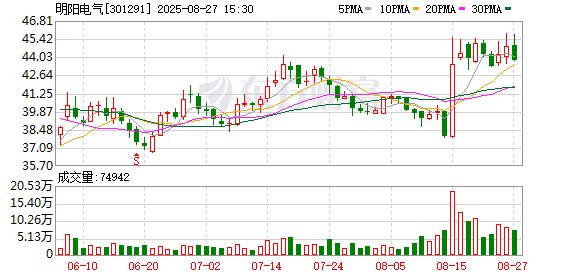
明阳电气2025年上半年营收、净利双增,拟每10股派现0.7元
Zheng Quan Shi Bao Wang· 2025-08-27 13:02
Core Viewpoint - Mingyang Electric (301291) reported a significant increase in revenue and net profit for the first half of 2025, driven by the rapid growth of the renewable energy sector and the company's strategic positioning in the market [1][2] Financial Performance - The company achieved an operating income of approximately 3.475 billion yuan, representing a year-on-year increase of 40.51% [1] - The net profit attributable to shareholders was around 306 million yuan, reflecting a year-on-year growth of 24.38% [1] - Basic earnings per share stood at 0.98 yuan, with a proposed cash dividend of 0.7 yuan per 10 shares (tax included) [1] Business Focus and Product Development - Mingyang Electric focuses on the research, production, and sales of power distribution and control equipment, with applications in renewable energy, new infrastructure, and smart grids [1][2] - The company is enhancing its competitive advantage in the renewable energy sector while developing new products for smart grids and data centers [2] Market Expansion and International Strategy - The company is accelerating its overseas capacity layout, with exports becoming a new growth driver [2] - Mingyang Electric is actively establishing overseas direct sales channels and customizing products based on regional standards [2] - The Malaysian base has officially commenced equipment investment, indicating a commitment to expanding international business [2] Industry Environment - The performance growth of Mingyang Electric is closely linked to the rapid development of the renewable energy industry, with a reported 99.3% year-on-year increase in newly installed renewable energy capacity in the first half of 2025 [1] - The power distribution and control equipment sector benefits from the stable development of the macro economy and the expansion of renewable energy generation capacity [1]
美国最大电网电费飙升 共和党面临政治风险
Xin Lang Cai Jing· 2025-08-27 11:44
Core Viewpoint - Rising electricity prices in key swing states are becoming a political liability for the Republican Party in the upcoming elections, particularly in the largest power grid area in the U.S. [1] Group 1: Electricity Prices - Wholesale electricity prices in the region have set historical records for two consecutive years [1] - The area includes states that will elect governors this November and four states that will have competitive congressional races next year [1] Group 2: Energy Sources - Nearly all electricity in this region is generated from natural gas, nuclear reactors, and coal [1] - Trump's strategy of blaming rising electricity prices on renewable energy sources may face challenges in gaining acceptance [1]
电力设备行业跟踪报告:逆变器出口:出口环比小幅回调,大洋洲市场创新高
Wanlian Securities· 2025-08-27 07:32
Investment Rating - The industry investment rating is "Outperform the Market" [5][39]. Core Views - In July 2025, China's inverter export amount was 6.505 billion yuan, a month-on-month decrease of 1.08% but a year-on-year increase of 16.02%, indicating a slight month-on-month adjustment while showing strong year-on-year growth [2][13]. - From January to July 2025, the cumulative inverter export amount reached 36.971 billion yuan, reflecting a year-on-year growth of 8.63%, demonstrating stable market performance [2][13]. - The report highlights that the global renewable energy installation is rapidly increasing, leading to sustained growth in energy storage demand [10][36]. Summary by Sections Global Overview - In July 2025, the overall inverter export amount showed a year-on-year increase, with a total of 6.505 billion yuan exported [13]. Regional Performance - **Asia**: In July 2025, inverter exports to Asia amounted to 2.054 billion yuan, a month-on-month decrease of 22.84% but a year-on-year increase of 1.69%. The Middle East performed well, while India and Pakistan saw a decline in household storage demand [2][14]. - **Europe**: Exports to Europe reached 2.831 billion yuan in July 2025, with a month-on-month increase of 15.70% and a year-on-year increase of 28.13%. The UK and Netherlands showed strong performance [3][21]. - **North America**: Exports to North America were 235 million yuan, with a month-on-month increase of 6.27% and a year-on-year increase of 31.93%, indicating stabilization of tariff impacts [4][25]. - **Oceania**: Exports to Oceania reached a record high of 397 million yuan, with a month-on-month increase of 60.89% and a year-on-year increase of 188.80% [8][26]. Export by Provinces - In July 2025, inverter exports from Guangdong, Zhejiang, Anhui, and Jiangsu were 2.441 billion, 1.543 billion, 834 million, and 987 million yuan respectively, with Guangdong showing month-on-month growth [9][31].
万联证券:逆变器出口环比小幅回调 关注海外布局完善、市场地位领先龙头
智通财经网· 2025-08-27 06:21
Group 1 - The long-term outlook for global renewable energy installations is positive, with increasing demand for energy storage driven by rising grid instability [1] - In Europe, the impact of household storage inventory is diminishing, leading to accelerated growth in large-scale storage installations [1] - The United States is experiencing significant demand for large-scale storage, with project grid connections expected to accelerate, supported by reduced tariff impacts [1] - Emerging markets in Asia, Africa, South America, and Oceania are expected to provide new momentum for energy storage demand growth [1] - Investment in renewable energy in the Middle East is increasing, with stable growth anticipated in large-scale storage projects in Saudi Arabia and the UAE [1] Group 2 - In July 2025, China's inverter export value reached 6.505 billion yuan, showing a year-on-year increase of 16.02% [2] - Cumulative inverter exports from January to July 2025 amounted to 36.971 billion yuan, reflecting a year-on-year growth of 8.63% [2] Group 3 - In July 2025, inverter exports to Asia totaled 2.054 billion yuan, with a year-on-year increase of 1.69% despite a month-on-month decline of 22.84% [3] - Notable growth in inverter exports to Saudi Arabia and the UAE, with year-on-year increases of 878.20% and 34.99% respectively [3] - Exports to India and Pakistan showed significant declines, indicating short-term market fluctuations [3] Group 4 - In July 2025, inverter exports to Europe reached 2.831 billion yuan, with a year-on-year growth of 28.13% [4] - Exports to the Netherlands saw a significant increase of 61.68%, while exports to Germany experienced a decline [4] - The UK market showed positive growth, while exports to Poland continued to decline [4] Group 5 - In July 2025, inverter exports to North America amounted to 235 million yuan, with a year-on-year increase of 31.93% [5] - Exports to Latin America decreased by 14.54% year-on-year, while exports to Mexico showed a month-on-month recovery [5] - In Africa, exports to Nigeria increased significantly, while the South African market continued to decline [5] - In Oceania, inverter exports reached a record high, with a year-on-year increase of 188.80% [5] Group 6 - In July 2025, Guangdong province exported 2.441 billion yuan worth of inverters, showing a month-on-month increase of 0.93% [6] - Jiangsu province experienced a slight month-on-month decline in exports, influenced by high base figures from June [6] - Anhui province showed strong year-on-year growth, while Zhejiang province's exports remained stable [6]
供应更足 韧性更强
Sou Hu Cai Jing· 2025-08-27 05:49
Core Viewpoint - During the "14th Five-Year Plan" period, China has established the world's largest and fastest-growing renewable energy system, with renewable energy generation capacity increasing from 40% to approximately 60% [2] Group 1: Energy Supply and Self-Sufficiency - China's energy self-sufficiency rate has consistently remained above 80% during the "14th Five-Year Plan" period [2][3] - In July, China's monthly electricity consumption exceeded 1 trillion kilowatt-hours for the first time, equivalent to Japan's total annual electricity consumption [2] - Domestic energy production has accounted for over 90% of the increase in energy consumption since the start of the "14th Five-Year Plan" [3] Group 2: Investment in Energy Sector - Energy industrial investment has shown a strong upward trend, with annual growth rates exceeding 16%, particularly in electricity and heat production, which has seen growth rates over 20% [4][5] - Cumulative investment in the energy sector has surpassed 6 trillion yuan, accounting for nearly 10% of total fixed asset investment in society [5] - Renewable energy investments are projected to constitute over 80% of power investment by 2024, indicating a significant shift towards green energy [5] Group 3: Development of Renewable Energy - China's wind and solar power installed capacity increased from 530 million kilowatts in 2020 to 1.68 billion kilowatts by July 2023, with an annual growth rate of 28% [6] - The share of wind and solar power in total electricity consumption rose from 9.7% in 2020 to 18.6% in 2024, with a significant increase in electricity generation [6] - China maintains the world's largest installed capacity for wind and solar power, contributing 47% of global capacity and 63% of new installations in 2024 [7]
今年夏天不缺电
21世纪经济报道· 2025-08-27 05:40
Core Viewpoint - The article highlights the significant growth in China's electricity consumption, with a record monthly usage of over 1 trillion kilowatt-hours in July 2023, indicating a robust economic recovery and the increasing demand from emerging industries such as electric vehicles and artificial intelligence [1][2]. Group 1: Electricity Consumption Growth - In July 2023, China's total electricity consumption reached 10,226 billion kilowatt-hours, marking a historic milestone [1]. - The cumulative electricity consumption for the first seven months of 2023 was approximately 58.6 trillion kilowatt-hours, continuously setting world records [2]. - The growth in electricity consumption is attributed to both high temperatures and economic recovery, leading to increased demand from residential and industrial sectors [2][10]. Group 2: Future Projections - By 2025, China's total electricity consumption is expected to exceed 10.3 trillion kilowatt-hours, with an annual growth rate of 5% to 6% [7]. - The trend shows that electricity consumption has been increasing by 1 trillion kilowatt-hours approximately every two years since 2017 [6]. - The year 2025 is anticipated to be a remarkable year in China's energy and electricity development history, with significant advancements in renewable energy capacity [8]. Group 3: Energy Supply and Stability - The summer of 2023 saw no major power outages, contrasting with previous years, indicating improved energy supply stability [11][13]. - The total installed power generation capacity reached 367 million kilowatts by the end of July 2023, a year-on-year increase of 18.2% [13]. - Renewable energy sources, particularly wind and solar, accounted for a significant portion of the new installed capacity, enhancing the overall energy supply [14]. Group 4: Economic Structure and Energy Demand - The electricity consumption structure reflects China's economic transformation, with the secondary and tertiary industries showing significant growth in electricity usage [16]. - The high-tech manufacturing and internet services sectors have seen substantial increases in electricity consumption, indicating a shift towards more energy-intensive industries [17]. - The demand for electricity from the electric vehicle sector has surged, with a year-on-year growth of 42.4% in charging services [16][17]. Group 5: Future Energy Strategy - The next phase of energy strategy focuses on transitioning from merely having sufficient electricity supply to optimizing electricity usage [18]. - The government aims to enhance the electricity grid's stability and expand capacity to meet the growing demand while promoting green energy consumption [18]. - The emphasis will be on developing a new type of power system that supports sustainable economic growth and meets the needs of the population [18].