
人民币汇率

Search documents
人民币市场汇价(11月14日)
Xin Hua Wang· 2025-11-14 02:06
100美元 708.25人民币 100欧元 824.03人民币 100日元 4.5846人民币 100港元 91.139人民币 100英镑 931.66人民币 100澳元 462.73人民币 100新西兰元 400.82人民币 100新加坡元 544.83人民币 100瑞士法郎 893.13人民币 100加元 504.92人民币 100人民币113.09澳门元 100人民币58.215马来西亚林吉特 100人民币1136.89俄罗斯卢布 100人民币240.55南非兰特 100人民币20667韩元 100人民币51.809阿联酋迪拉姆 100人民币52.902沙特里亚尔 100人民币4660.04匈牙利福林 100人民币51.317波兰兹罗提 100人民币90.61丹麦克朗 100人民币132.69瑞典克朗 100人民币141.41挪威克朗 100人民币596.305土耳其里拉 100人民币258.43墨西哥比索 100人民币456.08泰铢 【纠错】 【责任编辑:焦鹏】 新华社北京11月14日电 中国外汇交易中心11月14日受权公布人民币对美元、欧元、日元、港元、 英镑、澳元、新西兰元、新加坡元、瑞士法郎、 ...
人民币对美元中间价报7.0825 调升40个基点
Zhong Guo Jing Ji Wang· 2025-11-14 01:37
Group 1 - The central exchange rate of the Chinese yuan against the US dollar is reported at 7.0825, which is an increase of 40 basis points from the previous trading day [1] - The People's Bank of China has authorized the publication of the exchange rates for various currencies against the yuan, including 1 euro at 8.2403, 100 Japanese yen at 4.5846, and 1 British pound at 9.3166 [2] - The exchange rate data includes a wide range of currencies, indicating the yuan's value against multiple international currencies, which reflects its global trading position [2]
适度宽松的货币政策持续发力(锐财经)
Ren Min Ri Bao· 2025-11-13 21:08
Core Viewpoint - The People's Bank of China (PBOC) has released the monetary policy execution report for Q3 2025, highlighting the effectiveness of its counter-cyclical monetary policy measures in supporting economic recovery and stabilizing financial markets [1] Group 1: Monetary Policy Implementation - The PBOC has utilized various monetary policy tools to create a conducive financial environment for economic recovery, including maintaining reasonable growth in money and credit [2][3] - The report indicates a significant increase in social financing and broad money supply (M2), with year-on-year growth rates of 8.7% and 8.4% respectively, and a total RMB loan balance of 270.4 trillion yuan, reflecting a 6.6% increase [3] - The PBOC aims to lower social financing costs and optimize credit structure through market-oriented interest rate adjustments [2][3] Group 2: Structural Policy Measures - The report emphasizes the continuous optimization of financing structure, with notable year-on-year growth in various loan categories: technology loans (11.8%), green loans (22.9%), inclusive loans (11.2%), elderly care loans (58.2%), and digital economy loans (12.9%) [4] - The PBOC has implemented structural monetary policy tools to support key areas such as consumption, technology innovation, and rural revitalization, with a total balance of structural monetary policy tools reaching 3.9 trillion yuan by the end of September [4] Group 3: Future Policy Directions - The PBOC plans to maintain an appropriately loose monetary policy while enhancing the execution and transmission of monetary policy [5][6] - The report highlights the importance of consumer finance support and the effectiveness of the monetary policy transmission mechanism, indicating a shift in focus compared to previous quarters [6] - Future efforts will include improving the monetary policy framework, ensuring liquidity remains ample, and aligning social financing growth with economic growth and price level expectations [5][6]
花旗集团大中华区首席经济学家余向荣:人民币汇率或将迎来更大波动,呈现升值趋势
Zhong Guo Jing Ying Bao· 2025-11-13 16:05
Group 1 - The core viewpoint of the article highlights that the Chief Economist of Citigroup Greater China, Yu Xiangrong, is optimistic about China's economic growth, projecting a 5% growth target for the year and maintaining a forecast of around 5% for next year despite challenges in the real estate sector and supply-demand mismatches [1] - In the first three quarters, China achieved a growth rate of 5.2%, reinforcing confidence in meeting the annual target [1] - The baseline forecast for 2026 is set at 4.7%, which can be interpreted as approximately 5% [1] Group 2 - Regarding currency, Yu Xiangrong indicated that the RMB exchange rate may experience greater volatility and is expected to appreciate [1] - The actual effective exchange rate of the RMB is projected to depreciate by 2025, while the USD/RMB exchange rate is expected to stabilize beyond expectations [1] - Factors such as purchasing power evaluation, increased trade surplus, narrowing interest rate differentials between China and the US, and net inflows of cross-border capital are contributing to the formation of expectations for RMB appreciation, which may serve as a testing point for the future USD/RMB exchange rate [1]

创1年多新高,人民币对美元即期汇率升破7.10关口
Feng Huang Wang· 2025-11-13 10:36
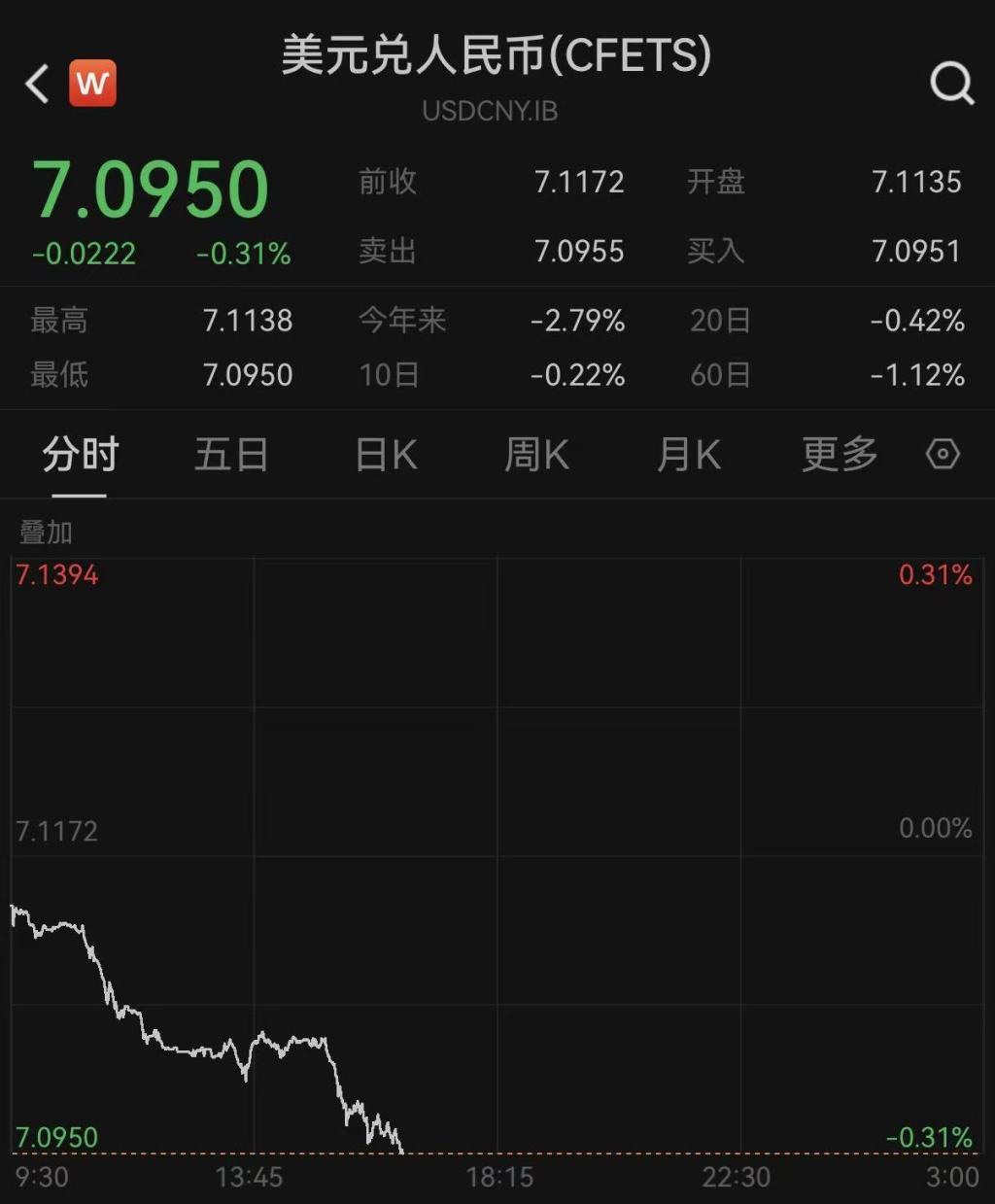
Core Viewpoint - The Chinese Yuan (CNY) has strengthened against the US Dollar (USD), reaching a one-year high as the USD index declines, with the onshore CNY/USD exchange rate breaking key psychological levels [1][3]. Exchange Rate Movements - On November 13, the CNY/USD exchange rate rose to 7.0959, an increase of 213 basis points from the previous trading day, marking the highest level since mid-October 2024 [1]. - The offshore CNY/USD rate also surpassed the 7.10 mark, reaching a monthly high of 7.09400 [2]. USD Index Performance - The USD index reversed its upward trend, dropping to a low of 99.2914, reflecting a decline of over 0.15% [3]. Monetary Policy Insights - The People's Bank of China (PBOC) emphasized maintaining a managed floating exchange rate system based on market supply and demand, aiming for stability in the CNY exchange rate [3]. Analyst Predictions - Analysts predict that the CNY will remain strong in the short term, with a focus on USD trends and the PBOC's intervention in the CNY midpoint rate. The CNY is expected to maintain a stable trajectory with limited volatility against the USD, with a low likelihood of breaking the 7.0 level before year-end [4].

创1年多新高!人民币对美元即期汇率升破7.10关口
Sou Hu Cai Jing· 2025-11-13 09:26
Core Points - The Chinese Yuan (CNY) against the US Dollar (USD) reached a one-year high on November 13, 2024, with the exchange rate breaking through the 7.11 and 7.10 thresholds, closing at 7.0959, an increase of 213 basis points from the previous trading day [1] - The offshore CNY also strengthened, surpassing the 7.10 mark, with a peak of 7.09400 during the day, marking a monthly high [2] - The US Dollar Index turned from an increase to a decrease, falling to a low of 99.2914, down over 0.15% [3] Summary by Sections Exchange Rate Movements - On November 13, the CNY/USD exchange rate reached 7.0959, up 213 basis points from the previous day, marking a new high since mid-October 2024 [1] - The offshore CNY also saw gains, with a peak of 7.09400, indicating strong performance in the international market [2] Economic Policy Insights - The People's Bank of China emphasized maintaining a managed floating exchange rate system, ensuring the CNY remains stable at a reasonable level while being responsive to market supply and demand [3] - The central bank's report highlighted the importance of guiding expectations and preventing excessive fluctuations in the exchange rate [3] Analyst Perspectives - Analysts predict that the CNY will remain strong in the short term, with a focus on the USD's performance and the central bank's control over the CNY's midpoint rate [4] - It is expected that the CNY will continue to exhibit a pattern of inverse fluctuations with the USD, with limited volatility, and the likelihood of breaking the 7.0 mark before year-end is low [4]
人民币大涨!在岸、离岸人民币兑美元双双突破7.1,日内涨超百点
Sou Hu Cai Jing· 2025-11-13 07:49
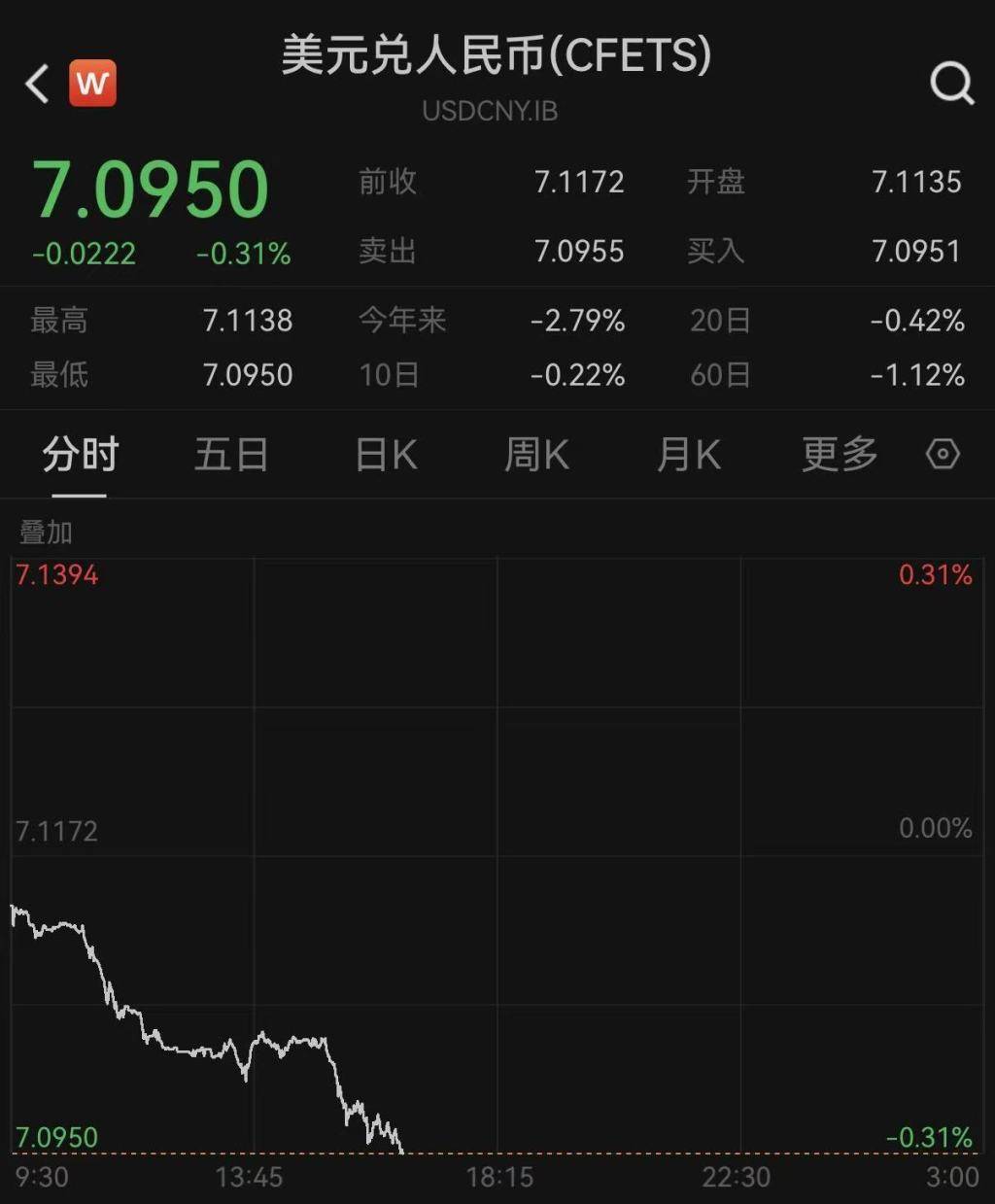
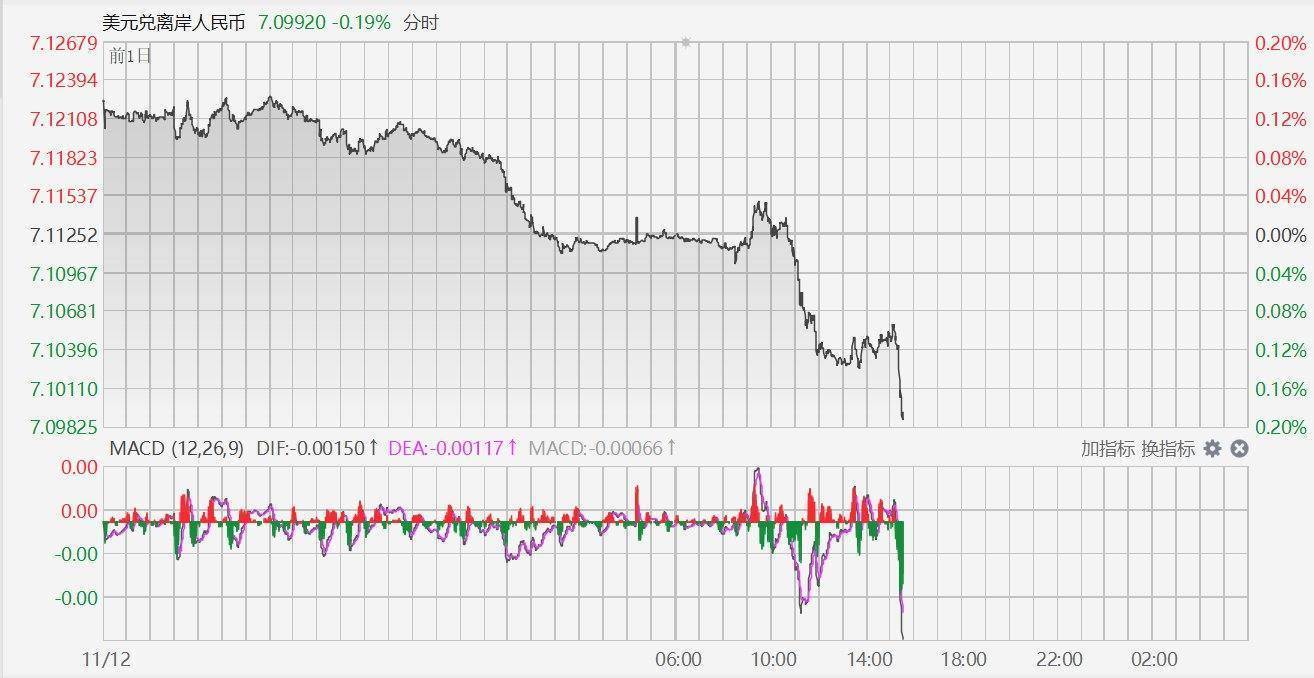
【免责声明】本文仅代表作者本人观点,与和讯网无关。和讯网站对文中陈述、观点判断保持中立,不对所包含内容的准确性、可靠性或完整性提供任何明 示或暗示的保证。请读者仅作参考,并请自行承担全部责任。邮箱:news_center@staff.hexun.com 格隆汇11月13日|在岸、离岸人民币兑美元双双突破7.1,日内涨超百点。 ...
人民币市场汇价(11月13日)
Xin Hua She· 2025-11-13 07:03
100日元 4.5878人民币 100新西兰元 401.94人民币 100新加坡元 545.12人民币 100瑞士法郎 889.27人民币 新华社北京11月13日电 中国外汇交易中心11月13日受权公布人民币对美元、欧元、日元、港元、 英镑、澳元、新西兰元、新加坡元、瑞士法郎、加元、澳门元、林吉特、卢布、兰特、韩元、迪拉姆、 里亚尔、福林、兹罗提、丹麦克朗、瑞典克朗、挪威克朗、里拉、墨西哥比索及泰铢的市场汇价。 11月13日人民币汇率中间价如下: 100美元 708.65人民币 100欧元 822.23人民币 100人民币 52.841沙特里亚尔 100人民币 4673.85匈牙利福林 100加元 506.59人民币 100人民币 113.03澳门元 100人民币 58.233马来西亚林吉特 100人民币 1142.32俄罗斯卢布 100人民币 240.93南非兰特 100人民币 20679韩元 100人民币 51.749阿联酋迪拉姆 100人民币 51.456波兰兹罗提 100人民币 90.82丹麦克朗 100人民币 133.1瑞典克朗 100人民币 142.04挪威克朗 100人民币 595.117土耳其 ...
人民币汇率稳中有升 美元走弱与政策托底共筑汇率韧性
Xin Hua Cai Jing· 2025-11-13 02:50
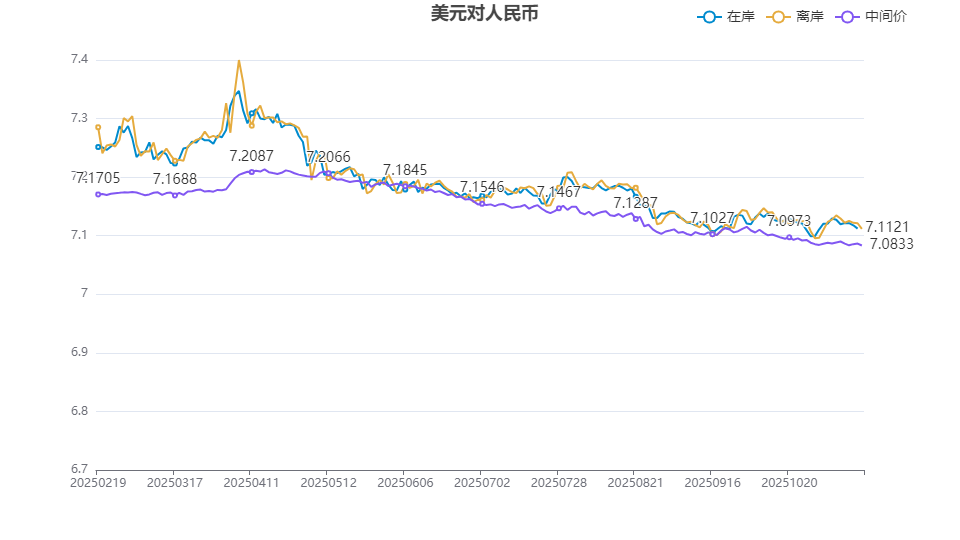
Core Viewpoint - The Chinese yuan has strengthened against the US dollar, reaching its highest level since October 15, 2024, with a central parity rate of 7.0833 on November 12, 2023, indicating a potential for continued strength in the short term [1][6]. Group 1: Currency Market Dynamics - The US dollar index has declined by 6.8% year-to-date, reflecting a challenging environment for the dollar amid expectations of economic data releases that could influence Federal Reserve policy [2][4]. - The recent passing of a temporary funding bill by the US Congress has ended a record 43-day government shutdown, which had cast a shadow over the US economic outlook [4]. - Analysts predict that the combination of a weakening dollar and a strong domestic economic performance in China will support the yuan's resilience [6][7]. Group 2: Economic Indicators and Predictions - The People's Bank of China (PBOC) aims to maintain a stable yuan exchange rate while implementing a moderately loose monetary policy to support economic growth [6][7]. - The PBOC's third-quarter monetary policy report emphasizes the need to prevent excessive fluctuations in the yuan and to keep it at a reasonable and balanced level [7]. - UBS Global Research expresses optimism about the Chinese stock market and the yuan, anticipating improved confidence and credit growth in emerging markets by 2026 [7].
人民币中间价调贬32基点报7.0865
Bei Jing Shang Bao· 2025-11-13 02:23
截至最新发稿时间9时37分,在岸、离岸人民币对美元分别报7.1139,7.1141。 北京商报讯(记者 岳品瑜 董晗萱)11月13日,中国人民银行授权中国外汇交易中心公布,当日银行间 外汇市场人民币汇率中间价为1美元对人民币7.0865元,相较前一交易日中间价7.0833元,调贬32个基 点。 人民银行发布的《2025年第三季度中国货币政策执行报告》指出,坚持以市场供求为基础、参考一篮子 货币进行调节、有管理的浮动汇率制度,保持汇率弹性,强化预期引导,防范汇率超调风险,保持人民 币汇率在合理均衡水平上基本稳定。 ...