
物理AI

Search documents
腾讯研究院AI每周关键词Top50
腾讯研究院· 2025-08-16 02:33
Group 1: Chip Industry - Export licensing fees are impacting Nvidia and AMD [3] - The U.S. is embedding trackers in chip exports [3] Group 2: Computing Power - Tesla's Dojo team has been disbanded [3] - Inspur is launching super-node AI servers [3] Group 3: AI Models - OpenAI's GPT-4o is making a comeback [3] - GPT-5 Pro is being developed by OpenAI [3] - Zhiyuan's GLM-4.5 has been released [3] - Kunlun Wanwei's SkyReels-A3 is now available [3] - Zhiyuan has open-sourced GLM-4.5V [3] - Tencent has introduced Large-Vision model [3] - Anthropic is working on a million-context model [3] - Kunlun Wanwei's Skywork UniPic 2.0 has been launched [3] Group 4: AI Applications - xAI has made Grok 4 available for free [3] - Tencent's CubeMe is integrating with mixed yuan [3] - Alibaba is developing embodied intelligence components [3] - Baichuan Intelligence has released Baichuan-M2 [3] - OpenAI's IOI Gold Medal has been awarded [3] - Kunlun Wanwei's Matrix-3D is now available [3] - SenseTime has introduced AI tools for film production [4] - Apple's new Siri is being developed [4] - Pika is working on audio-driven performances [4] - Claude Code has launched Opus planning mode [4] - Kunlun Wanwei's Deep Research Agent v2 is now available [4] - Tencent's Hunyuan-GameCraft is being developed [4] - Microsoft has outlined five modes for AI agents [4] - The OpenCUA framework is being developed by HKU and others [4] Group 5: Technology Developments - Over 100 robots were showcased at the World Robot Conference [4] - Agile intelligent robots are being developed by Lingqiao Intelligent [4] - Figure is working on robots that can fold clothes [4] - Apple's AI suite is being expanded [4] - Zhiyuan Robotics has launched an open-source world model platform [4] Group 6: Industry Insights - Wang Xingxing discusses the development of embodied intelligence [4] - Product Hunt highlights AI product releases [4] - Nvidia and others are exploring physical AI [4] - Scaling Law is being analyzed by Bi Shuchao [4] - The application of large models is discussed by Artificial Analysis [4] - Programming ability assessments are being conducted by foreign developers [4] - DeepMind emphasizes the importance of Genie 3 [4] - Notion is working on AI product standards [4] - Greg Brockman addresses algorithm bottlenecks [4] - Wang Xiaochuan discusses medical large models [4] Group 7: Capital Movements - Meta has acquired WaveForms [4] - Periodic Labs is securing funding for AI materials [4] - OpenAI is investing in brain-machine interfaces [4] - Perplexity has acquired Chrome [4] Group 8: Events - OpenAI is involved in AI chess events [4] - GitHub has merged with CoreAI [4]


高技术制造业宏观周报:国信周频高技术制造业扩散指数连续三周上行-20250815
Guoxin Securities· 2025-08-15 05:16
Group 1: High-tech Manufacturing Index - The Guosen weekly high-tech manufacturing diffusion index A recorded 0.2, while index B reached 51.4, marking three consecutive weeks of increase[1] - The increase in the index is driven by rising prices in acrylonitrile and dynamic random access memory (DRAM), along with improved conditions in the aerospace and semiconductor sectors[1] - Conversely, the price of 6-amino penicillanic acid decreased, leading to a decline in the pharmaceutical sector's performance[1] Group 2: Price Tracking and Policy Developments - The price of 6-amino penicillanic acid is 212 RMB/kg, down 3 RMB/kg from last week; acrylonitrile is 8,350 RMB/ton, up 150 RMB/ton[2] - DRAM prices increased to $1.7420, up $0.052, while wafer prices rose to $2.78, up $0.06[2] - A new national standard for the transportation of lithium batteries will be implemented on February 1, 2026, enhancing safety and packaging requirements[2] Group 3: Economic Indicators - Fixed asset investment cumulative year-on-year growth is at 2.80%[4] - Retail sales year-on-year growth for the month stands at 4.80%[4] - Monthly export growth is recorded at 7.20%[4] - M2 money supply growth is at 8.80%[4] Group 4: Risks and Challenges - Potential risks include the ineffectiveness of indicators due to structural adjustments in high-tech manufacturing[3] - Economic policies and industrial policy interventions may impact the sector[3] - A slowdown in economic growth poses additional challenges[3]

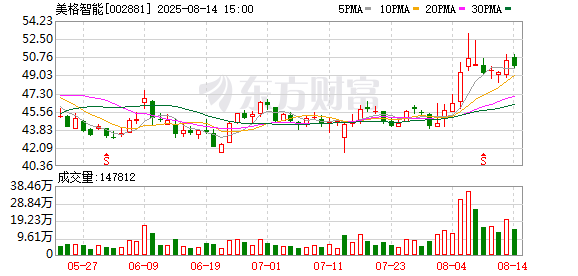
美格智能:公司的无线通信模组、高算力AI模组等产品,可为机器人产品提供高速通信及端侧计算能力
Mei Ri Jing Ji Xin Wen· 2025-08-14 13:34
Group 1 - The core viewpoint of the articles highlights that Meige Intelligent (002881.SZ) is actively developing high-performance AI modules and communication technologies for robotics, aiming to enhance the capabilities of humanoid robots [1] - The company announced that its AI module, which boasts a processing power of 48 Tops, will be integrated into a humanoid robot prototype to be showcased at the 2025 CES [1] - The robotics sector is characterized as an emerging industry, with product development influenced by technological iterations, market conditions, and customer demands, indicating inherent uncertainties [1] Group 2 - An inquiry was made regarding whether Meige Intelligent has any products or components related to physical AI and humanoid robots, emphasizing the integration of AI with physical laws for advanced applications in robotics and automation [3]

英伟达加码机器人 上新Omniverse库和Cosmos模型
2 1 Shi Ji Jing Ji Bao Dao· 2025-08-14 11:02
Group 1 - The global robotics industry is accelerating towards intelligence and scale, with capital and tech giants increasing investments [1] - NVIDIA is positioning itself as a core player in AI computing platforms, aiming to leverage "physical AI" for new growth opportunities [1][2] - The newly launched NVIDIA Omniverse library and Cosmos model are designed to enhance the development and deployment of robotic solutions [1][2] Group 2 - The Omniverse SDK and tools facilitate the creation and deployment of industrial AI and robotic simulation applications, helping developers validate algorithms and hardware designs in virtual environments [1][3] - The Cosmos model allows developers to generate large-scale training data for robots using text, images, and video prompts, with the upcoming Cosmos Transfer-2 capable of quickly generating realistic synthetic data [1][2] Group 3 - Cosmos Reason is a new open-source, customizable 7 billion parameter visual language model that enables robots to reason and understand the physical world like humans [2][3] - NVIDIA's integration of AI reasoning with precise physical simulation is expected to significantly impact various industries, potentially creating trillions of dollars in value [2] Group 4 - NVIDIA has deployed three major computing platforms for robotics and physical AI: embedded computers in robots, AI factory computers for data processing and model training, and simulation computers for testing robots [3][4] - The recent updates to models and toolkits aim to address the challenges of data and simulation in robotics [4] Group 5 - Rev Lebaredian highlighted the importance of generating synthetic data through simulation to overcome the data scarcity challenges faced by physical AI [4] - China is recognized for its strong capabilities in manufacturing efficient and practical robots, supported by expertise in mechatronics and a large manufacturing base [5] Group 6 - Domestic robotics companies are collaborating with NVIDIA to develop products, indicating a growing partnership in the industry [5] - The robotics industry is still in its early stages, facing challenges such as the lack of unified technical standards and the need for effective commercialization strategies [5]

Ai2推出MolmoAct模型:在机器人领域挑战英伟达和谷歌
Sou Hu Cai Jing· 2025-08-14 07:50
Core Insights - The article discusses the rapid development of physical AI, which combines robotics and foundational models, with companies like Nvidia, Google, and Meta releasing research results exploring the integration of large language models with robotics [2][4] Group 1: MolmoAct Overview - The Allen Institute for Artificial Intelligence (Ai2) has released MolmoAct 7B, an open-source model designed to enable robots to "reason in space," aiming to challenge Nvidia and Google in the physical AI domain [2] - MolmoAct is classified as an action reasoning model that allows foundational models to reason about actions in a three-dimensional physical space, enhancing robots' ability to understand the physical world and make better interaction decisions [2][3] Group 2: Unique Advantages - Ai2 claims that MolmoAct possesses three-dimensional spatial reasoning capabilities, unlike traditional visual-language-action (VLA) models, which cannot think or reason spatially, making MolmoAct more efficient and generalized [2][6] - The model is particularly suited for applications in dynamic and irregular environments, such as homes, where robotics face significant challenges [2] Group 3: Technical Implementation - MolmoAct utilizes "spatial location perception Tokens" to understand the physical world, which are pre-trained and extracted using vector quantization variational autoencoders, allowing the model to convert video data into Tokens [3][7] - These Tokens enable the model to estimate distances between objects and predict a series of "image space" path points, leading to specific action outputs [3] Group 4: Performance Metrics - Benchmark tests indicate that MolmoAct 7B achieves a task success rate of 72.1%, surpassing models from Google, Microsoft, and Nvidia [3][8] - The model can adapt to various implementations, such as robotic arms or humanoid robots, with minimal fine-tuning required [8] Group 5: Industry Trends - The development of more intelligent robots with spatial awareness has been a long-term goal for many developers and computer scientists, with the advent of large language models facilitating this process [4][5] - Companies like Google and Meta are also exploring similar technologies, with Google’s SayCan helping robots reason about tasks and determine action sequences [4]
英伟达为机器人推出懂推理的“大脑”,升级版Cosmos世界模型来了
3 6 Ke· 2025-08-12 10:20
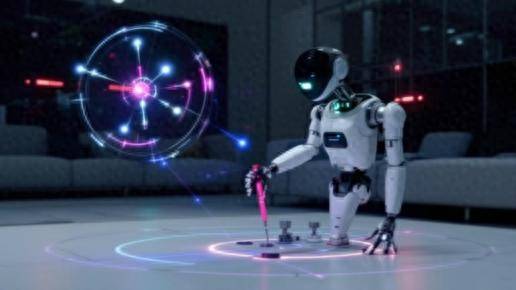
Core Viewpoint - NVIDIA has unveiled an upgraded Cosmos world model at the ongoing SIGGRAPH conference, aimed at enhancing robotics capabilities through advanced simulation and AI integration [1][10]. Software Updates - The Cosmos model is designed to generate synthetic data that adheres to real-world physical laws and has been adopted by notable companies such as Figure, Agility Robotics, and General Motors [2]. - A significant software update includes the introduction of Cosmos Reason, a 70 billion parameter visual language model that aids robots in task planning [5][6]. - The new Cosmos Transfer-2 and its lightweight version accelerate the conversion of virtual scenes into training data, significantly reducing the time required for this process [7]. Hardware Enhancements - NVIDIA has launched the RTX PRO Blackwell server to support various workloads including training, synthetic data generation, and robotic learning [9]. - The DGX Cloud platform allows developers to efficiently run Omniverse and Cosmos applications from anywhere, facilitating large-scale simulations and training tasks [9]. Strategic Focus - NVIDIA is heavily investing in the robotics sector, recognizing the convergence of computer graphics and AI as a transformative force in the industry [10][13]. - The company aims to create a comprehensive and realistic "virtual parallel universe" for robots to safely experiment and learn, thereby lowering the barriers and costs associated with traditional robot training [13][14]. Collaborations and Market Position - NVIDIA is forming deep partnerships with various companies in China, including Alibaba Cloud and several robotics firms, to expand its influence in the robotics market [17]. - The company is positioning itself as a key player in the embodied intelligence era, leveraging its expertise in graphics to support the development of diverse robotics and AI applications [15][17].
“所有移动的物体都能变成机器人”,英伟达加快物理AI部署
第一财经· 2025-08-12 07:26
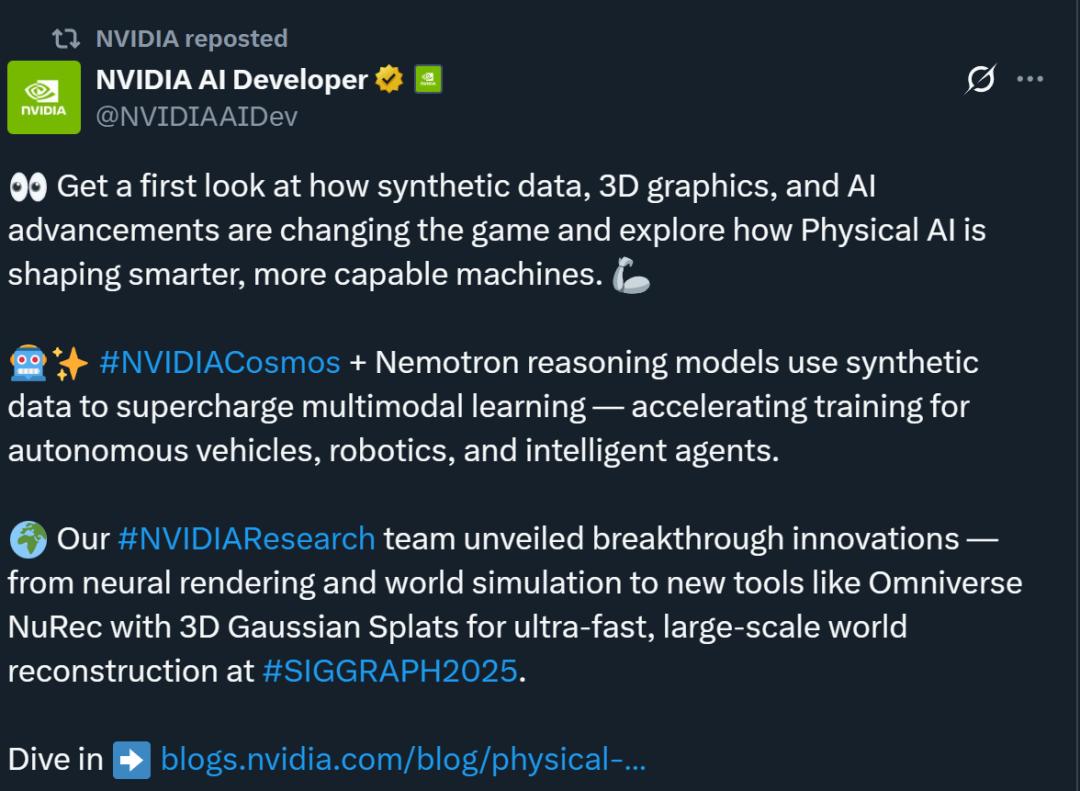
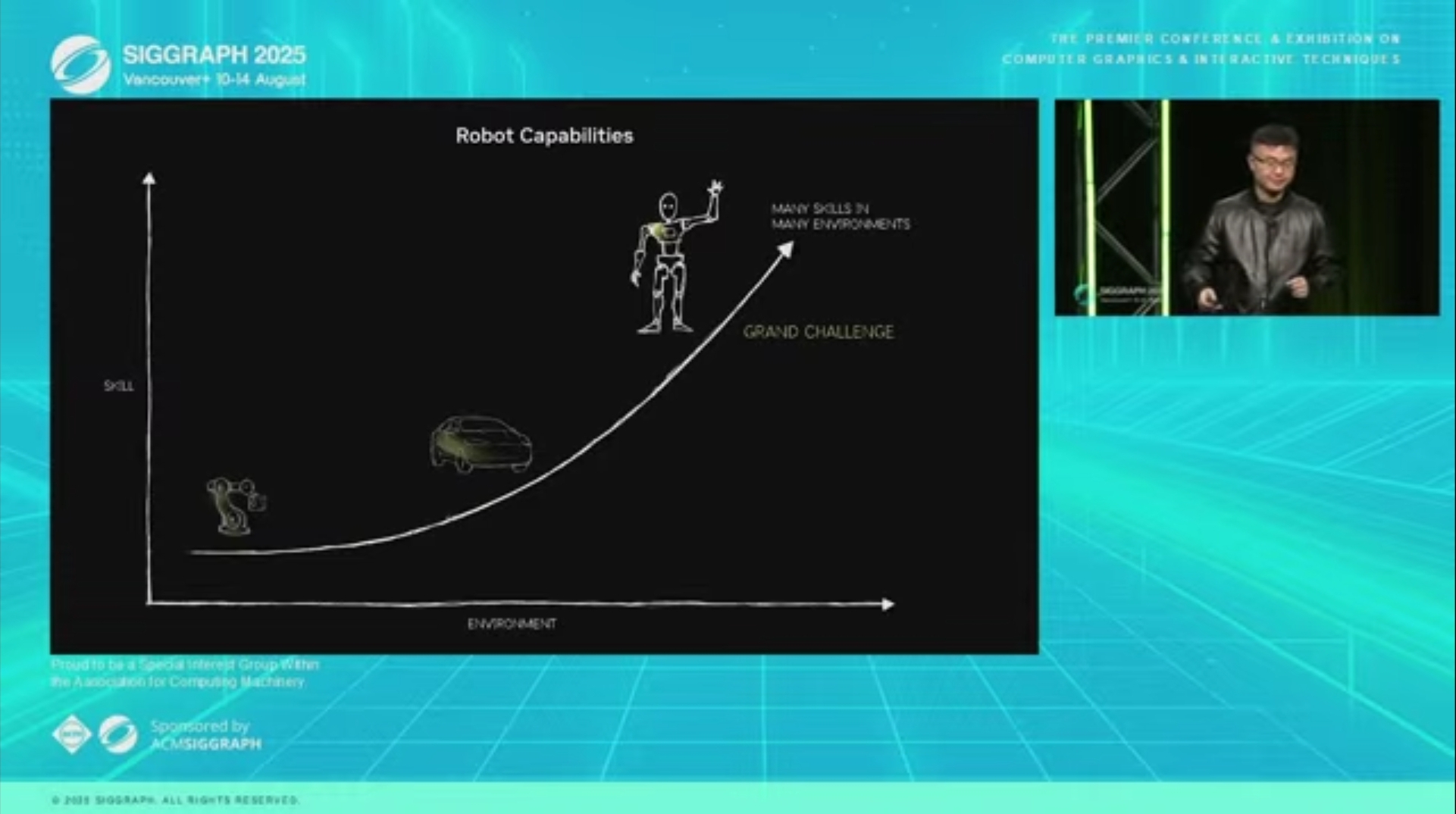
Core Viewpoint - The next wave of technology is Physical AI, which is being rapidly deployed by NVIDIA, leveraging neural graphics, synthetic data generation, physical models, reinforcement learning, and AI inference technologies [2] Group 1: Physical AI Development - NVIDIA's CEO Jensen Huang has emphasized the importance of Physical AI multiple times this year, indicating it as a significant future trend [2] - At the 2025 World Robot Conference, NVIDIA's Omniverse and simulation technology VP highlighted that Physical AI could unlock a trillion-dollar market [2] - NVIDIA presented 16 papers on Physical AI at the SIGGRAPH 2025 conference, marking it as the central theme of their participation [2] Group 2: Relationship Between Graphics Research and Physical AI - There is a close relationship between graphics research and Physical AI, with advancements in rendering leading to the creation of realistic virtual worlds for training advanced Physical AI systems [3] - NVIDIA has significantly improved real-time path tracing performance by 10,000 times over the past nine years, enhancing the training of AI systems [3] - Simulations play a crucial role in robot research, allowing for safe and efficient training in virtual environments, which can be several orders of magnitude more efficient than real-world training [3] Group 3: Expectations and Applications of Robotics - Different types of robots have varying expectations, from simple tasks for industrial arms to complex navigation for autonomous vehicles and versatile skills for humanoid robots [4] - The key to transforming generative AI into Physical AI lies in training data, with synthetic data being crucial to overcoming data challenges [4] - NVIDIA is actively seeking more applications for GPUs in industrial and robotics sectors, which are closely related to Physical AI [4] Group 4: Product Launches and Innovations - NVIDIA has accelerated the release of products related to Physical AI, including the Cosmos world model for generating synthetic driving scenarios and the open-source 70 billion parameter visual language model, Cosmos Reason [6] - New hardware solutions are being introduced, such as servers equipped with RTX PRO 6000 Blackwell GPUs for enterprise workloads related to AI and Physical AI [6] - Upcoming products include the RTX PRO 4000 Blackwell SFF and RTX PRO 2000 Blackwell GPUs, aimed at engineering, AI, and 3D visualization applications [6]

“所有移动的物体都能变成机器人”,英伟达加快物理AI部署
Di Yi Cai Jing· 2025-08-12 04:42
Core Viewpoint - The next wave of innovation is identified as Physical AI, which is emphasized by NVIDIA's CEO Jensen Huang, highlighting its potential to drive significant market growth in various sectors [1] Group 1: Physical AI Development - NVIDIA is accelerating its deployment in the Physical AI sector, which relies on neural graphics, synthetic data generation, physical modeling, reinforcement learning, and AI inference technologies [1] - Physical AI is expected to unlock a trillion-dollar market, as mentioned during the 2025 World Robot Conference [1] - At the SIGGRAPH 2025 conference, NVIDIA presented 16 papers focusing on Physical AI, indicating its central theme for the event [1][2] Group 2: Relationship Between Graphics and AI - There is a close relationship between Physical AI and graphics research, with advancements in rendering technology enabling the creation of realistic virtual worlds for training advanced Physical AI systems [2] - NVIDIA's rendering research has improved real-time path tracing performance by 10,000 times over nine years, showcasing significant technological progress [2] Group 3: Robotics and AI Integration - Future robots are expected to redefine operations in factories, warehouses, and agriculture, with a strong coupling between AI and simulation research [2] - Training robots in virtual environments is safer and more efficient than in the real world, allowing for rapid skill acquisition [2] Group 4: Product Launches and Innovations - NVIDIA has introduced several products related to Physical AI, including the Cosmos world model for generating synthetic driving scenarios and the open-source 70 billion parameter visual language model, Cosmos Reason [5] - New hardware solutions, such as the RTX PRO 6000 Blackwell server GPU, are being launched to support AI and Physical AI workloads [5]
英伟达高层与王兴兴、王鹤罕见同框,深聊人形机器人的“命门”与“钱途”
3 6 Ke· 2025-08-12 04:15
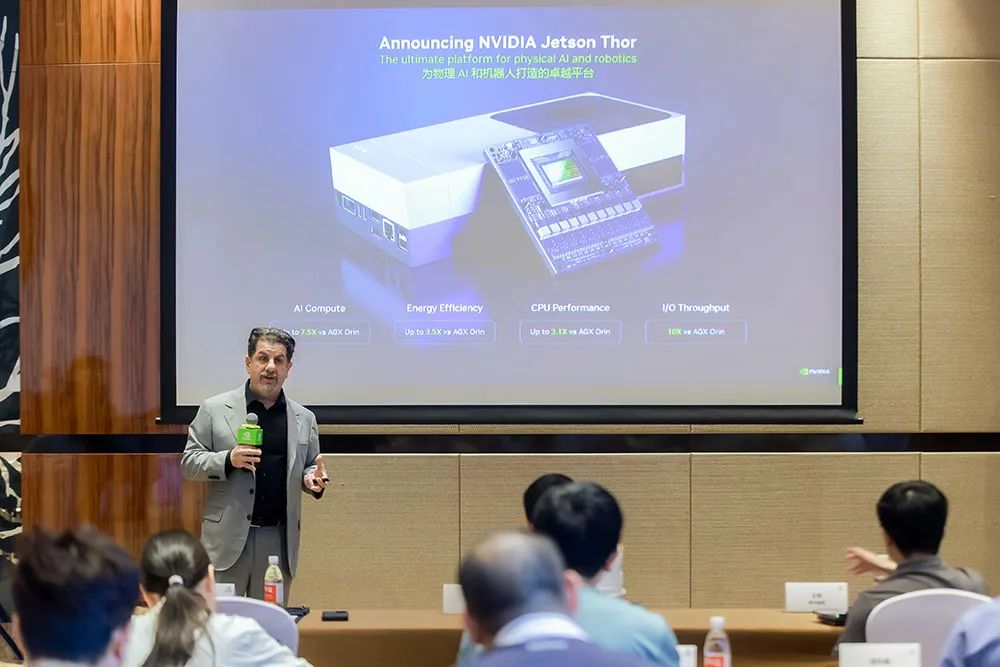
Core Insights - The discussion during the World Robot Conference highlighted the challenges and opportunities in the commercialization of humanoid robots, emphasizing that cost is not the primary barrier to scaling [1][3][4] - Companies like NVIDIA, Yushu Technology, and Galaxy General are at the forefront of developing humanoid robots and AI solutions in China, leveraging their technological capabilities and partnerships [1][2][18] Group 1: Commercialization Challenges - The main challenge for humanoid robots is not cost but the speed and capability of deployment in factories [3][4] - Current limitations include the versatility of embodied intelligent models and the ability of robots to perform a wider range of tasks effectively [4][5] - A robust target recognition and positioning system is essential for unlocking the humanoid robot market, which is projected to reach a scale of hundreds of billions in the next five years [5][6] Group 2: Technological Advancements - NVIDIA is enhancing its computing capabilities with the Jetson Thor platform, which significantly improves performance metrics such as computational power and bandwidth [42][44] - The integration of simulation technology is crucial for training robots, allowing for the generation of synthetic data that enhances the learning process [33][34][56] - Galaxy General's robots are utilizing advanced models for navigation and object manipulation, showcasing the potential for real-world applications in retail and healthcare [54][55] Group 3: Market Potential - The humanoid robot market is expected to surpass the total value of industrial robotic arms, with projections indicating exponential growth in production and sales over the next decade [11][12] - China is positioned uniquely in the physical AI and robotics sector due to its scale, talent pool, and manufacturing capabilities, which support rapid development and deployment [19][20] Group 4: Future Applications - Humanoid robots are anticipated to find widespread applications across various sectors, including industrial, service, and household environments, although ethical and safety concerns may slow adoption in domestic settings [22][24] - The collaboration between companies like NVIDIA and local firms is essential for driving innovation and ensuring the successful integration of AI and robotics into everyday life [58][59]
英伟达发布Cosmos Reason:AI机器人进入推理时代
Jin Shi Shu Ju· 2025-08-12 03:45
Core Insights - Nvidia has launched a new generation of global AI models and infrastructure for robot developers, notably the "Cosmos Reason," a reasoning visual language model with 7 billion parameters aimed at physical AI applications and robotics [1] - The models are designed to create synthetic text, image, and video datasets for training robots and AI agents, enhancing their reasoning capabilities [1] Group 1: Product Features - Cosmos Reason enables robots and AI agents to infer actions based on physical understanding and memory, allowing them to plan and execute tasks effectively [1] - The model can automate data organization and labeling, significantly improving the efficiency of processing diverse training datasets [2] - In video analysis, AI agents built on Nvidia's Blueprint can extract valuable insights from large volumes of recorded or real-time video, suitable for urban traffic networks and factories [2] Group 2: Technological Advancements - Nvidia introduced a new neural reconstruction library and rendering technology that allows developers to simulate the real world in 3D using sensor data [2] - The updates to the Omniverse software development kit and the launch of the RTX Pro Blackwell Server provide a unified architecture to support robotic development workloads [2] - DGX Cloud is introduced as a cloud-based management platform for robotics, indicating Nvidia's commitment to enhancing robotic workflows [2] Group 3: Strategic Direction - The releases indicate that Nvidia is accelerating its entry into the robotics sector, seeking new application scenarios for AI GPUs following AI data centers [3]