
美联储独立性

Search documents
两个凯文成美联储主席候选 特朗普想选谁?华尔街想要谁?
Di Yi Cai Jing· 2025-12-13 08:28
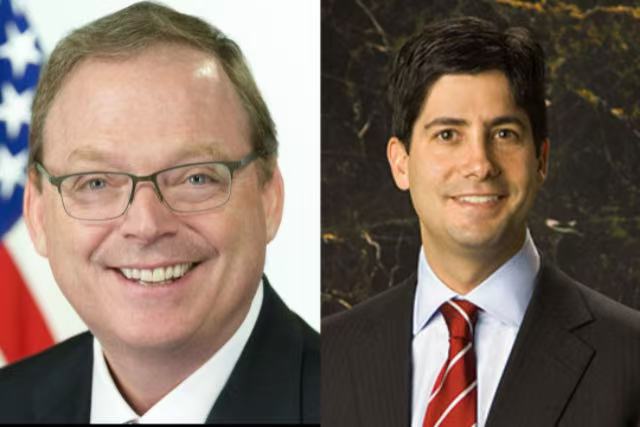
美联储主席热门人选又有新进展——又有一位"凯文(Kevin)"浮出水面。 据报道,美国总统特朗普在最新采访中表示,凯文·哈塞特(Kevin Hassett)和凯文·沃什(Kevin Warsh)均是 他心中领导美联储的人选。 特朗普预计,下一任美联储主席将在利率问题上与他协商,这将颠覆美联储独立性的传统。 特朗普表示,他认为利率应该"为1%甚至可能更低",并预计将在"未来几周内"选出下一任美联储主 席。 此前,华尔街已经向特朗普政府表态,对哈塞特"接棒"的前景表示忧虑,威胁美联储独立性。 据知情人士透露,摩根大通首席执行官戴蒙在11日晚在纽约举行的该行资产管理首席执行官私人会议上 表示,他赞同沃什关于美联储的观点。同时他还告诉华尔街高管,哈塞特更有可能支持特朗普提出的降 息要求。 美联储前高级经济学家、上海交通大学上海高级金融学院教授胡捷在近期接受第一财经记者采访时表 示:第一,美联储的基本运作规则与文化应会延续;第二,美联储主席在多大程度上听取总统意见,始 终存在一定弹性空间。"也就是说,若哈塞特上任,他可能会更认同特朗普的观点,但美联储决策仍遵 循数据导向的基本原则,不可能完全脱离这一框架,否则将沦为笑话 ...
两个凯文成美联储主席候选,特朗普想选谁?华尔街想要谁?
Di Yi Cai Jing· 2025-12-13 08:19
特朗普表示,他认为利率应该"为1%,甚至可能更低",并预计将在"未来几周内"选出下一任美联储主 席。 美联储主席热门人选又有新进展——又有一位"凯文(Kevin)"浮出水面。 据报道,美国总统特朗普在最新采访中表示,凯文·哈塞特(Kevin Hassett)和凯文·沃什(Kevin Warsh)均是 他心中领导美联储的人选。 特朗普预计,下一任美联储主席将在利率问题上与他协商,这将颠覆美联储独立性的传统。 特朗普表示,他认为利率应该"为1%甚至可能更低",并预计将在"未来几周内"选出下一任美联储主 席。 此前,华尔街已经向特朗普政府表态,对哈塞特"接棒"的前景表示忧虑,威胁美联储独立性。 据知情人士透露,摩根大通首席执行官戴蒙在11日晚在纽约举行的该行资产管理首席执行官私人会议上 表示,他赞同沃什关于美联储的观点。同时他还告诉华尔街高管,哈塞特更有可能支持特朗普提出的降 息要求。 美联储前高级经济学家、上海交通大学上海高级金融学院教授胡捷在近期接受第一财经记者采访时表 示:第一,美联储的基本运作规则与文化应会延续;第二,美联储主席在多大程度上听取总统意见,始 终存在一定弹性空间。"也就是说,若哈塞特上任,他可 ...

黄金、白银、美股,全线跳水!美联储官员公开回怼特朗普!降息前景突变
Sou Hu Cai Jing· 2025-12-13 00:25
昨日夜间,黄金、白银突然跳水,美股三大指数也集体收跌。 COMEX黄金在两个小时内短线跳水超100美元,最终报收4329.8美元/盎司。COMEX白银一度大跌 5.5%,最终报跌3.88%,回调至62.085美元/盎司。 美股也普遍下跌,不过盘中三大股指均震荡回升,纳指收跌1.69%,此前一度跌超2%。个股方面,特斯 拉涨近3%,苹果转涨,英伟达跌超3%。 特朗普一直隔空喊话美联储应降息以降低政府借款成本,但美联储官员并不买账,甚至公开回怼。 美联储古尔斯比周五表示,央行在制定利率政策时不应考虑政府融资成本,并称这是美联储独立性至关 重要的关键原因。 "令我痛心的是,为什么一群政府之外、行政部门之外的人要来决定利率?"古尔斯比在芝加哥联储经济 研讨会上表示,"甚至有人提出,美联储应该降息,以降低政府举债成本。这实际上是将债务货币化。 这正是我们希望美联储保持独立的根本原因。" 另外,周五多位美联储官员发声,给降息前景泼冷水。 施密德表示,劳动力市场正在降温,但仍基本保持平衡;通胀仍过高,经济呈现增长势头,希望保持货 币政策适度限制性。 古尔斯比表示,他之所以在本周投下反对票,是因为他希望等待更多经济数据,以确 ...
The Fed's Next Chair Faces AI Uncertainty, Political Heat and Credit Risks
Youtube· 2025-12-13 00:01
Core Viewpoint - The Federal Reserve's decision to maintain interest rates is not surprising, but the rationale behind it raises questions, particularly in light of the Fed's macroeconomic forecasts indicating higher GDP growth for the next year [1] Economic Outlook - The Fed's projections for GDP growth have increased by half a percent for 2026, suggesting a growing economy, which complicates the case for rate cuts [1] - The current Fed funds rate is viewed as appropriate given the economic conditions and inflation forecasts, leaving little room for further cuts [1] Artificial Intelligence Impact - The potential of artificial intelligence (AI) to boost productivity is acknowledged, but it poses a challenge for the Fed, as higher productivity could lead to higher interest rates rather than lower [1] - The uncertainty surrounding AI's impact on employment and productivity remains, with the possibility that AI could either complement or substitute human labor [1] Tariffs and Inflation - Chair Powell's comments on tariffs suggest that while they may temporarily raise prices, their long-term effects could be detrimental to productivity and supply chains [2][3] - The concern is less about immediate inflation and more about the corrosive long-term impact of tariffs on the economy [2] Federal Reserve Governance - The presence of dissenting opinions within the Fed is seen as a sign of a healthy organization, but it also presents challenges for governance, especially with an upcoming change in leadership [4][5] - The new Fed chair will need to unify differing perspectives while maintaining the Fed's independence from political influences [6][8] Economic Risks - There are both upside and downside risks to the economy, with the AI boom and economic resilience being potential positives, while a weakening labor market and credit cycle maturity pose risks [12][14] - Geopolitical risks are also highlighted as unpredictable factors that could impact the economic landscape [15]

南财早新闻|监管出手:卖车须明码标价;证监会对私募机构开出“顶格”罚单
2 1 Shi Ji Jing Ji Bao Dao· 2025-12-12 23:17
Group 1 - The Central Financial Committee emphasizes the need to effectively manage financial risks related to local small and medium financial institutions, real estate companies, and local government financing platforms, while strictly controlling new risks and addressing existing ones [1] - In November, China's financial data shows an increase of 15.36 trillion yuan in RMB loans for the first 11 months, with a cumulative social financing scale of 33.39 trillion yuan, exceeding last year's total by 3.99 trillion yuan [1] - The Ministry of Industry and Information Technology and the People's Bank of China jointly issued a notice to support green factory construction through green finance policies, focusing on R&D, industrial application projects, and zero-carbon factory construction [1] Group 2 - The State Administration for Market Regulation is soliciting opinions on the "Compliance Guidelines for Pricing Behavior in the Automotive Industry," which aims to standardize pricing practices and address issues like failure to clearly mark prices and false promotions [2] - The Financial Regulatory Bureau has released the "Supervision and Management Measures for Commercial Bank Custody Business (Trial)," which includes significant modifications such as new requirements for custodians of non-standard products and prohibitions on providing liquidity support [2] Group 3 - The China Securities Regulatory Commission is seeking opinions on the strictest public fund sales behavior regulations, targeting long-standing industry issues such as "heavy sales, light service" and introducing new rules for performance display and sales practices [3] - The Shanghai Stock Exchange has disclosed that it will monitor stocks with significant volatility and conduct special investigations into major corporate events [3] - Reports indicate that the market for bank wealth management products has reached a historical high of approximately 33.8 trillion yuan, with a growth of about 3.43 trillion yuan in the first 11 months of the year [3] Group 4 - The wholesale price of Feitian Moutai has dropped below the official guidance price of 1499 yuan per bottle, marking a new low [4] - Douyin has launched a new payment feature called "Douyin Buy," allowing consumers to pay at merchant locations through the Douyin app [4] Group 5 - Moore Threads plans to use 7.5 billion yuan of idle fundraising for cash management, investing in safe and liquid principal-protected products [5] - Enjie Co. intends to acquire 100% of Zhongke Hualian's shares, with stock resuming trading on December 15 [6] - Kehua Data has launched a high-density liquid-cooled computing POD in collaboration with Muxi Co. and has engaged in business partnerships with domestic GPU chip manufacturers [6] Group 6 - The U.S. stock market saw declines across major indices, with the Dow Jones down 0.51% and the Nasdaq down 1.69%, influenced by significant drops in companies like Caterpillar and Nvidia [6] - The EU has agreed to indefinitely freeze the assets of the Russian central bank in Europe [6] - U.S. President Trump announced a ceasefire agreement between Thailand and Cambodia after discussions with their leaders [6] Group 7 - The Central Economic Work Conference prioritizes domestic demand and introduces a plan for increasing income among urban and rural residents, indicating a shift towards relying on domestic consumption for economic growth in 2026 [7] - The emphasis on quality investment expansion reflects a focus on urban renewal and optimizing the use of special bonds [7]
特朗普将沃什和哈塞特列为最有希望美联储主席候选人
Xin Lang Cai Jing· 2025-12-12 22:00
Group 1 - President Trump has named Kevin Hassett and Kevin Walsh as his top candidates for the Federal Reserve Chair position, indicating a preference for collaboration on interest rate decisions [1][2] - Trump suggested that Walsh's ranking among candidates has improved, while Hassett was previously seen as the frontrunner [1][2] - Trump emphasized that both candidates are excellent and mentioned the possibility of other outstanding candidates [1][2] Group 2 - Trump reiterated his call for significant interest rate cuts, stating that rates should be lowered to 1% or even lower [3] - He believes that the next Federal Reserve Chair should consult him on interest rate matters, which would challenge the traditional independence of the Federal Reserve [1][2]
美元指数七周新低!市场预期降息加速,美联储独立性受质疑
Sou Hu Cai Jing· 2025-12-12 07:37
(市场有风险,投资需谨慎。本文为AI基于第三方数据生成,仅供参考,不构成个人投资建议。) 本周美元指数持续承压,徘徊在七周新低附近,反映出市场对美联储未来政策路径的重新定价。尽管最新议息会议仅实施了25个基点的降息,但投资者普遍 预计未来的降息节奏将显著快于决策者所暗示的步调。 来源:市场资讯 根据美联储公布的最新利率路径,决策层预计到2026年底的联邦基金利率将降至3.4%。根据CME FedWatch数据,市场认为未来一年至少两次降息的概率高 达58%,明显偏向更宽松的方向。美元兑主要货币普遍走弱。 有外汇策略师表示,当前美元的下跌并非单一因素所致,而是利率预期、风险情绪与政策沟通共同作用的结果。 市场近期还关注到关于美联储独立性的讨论升温。此外,本周宏观环境整体偏向风险偏好,进一步削弱了美元的避险价值。在此背景下,下周将公布的非农 就业数据、零售销售与采购经理人指数(PMI)被视为判断经济韧性与未来政策节奏的关键窗口。 ...
南财快评|降息之外,关键时期的美联储面临的关键问题
2 1 Shi Ji Jing Ji Bao Dao· 2025-12-12 07:32
Group 1 - The Federal Reserve decided to lower the federal funds rate target range by 25 basis points to 3.5%-3.75% during the last FOMC meeting of the year, while also announcing the purchase of short-term government bonds to maintain ample reserve levels [1] - The median forecast for U.S. economic growth was raised to 1.7% for this year and 2.3% for next year, while inflation forecasts were lowered to 2.9% and 2.4% for PCE and core PCE respectively for the next two years [1] - The decision to lower rates was in line with market expectations, and the optimistic tone from Fed Chair Powell during the press conference led to a positive market reaction [2] Group 2 - The Fed faces a challenging situation with high inflation and potential job losses, creating a dilemma between controlling inflation and supporting employment [3] - The Fed's reliance on economic data has been compromised due to budget cuts and staffing shortages, leading to delays in key economic data releases, which complicates their decision-making process [3] - The independence of the Federal Reserve is under threat, with recent actions from the White House raising concerns about its ability to control inflation and maintain market stability [4] Group 3 - Despite the rate cut, U.S. Treasury yields rose before the Fed meeting, indicating market concerns about the potential for a change in leadership at the Fed and its impact on inflation control [5] - The nomination of a new Fed Chair could face significant hurdles, including Senate approval and differing opinions among Fed officials, which may complicate the implementation of rate cuts as desired by the White House [5]
美联储这次“平平无奇”的降息,其实暗藏玄机
Sou Hu Cai Jing· 2025-12-12 05:35
《美联储这次"平平无奇"的降息,其实暗藏玄机》 ——连续三次降息背后,美联储为何突然"步子乱了"?分歧、政治与流动性正在重塑全球预期 real g min TOMES E 7 3 4 5 n 2 2 3 4 4 4 the first 0 1 the state t 2 30 1 the st STATE THE THE all no a s t and ans in Ship STATION the state 再看点阵图,已经不是"有分歧",而是未来路径严重撕裂:有人把利率看到2%,也有人准备随时加息。市场一边上涨,一边心里发虚——这不是指路牌, 更像一道谜题。 真正点燃情绪的,是资产负债表操作。美联储嘴上说"不是QE",手上却开始买短债。历史早就告诉市场:流动性一旦放出,情绪比逻辑跑得快,于是股债 齐涨、美元回落、黄金走强。 往前看,政治变量正在逼近。主席换届在即,潜在接班人立场更鸽,白宫声音更直接,美联储独立性成了新的风险点。 放在全球坐标系里,美国在摇摆,中国却更显定力。内生增长、产业升级与政策韧性,正在为中国经济提供更稳的锚。 一句话总结:这次降息不是答案,而是序章。真正的戏,还在后面。 "重点不 ...

降息之外,关键时期的美联储面临的关键问题
2 1 Shi Ji Jing Ji Bao Dao· 2025-12-12 03:46
Core Viewpoint - The Federal Reserve's decision to lower the federal funds rate target range by 25 basis points to 3.5%-3.75% reflects a more optimistic economic outlook, despite internal dissent within the Fed [1][2]. Economic Forecast - The median forecast for U.S. GDP growth has been raised to 1.7% for this year and 2.3% for next year, while inflation forecasts have been lowered to 2.9% and 2.4% for PCE and core PCE respectively for the next two years [1]. - The unemployment rate is projected to be 4.5% at the end of this year and 4.4% by the end of next year, with interest rates expected to be 3.4% by the end of 2026 and 3.1% by the end of 2027 [1]. Market Reaction - The market responded positively to the Fed's decision, which was in line with expectations, and emphasized the Fed's ability to "wait and observe" economic developments [2]. Challenges Faced by the Fed - The Fed is navigating unprecedented challenges, including the impact of the global pandemic, which has led to the highest inflation rates since the 1980s and necessitated a year-long series of interest rate hikes [2][3]. - The Fed's reliance on economic data has been compromised due to budget cuts and staffing shortages, leading to concerns about data quality and delays in key economic indicators [3]. Independence of the Fed - The independence of the Federal Reserve is under threat, with recent actions from the White House raising concerns about its ability to control inflation and maintain the value of the dollar [4]. - The potential nomination of a new Fed chair who may prioritize interest rate cuts poses additional risks to the Fed's independence and decision-making process [5].