差异化竞争

Search documents
2025年电商行业“寒冬”来袭,大批商家撤离淘宝,背后四大缘由引人深思
Sou Hu Cai Jing· 2025-09-14 01:06
Core Insights - The traditional e-commerce industry is facing significant challenges, including rising traffic costs, shrinking profit margins, and intensified competition, leading to a fundamental change in the operating environment [1][2]. Group 1: Industry Challenges - The number of e-commerce practitioners in China is projected to decrease by 12.5% by June 2025, with active merchants on the Taobao platform declining by 18.3% [1]. - Average customer acquisition costs on Taobao have increased by 47% year-on-year, reaching 78 yuan per new customer [1]. - The average gross profit margin for e-commerce platforms has dropped by 8.3 percentage points over the past five years, with many merchants reporting net profit margins of less than 5% after accounting for commissions, logistics, and promotional costs [2]. Group 2: Market Competition - The number of newly registered online stores increased by 8.7% in the first half of 2025, while the growth of online shopping users was only 1.2% [2]. - The entry of brand official flagship stores has intensified competition, posing a significant challenge to traditional distributors [2]. - Frequent adjustments to platform rules have created uncertainty for merchants, with over 30 rule updates on Taobao in the first half of 2025 alone [2]. Group 3: Emerging Trends - New e-commerce platforms, such as Douyin, are reshaping the industry landscape, with GMV growth of 78.5% year-on-year in Q2 2025, outpacing traditional platforms [3]. - Merchants are adopting innovative strategies to survive, such as offering specialized services or leveraging multiple platforms to diversify income sources [3]. - The value of private traffic operations is becoming increasingly important, with merchants finding success through direct consumer engagement and reduced reliance on platform traffic [3]. Group 4: Future Outlook - Experts suggest that the current cooling of the e-commerce sector is a necessary transition from extensive growth to quality competition, where adaptable and innovative merchants will thrive [5].



浙江正特(001238):体现差异化制造(产品)逻辑
Xin Lang Cai Jing· 2025-09-12 12:35
Core Viewpoint - The company reported strong financial performance in H1 2025, driven by strategic product placements and market expansion in the outdoor leisure furniture sector, particularly in North America [1][7]. Financial Performance - In Q2 2025, the company achieved revenue of 500 million, a 36% year-on-year increase, and a net profit attributable to shareholders of 30 million, up 25% [1]. - For H1 2025, total revenue reached 1 billion, reflecting a 39% increase, while net profit attributable to shareholders was 70 million, marking a 56% growth [1]. Industry Insights - The outdoor leisure furniture and supplies industry is a key aspect of modern lifestyle upgrades, with applications in villas and hotels, making it one of the most active segments in the furniture industry [1]. - The North American market is characterized by a shortened product replacement cycle of 18-24 months and a growing demand for modular and scenario-based products, which accelerates innovation [1]. - There is a decline in R&D investment from European and American brands, leading to a lack of innovation and reduced consumer purchasing willingness, creating opportunities for innovative companies [1]. Product Innovation and Marketing - The company focuses on core SKUs and product innovation, aiming to create industry-leading products [2]. - Three products, including the Novara umbrella, received prestigious awards at the 2025 German Red Dot Design Awards, highlighting the company's international competitiveness in product design [2]. - The company enhances customer marketing by serving major clients in North America and improving direct-to-consumer capabilities through cross-border e-commerce [2][5]. Manufacturing and Delivery - The company is improving automation and digital capabilities, establishing a vertically integrated production line to optimize delivery times and inventory management [3]. Key Account Expansion - The company successfully entered multiple Costco locations in North America with its star product, the Stargazing Canopy, increasing retail coverage [4]. - The Stargazing Canopy also launched on the Sams online platform, marking a significant breakthrough in mainstream channel distribution [4]. - New outdoor furniture categories have been introduced to Costco's online platform, achieving impressive sales and recognition [4]. - The company has made strides in the camping category by entering Walmart's physical stores [4]. E-commerce Development - The company is focusing on cross-border e-commerce, particularly on platforms like Amazon and Wayfair, while enhancing its independent operational capabilities [5][6]. Profit Forecast Adjustment - The company has adjusted its profit forecasts upward, expecting revenues of 1.7 billion, 2.4 billion, and 3.2 billion for 2025-2027, with net profits of 100 million, 130 million, and 170 million respectively [7].
浙江正特(001238):体现差异化制造(产品)逻辑
Tianfeng Securities· 2025-09-12 10:45
Investment Rating - The investment rating for the company is "Hold" with a target price not specified [4] Core Insights - The company reported a revenue of 500 million yuan in Q2 2025, representing a 36% year-on-year increase, and a net profit attributable to the parent company of 30 million yuan, up 25% year-on-year. For the first half of 2025, revenue reached 1 billion yuan, a 39% increase, with a net profit of 70 million yuan, up 56% year-on-year. The growth is attributed to the strategic introduction of the "Starry Canopy" product into multiple Costco stores [1] - The outdoor leisure furniture and supplies industry is a significant reflection of modern lifestyle upgrades, widely used in villas and hotels, and is one of the most active segments in the furniture industry. The core consumer market in Europe and the United States is currently characterized by "demand stratification and supply restructuring" [1] - The demand side shows a shortened product replacement cycle in North America to 18-24 months, with increasing scene-based and modular demands, accelerating innovation iterations among companies. On the supply side, a decline in R&D investment by European and American brands has led to a lack of innovation, creating significant opportunities for innovative companies [1] - China, leveraging its industrial chain and cost advantages, has become a major global production base, but the industry remains fragmented with weak brand building. Future market concentration and enhanced consumer brand awareness are expected to drive the industry towards "branding and value orientation," achieving high-quality development [1] Summary by Sections Product Innovation - The company focuses on core SKUs, innovating new products to create industry bestsellers. The design philosophy emphasizes "good-looking, practical, and high-value" products. In the 2025 German Red Dot Design Award, three products, including the Mirador storage box and Sky series Starry Canopy, won prestigious awards, showcasing the company's international competitiveness in product innovation and design aesthetics [2] Customer Marketing - On the B2B side, the company serves major clients in Europe and the United States, such as Walmart and Costco, providing flexible delivery solutions to enhance service experience. On the B2C side, it strengthens local logistics and customer service capabilities through its self-operated cross-border e-commerce team [2] Manufacturing and Delivery - The company enhances automation and digital capabilities, constructing vertically integrated production lines to optimize delivery times and inventory management. The operational model is centered on efficient collaboration among product innovation, customer marketing, and manufacturing delivery, building a differentiated competitive advantage [2] Key Account Expansion - The Starry Canopy successfully entered multiple Costco stores in North America, increasing retail terminal coverage. It also launched on the Sams online platform, marking a significant breakthrough in the company's layout in mainstream North American channels. The successful entry is attributed to the company's long-term accumulation in product quality, delivery capability, and brand influence [3] - Innovative outdoor furniture products have entered Costco's online platform, achieving impressive sales performance and gaining high recognition from Costco, leading to tests for offline sales [3] - The innovative camping trailer has successfully entered multiple Walmart stores, marking a key step in the company's expansion into the camping category [3] Financial Forecast - The company has adjusted its profit forecast, expecting revenues of 1.7 billion yuan, 2.4 billion yuan, and 3.2 billion yuan for 2025, 2026, and 2027 respectively. The net profit attributable to the parent company is projected to be 100 million yuan, 130 million yuan, and 170 million yuan for the same years. The EPS is expected to be 0.9 yuan, 1.2 yuan, and 1.6 yuan, with corresponding P/E ratios of 55x, 42x, and 32x [10]
{快递行业“反内卷”涨价潮起,低价包邮模式能否经受住考验?
Sou Hu Cai Jing· 2025-09-06 20:26
Core Viewpoint - The recent increase in express delivery fees in Guangdong and Zhejiang is a response to the "involution" competition in the logistics industry, significantly impacting small e-commerce sellers' profitability and survival [3][4]. Group 1: Price Increase Impact - The express delivery fee in Guangdong was raised from 1.25 yuan to 1.7 yuan, which could reduce annual profits for small sellers by nearly half [1][3]. - In Yiwu, the minimum express delivery price was increased from 1.1 yuan to 1.2 yuan starting July 17, indicating a broader trend of price hikes across the industry [3]. Group 2: Historical Context and Competition - The logistics industry has experienced severe price wars, with delivery fees dropping to as low as 0.8 yuan due to aggressive competition, leading to a decline in revenue for major companies [3]. - In July, the average revenue per package for major express companies like Shentong, YTO, and Yunda fell by 1.50%, 7.20%, and 3.54% respectively, with SF Express seeing a decline of 14.02% [3]. Group 3: Small Seller Challenges - For small sellers like Wang Yifeng, the increase in delivery costs directly threatens their profit margins, with a potential 45% reduction in profit per item sold [4]. - Small sellers, lacking scale advantages, face the dilemma of either raising prices or sacrificing profits to remain competitive [4]. Group 4: Policy and Market Dynamics - The government's intention to regulate the logistics market may not be effective without a unified national pricing strategy, as businesses can relocate to avoid price increases [4]. - Experts suggest that merely raising prices will not resolve the underlying issues of "involution," and that companies need to pursue differentiated competition to escape price wars [4].
方便食品突围:深挖需求提价值,技术创新破“内卷”丨行业风向标
Tai Mei Ti A P P· 2025-09-05 14:05
Core Viewpoint - The convenience food industry in China is transitioning from rapid growth to intense competition, facing challenges due to changing consumer preferences and market saturation, with a significant decline in instant noodle consumption observed from 2020 to 2023 [2][3]. Industry Trends - The convenience food sector is experiencing a shift from "incremental competition" to "value competition," with a focus on health and innovation as key drivers for growth [3][4]. - The overall consumption of instant noodles in China remains substantial, with 447.2 billion servings consumed in 2024, accounting for 37% of global consumption [4]. - The market is witnessing a K-shaped differentiation, where high-end products are upgrading while budget-friendly options maintain their market share [4][6]. Company Performance - Major companies like Anjuke and Kemin Foods are reporting declining revenues, with Anjuke's revenue increasing only slightly by 0.8% to 76.04 billion yuan, while net profit fell by 15.79% [5]. - Kemin Foods also experienced a revenue drop of 10.85% and a net profit decline of 2.34% [5]. Consumer Demographics - The new generation (born between 1995-2009) is becoming the main consumer force, contributing 40% to national consumption despite being only 20% of the population [6]. - The aging population is also creating diverse demands, with the silver economy expected to reach 12 trillion yuan by 2030 [6]. Strategic Directions - Companies are encouraged to adopt differentiation strategies to meet evolving consumer needs, focusing on health-oriented and unique products [7][8]. - The importance of innovation in product development is emphasized, with companies exploring new categories and consumer scenarios [10][11]. Technological Innovation - The industry is urged to embrace technological advancements to enhance product quality and meet consumer expectations [10][11]. - There is a call for collaboration between companies and research institutions to address technical challenges and drive industry growth [12].
联得装备(300545.SZ):积累了如大陆汽车电子、博世、伟世通、哈曼、法雷奥等诸多世界500强的客户资源
Ge Long Hui A P P· 2025-09-04 10:16
Core Insights - The company is actively expanding its overseas market presence and adhering to a differentiated competition strategy [1] - The company leverages its strengths to continuously enhance its core competitiveness [1] - The company has accumulated a strong client base, including several Fortune 500 companies such as Continental Automotive Electronics, Bosch, Visteon, Harman, and Valeo, establishing good cooperative relationships [1]
新造车8月成绩单:零跑继续领跑
Bei Jing Shang Bao· 2025-09-02 16:30
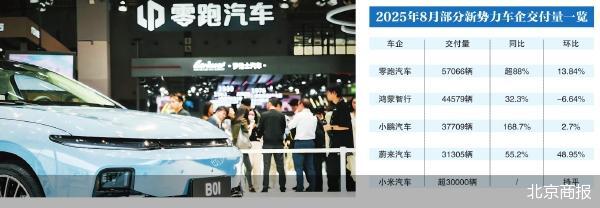
Core Viewpoint - The new energy vehicle market continues to thrive, with new force car manufacturers achieving impressive delivery numbers, although the industry remains unstable due to product homogeneity and the need for differentiation in order to boost sales [1][3][8]. Group 1: Delivery Performance - Leap Motor leads the new force car manufacturers with 57,100 new car deliveries in August, a year-on-year increase of over 88%, and a total of 328,900 deliveries in the first eight months, up 136.4% [3][4]. - Hongmeng Zhixing delivered 44,600 new cars in August, with a cumulative delivery surpassing 900,000, while Xiaopeng Motors delivered 37,700 new cars, marking a year-on-year growth of 168.7% [3][4]. - NIO reversed its sales stagnation with 31,300 new car deliveries in August, a year-on-year increase of 55.2%, while Li Auto's deliveries fell below 30,000 for the first time in three months, totaling 28,500 [4][5]. Group 2: Market Dynamics - The overall sales situation in August indicates that cost-effectiveness and technological capabilities are key drivers for the growth of new force car manufacturers [5][7]. - The new car effect was significant in August, with several new models like Leap B01 and Xiaopeng P7 receiving substantial market attention upon launch [5][6]. - The penetration rate of new energy passenger vehicles reached 56.7% in August, with retail sales of approximately 1.1 million units [7]. Group 3: Industry Challenges and Strategies - New force car manufacturers face challenges such as insufficient production capacity and tight cash flow, necessitating a shift towards flexible production and diversified product strategies [8]. - There is a noted issue of product homogeneity among new force car manufacturers, with a call for differentiation focusing on vehicle stability and safety as key competitive factors [8].


经纪、自营业务大增!42家上市券商哪家强?
Guo Ji Jin Rong Bao· 2025-09-02 14:39
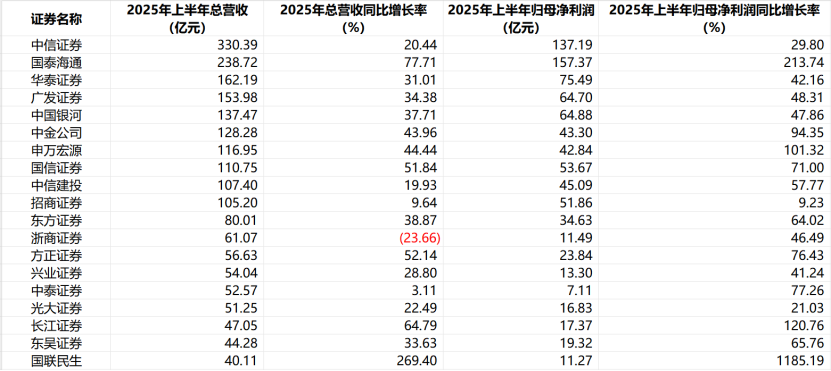
伴随上市公司半年报的披露, A 股 42 家上市券商 2025 年上半年的成绩单也正式出炉。 整体来看,42家上市券商的归母净利润均实现正增长。其中,经纪业务净收入同比增长44%,自营业务净收入同 比增长54%,这两项业务成为推动整体业绩增长的两大核心动力。 不过,在行业整体向好的大趋势下,浙商证券、中原证券、南京证券、西部证券、财通证券等券商的营收却出现 下滑,这一现象引发了市场的关注。 受访人士分析认为,券商在细分业务上的表现出现分化,根源在于券商的资源储备和核心能力存在差异。以自营 业务为例,头部券商和中小券商在投研能力上的差距,直接导致了两者在自营业务的盈利能力和风控能力上的分化。 中小券商若想扭转当前局面,必须打造自身的经营特色,与头部券商开展"不对称竞争"。 42家归母净利润增加 从具体指标来看,在42家上市券商中,有37家券商的营收实现同比增长,其中10家券商的营收突破100亿元大 关;而42家券商的归母净利润则全部实现同比增长,更有8家券商的归母净利润超过50亿元。 大中小券商业绩分化显著。头部券商中,中信证券、国泰海通、华泰证券表现突出,分别以330.39亿元、238.72 亿元、162.1 ...



透视顺丰同城(09699)半年报:“第三方+全场景”稀缺性加持,收入利润持续双高增
智通财经网· 2025-09-01 03:32
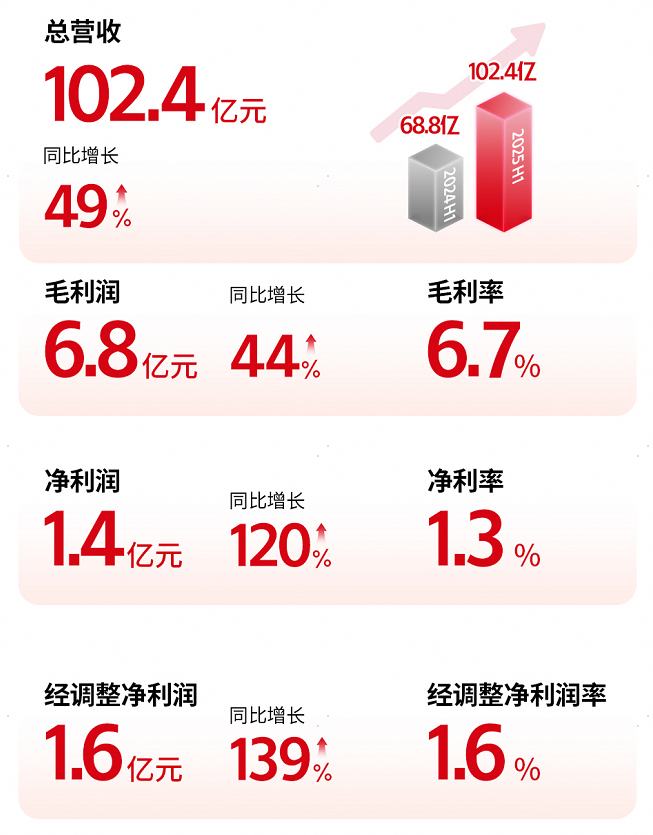
Core Viewpoint - SF Express City (顺丰同城) has demonstrated significant growth in the instant delivery industry, achieving a revenue of 10.24 billion yuan in the first half of 2025, representing a 49% year-on-year increase, and a net profit of 140 million yuan, up 120% year-on-year, indicating a strong performance amidst industry competition [1][4][12] Group 1: Financial Performance - The company reported a revenue of 10.24 billion yuan for the first half of 2025, with a year-on-year growth of 49% [1] - Net profit reached 140 million yuan, marking a 120% increase year-on-year, while adjusted net profit was 160 million yuan, up 139% [1] - The company has achieved continuous profitability for five consecutive periods since the first half of 2023, with net profit doubling [12] Group 2: Business Segments and Growth Drivers - The company’s revenue from merchant-oriented same-city delivery services was 4.467 billion yuan, a 55.4% increase year-on-year, while consumer-oriented same-city delivery revenue was 1.312 billion yuan, up 12.7% [4] - Last-mile delivery revenue surged to 4.457 billion yuan, reflecting a 56.9% year-on-year increase [4] - The number of active merchants on the platform grew by 55% year-on-year, reaching 850,000 [6] Group 3: Competitive Landscape - The instant delivery industry is experiencing significant differentiation, with competitors like Meituan and JD.com intensifying their efforts in the food delivery sector [3] - SF Express City has established long-term partnerships with major clients across various industries, enhancing its service capabilities [4] - The company has adapted to the multi-polarization of traffic trends, leveraging its independent third-party platform to improve order management and delivery efficiency [4] Group 4: Operational Efficiency and Technology - The company has implemented digital and AI-driven solutions across its operations, enhancing efficiency and optimizing logistics [10] - SF Express City has integrated a network of riders and autonomous delivery vehicles, with over 300 autonomous vehicles in operation, achieving an average of 20,000 trips per month [10] - The company’s focus on operational excellence and technology has led to a reduction in unit costs and an improvement in gross margins [12] Group 5: Market Recognition and Future Outlook - The stock price of SF Express City has seen a maximum increase of nearly 150% in the first half of 2025, reflecting market recognition of its growth potential [12] - The company’s comprehensive advantages in scale, cost, customer breadth, and risk resilience position it as a foundational player in the instant delivery sector [12]
射频前端的反内卷之路
半导体行业观察· 2025-08-29 00:44
Core Viewpoint - The current state of the RF front-end industry is characterized by a competitive environment that is both challenging and necessary for rational development, as companies face varying degrees of losses and must navigate through market pressures to avoid resource misallocation [1][2]. Competition Landscape - The ODM market and certain Cat1 markets are experiencing intense competition driven by low procurement standards, leading to a situation described as "blood flowing in the streets" [2]. - In contrast, the brand client market is orderly and conducive to rapid industry iteration, with major smartphone manufacturers selecting a limited number of domestic RF front-end suppliers based on comprehensive evaluations rather than just price [2][3]. Market Size and Growth Potential - The global consumer RF front-end market is approximately 1200 billion, with Apple and Google accounting for about half of this market [3]. - The domestic RF front-end market is currently under 200 billion, indicating significant growth potential, as it is expected to double in size [3][4]. Profitability and Business Strategy - A healthy profit margin for the RF front-end industry is estimated to be between 20% and 30%, as evidenced by the financial reports of leading companies like Zhaoshengwei and Weijie Chuangxin [2][3]. - Companies are advised to be cautious in their operational strategies, particularly regarding capacity expansion, to avoid oversupply and intensified competition [2][6]. Opportunities for Domestic Companies - Domestic RF front-end companies need to focus on high-end modules to maintain growth, as the mid-to-high-end module market is currently dominated by Qualcomm and Qorvo [5]. - There are significant opportunities in high-performance modules, Sub6G modules, and automotive-related RF front-ends, which require companies to enhance product development and differentiation [5][6]. Collaboration and Industry Health - Companies are encouraged to strengthen collaboration across the supply chain to avoid excessive capacity building and to ensure a healthy industry ecosystem [6]. - Smaller RF front-end companies should consider differentiated development strategies and manage cash flow effectively to avoid unnecessary losses [6].