
猪价走势

Search documents
农林牧渔行业点评报告:8月大猪持续出栏去化,后市猪价不悲观
KAIYUAN SECURITIES· 2025-09-16 09:14
Investment Rating - The industry investment rating is "Positive" (maintained) [1] Core Viewpoints - The report indicates that the pig price is expected to remain stable in the future despite a decline in August due to factors such as heavy weight slaughtering and the spread of African swine fever [3][13] - The average national pig sales price in August 2025 was 13.77 yuan/kg, down 5.35% month-on-month and down 32.35% year-on-year [3][13] - The report highlights that the supply of pigs may gradually tighten in the future due to a decrease in the proportion of large pigs in stock and an increase in the proportion of large pigs being slaughtered [4][17] Summary by Sections Industry Overview - In August 2025, the national pig slaughter volume was 4.3388 million heads, an increase of 4.34% month-on-month and 5.66% year-on-year [3][13] - The report notes that the completion rate of pig slaughtering plans was 100.04% in August, with a planned increase of 3.92% in September compared to actual slaughter in August [3][13] Market Dynamics - The structure of pig slaughtering shows an increase in the proportion of large pigs (over 150kg) being slaughtered, while the proportion of large pigs in stock has decreased [4][17] - The average profit for self-breeding and self-raising pigs in August was 36.80 yuan/head, a decrease of 63.80% month-on-month [5][20] Company Performance - A total of 12 listed pig farming companies reported a combined slaughter of 15.116 million heads in August, an increase of 29.79% year-on-year [6][23] - The average sales price of pigs for major listed companies decreased month-on-month, with specific companies reporting the following prices: - Muyuan Foods: 13.51 yuan/kg, down 5.5% - Wens Foodstuffs: 13.90 yuan/kg, down 6.5% - New Hope Liuhe: 13.54 yuan/kg, down 6.9% [7][28]




最低跌破13元/公斤,9月的猪价要危险?
Sou Hu Cai Jing· 2025-09-10 07:50
Core Viewpoint - The pork price is experiencing a downward trend, reaching new lows, with concerns about potentially falling below 13 yuan/kg. However, there is a belief that prices may stabilize by the end of September if the market can withstand the mid-month pressures [2]. Group 1: Supply Risks - The official target is to reduce the breeding pig capacity to below 39 million heads by the end of the year, while the breeding sow capacity was still at 40.42 million heads as of the end of July, indicating a tight timeline for adjustments [4]. - The concentration of the pig farming industry has increased significantly after previous capacity reductions, making the actions of leading companies more impactful on the market. Typically, there is a tightening of supply at the beginning and end of the month, with increased supply expected mid-month, leading to potential price declines [5]. - There is a risk of supply pressure due to the ongoing production capacity adjustments and the need to manage the market effectively [2]. Group 2: Demand Dynamics - Although there has been a slight improvement in pork consumption with the cooling weather, it is still far from the expected peak consumption season, indicating that demand has not significantly rebounded [6]. - The increase in supply from large enterprises, coupled with sluggish demand, poses a significant challenge for small and medium-sized farmers, potentially pushing some out of the market [6]. - The upcoming double festival at the end of the month is expected to provide a temporary boost to market consumption, which may influence market sentiment positively [6]. Group 3: Market Adjustments - The pace of reducing the weight of pigs for slaughter is slowing down, which means that the market supply of pork may decrease, alleviating some supply pressure [8]. - There has been a rise in secondary fattening practices, which, despite official controls, are expected to increase as the consumption season approaches, further tightening the supply pressure [9]. - With a reduction in supply and an anticipated increase in demand, there is a possibility for pork prices to stabilize or even see a slight increase, especially as the peak consumption season approaches in October [11].

开学效应褪去后猪价或止涨下滑
Xin Hua Cai Jing· 2025-09-04 06:33
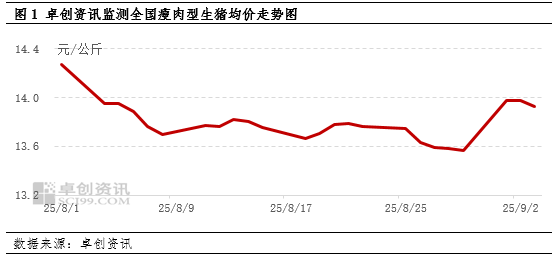
Group 1 - The core viewpoint is that pig prices experienced an increase in early September due to rising orders from slaughter enterprises driven by the start of the school year, alongside a reduction in pig supply from farms, leading to a supply-demand imbalance [1][3]. - In early September, the average price of lean pigs was 13.98 yuan per kilogram, which is an increase of 0.41 yuan per kilogram compared to August 29 [1]. - The demand side saw a continuous increase in pig consumption due to low pork prices in August, with slaughter enterprises ramping up orders as schools reopened [3]. Group 2 - On the supply side, the reduction in pig outflow in early September contributed to the price increase, with daily outflow recorded at 14.20 million heads, a decrease of 4.58 million heads compared to August 26 [5]. - Despite the short-term price increase, the supply is expected to rise in September, with a planned outflow increase of 4.19% from over 200 surveyed breeding enterprises [5]. - The market is anticipated to see a price decline in mid-September, but there may be potential for price increases towards the end of the month as some farms may choose to increase the weight of pigs being sold [5].
消费旺季、集团拉涨,猪价“破8”在即?附:9月3日猪价
Sou Hu Cai Jing· 2025-09-02 07:59
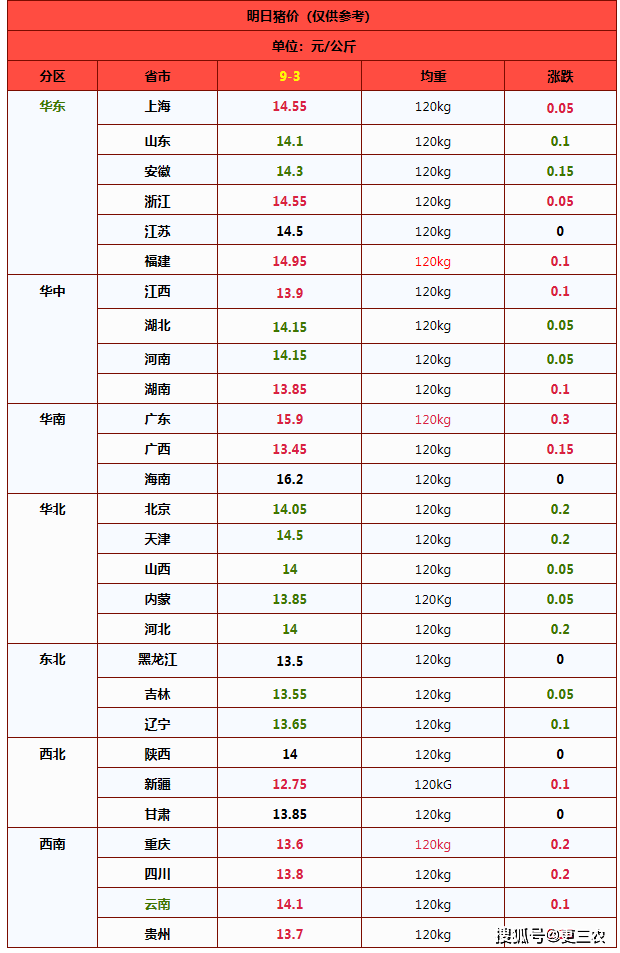
Core Viewpoint - The domestic pig market has experienced fluctuations in prices, with a recent upward trend due to seasonal demand and changes in supply dynamics, although potential pressures on prices remain [1] Price Trends - After hitting a low of 13.91 yuan/kg in June, pig prices rose to 15.4 yuan/kg in early July, but subsequently fell again due to supply pressures and weak demand [1] - By the end of August, pig prices dropped to a new low of 13.71 yuan/kg, but have since shown signs of recovery, with prices returning to the "7 yuan era" [1] Supply and Demand Dynamics - The increase in pig prices is supported by seasonal demand as schools reopen and restaurant purchases rise, leading to improved consumer demand for pork [1] - The slaughtering rate of sample enterprises reached approximately 31.5%, indicating a strong demand for pig sources [1] - However, there are concerns about oversupply as pig production capacity is expected to increase in September, which may counteract the recent price increases [1] Regional Price Variations - As of September 3, 2023, pig prices vary across regions, with Guangdong at 15.9 yuan/kg and Xinjiang at 12.75 yuan/kg, reflecting regional supply and demand conditions [2]
大越期货生猪期货早报-20250902
Da Yue Qi Huo· 2025-09-02 05:34
Report Industry Investment Rating - Not provided in the content Core Viewpoints - The supply and demand of the domestic pig market are expected to increase this week, and the pig price is expected to bottom out and rebound, maintaining a volatile pattern. The LH2511 contract of live pigs is expected to fluctuate in the range of 13,400 - 13,800 [10]. Summary by Relevant Catalogs 1. Daily Prompt - The fundamentals show that in September, as the Mid - Autumn Festival and National Day approach, the supply of pigs and pork is expected to increase this week. The demand is boosted by the return of students to school and the approaching long - holiday, and the consumption of fresh pork is expected to increase. Overall, the market may see a situation of increasing supply and demand, with pig prices bottoming out and rebounding to maintain a volatile pattern. The market should pay attention to the monthly slaughter rhythm of group farms and the dynamic changes in the secondary fattening market [10]. - The basis: The national average spot price is 13,880 yuan/ton, and the basis of the 2511 contract is 255 yuan/ton, with the spot price at a premium to the futures price [10]. - Inventory: As of June 30, the live pig inventory was 424.47 million heads, a month - on - month increase of 0.4% and a year - on - year increase of 2.2%. As of the end of June, the inventory of breeding sows was 40.42 million heads, a month - on - month increase of 0.02% and a year - on - year increase of 4.2% [10]. - The market trend: The price is below the 20 - day moving average and the direction is downward [10]. - Main positions: The main positions are net long, and the long positions are increasing [10]. - Expectation: The supply and demand of live pigs have recently begun to pick up. It is expected that the pig price will bottom out and rebound this week, maintaining a range - bound pattern. The LH2511 contract of live pigs is expected to fluctuate in the range of 13,400 - 13,800 [10]. 2. Recent News - China's additional tariffs on pork imports from the United States and Canada have boosted market confidence. Affected by the off - season, as the Mid - Autumn Festival and National Day approach, the slaughter of large pigs has increased, resulting in an increase in both supply and demand of live pigs. The spot price has returned to a volatile pattern in the short term, and the futures price has also shown a range - bound pattern [12]. - The recent high - temperature weather has led to a short - term decline in pork demand. Affected by the increase in supply, the spot price of live pigs has been fluctuating weakly. However, due to the gradual recovery of demand, the downward space may be limited [12]. - The domestic pig farming profit has remained at a low level, and the short - term profit has deteriorated. The enthusiasm for slaughtering large pigs has been relatively high in the short term. The increase in both supply and demand supports the short - term price expectations of live pig futures and spot [12]. - The spot price of live pigs may fluctuate strongly before the National Day, and the futures price will generally return to a range - bound pattern in the short term. Further observation of the growth of supply and demand is needed in the future [12]. 3. Bullish and Bearish Factors - Bullish factors: The domestic pig consumption has entered the peak season before the long - holiday, and the room for further decline in the domestic live pig spot price may be limited [13]. - Bearish factors: The domestic macro - environment has a pessimistic expectation due to the Sino - US tariff war, and the domestic live pig inventory has increased year - on - year [13]. - Current main logic: The market focuses on the slaughter situation of live pigs and the demand for fresh meat [13]. 4. Fundamental Data - The report provides data on live pig futures, warehouse receipts, and spot prices from August 22 to September 1, including the prices of the main 2511 contract, far - month 2601 contract, and some regional spot prices [14]. - It also presents various charts related to the fundamentals of live pigs, such as the basis and spread trends of live pig futures, the average prices of different specifications of live pigs in the spot market, and indicators on the supply side (including pig prices, piglet indicators, inventory at different levels, pork imports, fattening costs, etc.), the slaughter side (including prices, profits, etc.), and the demand side (including consumption trends, etc.) [15][17][23]. 5. Position Data - Not provided in the content
猪价“跌跌不休”,养猪人为何还能赚钱?
Sou Hu Cai Jing· 2025-08-28 11:31
Core Viewpoint - The recent decline in pig prices has been observed, with live pig and pork prices dropping for six consecutive weeks, while piglet prices have decreased for 15 weeks. Despite this, pig farming has remained profitable due to lower breeding costs [1][6]. Price Trends - From January to August, live pig prices shifted from an upward trend to a downward trend, with a significant year-on-year decline of 31.4% by the second week of August, reaching 14.35 yuan/kg [1][2]. - Pork prices also experienced a decline, falling to 24.93 yuan/kg by the third week of August, reflecting a year-on-year decrease of 22% [2]. - Piglet prices rose from 32.77 yuan/kg to 39.57 yuan/kg from January to April, but have since dropped to 33.25 yuan/kg by August, marking a year-on-year decline of 25.4% [2]. Supply and Demand Analysis - The recent drop in pig prices is attributed to a normal correction following a temporary price surge in June, driven by seasonal demand and reduced slaughter volumes [3]. - The supply of live pigs has increased, with a 14.5% year-on-year rise in slaughter volumes from January to June [3]. - Despite some recovery in pork consumption due to seasonal factors, overall demand remains weak, limiting support for pig prices [5]. Cost and Profitability - Breeding costs have decreased, allowing pig farming to remain profitable for 15 consecutive months, although profit margins are expected to narrow starting from the fourth quarter of 2024 [6][7]. - The average profit per head of live pig from January to July was approximately 110 yuan, dropping below 100 yuan in July [7]. Future Outlook - The supply of live pigs is expected to continue growing into the third quarter and early next year, with a potential seasonal increase in demand starting in September [8]. - The government plans to initiate a new round of frozen pork storage by the end of August, which may boost market confidence [8]. - The pig farming industry is anticipated to maintain profitability, but farmers are advised to manage production capacity and risks effectively [8].
中国银河证券:宠物食品出口量恢复增长 重点关注猪企产能变化节奏
智通财经网· 2025-08-26 01:56
Core Viewpoint - The report from China Galaxy Securities indicates that the pig prices in 2025 may show a downward trend year-on-year, while remaining relatively stable throughout the year. The pet food industry is in a growth phase, with leading domestic companies expected to maintain rapid growth due to increasing acceptance of domestic brands by pet owners [1][5]. Group 1: Pig Farming Industry - In July, the Consumer Price Index (CPI) remained flat year-on-year, with a 16% decrease in the cumulative trade deficit for agricultural products [1]. - The pig price fluctuated downwards in August, reaching a high of 21.06 yuan/kg in mid-August before falling to 14.25 yuan/kg by August 13, a 12% decrease compared to the end of 2024 [3]. - The number of breeding sows in China was 40.43 million at the end of Q2, with a slight increase of 0.1% [3]. - The report emphasizes the importance of monitoring cost changes and the financial health of quality pig farming companies, recommending companies such as Wens Foodstuff Group, Muyuan Foods, and others [5]. Group 2: Pet Food Industry - The export volume of pet food in July showed a recovery, with a year-on-year increase of 11.67%, although the export value decreased by 3.08% [4]. - The pet food market in China has a low concentration, but leading domestic companies are expected to grow rapidly as acceptance of domestic brands increases [4][5]. - Recommendations for the pet food sector include Zhongchong Co., Guibao Pet, and Petty Holdings, with a focus on companies that are likely to benefit from the growing market [5]. Group 3: Agricultural Index Performance - The agricultural index underperformed compared to the CSI 300 index from early August to August 22, with the agricultural index rising by 6.02% while the CSI 300 increased by 7.42% [2]. - Among sub-sectors, agricultural product processing and animal health showed relatively strong performance, while fisheries and planting sectors lagged behind [2].

大越期货生猪期货早报-20250822
Da Yue Qi Huo· 2025-08-22 03:44
Report Industry Investment Rating - Not provided in the content Core Viewpoints - In August, as China approaches the Mid - Autumn Festival and National Day holiday season, the supply of pigs and pork is expected to increase. However, the domestic macro - environment is pessimistically expected, and high - temperature weather suppresses short - term fresh pork consumption. Although China's additional tariffs on pork imports from the US and Canada boost market confidence, the market is likely to see both supply and demand increase this week, with pig prices maintaining a short - term oscillatory pattern. The LH2511 contract of live pigs is expected to oscillate in the range of 13,600 - 14,000 [8]. Summary by Directory 1. Daily Prompt - Not provided in the content 2. Recent News - China's additional tariffs on pork imports from the US and Canada boost market confidence. After the May Day holiday, the domestic pig consumption market enters the off - season, with a decrease in both supply and demand. Spot prices are short - term oscillatory and weak, and the futures market follows a similar pattern. Although the spot price is weak, the decline may be limited due to reduced slaughter. Low pig - raising profits and relatively good large - pig slaughter enthusiasm also suppress short - term price expectations. The stabilization of the market depends on future supply reduction and demand recovery [10]. 3. Bullish and Bearish Factors - **Likely to be Bullish**: Domestic pig inventory has declined year - on - year, and the further decline of domestic pig spot prices may be limited [11]. - **Likely to be Bearish**: The domestic macro - environment has a pessimistic outlook due to the Sino - US tariff war, and pig and pork consumption enters the off - season after May Day [11]. - **Main Logic**: The market focuses on pig slaughter and fresh meat demand [11]. 4. Fundamental Data - **Supply and Demand**: In August, supply and demand are expected to increase. The market may see both pig and meat supply increase. High - temperature weather and a pessimistic macro - environment suppress short - term demand, but tariff policies boost market confidence [8]. - **Inventory**: As of June 30, the pig inventory was 424.47 million heads, a 0.4% month - on - month increase and a 2.2% year - on - year increase. As of the end of June, the breeding sow inventory was 40.42 million heads, a 0.02% month - on - month increase and a 4.2% year - on - year increase [8]. - **Price**: The national average spot price is 13,700 yuan/ton, and the basis of the 2511 contract is - 65 yuan/ton, indicating that the spot price is at a discount to the futures price. The price is below the 20 - day moving average and trending downward [8]. 5. Position Data - The net long position of the main contract is decreasing [8].
卓创资讯:8月湘赣生猪价震荡下行月底或迎反弹
Xin Lang Cai Jing· 2025-08-19 03:12
Core Viewpoint - In August, the pig prices in Hunan and Jiangxi provinces showed a downward trend, with a slight narrowing of the decline in Jiangxi by mid-month. The market was characterized by oversupply due to reduced weight from the breeding sector and seasonal consumption decline, leading to falling prices [1][1]. Price Trends - As of August 18, the average trading price of live pigs in Hunan was 13.54 yuan per kilogram, reflecting a decline since the beginning of the month [1][1]. - The average trading weight of live pigs in Hunan was recorded at 124.55 kilograms, a decrease of 0.77% compared to the previous month [1][1]. Supply and Demand Analysis - The breeding sector in both provinces continued to reduce weights, contributing to an oversupply situation in the market, which pressured prices downward [1][1]. - In August, the outflow plans from 16 sample breeding enterprises in Hunan increased by 9.74% month-on-month, while 12 sample enterprises in Jiangxi saw a 3.83% increase [1][1]. Future Outlook - Towards the end of August, there may be a rebound in pig prices due to increased demand from schools preparing for the new academic year, which typically leads to higher procurement volumes [1][1]. - Despite the ongoing supply pressure, the current low price levels suggest that the extent of price declines may be limited, with potential support from seasonal demand factors [1][1].


大越期货生猪期货早报-20250818
Da Yue Qi Huo· 2025-08-18 02:44
1. Report Industry Investment Rating - Not provided in the given content 2. Core Viewpoints of the Report - The supply of pigs and pork is expected to increase this week, and the market may experience a situation of both supply and demand increasing. The pig price is expected to maintain a short - term oscillating pattern. The LH2511 contract of live pigs is expected to oscillate in the range of 13,800 to 14,200 [8]. - The overall sentiment in the domestic macro - environment is pessimistic, and the high - temperature weather has dampened residents' enthusiasm for fresh pork consumption. However, the additional tariffs imposed on pork imports from the US and Canada have boosted market confidence [8]. 3. Summary According to the Table of Contents 3.1 Daily Tips - Not provided in the given content 3.2 Recent News - China's additional tariffs on pork imports from the US and Canada have boosted market confidence. After the May Day holiday, the domestic pig consumption market entered a slack season, with both supply and demand of pigs decreasing. The spot price of live pigs oscillated weakly in the short term, and the futures market followed a similar pattern [10]. - After the May Day holiday, the demand for pork decreased in the short term. Affected by the decrease in both supply and demand, the spot price of live pigs oscillated weakly, but the decline may be limited due to the reduction in slaughter [10]. - The profit of domestic pig farming remains at a relatively low level, but there is still a short - term profit. The enthusiasm for slaughtering large pigs is relatively high in the short term. The decrease in both supply and demand has suppressed the short - term price expectations of live pig futures and spot markets [10]. - The spot price of live pigs may oscillate weakly after the May Day holiday, and the futures market will generally maintain a weakly oscillating pattern in the short term. When the market stabilizes depends on the future reduction in supply and increase in demand [10]. 3.3 Bullish and Bearish Factors - **Bullish factors**: The year - on - year decline in domestic pig inventory and the limited potential for further decline in domestic live pig spot prices [11]. - **Bearish factors**: The pessimistic expectations in the domestic macro - environment due to the China - US tariff war and the entry of the pig and pork consumption market into a slack season after May Day [11]. - **Main logic**: The market focuses on the slaughter situation of live pigs and the demand for fresh meat [11]. 3.4 Fundamental Data - **Supply and demand**: In August, as the peak season for supply and demand before the Mid - Autumn Festival and National Day approaches, the enthusiasm for domestic slaughter has increased. The short - term bottom - out and rebound of the pig price is followed by an oscillating pattern. It is expected that the supply of pigs and pork will increase this week. On the demand side, the pessimistic domestic macro - environment and high - temperature weather have dampened residents' consumption enthusiasm, suppressing short - term fresh pork consumption [8]. - **Basis**: The national average spot price is 13,700 yuan/ton, and the basis of the 2511 contract is - 245 yuan/ton, indicating that the spot price is at a discount to the futures price [8]. - **Inventory**: As of June 30, the pig inventory was 424.47 million heads, a month - on - month increase of 0.4% and a year - on - year increase of 2.2%. As of the end of June, the inventory of breeding sows was 40.42 million heads, a month - on - month increase of 0.02% and a year - on - year increase of 4.2% [8]. - **Market trend**: The price is below the 20 - day moving average and moving downward [8]. - **Main positions**: The net position of the main players is short, and the short positions are decreasing [8]. 3.5 Position Data - The net position of the main players is short, and the short positions are decreasing [8]