Scaling Law

Search documents
AI巨头们的万亿美元债务去哪了?
Tai Mei Ti A P P· 2025-11-24 04:42
Core Insights - Meta plans to invest $60 billion in AI despite reporting a net profit of $37 billion in the first three quarters of 2025, highlighting the financial challenges faced by tech giants in the AI arms race [1][2] Financing Challenges - The need for massive funding for AI infrastructure, including expensive AI chips and data centers, poses a dilemma for tech giants on how to secure funds without negatively impacting their financial statements [2][3] - Morgan Stanley estimates that "invisible debt" could reach $800 billion by 2028, representing significant liabilities that do not appear on the balance sheets of these companies [2] SPV Financing Method - The Special Purpose Vehicle (SPV) financing method allows tech giants to isolate debt and optimize their financial reports by transferring the debt to a separate entity [3][4] - This method involves creating an SPV to borrow money using the parent company's credit, allowing the SPV to purchase assets and lease them back to the parent company, thus keeping the debt off the parent company's balance sheet [4] Examples of SPV Utilization - Meta successfully utilized this SPV method to increase its debt by $30 billion on its balance sheet while leveraging it to acquire $60 billion in computing assets [4] - Google has adopted a similar strategy by providing credit guarantees to weaker companies, allowing them to secure loans for data center assets, which are then leased back to Google [5] Circular Financing - The concept of circular financing allows companies to create a closed loop of capital flow among related parties, enhancing financial efficiency [7] - For instance, xAI established an SPV to raise $20 billion for purchasing NVIDIA chips, with minimal direct debt risk, showcasing the flexibility of this financing model [7] Industry Dynamics - Major tech companies are forming strategic alliances to create a tightly-knit capital community, which can amplify their financial capabilities and market influence [9][10] - Recent collaborations among giants like OpenAI, NVIDIA, and Oracle have resulted in over $1 trillion in infrastructure and chip agreements, indicating a trend towards deeper integration in the AI sector [9] Scaling Law and Market Sentiment - The pursuit of Scaling Law drives exponential growth in computing demand, benefiting companies like NVIDIA, which has seen significant revenue increases [15] - However, industry leaders express caution regarding potential irrational exuberance in AI investments, with warnings about the risks of a bubble [15][16] Capital Market Movements - Notable investors are shifting their strategies, with significant sell-offs in NVIDIA stock while simultaneously investing in AI applications and models, indicating a transition in focus from hardware to software [16][17] - This shift suggests that while financing challenges may be temporarily addressed, the competition in the AI landscape is just beginning, with a more intense focus on applications and models ahead [17]


拆解Gemini 3:Scaling Law的极致执行与“全模态”的威力
3 6 Ke· 2025-11-24 03:55
Core Insights - Google’s Gemini 3 has transformed the AI landscape in Silicon Valley, positioning the company as a leader rather than a follower in the AI race against OpenAI and Anthropic [1][3] - Gemini 3 is recognized for its significant advancements in multimodal capabilities and is seen as a prime example of executing Scaling Law effectively [1][3] Performance Evaluation - Within 48 hours of its release, Gemini 3 topped various performance rankings, showcasing its true multimodal native model capabilities [4][6] - Users reported that Gemini 3 provides a more integrated development experience, particularly with tools like Google AntiGravity, which enhances coding efficiency by allowing simultaneous visual and coding tasks [6][7] Technical Innovations - The model achieved a notable improvement in Few-shot Learning, reaching over 30% on the ARC-AGI-2 Benchmark, indicating a qualitative leap in its reasoning capabilities [10][11] - Gemini 3 employs a tree-based thought process and self-rewarding mechanisms, allowing it to explore multiple reasoning paths simultaneously [19][20] Developer Ecosystem - The release of Gemini 3 and AntiGravity has led to discussions about the end of the coding competition, as Google’s ecosystem may create significant barriers for startups like Cursor [22][23] - Despite the strong capabilities of AntiGravity, it still faces challenges in backend deployment and complex system architecture, suggesting that independent developers may still find opportunities in niche areas [25][26] Future Trends in AI - The focus is shifting towards new AI paradigms beyond LLMs, with emerging labs like NeoLab attracting significant venture capital [27][28] - There is a growing interest in developing world models that understand physical laws, indicating a potential shift in AI research directions [31][32] Conclusion - The launch of Gemini 3 serves as a robust counter to the "AI bubble" narrative, demonstrating that with sufficient computational power and engineering optimization, Scaling Law remains a viable path for AI advancement [32][33]



活动报名:AI 的机会与泡沫|42章经
42章经· 2025-11-23 13:01
Group 1 - The core viewpoint of the article discusses the current state of the AI market, highlighting that the growth from 2023 to 2024 relies on the scaling law and the consensus around AGI, while there is no unified judgment on RL scaling law since 2025 [5] - AI models are developing in a stepwise manner, while applications are experiencing pulsed advancements, indicating a subtle blank period currently [5] - There is uncertainty regarding the continued enhancement of intelligence, but the acceleration of application deployment is assured [5] Group 2 - The narrative logic is changing, suggesting that while prices that rose previously may have bubbles, the intrinsic value of AI remains intact [5] - Several unresolved questions about the future development of AI, including whether to buy or short Nvidia, the opportunities in multimodal applications, and the feasibility of embodied production and deployment, are raised [5] - An online discussion meeting is scheduled for November 29, aiming to engage in these topics with interested participants [5]

【兴证计算机】AI应用:谷歌王者归来,商业奇点临近
兴业计算机团队· 2025-11-23 09:19
Core Viewpoint - The market is experiencing a decline in risk appetite, suggesting that investors should increase positions in certain directions and leading stocks during this period of volatility [1] Group 1: Market Analysis - The current market environment indicates a preference for stocks with cross-year certainty, focusing on valuation, earnings growth, and industry prosperity changes as core considerations [1] - The overall allocation in the computer sector is currently low, presenting a comparative advantage for positioning ahead of the spring rally [1] Group 2: AI Application Insights - Google's recent releases of Gemini3 and Nano Banana Pro have demonstrated significant performance improvements, reaffirming the effectiveness of Scaling Law and indicating sustained high demand in the AI sector [2] - The launch of xAI's Grok4.1 model and the public testing of Qianwen APP by Ant Group highlight ongoing advancements in AI capabilities, suggesting that the industry may be approaching a commercial singularity [2]

Generalist发现具身智能的Scaling Law,还让模型能同时思考与行动
3 6 Ke· 2025-11-21 01:52
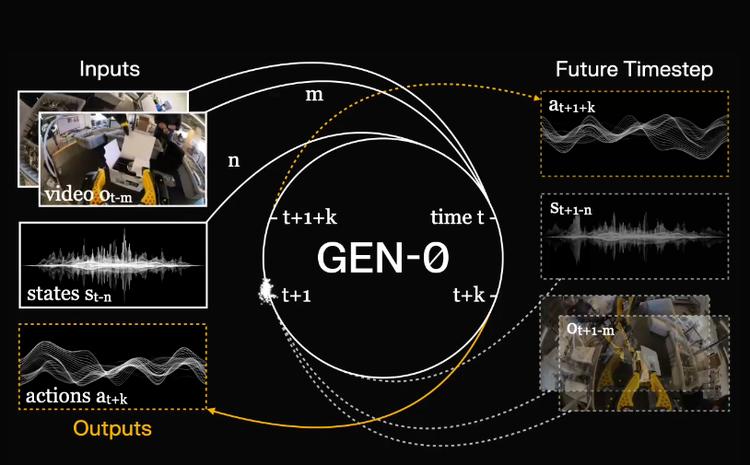
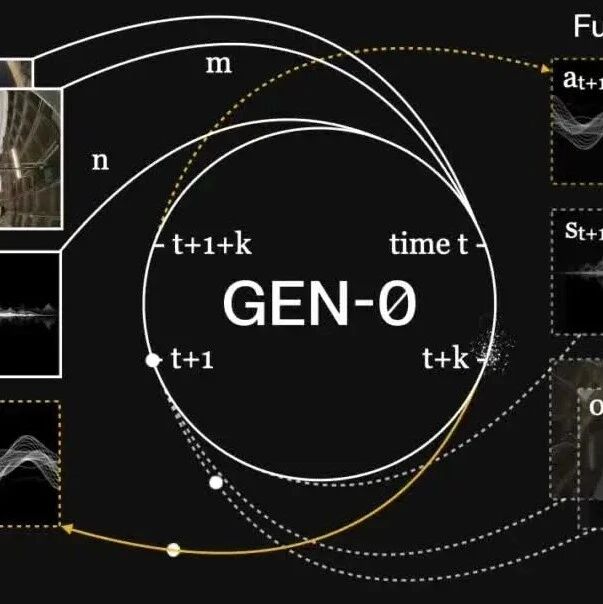
Core Insights - Generalist, a company founded by Pete Florence, has released a new embodied foundation model called GEN-0, which can scale predictably with the growth of physical interaction data [1][4] - The company aims to create universal robots, focusing initially on the dexterity of robots [4][5] Company Overview - Generalist was co-founded by Pete Florence, Andrew Barry, and Andy Zeng, with a team that includes experts from OpenAI, Waymo, and Boston Dynamics [4] - Early investors include Spark Capital, NVIDIA, and Bezos Expeditions, although the investment amounts remain undisclosed [3] Model Features - GEN-0 is based on high-fidelity raw physical interaction data and employs a multi-modal training approach [5] - A key feature of GEN-0 is "Harmonic Reasoning," allowing the model to think and act simultaneously, which is crucial for real-world applications [6][7] Scaling and Performance - The model exhibits a "phase transition" point in its intelligence capacity, indicating that larger models are necessary to absorb complex sensory-motor data [8][10] - Models with 1 billion parameters struggle to absorb diverse data, while those with 6 billion parameters show strong multi-task capabilities [10][11] - Models with over 7 billion parameters can internalize large-scale pre-training data and quickly adapt to downstream tasks [12] Scaling Law - GEN-0 demonstrates a clear Scaling Law, where increased pre-training data and computational resources lead to predictable improvements in downstream performance [15] - The company has developed a predictive formula to determine the optimal data allocation for specific tasks [15][16] Data Quality and Diversity - The training dataset for GEN-0 consists of 270,000 hours of real-world manipulation trajectories collected from diverse environments, significantly larger than existing datasets [16][18] - The quality and diversity of data are more critical than sheer volume, allowing for the creation of models with different characteristics [18] Industry Context - The field of embodied intelligence is still in its early stages, with various companies exploring foundational models [19] - Despite the presence of numerous top-tier companies, the technology landscape remains fragmented, and commercial applications are limited [19][20] Future Prospects - The advancements in Scaling Law and model capabilities suggest a promising future for the commercialization of embodied intelligence [20] - Chinese entrepreneurs have a competitive advantage in this field due to a mature hardware supply chain and rich data sources [21]
GEN-0 以及后续的 VLA 发展的看法
具身智能之心· 2025-11-21 00:04
Core Insights - The release of GEN-0 marks a significant advancement in the field of embodied intelligence, particularly in manipulation tasks, which have historically faced challenges due to data scarcity and the difficulty of generalization [1][2] - GEN-0 has leveraged a massive dataset of 270,000 hours, equivalent to approximately 31 years, and continues to collect data at a rate of 10,000 hours per week, surpassing previous models like the Pi series in pre-training effectiveness [2][3] - Despite its advancements, GEN-0 has not achieved a "GPT moment" or true zero-shot capabilities, indicating ongoing challenges in the field [2][3] Data Collection and Utilization - The data collection strategy for GEN-0 emphasizes the importance of data diversity and quality over sheer quantity, as evidenced by the scaling laws observed in the model's performance [10][13] - The emergence of UMI (Unified Multi-Instance) has posed challenges to traditional simulation methods, highlighting the need for real-world data collection to achieve high success rates in manipulation tasks [5][7] - The success rate of real-world data collection approaches 100%, while simulation methods face significant challenges, particularly in generating long-horizon data [8][9] Model Training and Performance - GEN-0's results suggest that larger models are necessary to effectively utilize vast amounts of data, as smaller models struggle to generalize under data overload conditions [11][12] - Pre-training in GEN-0 focuses on learning action space exploration rather than generalization, indicating a shift in how models are trained to handle diverse tasks [12] - The insights gained from GEN-0's pre-training process emphasize the need for a deeper understanding of data quality and diversity, which can significantly impact model performance [10][13] Future Directions - The findings from GEN-0 challenge existing paradigms in the field, suggesting that new engineering efforts and problem-solving approaches are required to advance embodied intelligence [15] - The industry is expected to see a shift towards larger model infrastructures and a focus on co-training methodologies to enhance model capabilities [11][14] - The ongoing development of data collection environments and pre-training methodologies will likely shape the future landscape of embodied intelligence research [15][16]
国泰海通:谷歌(GOOGL.US)Gemini 3实现断层式领先 大模型竞争格局加速重构
智通财经网· 2025-11-20 13:12
Core Insights - The release of Google's Gemini 3 marks a new leap in large model technology, showcasing significant advancements in reasoning, multimodal capabilities, and code generation, along with the introduction of generative UI and the Antigravity platform [1][2][3] Group 1: Model Performance - Gemini 3 demonstrates a substantial improvement in core reasoning abilities, achieving a score of 37.5% in Humanity's Last Exam, up from 21.6% in the previous version, and outperforming GPT-5.1 in the ARC-AGI-2 test with a score of 31.1% compared to 17.6% [1] - The model sets new records in multimodal understanding, excelling in complex scientific chart analysis and dynamic video comprehension, laying a solid foundation for practical AI agents [1] - In mathematical reasoning, Gemini 3 has advanced from basic calculations to solving complex modeling and logical deduction problems, providing a reliable technical basis for high-level applications in engineering and financial analysis [1] Group 2: Code Generation and Design - Gemini 3 exhibits revolutionary progress in code generation and front-end design, reversing Google's competitive stance in programming competitions and paving the way for large-scale commercial use [2] - The model leads in LiveCodeBench and ranks first in four categories, including website and game development, showcasing its ability to generate functional code and aesthetically intelligent designs that align with modern design standards [2] - The new sparse MoE architecture supports a context length of millions of tokens, demonstrating excellent performance in long document understanding and fact recall tests, despite API pricing being at the high end of the industry [2] Group 3: Agent Capabilities - Gemini 3 achieves a qualitative leap in agent capabilities, becoming the first foundational model to deeply integrate general agent abilities in consumer products, with a 30% improvement in tool usage compared to its predecessor [3] - The model excels in end-to-end task planning and execution in terminal environment tests and long-duration business simulations, transforming AI from a mere tool to an "active partner" through the new Antigravity development platform [3] - The breakthroughs validate the ongoing effectiveness of Scaling Law and accelerate the maturation of the AI application ecosystem, fundamentally changing the paradigm of AI application development [3]


国泰海通|计算机:谷歌Gemini 3实现断层式领先,大模型竞争格局加速重构
国泰海通证券研究· 2025-11-20 12:46
Core Insights - The launch of Google's Gemini 3 marks a significant leap in large model technology, showcasing breakthroughs in reasoning, multi-modal capabilities, and code generation, while introducing a generative UI and the Antigravity agent platform [1][2][3] Group 1: Model Performance - Gemini 3 demonstrates substantial advancements in reasoning abilities, achieving a score of 37.5% in Humanity's Last Exam, up from 21.6% with the previous model, and scoring 31.1% in the ARC-AGI-2 test, nearly doubling the performance of GPT-5.1 [1] - The model excels in multi-modal understanding, setting new records in complex scientific chart analysis and dynamic video comprehension, laying a solid foundation for practical AI agents [1] - In mathematical reasoning, Gemini 3 has improved from basic operations to solving complex modeling and logical deduction problems, providing a reliable technical basis for high-level applications in engineering and financial analysis [1] Group 2: Code Generation and Design - Gemini 3 shows revolutionary progress in code generation and front-end design, reversing Google's competitive stance in programming contests and paving the way for large-scale commercial applications [2] - The model leads in LiveCodeBench and ranks first in four categories of the Design Arena, demonstrating its ability to generate functional code and aesthetically intelligent user interfaces that align with modern design standards [2] - The new architecture of Gemini 3, featuring sparse MoE design, supports a context length of millions of tokens, excelling in long document comprehension and fact recall tests [2] Group 3: Agent Capabilities - Gemini 3 achieves a qualitative leap in agent capabilities, becoming the first foundational model to deeply integrate general agent abilities into consumer products [3] - The model's tool usage capability has improved by 30% compared to its predecessor, excelling in terminal environment tests and long-duration business simulations, enabling it to autonomously plan and execute complex end-to-end tasks [3] - The introduction of the Antigravity agent development platform allows developers to engage in task-oriented programming at a higher abstraction level, transforming AI from a mere tool to an "active partner" [3]

谷歌 Gemini 3 实现断层式领先,大模型竞争格局加速重构
GUOTAI HAITONG SECURITIES· 2025-11-20 05:48
Investment Rating - The report assigns an "Overweight" rating for the industry, indicating an expected performance that exceeds the CSI 300 Index by more than 15% [4][10]. Core Insights - The release of Google Gemini 3 marks a significant leap in large model technology, achieving substantial advancements in reasoning, multi-modal understanding, and code generation, which may reshape the competitive landscape of large models [2][5]. - Gemini 3 demonstrated remarkable improvements in core reasoning capabilities, scoring 37.5% in Humanity's Last Exam, up from 21.6% in the previous version, and achieving 31.1% in the ARC-AGI-2 test, nearly doubling the performance of GPT-5.1 [5]. - The model excels in multi-modal understanding, setting new records in complex scientific chart analysis and dynamic video comprehension, laying a solid foundation for practical AI agents [5]. - In mathematics reasoning, Gemini 3 has advanced from basic operations to solving complex modeling and logical deduction problems, providing a reliable technical basis for high-level applications in engineering and financial analysis [5]. - The model shows revolutionary progress in code generation and front-end design, leading in competitions and introducing a new paradigm of "generative UI" that automatically creates user interfaces based on modern design standards [5]. - Gemini 3's architecture, featuring sparse MoE design, supports a context length of millions of tokens, excelling in long document comprehension and factual recall tests, which is crucial for enterprise-level applications [5]. - The model's agent capabilities have significantly improved, with a 30% enhancement in tool usage, allowing for autonomous planning and execution of complex tasks, thus transforming AI from a supportive tool to an active partner in development [5]. Summary by Sections - **Investment Rating**: The industry is rated as "Overweight" [4]. - **Technological Advancements**: Gemini 3 achieves a leap in reasoning, multi-modal understanding, and code generation [2][5]. - **Performance Metrics**: Significant improvements in key performance metrics, including scores in critical tests [5]. - **Application Potential**: The model's advancements provide a strong foundation for high-level applications in various fields [5]. - **Architectural Innovations**: Introduction of a new architecture that enhances performance and efficiency [5]. - **Agent Capabilities**: Enhanced capabilities in autonomous task execution and planning [5].
OpenAI深夜双王炸,GPT-5.1 Pro紧急发布,降维打击Gemini 3
3 6 Ke· 2025-11-20 03:37
Core Insights - OpenAI has launched GPT-5.1 Pro and GPT-5.1-Codex-Max, enhancing emotional and intellectual capabilities in AI models [2][8] - The new models are designed for high-intensity development tasks, capable of working autonomously for over 24 hours and processing millions of tokens [5][23] - GPT-5.1-Codex-Max features a new compression mechanism, allowing it to handle longer contexts and complex tasks more efficiently [6][22] Group 1: Model Features - GPT-5.1 Pro emphasizes both emotional and intellectual strengths, pushing these advantages to a higher level [2] - GPT-5.1-Codex-Max is specifically trained for software, engineering, mathematics, and research tasks, resulting in improved performance and reduced token usage [4][10] - The model achieved a score of 77.9% on the SWE-bench Verified evaluation, outperforming previous models [12][13] Group 2: Performance and Efficiency - GPT-5.1-Codex-Max reduces token usage by approximately 30% during medium reasoning tasks, leading to lower operational costs for developers [14] - It can autonomously manage tasks over extended periods, maintaining coherence and efficiency through its compression mechanism [22][23] - The model has shown significant improvements in programming efficiency, with a reported 70% increase in Pull Request submissions among OpenAI engineers [25] Group 3: User Experience and Comparisons - Early testers of GPT-5.1 Pro have noted its superior clarity and insight compared to GPT-5.0, making complex topics more understandable [34] - While GPT-5.1 Pro excels in reasoning and deep thinking tasks, it is slower than competitors like Gemini 3, which may be more suitable for everyday tasks [35][40] - The interface limitations of GPT-5.1 Pro restrict its integration into IDEs and other toolchains, similar to its predecessor [40]