资产配置

Search documents
六大行,全面停售5年期大额存单
财联社· 2025-12-02 08:25
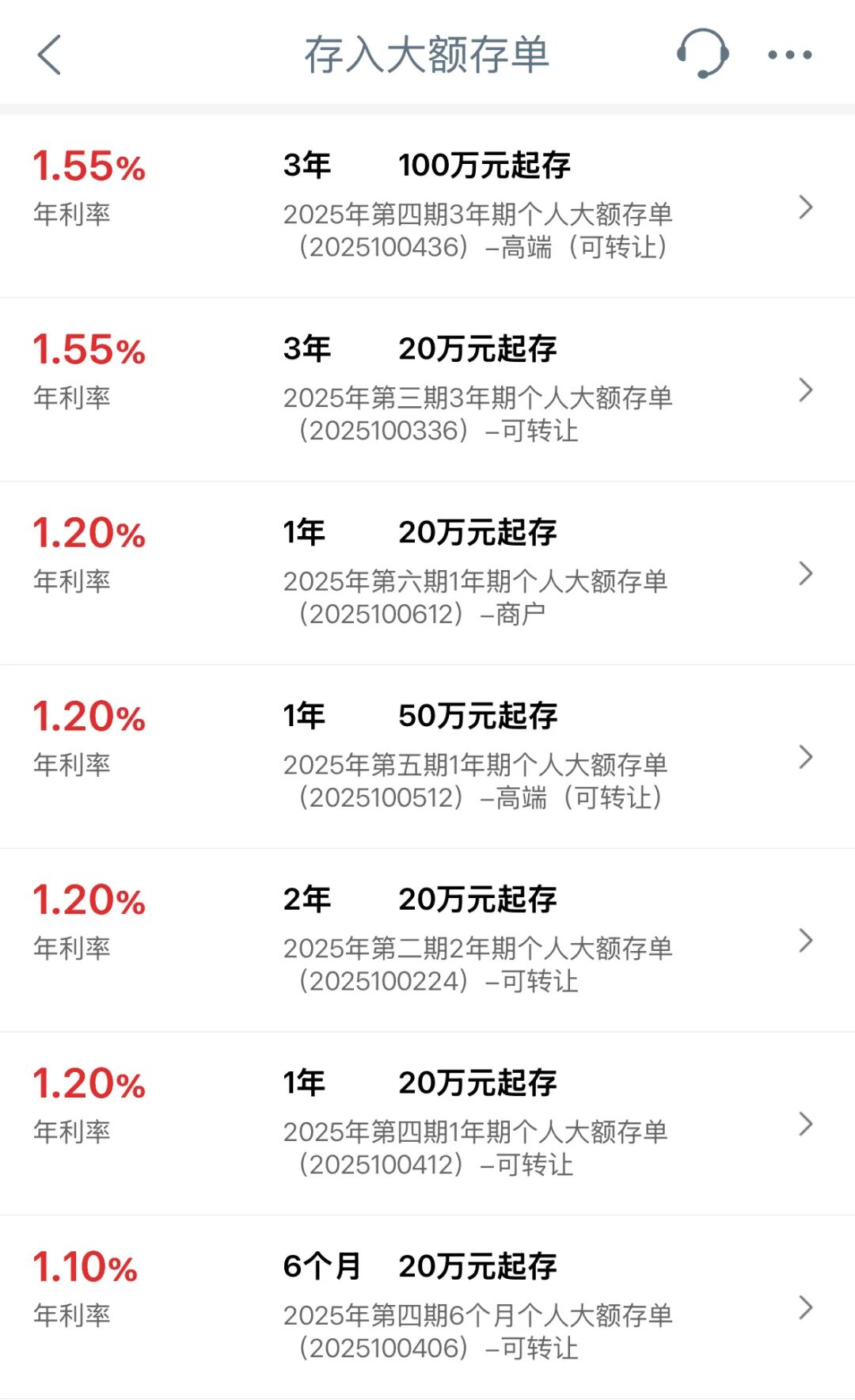
"我跑了两家大行网点,5年期大额存单都停售了,就连3年期的都得靠'抢',额度一出来很快就没了,关键利率还比去年降了不少。"家住北京市的王 女士告诉记者,她手中的50万元闲置资金本想配置长期大额存单以求稳健收益,如今却陷入了"无处可放"的困境。 王女士的遭遇并非个例。记者近期调研发现,工商银行、农业银行、中国银行、建设银行、交通银行、邮储银行六家国有大行已全面停售5年期大额 存单产品,部分股份制银行及城商行也紧随其后收缩长期存款业务。 六大行全面停售5年期大额存单 记者登录六大行官方APP及手机银行查询时发现,目前各银行大额存单期限结构已明显"短期化"。工商银行"大额存单"栏目下仅剩余1个月、3个月、 6个月、1年、2年、3年六个期限产品。其中,3年期大额存单产品利率为1.55%,1年期、2年期产品利率均为1.20%。 此外,中国银行、建设银行、交通银行及邮储银行的产品矩阵呈现相似特征,5年期产品均已从在售列表中移除。在农业银行2018年至2025年的人民 币个人大额存单产品目录中,也并未出现5年期大额存单产品的"踪影"。 回溯来看,5年期大额存单的退出并非突然之举。以中国银行为例,今年5月20日,中国银行曾在 ...





六大行全面停售5年期大额存单 储户该如何调整资产配置?
Jin Rong Shi Bao· 2025-12-02 08:23
Core Viewpoint - The major state-owned banks in China have completely stopped offering 5-year large denomination certificates of deposit (CDs), with a trend towards shorter-term products, reflecting a shift in the banking sector's approach to long-term deposits amid declining interest rates and changing depositor behavior [1][2][10]. Group 1: Bank Actions - Six major state-owned banks, including ICBC, ABC, BOC, CCB, BOCOM, and PSBC, have ceased offering 5-year large denomination CDs, with some also reducing the availability of 3-year products [1][2][6]. - The current offerings from these banks now primarily include shorter-term products, with the longest available being 3 years at a rate of 1.55% [2][6]. - The trend of discontinuing long-term deposit products is not limited to national banks; local commercial banks and private banks are also following suit, as seen with the announcements from banks in Inner Mongolia [10][11]. Group 2: Market Dynamics - The reduction in long-term deposit products is attributed to the downward trend in interest rates, leading banks to avoid higher costs associated with long-term deposits [10][11]. - There is a notable increase in deposit enthusiasm among residents, resulting in rapid growth in bank deposit scales, while credit demand remains weak, reducing banks' motivation to attract long-term deposits [10][11]. - Many banks are also lowering deposit rates, with some reductions reaching up to 65 basis points, indicating a broader strategy to optimize their liability structure under pressure from interest margins [10][11]. Group 3: Depositor Behavior - The withdrawal of long-term deposit products has created a dilemma for depositors, as many are uncertain about where to allocate their idle funds, with a significant portion of savers expressing a desire for more savings [11]. - A survey indicates that the proportion of depositors inclined towards saving more has decreased by 1.5 percentage points, suggesting a shift in asset allocation strategies among investors in a low-interest-rate environment [11]. - Financial experts recommend that investors adjust their expectations for returns and consider diversifying their asset allocation to include cash management products, money market funds, and government bonds [11].



十年国债ETF(511260)近20日净流入近6亿元,资金布局股市风险对冲器,2018-2024年每年正收益
Mei Ri Jing Ji Xin Wen· 2025-12-02 07:05
值得关注的是,十年国债ETF成立以来经历了2018-2024年共计7个完整自然年度,均保持每年正收益, 有望成为穿越牛熊周期的资产配置利器。 (文章来源:每日经济新闻) 相关机构表示,对债市的观点仍以震荡为主。央行重启国债买卖,为债市定下了收益率的顶部,整体波 动空间不大。在操作上建议顺势而为。从资产配置的角度,我们仍将债券视为股市风险的对冲器,投资 者可以关注作为债市压舱石的十年国债ETF(511260),进行股债均衡配置。 十年国债ETF(511260)跟踪上证10年期国债指数,选取剩余期限7到10年且在上交所挂牌的国债作为 样本,久期恒定。从过往表现来看,十年国债ETF(511260)成立以来净值屡创新高,历史业绩持续稳 健。根据基金定期报告,截止二季度末,近1年回报率达5.88%,近3年回报率达16.13%,近5年回报率 达22.41%,成立至今累计回报率达36.68%。 ...
打造买方投顾新模式!这家头部券商发力“企业家办公室”,构建“人-家-企-社”生态格局
Mei Ri Jing Ji Xin Wen· 2025-12-02 05:08
Core Insights - The changing interest rate environment in China is significantly impacting wealth management strategies, prompting a shift from single-asset investments to diversified and comprehensive asset allocation [1][3] - The decline in risk-free returns is driving investors to seek new asset allocation paths, indicating an upgrade in wealth management concepts [1][3] - The wealth management market in China has substantial room for growth, as property income remains significantly lower than in mature markets [3] Group 1: Market Trends - The structural change in the interest rate environment is reshaping the risk-return characteristics of investments, leading to a transformation in wealth management practices [3] - Investors are increasingly focusing on long-term returns and personalized needs, moving away from simplistic, product-driven wealth management models [3][4] Group 2: Company Strategy - Guotai Junan is leveraging its comprehensive financial advantages to develop a new wealth management model centered around the "Entrepreneur Office" concept [1][4] - The company aims to integrate six core capabilities: asset allocation, family inheritance, cross-border investment, green finance, comprehensive enterprise services, and non-financial ecosystem services [4][5][6][7][8][9] Group 3: Service Capabilities - The asset allocation capability focuses on in-depth research and dynamic management of investment portfolios to align with clients' risk-return objectives [4] - The family inheritance capability addresses the pain points and needs of entrepreneurial clients regarding generational wealth transfer [5] - The cross-border investment capability is evolving to meet the increasing demand for global asset allocation among clients [6] - The green finance service capability aims to enhance sustainable finance offerings in line with ESG themes [7] - The comprehensive enterprise service capability provides a range of services, including equity incentives and human resource cost optimization [8] - The non-financial ecosystem service capability fosters a platform for resource and knowledge sharing among entrepreneurs [9] Group 4: Industry Outlook - The wealth management industry is entering a new development phase centered on professional capabilities and service ecosystems, with Guotai Junan positioning itself as a co-creator of value in this transformative era [10]

人民币又升值了,这次离“破7”还远吗?
Sou Hu Cai Jing· 2025-12-02 03:53
Core Viewpoint - The recent strengthening of the RMB against the USD is driven by several factors, including seasonal demand for currency exchange from export enterprises, changing macroeconomic expectations, and the central bank's commitment to maintaining a stable exchange rate [1][3]. Group 1: Factors Influencing RMB Strength - Seasonal currency exchange needs from export companies are increasing the demand for RMB as they convert their earnings from USD [3]. - Market expectations regarding the narrowing of policy interest rate differentials between China and the US are alleviating pressure on the RMB [3]. - The central bank's clear stance on maintaining a stable exchange rate provides reassurance to the market [3]. - Recent improvements in the stock market and cross-border capital flows are also supporting the RMB [3]. Group 2: Future Outlook on RMB Exchange Rate - The likelihood of the RMB breaking the 7.0 mark against the USD in the short term is low, but there is increased volatility potential [3]. - External complexities and the inability of the USD to weaken indefinitely pose constraints on the RMB's appreciation [3]. - Regulatory focus is on exchange rate stability rather than specific levels, suggesting a more probable scenario of fluctuations within a certain range [3]. Group 3: Implications for Investors - A stable and appreciating RMB, supported by economic fundamentals, could enhance the attractiveness of core equity assets priced in RMB, drawing long-term investment into quality A-shares [4]. - Stability in the exchange rate may reduce currency risk for investors holding Chinese bonds, increasing their appeal for those seeking stable returns [4]. - For individuals with overseas consumption or study needs, a strategy of gradual and diversified currency exchange within a stable range is advisable to avoid overcommitting to a single exchange rate [4].

当“稳健”不再等于保本 大资管如何重建客户信任?
Jing Ji Guan Cha Bao· 2025-12-02 03:21
Core Insights - The Chinese asset management industry is undergoing a significant transformation from "guaranteed returns" to "net value rationality" in the context of low interest rates and high market volatility [1][8] - The focus is shifting towards multi-asset and multi-strategy allocation paths to meet the changing wealth management needs of residents [1][3] Group 1: Industry Trends - The low interest rate environment is compressing traditional fixed-income asset yields, prompting a shift from "everything + fixed income" to "fixed income + everything" in asset allocation logic [1][3] - The wealth structure of Chinese residents is changing, with a decrease in the proportion of fixed deposits and an increase in demand for asset management products [3][4] - The collaboration between public funds and bank wealth management is increasing, leveraging the strengths of both sectors to enhance investment strategies [4][5] Group 2: Client-Centric Strategies - The essence of "stability" is subjective and should bridge the gap between professional logic and client perception through product transformation and clear communication [2][6] - The ultimate goal of asset management is not just numerical returns but ensuring clients' "sense of gain" through understanding product logic and managing expectations [6][8] - Financial institutions must focus on providing suitable products for different risk profiles, ensuring that clients can understand and manage their investments effectively [3][7] Group 3: Risk Management and Strategy - Financial institutions are prioritizing risk control and the achievement of certain returns within limited timeframes, especially in a low-yield, high-volatility market [3][7] - The integration of various strategies and the ability to assess their effectiveness is crucial for wealth management firms to meet client needs [4][5] - A comprehensive approach that includes strategy selection, language simplification, and ongoing client support will enhance market recognition and client loyalty [7][8]
高盛重磅预测:美股“躺赢”时代结束了?未来十年回报率恐腰斩!
Jin Rong Jie· 2025-12-02 00:12
Core Insights - Goldman Sachs released a report titled "2025-2035 Global Stock Market Decadal Outlook," emphasizing a shift from the previous decade's "U.S. stock dominance" trend and providing a warning on future asset pricing [1] Group 1: U.S. Market Outlook - The S&P 500 index achieved an annualized return of 15% over the past decade, a rare "long bull" period, but a regression to the mean is expected [2] - Goldman Sachs predicts the annualized nominal total return for the S&P 500 will decline to 6.5% over the next decade, indicating a need for investors to lower their expectations for U.S. equity beta returns [2] Group 2: Return Attribution Analysis - The expected return is broken down into three core variables: - Earnings growth is projected to contribute positively with a compound annual growth rate of approximately 6% [3] - Dividend contributions are expected to be around 1.4% [4] - Valuation adjustments are anticipated to be the largest variable, with a forecasted annual negative impact of about 1% on total returns due to a gradual contraction in the forward P/E ratio, currently at approximately 23 times [4] Group 3: Global Market Opportunities - As U.S. market returns are expected to decline, relative value in global assets is becoming apparent, with a forecasted annual return of approximately 7.7% for global equities (MSCI ACWI), surpassing U.S. equities [5] - Non-U.S. markets, both developed and emerging, are expected to outperform U.S. stocks due to structural advantages and more attractive valuations [5] Group 4: Emerging Markets and Asia - Emerging markets are projected to have the highest expected returns, driven by an average earnings growth of 9% and lower valuation starting points [6] - Total annualized returns for emerging markets are estimated at 10.9%, with Asia (excluding Japan) at 10.3% [7] - Specific high-growth segments include India leading with a 13% expected return, followed by China at 10.4%, and Korea/Taiwan at 10% [8] Group 5: Developed Markets - Developed markets like Europe and Japan are also expected to outperform U.S. stocks due to structural advantages [9] - Japan's annualized return is projected at 8.2%, driven by ongoing corporate governance reforms and shareholder return enhancements [10] - Europe is expected to have an annualized return of 7.5% in USD terms, supported by high dividends and share buybacks, with 60% of European companies' revenues coming from outside Europe [10] Group 6: Currency Factors - If the U.S. dollar enters a long-term depreciation phase, non-U.S. assets could benefit from additional currency gains, with an estimated annual contribution ranging from 0.6% to 3.5% [11] Conclusion - The report serves as a correction to expectations rather than a bearish outlook on U.S. stocks, suggesting a shift from a concentrated U.S. equity strategy to a more balanced global allocation [12] - It emphasizes the importance of maintaining focus on U.S. earnings resilience while increasing exposure to emerging markets and non-U.S. developed markets to capture valuation recovery and currency fluctuations [12]
资产组合如何攻守兼备?买这种债基或许就够了!
Sou Hu Cai Jing· 2025-12-01 20:07
刚刚过去的11月,全球资本市场都有一定波动。 一般我们买的纯债基金,投资标的可能包括各种利率债、信用债,但禁止投资权益类资产。 上证指数月K线"六连阳"后,11月下跌1.67%;美股纳斯达克指数也在月K线"七连阳"后,跌了1.15%。 每当这时候,资产配置的重要性就体现出来了。 因为大家投资的诉求,不外乎是在提高收益的同时降低波动风险。而像11月这种行情,如果你的资产全部在权益市场,可能会跟着市场一起回调。 但如果你配置了一些债券产品,情况估计会好很多。 当然,要做这种资产配置,并不需要"分头买",买那些既有股又有债的二级债基就是不错的选择。比如招商基金旗下即将发行的招商安琪债券型投资基金 (A类026161,C类026162)。 01 一只基金,买债又买股 二级债基是一种资产配置以债券为主、权益为辅的中低风险债券基金。 这类产品之所以被叫做二级债基,也是因为它能够直接在二级市场投资股票。 区别于纯债基金,二级债基通常在合同中明确约定,债券配置要大于80%,同时可以配置不超过20%的股票等其他非债券资产。 也就是说,买了一只这样的产品,你就等于以一定的比例,同时投资了债券和股票市场。 这样的产品,最直接的优势 ...
保险和券商:长线资金青睐商业不动产REITs
Zheng Quan Shi Bao· 2025-12-01 18:14
Core Insights - The recent pilot program for commercial real estate REITs represents an expansion beyond infrastructure REITs, drawing on experiences from developed economies like the US and Japan, and is timely given the large scale of China's real estate market [1][2] Group 1: Market Context - Commercial real estate REITs are considered important underlying assets, with China's real estate sector needing to explore new development models [1] - The REITs concept originated in the US in 1960, aimed at stabilizing the housing market by combining real estate and stock investments, requiring funds to invest at least 75% in real estate and distribute 90% of income as dividends [1] - China's REITs market has five years of practical experience, initially focusing on infrastructure, and has now expanded to include commercial real estate assets such as shopping centers, retail, office buildings, and hotels [1] Group 2: Performance and Investor Structure - Public REITs have shown strong valuation performance, with the CSI REITs total return index increasing by 10% in 2023 and 22.46% since the beginning of 2024, despite a downturn earlier in 2023 [2] - The main investors in public REITs are brokerages and insurance companies, followed by individual investors and bank wealth management products [2] - In 2024, insurance institutions have a higher investment share in logistics and park REITs compared to brokerages, while brokerages dominate in sectors like ecological protection, transportation, energy, and consumption [2] Group 3: Investment Preferences - Insurance companies prefer public REITs due to their long-term capital allocation needs, especially in the context of declining bond yields [3] - Insurance firms typically favor ownership-type REITs due to their familiarity and experience with real estate investment decisions, while they lean towards high-speed and renewable energy projects in usage-type assets [3] - Public REITs possess both stable dividend characteristics akin to bonds and equity-like attributes influenced by market expectations, necessitating careful assessment of the underlying assets [3]
2025年ETF与衍生品策略研讨会在上海成功举办
Sou Hu Cai Jing· 2025-12-01 10:34
2025 年 11 月 26 日,由上海证券交易所指导,南方基金、华泰证券及南方东英联合主办的 "智汇期现,共赢未来 ——ETF 与衍生品策略研讨会" 在上海成功 举行。本次会议汇聚行业精英,共同深入探讨 ETF 与期权等衍生品在投资中的策略应用,聚焦期现联动、跨境 ETF、衍生品风险管理等前沿议题,为与会 者带来涵盖市场趋势洞察与落地策略指引的思想盛宴,赋能机构投资者精准把握行业机遇、优化投资组合配置。 会议在南方基金副总经理侯利鹏先生的开幕致辞中拉开帷幕。他回顾了中国资本市场的发展概况,并指出ETF作为普惠金融工具,在引导中长期资金入市、 助力市场平稳健康运行方面发挥着关键支撑作用。以ETF期权为代表的指数衍生品,不仅丰富了风险管理工具,更对促进市场稳定、服务实体经济具有重要 意义。 随后,华泰证券研究所策略首席兼金工联席首席何康先生分享了2026年A股市场展望。他深度解析当前海内外宏观环境,系统阐述资产配置核心逻辑:一方 面践行 "分散投资"这一经典策略,通过成长与价值风格的均衡布局、多资产多策略的组合配置,优化投资组合风险收益结构;另一方面聚焦高确定性机 会,把握流动性宽松环境下的纯粹超额收益机遇,同 ...