AI泡沫

Search documents
美股深夜大反转!金价跳水,加密货币重挫,超27万人爆仓
Mei Ri Jing Ji Xin Wen· 2025-11-14 23:00
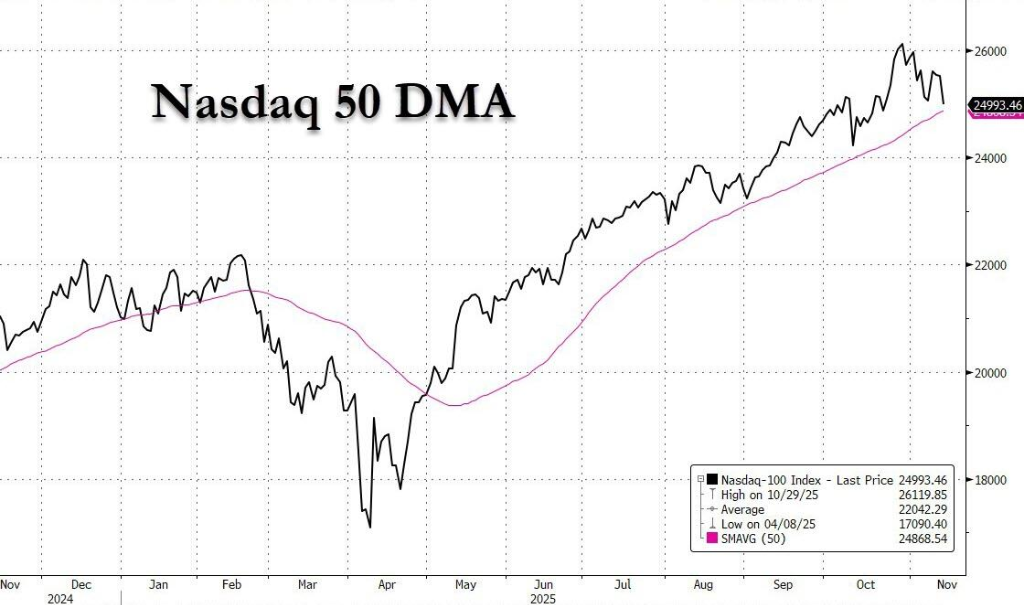
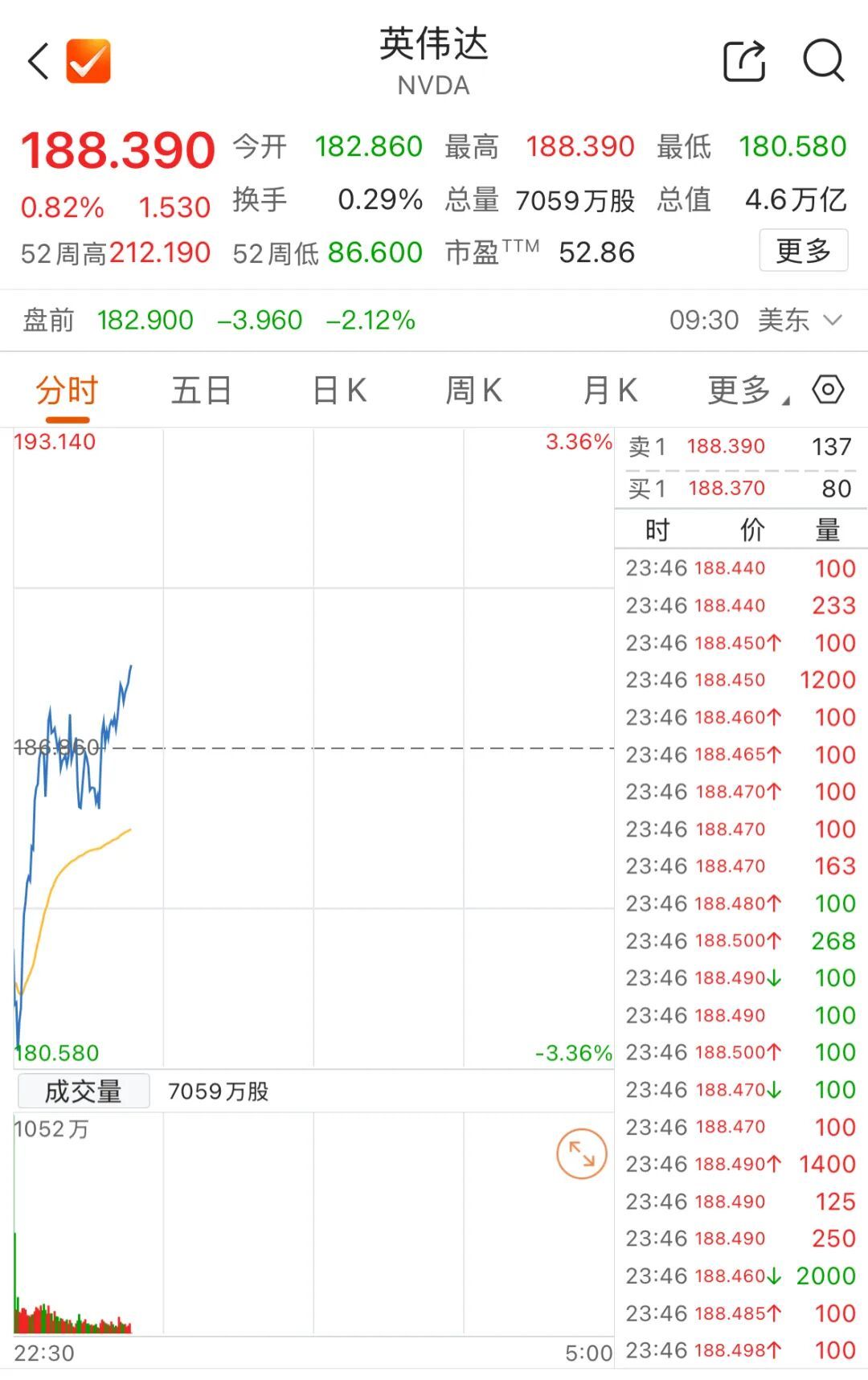
Market Overview - On November 14, US stock indices opened significantly lower, with major tech stocks mostly declining, while gold and silver prices dropped sharply, and Bitcoin fell below $100,000 [1] - The Nasdaq turned positive later, and the S&P 500 nearly recovered its initial losses, while the Dow Jones remained down by over 300 points [1] - By the close, the Dow Jones fell by 309.74 points (0.65%) to 47,147.48, the Nasdaq rose by 30.23 points (0.13%) to 22,900.59, and the S&P 500 dropped by 3.38 points (0.05%) to 6,734.11 [1] Semiconductor Sector - Semiconductor stocks surged against the market trend, contributing to a recovery in market sentiment, with SanDisk rising over 7% and Micron Technology increasing by over 6% [1] - Nvidia, a global chip leader, saw its stock price rebound, rising by 0.82% after initially declining [1] Precious Metals - Spot gold and silver experienced a sharp decline, with gold dropping below $4,100 to $4,075.57 per ounce, a decrease of over 2%, after reaching above $4,200 earlier [3] - Spot silver fell to $50.94 per ounce, down more than 2.5% [3] Cryptocurrency Market - Major cryptocurrencies faced significant declines, with Bitcoin plummeting over 6% to $96,501 per coin, and Ethereum down by 7.48% to $3,201.89 [5][6] - Over the past 24 hours, more than 278,000 traders were liquidated, with total liquidation amounting to $1.366 billion [7] AI and Tech Sector Concerns - The US tech giants index fell by 3.2% last week and 0.7% in the first four trading days of this week, with Nvidia down nearly 10% from its recent high and Tesla down 12% this month [8] - CoreWeave, considered a shadow stock of Nvidia, has dropped over 40% this month, raising concerns about its business model and reliance on Nvidia's support [8] - Mohamed El-Erian from Allianz Group noted that the market is experiencing a "rational bubble," suggesting that while the total value created is significant, it may lead to losses [8] - Mary Callahan Erdoes from JPMorgan emphasized the importance of focusing on future opportunities presented by AI rather than fixating on the current bubble concerns [8]


深夜,美股大反转,英伟达拉升!金价跳水,加密货币重挫,超27万人爆仓
Mei Ri Jing Ji Xin Wen· 2025-11-14 16:32
Market Overview - Major U.S. stock indices opened significantly lower, with large tech stocks mostly declining, while gold and silver prices dropped sharply, and Bitcoin fell below $100,000 [1] - The Nasdaq index turned positive later, and the S&P 500 nearly recovered its initial losses, while the Dow Jones remained down by over 300 points, a decline of more than 0.6% [1] Stock Performance - Semiconductor stocks in the U.S. rallied against the trend, contributing to a market sentiment recovery, with SanDisk rising over 7% and Micron Technology increasing more than 6% [2] - Nvidia, a global chip leader, saw its stock price rebound, turning from a decline to a gain of 0.82% [2] Commodity Prices - Spot gold and silver experienced a sharp decline, with gold dropping below $4,100 to a latest price of $4,075.57 per ounce, a decrease of over 2%, after reaching above $4,200 earlier [4] - Spot silver fell to $50.94 per ounce, with a decline exceeding 2.5% [4] Cryptocurrency Market - Major cryptocurrencies faced significant downturns, with Bitcoin plummeting over 6% to $96,501 per coin, and over 270,000 traders liquidated in the past 24 hours [6][7] - Ethereum and Solana also saw declines of 7.48% and 8.89%, respectively [7] Tech Sector Insights - The U.S. tech giants index fell by 3.2% last week and dropped 0.7% in the first four trading days of this week, with Nvidia down nearly 10% from its recent high and Tesla down 12% this month [7] - CoreWeave, once considered a shadow stock of Nvidia, has seen a decline of over 40% this month, raising concerns about its business model and reliance on Nvidia's support [8] Economic Commentary - Mohamed El-Erian from Allianz Group noted that the market is experiencing a "rational bubble," suggesting that while the total value created is significant, it may lead to losses [8] - Mary Callahan Erdoes from JPMorgan emphasized the importance of focusing on future opportunities presented by artificial intelligence rather than fixating on the current bubble concerns [8]
“英伟达亲儿子”CoreWeave(CRWV.US)续跌近5% 月内暴跌45% 美媒指其为“AI泡沫的核心”
Zhi Tong Cai Jing· 2025-11-14 15:43
周五,"英伟达亲儿子"CoreWeave(CRWV.US)续跌近5%,月内暴跌45%。消息面上,美国科技媒体昨日 预告了一篇即将发布的调查报道,将AI基础设施供应商CoreWeave形容为"AI泡沫的核心",并对其商业 模式及对英伟达的高度依赖提出质疑。报道强调,CoreWeave几乎不可能在缺乏英伟达大规模资金与硬 件支持的情况下运作,并对其模式在AI需求出现波动时是否能维持提出疑问。 ...

美股异动 | “英伟达亲儿子”CoreWeave(CRWV.US)续跌近5% 月内暴跌45% 美媒指其为“AI泡沫的核心”
智通财经网· 2025-11-14 15:41
Core View - CoreWeave (CRWV.US) has experienced a nearly 5% decline on Friday and a 45% drop within the month, raising concerns about its business model and reliance on Nvidia [1] Business Model Concerns - A forthcoming investigative report from a U.S. tech media outlet describes CoreWeave as "the core of the AI bubble," questioning its sustainability without substantial funding and hardware support from Nvidia [1] - The report emphasizes that CoreWeave's operations may be nearly impossible without Nvidia's large-scale financial and hardware backing [1] Market Demand Fluctuations - There are doubts regarding CoreWeave's ability to maintain its business model amid fluctuations in AI demand, highlighting potential vulnerabilities in its operational strategy [1]
中国AI再次刷屏硅谷!华尔街发出预警,直指美股泡沫
Sou Hu Cai Jing· 2025-11-14 15:22
Core Insights - The recent launch of the open-source model Kimi K2 Thinking by the Chinese tech company Moonlight has surpassed top global models like GPT-5 and Claude 4.5 in various tests, creating a significant impact in the tech community [2][3][10] - Kimi K2 Thinking's training cost was only $4.6 million, which is less than 1% of the cost incurred by OpenAI for training GPT-5, highlighting the cost efficiency of Chinese AI development [3][5] - The success of Kimi K2 has reignited discussions about the AI development trajectory, with concerns in Silicon Valley regarding the rapid advancements made by Chinese AI companies [5][9] Investment and Market Dynamics - The U.S. stock market experienced a significant decline, with major tech stocks like Nvidia and Google dropping due to investor concerns over the high valuations in the AI sector [6][7] - There is a stark contrast in capital expenditure between U.S. and Chinese tech companies, with U.S. giants expected to invest nearly $700 billion in data centers by 2027, while leading Chinese firms are projected to spend less than $80 billion [7][9] - The disparity in investment levels, with a ratio of 10:1 in favor of the U.S., raises questions about the sustainability of the current AI development model in the U.S. [7][9] Competitive Landscape - The rapid rise of Chinese AI models like Kimi K2 and Alibaba's Tongyi Qianwen has surprised international observers, especially given the significant investment gap [9][14] - High-profile figures in the tech industry, including Nvidia's CEO Jensen Huang, have acknowledged the competitive edge that China holds in the AI race, citing a larger workforce dedicated to AI development [9][19] - The performance of Kimi K2 in benchmark tests, achieving a score of 93% in a third-party evaluation, indicates that open-source models from China are closing the gap with proprietary models from the U.S. [12][14] Strategic Implications - The Chinese government's strategic focus on AI, as outlined in its development plans, positions the country to potentially lead in AI innovation and application by 2030 [19][20] - The dual approach of advancing AI technology while integrating it into various sectors under the "AI+" strategy provides a robust foundation for growth in China's AI industry [21][22] - The evolving landscape suggests that the competition between the U.S. and China in AI will continue to intensify, with significant implications for global tech dynamics [22]

深夜!美股全线大跌!
Zheng Quan Shi Bao· 2025-11-14 15:20
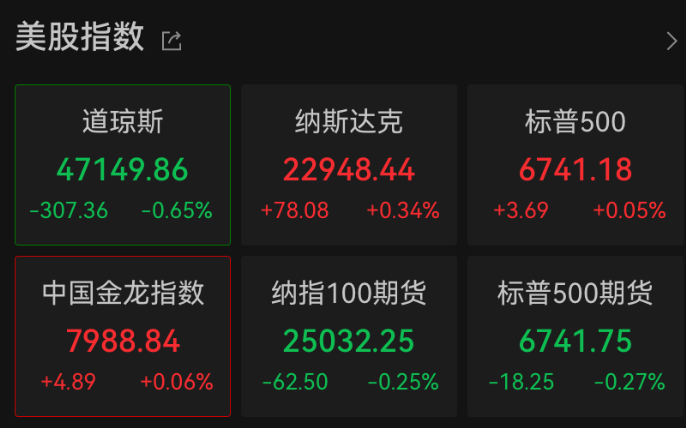
Core Viewpoint - The technology sector in the U.S. continues to experience a downward trend, significantly impacting major stock indices, with the Nasdaq Composite Index dropping over 1.6% [1][2]. Market Performance - As of the latest report, the Dow Jones Industrial Average is at 46,957.63, down 499.59 points (-1.05%); the Nasdaq is at 22,498.81, down 371.55 points (-1.62%); and the S&P 500 is at 6,659.34, down 78.15 points (-1.16%) [2]. - Major tech stocks are also declining, with Nvidia down 2.12%, Tesla down nearly 4%, and Google down 2.49% [2][3]. Technology Sector Analysis - The U.S. Technology Seven Index fell by 3.2% last week and 0.7% in the first four trading days of this week. Nvidia has seen a nearly 10% pullback from its recent highs, while Tesla has dropped 12% this month, and Meta has retreated over 20% since its peak in August [4]. - CoreWeave, considered a shadow stock of Nvidia, has plummeted over 40% this month, raising concerns about its business model and reliance on Nvidia's support [4]. Institutional Perspectives - Citigroup has significantly reduced its holdings in major tech stocks like Nvidia, Microsoft, Apple, and Amazon, while increasing bearish positions on small-cap stocks [6]. - Conversely, JPMorgan's top holdings still include major tech companies, with Nvidia being its largest position, having increased its holdings by 5.63% [6]. - Wells Fargo has continued to buy tech stocks, with its top five purchases including Apple, Google, and Nvidia [6]. Earnings Outlook - Nvidia is set to release its quarterly earnings on November 19, which is expected to have a substantial impact on its stock price and the broader market [7]. - Citigroup has maintained a "buy" rating on Nvidia, raising its target price from $210 to $220 per share, citing ongoing demand for AI chips despite concerns about funding sources [7]. Economic Context - The recent government shutdown has created a data vacuum, complicating the Federal Reserve's decision-making regarding interest rate cuts, with the probability of a December rate cut dropping from 90% to about 50% [8][9]. - Federal Reserve officials have expressed caution regarding potential rate cuts, emphasizing the importance of upcoming economic data [9].
深夜!美股全线大跌!
证券时报· 2025-11-14 15:19
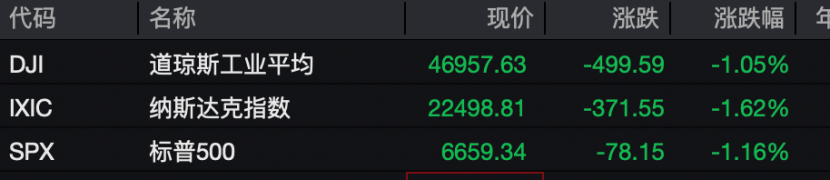
Core Viewpoints - The technology sector continues to experience a downward trend, impacting major U.S. stock indices, with the Dow Jones, Nasdaq, and S&P 500 all declining over 1% [1][2] - Major tech stocks such as Nvidia, Tesla, and Google have seen significant declines, with Nvidia down 2.12%, Tesla down nearly 4%, and Google down 2.49% [2][3] Technology Sector Performance - The U.S. technology giants index fell 3.2% last week and 0.7% in the first four trading days of this week [5] - Nvidia has retreated nearly 10% from its recent highs, while Tesla has dropped 12% this month, and Meta has seen a decline of over 20% since its peak in August [5] - CoreWeave, considered a shadow stock of Nvidia, has plummeted over 40% this month, raising concerns about its business model and reliance on Nvidia [5] Market Sentiment and Institutional Views - Investors are questioning whether the AI bubble is beginning to burst, with differing opinions among financial institutions [6][8] - Citigroup has significantly reduced its holdings in major tech stocks like Nvidia, Microsoft, Apple, and Amazon, while increasing bearish options on small-cap stocks [9] - Conversely, JPMorgan's top holdings still include major tech stocks, with Nvidia being its largest position, having increased its holdings by 5.63% [9] - Wells Fargo has continued to buy tech stocks, with its top purchases including Apple, Google, and Nvidia [9] Earnings Outlook - Nvidia is set to release its quarterly earnings report on November 19, which is expected to significantly influence market sentiment [11] - Citigroup maintains a "buy" rating on Nvidia, raising its target price from $210 to $220 per share, citing supply constraints in AI chip production [11] Federal Reserve and Economic Outlook - The recent U.S. government shutdown has created uncertainty regarding economic data, which may delay or hinder the Federal Reserve's ability to lower interest rates [13][15] - The probability of a rate cut in December has dropped from 90% to about 50%, reflecting a cautious stance from several Federal Reserve officials [14][15]





道指开盘跌0.5%,标普500跌0.9%,纳指跌1.4%
Xin Lang Cai Jing· 2025-11-14 14:38
Group 1 - Tesla's stock fell by 4.2%, dropping below $400, marking a negative trend for the year [1] - CoreWeave experienced a decline of 3.8%, being identified by media as the "core of the AI bubble" [1] - Walmart's shares decreased by 2.5% as CEO Doug McMillon announced his retirement in January [1] Group 2 - Cidara Therapeutics saw a significant increase of 104.9% after Merck agreed to acquire the company for $9.2 billion in cash [1] - Warner Bros. Discovery's stock rose by 2.8%, with Paramount, Comcast, and Netflix planning to participate in bidding for the company [1]


一周热榜精选:数据“消失”不影响美联储放鹰!AI泡沫带崩美股?
Jin Shi Shu Ju· 2025-11-14 13:33
Market Overview - The US dollar index faced slight pressure this week, dipping below the 99 mark, and is expected to close lower for the second consecutive week. The longest government shutdown in US history has ended, but key economic data will take time to be released. Fed officials have signaled a hawkish stance, reducing the likelihood of a rate cut in December [1] - Precious metals prices rose overall, with spot gold reaching a high of $4245 per ounce due to a weaker dollar and safe-haven buying. Spot silver saw a similar trend but with a larger increase, rising nearly 10% at one point. However, both gold and silver experienced a sharp decline on Friday, narrowing their weekly gains [1] - Oil prices for WTI and Brent crude saw significant mid-week declines followed by a rebound. OPEC's latest report adjusted its forecast for a "supply shortage" to "supply surplus" for Q3, while the IEA raised its forecast for global oil supply surplus for the sixth consecutive month, predicting that demand will stop growing by the end of this decade [1] Economic Data and Federal Reserve - The US government shutdown has ended, but key economic data such as non-farm payrolls and CPI remain absent. The shutdown is estimated to have caused a GDP decline of over 0.1%. The release of economic data may take months to normalize due to staffing shortages and leadership vacancies [6][7] - Market analysis suggests that unless there are significant surprises in delayed data, the rationale for a third rate cut by the Fed this year is rapidly diminishing. The probability of a 25 basis point cut in December is now at 51.6%, down from 95.5% a month ago [8][9] - Several Fed officials have expressed hawkish views, indicating a preference for maintaining current rates due to high inflation and the absence of key data. The Fed's stance is complicated by internal disagreements among officials regarding the economic outlook and policy direction [9][10] Corporate Developments - Nomura expects the Fed to pause rate cuts in December, while UBS predicts that global gold demand will reach its highest level since 2011 this year and next. JPMorgan Private Bank forecasts gold prices to exceed $5000 per ounce by the end of 2026 [5] - Alibaba has reportedly launched a secret project called "Qianwen," aimed at developing a personal AI assistant to compete with ChatGPT. This initiative is seen as a significant move to integrate AI capabilities into its e-commerce platform [24] - SoftBank has completed the liquidation of its Nvidia shares, raising $5.83 billion to fund an additional investment of $22.5 billion in OpenAI. This decision has led to a significant drop in SoftBank's stock price [25][26] Geopolitical Events - The US has initiated "Operation Southern Shield" to combat drug-related terrorism in the Western Hemisphere, with military actions already taken against suspected drug trafficking vessels [11][12] - Venezuela is preparing for potential military action from the US by deploying guerrilla tactics, having established combat positions at over 280 sites [13][14] - Tensions between India and Pakistan have escalated following bombings in both capitals, leading to a declaration of war readiness by Pakistan [19]

投机主题都在抛!高盛交易台:周四美股动量交易创DeepSeek冲击以来最大跌幅
Hua Er Jie Jian Wen· 2025-11-14 13:25
Core Viewpoint - The market is experiencing significant sell-offs in technology stocks, particularly those related to AI, due to concerns over massive financing needs and a shift in investor sentiment towards a defensive stance [1][10]. Group 1: Market Performance - The Nasdaq 100 index fell over 2% on Thursday, marking five declines in the last six trading days, with the index only about 5% away from its historical high [1]. - High Beta Momentum Pair Trading (GSPRHIMO) dropped 7% on Thursday, the second-worst performance of the year, indicating a severe sell-off in speculative sectors like AI-related stocks and Bitcoin-sensitive stocks [4][9]. Group 2: Factors Behind the Sell-off - Goldman Sachs identified five key triggers for the recent market downturn: profit-taking ahead of Nvidia's earnings report, concerns over inflated power demand for AI infrastructure, hawkish comments from Federal Reserve officials, corporate cost-cutting announcements, and upcoming economic data releases [6][11]. - The market is currently facing a challenging macro backdrop, with deteriorating performance from internet companies and signs of fatigue in leading sectors like AI and large tech stocks [6]. Group 3: Momentum Trading Strategies - Momentum trading strategies are highly correlated with AI narratives, and the recent sell-off has raised concerns about a potential wave of position liquidations before year-end [7]. - The correlation between momentum factors and high short interest, high residual volatility, and high beta has significantly increased, while the correlation with high-quality factors remains low [7][9]. Group 4: AI Sector Sentiment - AI beneficiary stocks have declined by 9% relative to the S&P 500, excluding the "Magnificent Seven" tech giants, with previous similar pullbacks averaging around 20% [9]. - Skepticism towards AI is rising, influenced by factors such as Oracle's widening credit default swaps and SoftBank's sale of Nvidia shares, which are impacting the AI thematic basket [11].