
创新药

Search documents
创新药再开大单 复星医药GLP-1药物或超20亿美元“交付”辉瑞
Zheng Quan Ri Bao Wang· 2025-12-10 13:05
Core Viewpoint - Shanghai Fosun Pharmaceutical announced the exclusive global rights grant for its GLP-1 drugs, including YP05002, to Pfizer, marking a significant collaboration in the internationalization of Chinese innovative drugs [1][2]. Group 1: Transaction Details - The initial payment for the transaction is set at $150 million, with potential milestone payments reaching up to $1.935 billion, leading to a total potential transaction value exceeding $2 billion [1]. - This deal is considered a top-tier transaction, reflecting the ongoing competitiveness in the GLP-1 drug market [1]. Group 2: Market Context - GLP-1 drugs mimic the hormone GLP-1, which helps control diabetes and promote weight loss, and are gaining traction among global pharmaceutical companies [2]. - Currently, four domestic GLP-1 drugs have been approved in China, with nearly 90 products in the research and development phase [2]. Group 3: Strategic Insights - Fosun Pharmaceutical's decision to grant global rights to Pfizer may be a strategic move to avoid intense competition in the domestic GLP-1 market, preserving maximum value [2]. - Pfizer is actively enhancing its GLP-1 portfolio through acquisitions, including a recent $10 billion purchase of Metsera, indicating the importance of GLP-1 products in maintaining competitive advantage [2]. Group 4: Future Development - The GLP-1 drug involved in the transaction is currently in Phase I clinical trials, and both companies aim to leverage their strengths to accelerate global clinical development and commercialization [3]. - Fosun Pharmaceutical's chairman emphasized the collaboration as a milestone in the company's strategy for innovation and internationalization, aiming to address unmet clinical needs in obesity and metabolic diseases [3].
创新药大爆发
Bei Jing Shang Bao· 2025-12-10 12:13
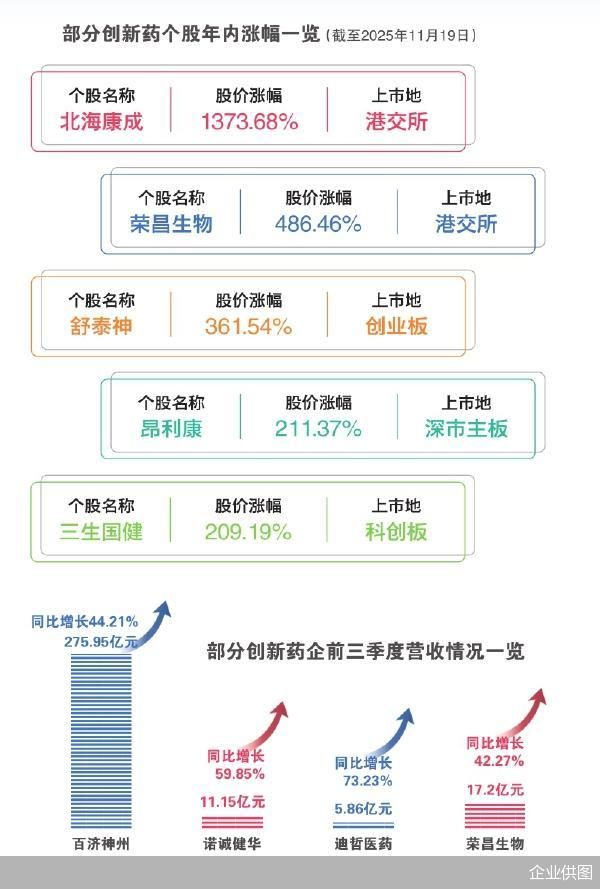
Core Insights - The agreement between 3SBio and Pfizer, involving a $1.25 billion upfront payment and a total transaction value of $6 billion, highlights the growing interest in China's innovative pharmaceuticals sector, marking a "DeepSeek moment" for the industry [1] - The capital market has recognized the potential of innovative drug companies, with the Hong Kong innovative drug index surging over 100% and the A-share innovative drug sector also showing significant gains [3][4] - The number of innovative drug companies with a market capitalization exceeding 100 billion yuan has reached eight, indicating a robust growth trend in the sector [4] Market Performance - The Hong Kong innovative drug index has increased by 110.75% from April 9 to November 19, while the A-share innovative drug sector rose by 47.82% during the same period [3] - Individual stocks have shown remarkable performance, with companies like 3SBio seeing a year-to-date increase of 393.34% as of November 19 [4] Financial Highlights - 3SBio's partnership with Pfizer includes milestone payments that could reach up to $48 billion, setting a record for upfront payments in the domestic innovative drug sector [4] - BeiGene reported a revenue of 27.595 billion yuan for the first three quarters of the year, a 44.2% increase year-on-year, marking its transition from a loss-making to a profitable entity [5] Policy and Regulatory Environment - The growth of China's innovative drug sector is closely linked to supportive government policies, including streamlined clinical trial approval processes and financial incentives for innovation [6][7] - Recent policies have facilitated the listing of innovative drug companies, with nearly ten companies submitting applications to the Hong Kong Stock Exchange in November alone [6] Technological Advancements - Chinese pharmaceutical companies are demonstrating global competitiveness in cutting-edge fields such as dual antibodies and ADCs, with several products achieving significant clinical milestones [7] - The approval of innovative traditional Chinese medicine products has also contributed to the sector's growth, with multiple new drugs receiving clinical trial approvals this year [8] Business Development Trends - The surge in business development (BD) transactions has been a catalyst for the current innovative drug market rally, with significant deals reported, including a $12 billion upfront payment from Takeda to Innovent [8] - The investment landscape is evolving from short-term speculative behavior to more structured and strategic investments, reflecting a shift in investor focus towards clinical data and commercial viability [10][11] Future Outlook - The innovative drug sector is expected to continue its growth trajectory, driven by long-term, high-quality R&D investments and the realization of clinical value [13] - The industry is characterized by a "double ten law," indicating a long development cycle and substantial financial investment, necessitating ongoing funding and strategic resource allocation [14][15]


首版商保创新药目录发布,恒生创新药ETF(159316)获资金持续加仓
Sou Hu Cai Jing· 2025-12-10 11:14
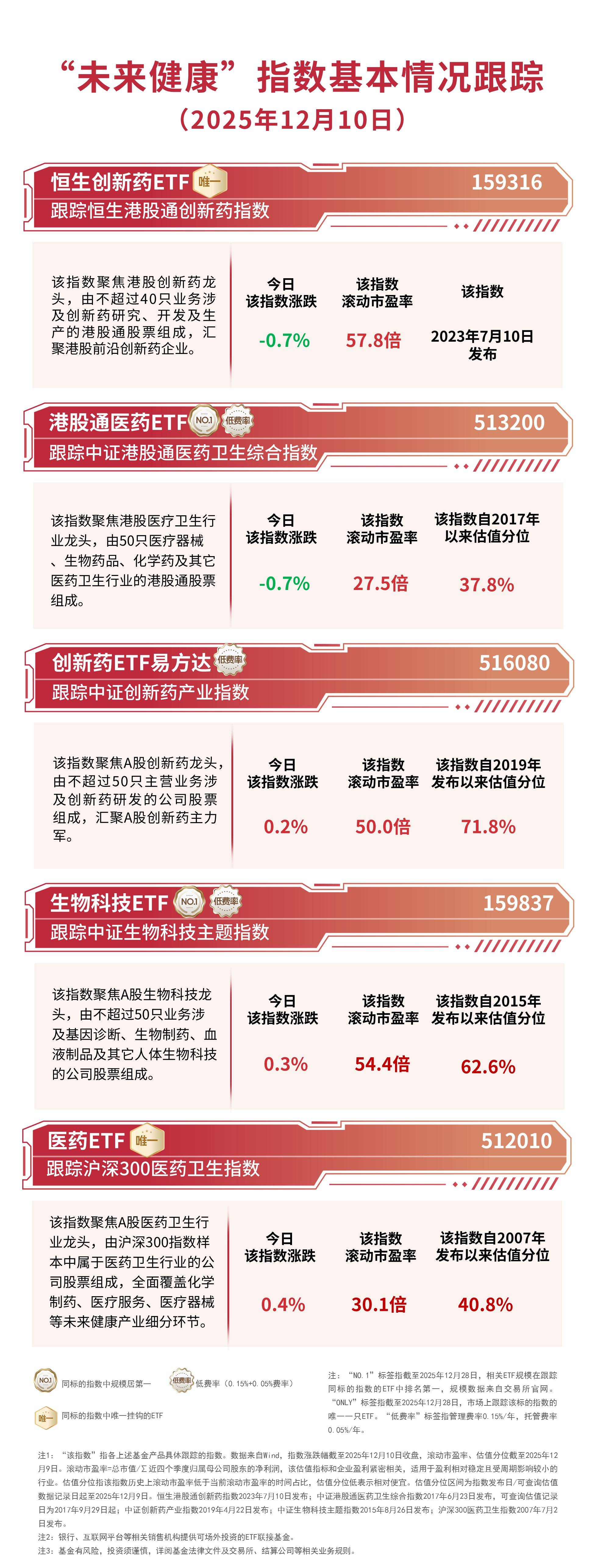
Core Viewpoint - The pharmaceutical sector is experiencing volatility, with Hong Kong stocks continuing to adjust while A-share pharmaceutical stocks saw a slight rebound in the afternoon. The overall market indices for innovative drugs and biotechnology are mixed, indicating varied investor sentiment in the sector [1]. Group 1: Market Performance - The Hang Seng Hong Kong Stock Connect Innovative Drug Index and the CSI Hong Kong Stock Connect Pharmaceutical and Health Comprehensive Index both declined by 0.7% [1]. - The CSI Innovative Drug Industry Index increased by 0.2%, while the CSI Biotechnology Theme Index rose by 0.3% [1]. - The CSI 300 Pharmaceutical and Health Index saw a gain of 0.4%, reflecting continued capital inflow into the sector [1]. Group 2: Fund Flows - The Hang Seng Innovative Drug ETF (159316) attracted a total of 140 million yuan in the previous two trading days, with an additional net subscription of nearly 10 million shares today [1]. Group 3: Policy Updates - The National Medical Insurance Drug List for 2025 and the first version of the Commercial Health Insurance Innovative Drug List (2025) will be released on December 7, marking the 8th adjustment since the establishment of the National Medical Insurance Bureau [1]. - A total of 114 new drugs will be added to the list, including 50 first-class innovative drugs, targeting key areas such as cancer, chronic diseases, mental health, rare diseases, and pediatric medications [1].
9款创新药首纳医保目录、商保目录亦有斩获!科创板创新药企收获颇丰 硬核实力凸显
Zheng Quan Shi Bao Wang· 2025-12-10 10:23
Core Insights - The 2025 National Medical Insurance Drug List includes 114 new drugs, with 50 being innovative drugs, achieving an overall success rate of 88%, a significant increase from 76% in 2024 [1] - The first version of the commercial insurance innovative drug list includes 19 drugs, laying the foundation for a multi-tiered medical security system [1] - The inclusion of nine innovative drugs from the Sci-Tech Innovation Board in the medical insurance list highlights the robust capabilities and vitality of these companies [1] Group 1: Innovative Drug Inclusion - Nine innovative drugs from Sci-Tech Innovation Board companies have been included in the medical insurance list, with several others successfully renewing or expanding their indications [1] - Junshi Biosciences' drug, Juntai® (generic name: Angrexis monoclonal antibody injection), is the only domestic PCSK9-targeted drug for patients intolerant to statins included in the new list [2] - Haichuang Pharmaceutical's first marketed drug, Hainaan® (generic name: Dihydrotestosterone enzalutamide soft capsule), received approval for market launch and is included in the 2025 medical insurance list, enhancing patient access [2] Group 2: Commercial Insurance Innovations - The first commercial health insurance innovative drug list complements the basic medical insurance, providing new possibilities for patients to access cutting-edge treatments [4] - Two advanced therapy drugs from BeiGene, including Baihe An® (generic name: Zhenidat monoclonal antibody injection), are among the first to be included in the commercial insurance list, marking a significant market access pathway for high-value innovative drugs [4] Group 3: Renewal and Expansion of Indications - Successful renewals of innovative drugs confirm their clinical value and market position, with BeiGene's Bai Ze An® (generic name: Tarelizumab injection) and Junshi Biosciences' Tuoyi® (generic name: Toripalimab injection) expanding their insurance coverage [5][6] - Junshi Biosciences' Tuoyi® has now been included for 12 indications in the national medical insurance list, showcasing the recognition of its clinical value and innovation by the National Medical Insurance Bureau [6] Group 4: R&D Investment and Development Cycle - Sci-Tech Innovation Board companies have maintained a high level of R&D investment, with total R&D spending reaching a new high in the first three quarters of 2025, growing over 10% year-on-year [6] - The R&D intensity of these companies stands at 42%, significantly surpassing the overall level of A-shares during the same period, indicating a solid cycle of "R&D investment - innovative results - insurance support - market returns - reinvestment in R&D" [6][7]
国家医保局详解2025年医保药品目录变化 为何有一类创新药无法通过专家评审?
Yang Guang Wang· 2025-12-10 10:08
Core Insights - The National Healthcare Security Administration (NHSA) has released the 2025 National Medical Insurance Drug List, adding 114 new drugs, including 50 innovative drugs of Class A, and 19 drugs included in the first commercial insurance innovative drug list [1][4] Summary by Sections New Drug Additions - The 2025 National Medical Insurance Drug List primarily adds chemical drugs, with a rapid increase in biological products and some traditional Chinese medicine [1] - Out of the 114 new drugs, 112 were included through negotiation and bidding, while 2 were directly included from national procurement [1] - A total of 111 new drugs were approved in the last five years, with the number of Class A innovative drugs reaching a historical high of 50 [1] Financial Impact - As of October 2023, the NHSA has paid over 460 billion yuan for drugs under agreement, benefiting over 1 billion patients and driving related sales exceeding 670 billion yuan [2] - Basic medical insurance covers approximately 44% of the costs for innovative drugs, while commercial insurance covers about 7% [2] Evaluation and Selection Criteria - The selection process for new drugs has seen a low pass rate during expert reviews, with only 127 out of 311 drugs passing to the negotiation table this year [2] - Some drugs were not favored due to "involutionary innovation," where the clinical value does not significantly improve compared to existing drugs [3][4] - To be included in the list, drugs must meet at least one of three criteria: filling clinical gaps, superior efficacy, or better cost-effectiveness [4] Commercial Insurance Innovations - The newly introduced commercial health insurance innovative drug list emphasizes drug innovation and clinical value, with 19 out of 141 submitted drugs successfully negotiated for inclusion [5] - The drugs in the commercial insurance list include 9 Class A new drugs, addressing gaps in basic medical insurance coverage [5] Future Directions - The NHSA plans to continue annual adjustments to the drug list to meet evolving clinical needs and incorporate advancements in medical technology [6] - The focus will be on supporting domestic and innovative drugs, enhancing collaboration between commercial insurance and innovative pharmaceutical companies [6]
长城基金医药投资团队:持续看好AI医疗,创新药领域关注两大方向
Xin Lang Cai Jing· 2025-12-10 09:00
Core Viewpoint - The A-share market is expected to face short-term risks but may enter a preparation window for next year's expectations due to upcoming economic meetings and potential interest rate cuts by the Federal Reserve [2][6]. Group 1: Market Outlook - In November, the market was influenced by U.S. liquidity expectations, with strong performance in dividend and cyclical sectors, while growth stocks lagged [2][6]. - December may present a window for positioning as the Central Economic Work Conference approaches and the Federal Reserve is expected to lower interest rates [2][6]. Group 2: AI Applications - The company maintains a positive outlook on AI applications in the healthcare and consumer sectors, particularly in new technology sub-sectors [3][7]. - After an initial overestimation of AI application expectations, the market has adjusted to more rational forecasts, with significant infrastructure already in place for AI applications [3][7]. - The current low market expectations in the AI application field may lead to valuation recovery opportunities [3][7]. Group 3: Innovative Pharmaceuticals - In the innovative drug sector, two focus areas are identified: deep globalization of already business-developed (BD) companies and the confirmation of pipeline value for non-BD companies [4][9]. - Many innovative drug stocks have absorbed negative sentiment, but December lacks significant data releases or BD catalysts, shifting attention to the clinical data readout rhythm of potential heavy-hitting pipelines [4][9].
北交所行业主题报告:北交所医药投资地图:布局小而美的创新药、高端器械与稳健仿制三大方向
KAIYUAN SECURITIES· 2025-12-10 08:34
Investment Rating - The report suggests a focus on "innovation-driven" and "steady growth" strategies within the pharmaceutical sector, indicating a positive investment outlook for the industry [3][4]. Core Insights - The North Exchange's pharmaceutical and biotechnology sector comprises 21 companies, all classified as specialized and innovative, with a significant proportion being national and provincial champions [2][16]. - The report emphasizes the potential of innovative drugs, high-end medical devices, and robust generics as key investment areas, highlighting the importance of unique products and market share advantages [3][4]. - The medical device sector has shown the highest market value growth in 2025, with an increase of 130.47%, while traditional Chinese medicine has faced performance challenges [28][32]. Summary by Sections Industry Overview - The North Exchange's pharmaceutical sector includes five sub-sectors: traditional Chinese medicine, medical devices, medical aesthetics, biological products, and chemical pharmaceuticals [12][24]. - The average market capitalization of the 21 companies in this sector reached 3.643 billion yuan as of December 1, 2025, reflecting a year-to-date increase of 41.97% [21][23]. Sub-sector Analysis - The medical device industry led the market value growth in 2025, with a total market value increase from 6.818 billion yuan at the end of 2024 to 15.713 billion yuan by December 1, 2025 [28]. - The chemical pharmaceutical sector also performed well, with notable companies like Deyuan Pharmaceutical showing a revenue increase of 22% year-on-year in the first three quarters of 2025 [4][34]. Company Case Studies - **Innovative Drugs**: Norsland's gene therapy drug NL003 is nearing approval, targeting a significant patient population with a new treatment method [4][9]. - **Medical Devices**: Weizhu Zhiyuan focuses on smart orthopedic surgical navigation systems, emphasizing the importance of unique technology and market positioning [4][11]. - **Generics**: Deyuan Pharmaceutical is transitioning from generics to innovative drugs, with a solid historical performance and a focus on diabetes and hypertension treatments [4][34]. Performance Metrics - The report notes that the average PE TTM for the pharmaceutical sector was 32X as of December 1, 2025, with the medical device sector showing a higher valuation at 78X [15][55]. - Companies like Jinbo Biological and Norsland have seen significant stock price increases, with Jinbo's stock rising by 170.68% and Norsland by 113.10% in 2025 [41][42].
——2025年版医保目录调整政策点评:医保和商保目录并轨,扩容与提质并重,支持创新药高质量发展
EBSCN· 2025-12-10 08:28
Investment Rating - The report maintains an "Overweight" rating for the pharmaceutical and biotechnology industry [1] Core Insights - The 2025 National Medical Insurance Directory has been adjusted, increasing the total number of drugs from 3,159 to 3,253, with a notable success rate of 88% for negotiations, the highest in seven years [3][4] - The first version of the Commercial Health Insurance Innovative Drug Directory includes 19 drugs, with a success rate of 79% for price negotiations, highlighting a focus on innovative treatments for critical diseases [3][5] - The adjustment emphasizes both expansion and quality improvement of the medical insurance directory, with a high renewal rate of 75% for drugs under negotiation [4] Summary by Sections Medical Insurance Directory Adjustments - The new directory includes 114 new drugs, with 29 drugs removed due to replacement or long-term supply issues [4] - A total of 535 drugs underwent formal review, with a pass rate of 41.48% for those outside the directory [4] Commercial Health Insurance Directory - The first version of the directory includes 24 drugs, focusing on high-value drugs not covered by basic insurance but with significant clinical value [5][29] - The directory supports "true innovation" and "differentiated innovation," encouraging the inclusion of innovative drugs in both basic and commercial insurance [5] Drug Categories and Success Rates - The newly added drugs primarily target cancer, infectious diseases, chronic diseases, and rare diseases, with 50 classified as first-class new drugs [3][15] - The success rate for negotiations of drugs outside the directory has significantly improved, indicating a more favorable environment for innovative drug development [6][21]
港药探底回升!港股通创新药ETF(159570)连续第二天涌入超1亿元!从2025医保看行业风向:成功率提升,创新导向持续强化!
Sou Hu Cai Jing· 2025-12-10 08:19
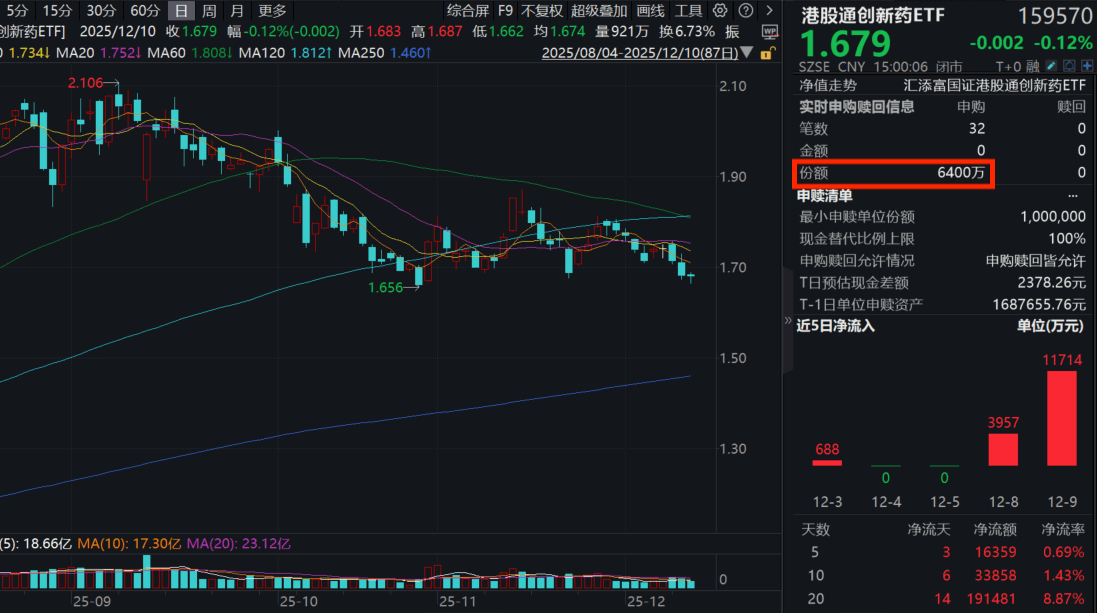
Group 1: Market Performance - The Hong Kong Innovation Drug ETF (159570) experienced a slight decline of 0.12% today, with a total trading volume exceeding 1.5 billion yuan [1] - The fund has seen a net inflow of over 1.1 billion yuan yesterday and more than 1 billion yuan today, accumulating a total of over 1.9 billion yuan in the last 20 days [1] - As of December 9, the latest scale of the Hong Kong Innovation Drug ETF reached over 23 billion yuan, leading its peers in the same category [1] Group 2: Federal Reserve and Market Sentiment - The Federal Reserve is expected to announce a 25 basis point rate cut, bringing the federal funds rate to a range of 3.5%-3.75% [3] - There is a notable division within the Federal Open Market Committee (FOMC), leading to the term "hawkish cut" being used, indicating that while a rate cut is expected, further cuts may not be imminent [3] Group 3: Pharmaceutical Sector Developments - The new National Medical Insurance Drug List has added 114 new drugs, including 50 first-class innovative drugs, with an overall success rate of 88%, up from 76% last year [5][8] - The total number of drugs in the National Medical Insurance Drug List has increased to 3,253, enhancing coverage for critical areas such as oncology, chronic diseases, and rare diseases [8] - The first commercial insurance innovative drug list has been released, including 19 drugs from 18 companies, aimed at improving access to high-value innovative drugs [6][13] Group 4: Investment Opportunities - The Hong Kong Innovation Drug ETF (159570) is fully invested in innovative drugs, with the top ten constituent stocks accounting for over 74% of its weight [15] - The index has shown a year-to-date increase of over 90%, outperforming other Hong Kong pharmaceutical indices [16] - The ETF's underlying assets are Hong Kong stocks, allowing for T+0 trading, which may attract more investors [16]
君实生物涨0.58%,成交额1.73亿元,近3日主力净流入-472.11万
Xin Lang Cai Jing· 2025-12-10 07:44
Core Viewpoint - Junshi Biosciences aims to establish itself as a global innovative pharmaceutical company with a complete industry chain capability from drug discovery to commercialization, focusing on quality and innovation [2] Group 1: Company Overview - Junshi Biosciences was founded on December 27, 2012, and went public on July 15, 2020, specializing in the research and commercialization of monoclonal antibodies and therapeutic proteins [7] - The company's main revenue sources include drug sales (90.67%), technology licensing (8.74%), and other services (0.59%) [7] - As of September 30, 2025, Junshi Biosciences reported a revenue of 1.806 billion yuan, a year-on-year increase of 42.06%, while the net profit attributable to shareholders was -596 million yuan, a year-on-year increase of 35.72% [8] Group 2: Product Development and Pipeline - The company has developed a strong product pipeline, including its core product, Toripalimab, which is the first domestically approved PD-1 monoclonal antibody in China, with 11 approved indications and one supplemental NDA under review [2] - Toripalimab is also the first innovative biologic drug developed and produced in China to receive FDA approval, with approvals in multiple regions including the EU, the UK, and Australia [2] - Junshi Biosciences is also developing Tifcemalimab, the world's first anti-BTLA monoclonal antibody entering clinical development, with ongoing Phase III trials and several combination studies with Toripalimab [2] Group 3: Collaborations and New Initiatives - On October 27, 2023, Junshi Biosciences announced collaborations with several institutions, including Peking University and the Chinese Academy of Sciences, to develop a monkeypox recombinant protein vaccine [3] - The company's subsidiary, JunTuo Biotech, is involved in the preclinical development of vaccines for monkeypox and Zika virus, indicating a focus on expanding its vaccine pipeline [3] Group 4: Market Performance - On December 10, Junshi Biosciences' stock rose by 0.58%, with a trading volume of 173 million yuan and a market capitalization of 37.269 billion yuan [1] - The stock has seen a net outflow of 7.0425 million yuan from major investors, indicating a reduction in holdings over the past two days [4][5]
