物理AI

Search documents
下一波AI催化剂来了?大摩详解英伟达GTC三大亮点:欧洲投资追赶、量子商业化、工业AI全面提速
Hua Er Jie Jian Wen· 2025-06-12 11:30
Core Viewpoint - Morgan Stanley supports Nvidia, highlighting three growth drivers that will provide additional momentum, maintaining an overweight rating and a target price of $170, indicating approximately 20% growth potential, and listing it as a preferred stock in the semiconductor sector [1] Group 1: Growth Drivers - Nvidia is expected to benefit from accelerated AI data center investments in Europe, opportunities in quantum computing, and industrial/physical AI applications [1][3] - The company reported that its top four cloud customers plan to deploy 1.3 million Hopper chips in 2024 and 3.6 million Blackwell chips in 2025, indicating a significant increase in demand [1][2] - Morgan Stanley noted that the power capacity of 5GW corresponds to a demand for about 2 million Blackwell chips, slightly exceeding the orders from the four major U.S. cloud service providers [1] Group 2: European AI Investment - The EU launched a €200 billion AI investment plan earlier this year, which includes €20 billion for the construction of five AI super factories, each equipped with over 100,000 GPUs [3] - Nvidia's plans require "over 3000 exaflops of Nvidia Blackwell computing power," with GPU installations expected to triple from 2024 to 2026 [3] - Revenue from the European market is projected to increase eightfold or more from 2024 to 2026, with a growth rate exceeding 150% in 2026 [3] Group 3: Quantum Computing - CEO Jensen Huang indicated that quantum computing is reaching a critical turning point, with the potential to solve significant global issues in the coming years [4] - Morgan Stanley expressed optimism about the commercial application timeline for GPU/QPU hybrid systems, despite a cautious outlook on the timeline beyond the NISQ era [4] Group 4: Industrial AI and Physical AI - The focus is shifting towards physical AI and industrial applications, with significant investments being made despite the long development timeline for humanoid robots [5][7] - The use of Omniverse for creating digital twins for manufacturing and warehousing planning is highlighted as a key area of investment [7] - Collaborations with various partners aim to establish the first industrial AI cloud in Europe, equipped with 10,000 Blackwell GPUs [6]

亚马逊机器人快递员要来了,所用技术涉及宇树、DeepSeek和阿里
Zheng Quan Shi Bao· 2025-06-06 11:06
Core Insights - Amazon is testing humanoid robots for package delivery, incorporating technologies from several Chinese tech companies [1][4] - The company aims to automate logistics to reduce labor costs, which currently account for about 20% of its retail revenue [2][3] - Successful implementation of humanoid robots could transform Amazon's logistics model and impact the entire delivery industry [3] Group 1: Testing and Development - Amazon has created an indoor obstacle training ground in San Francisco to test the robots' balance, package handling, and environmental interaction [2] - The training ground includes complex terrains and a Rivian electric delivery vehicle to simulate real delivery scenarios [2] - A new team, AgenticAI, has been formed within Amazon's Lab126 to focus on developing robots that can execute tasks based on natural language commands [2][3] Group 2: Cost Savings and Automation - If 30%-40% of Amazon's U.S. retail goods can be processed by robots by 2030, the company could save $10 billion annually [2] - Amazon has already deployed over 750,000 robots in its global logistics network, including fixed and mobile robots for warehouse operations [3] Group 3: Technology Partnerships - The humanoid robots' hardware is being tested with contributions from Chinese companies, including a robot developed by Yushu Technology [4] - Software development for the robots is based on DeepSeek's DeepSeek-VL2 model and Alibaba's Qwen model, enabling the robots to recognize addresses and navigate obstacles [4][5] - The integration of AI capabilities from Chinese firms is seen as essential for advancing logistics automation [5]


6月金股组合:中银证券研究部2025年6月金股
中银证券· 2025-06-04 07:48
Strategy Overview - The market in June is expected to remain in a state of waiting for a breakthrough, with large-cap stocks likely to see a recovery. Domestic demand momentum is anticipated to improve marginally, although April's industrial profits showed a decline in both volume and price, with cost reductions being the main driver for profit growth. The PMI for May indicates a slight recovery in domestic production demand compared to April. It is expected that growth-stabilizing policies will be implemented alongside resilient external demand, continuing the trend of weak inventory replenishment in the second quarter. However, global trade policies remain uncertain, compounded by concerns over rising US debt rates, which may pressure market sentiment in the short term. In June, various growth-stabilizing policies are expected to accelerate, maintaining a volatile consolidation pattern in the market. Key areas to monitor for a breakthrough include overseas tariff developments and the implementation of domestic growth-stabilizing policies in June. [5][7] June Stock Recommendations - The June stock selection by Zhongyin Securities includes: - SF Express (Transportation) - Anji Technology (Chemicals) - Bairen Medical (Healthcare) - Lingnan Holdings (Social Services) - Qingdao Beer (Food and Beverage) - Suochen Technology (Computers) [14][16] Performance Review of May Stock Selection - The stock selection for May outperformed the market, with notable performances from Jiemian Express-W and Yiwei Lithium Energy, both achieving over 10% monthly returns. The absolute return of the May stock selection was 3.87%, outperforming the market benchmark (CSI 300) by 2.02 percentage points. Three stocks achieved excess returns of over 5% compared to the CSI 300. [9] Company-Specific Insights SF Express (Transportation) - In Q1 2025, SF Express reported a net profit of 2.234 billion yuan, reflecting a stable growth trend. The company achieved a total express volume of 3.56 billion parcels, a year-on-year increase of 19.7%, with revenue reaching 69.85 billion yuan, up 6.9% year-on-year. The net profit increased by 16.87% year-on-year, driven by continuous improvement in product matrix and service competitiveness. The gross profit margin was 13.3%, slightly up by 0.1 percentage points. [16][17] Anji Technology (Chemicals) - Anji Technology is expected to see rapid growth in revenue and net profit in 2024, driven by increased market coverage and new product introductions. The gross margin for 2024 is projected at 58.45%, up 2.64 percentage points year-on-year. The company’s polishing liquid revenue reached 1.545 billion yuan in 2024, a year-on-year increase of 43.73%. The global semiconductor CMP polishing materials market is expected to grow from 3.42 billion USD in 2024 to 3.62 billion USD in 2025. [19][20] Bairen Medical (Healthcare) - Bairen Medical reported rapid growth in Q4 2024 and Q1 2025, with significant increases in revenue across all three major business segments. The heart valve replacement and repair segment saw a year-on-year growth of 64.28%. The approval of the TAVR product in August 2024 is expected to drive further growth in 2025. [24][25] Lingnan Holdings (Social Services) - Lingnan Holdings achieved a revenue of 4.309 billion yuan in 2024, a year-on-year increase of 25.43%, with a net profit of 150 million yuan, up 116.08%. The travel agency and hotel management segments are expected to continue growing, particularly with the recovery of inbound tourism. [29][30] Qingdao Beer (Food and Beverage) - Qingdao Beer faced challenges in 2024 with a volume decline of 7.0% and a slight price increase of 0.5%. The company’s gross margin improved due to lower raw material costs, but net profit margin slightly decreased. Future growth is anticipated as restaurant demand recovers. [34][35] Suochen Technology (Computers) - Suochen Technology reported a revenue of 39 million yuan in Q1 2025, a year-on-year increase of 21.73%. The company is focusing on enhancing its CAE software capabilities and exploring AI applications in various fields. [38][39][40]





OpenAI的AI硬件设备究竟长啥样? 科技圈早已猜了个遍
3 6 Ke· 2025-05-26 11:22
Core Insights - OpenAI has acquired AI hardware startup io, founded by former Apple chief designer Jony Ive, for $6.5 billion, marking a significant move in the tech industry during the Google I/O developer conference [2] - The collaboration aims to create a revolutionary device that could redefine human-computer interaction, with predictions ranging from wearable technology to a new standard for smart assistants [2][7] Group 1: Product Design and Features - The device is expected to embody a minimalist design philosophy akin to the iPod Shuffle, with a size comparable to a business card holder [3] - It will feature a neck-worn design, avoiding screens to promote a "no-distraction AI" concept, and will utilize a distributed computing architecture to work alongside smartphones and computers [5][7] - The device is planned to be modular, with three foundational forms: a neck-worn smart pendant, a magnetic desktop terminal, and a flexible patch-style wearable [7] Group 2: Market Strategy and Production Timeline - OpenAI aims for mass production by 2027, allowing ample time for concept development and industry positioning [3] - The company plans to adopt a "Tesla-like" production ramp-up strategy, targeting an annual delivery of 100 million units by 2030 [7] - The business model will leverage subscription-based AI services, potentially increasing the company's valuation beyond $1 trillion [7] Group 3: Competitive Landscape - The device represents a strategic move for OpenAI to establish a foothold in the hardware market, competing against dominant players like Apple and Google [32] - Previous attempts by other companies, such as Humane's AI pin and Meta's Ray-Ban smart glasses, have faced challenges, raising questions about OpenAI's ability to succeed [32] - The collaboration between Ive and OpenAI is seen as a bold gamble on the importance of both interaction methods and AI capabilities in shaping the future of technology [32]


2024年中国人工智能产业研究报告
艾瑞咨询· 2025-05-23 09:42
Core Viewpoint - The artificial intelligence (AI) industry is recognized as a key development direction by the government, with significant policies aimed at promoting innovation and enhancing regional economic competitiveness. The rise of open-source models like DeepSeek is accelerating the domestic AI ecosystem's openness and competitiveness, marking a significant event in China's AI industry development [1][4][25]. Summary by Sections Research Background - The AI industry is positioned as a core engine for the new technological revolution and industrial transformation, with the government emphasizing its strategic importance [1]. Macro Environment - In 2024, the national focus on AI development is evident, with local governments promoting research innovation and infrastructure. Despite a slowdown in GDP growth, AI technology shows vast potential for efficiency improvement and industrial upgrading, supported by government initiatives [4]. Industry Dynamics - The AI market size in China is projected to reach 269.7 billion yuan in 2024, with a growth rate of 26.2%, slightly below expectations due to high costs and unmet client needs in real business scenarios [6]. - The demand for computing power is shifting structurally, with increased utilization expected as open-source models drive application growth [6]. - The ecosystem of AI tools is improving, with advancements in distributed AI frameworks and LLMOps platforms facilitating model training and deployment [6]. - Commercialization is primarily project-based for enterprises, while consumer products often adopt a "free + subscription" model [6]. - Many companies are actively pursuing overseas markets to mitigate domestic competition [6]. Development Trends - AI Agents are evolving product applications from simple Q&A to complex task completion, with embodied intelligence becoming a strategic focus for future AI competition [8]. - The open-source movement led by DeepSeek is promoting equitable access to AI technology, enhancing its application in both industrial and consumer sectors [8]. Policy Environment - The government has integrated AI into national development strategies, with various cities launching initiatives to foster local AI industries [9]. Capital Environment - Investment in the AI sector is increasing, particularly in language and multimodal applications, with a notable rise in equity investment [12]. Technology Environment - The Transformer architecture is the foundation for current large model developments, with ongoing exploration in efficiency optimization and new attention mechanisms [16][18]. Market Size - The AI industry in China is expected to exceed 1 trillion yuan by 2029, with a compound annual growth rate of 32.1% from 2025 to 2029 [24][25]. Application Layer Insights - The application layer is seeing a competitive landscape where pricing and user engagement strategies are critical, with many companies adopting aggressive pricing tactics [34]. - B-end applications are primarily driven by state-owned enterprises, focusing on sectors like government, education, and energy [37]. C-end Product Ecosystem - C-end AI products are rapidly developing, but many still face challenges in user retention and monetization [39]. AI Agent Development - AI Agents are bridging the gap between model capabilities and application needs, with a growing ecosystem of diverse vendors driving innovation [45][76]. AI Hardware - AI capabilities are increasingly integrated into consumer hardware, with significant advancements in mobile devices and educational tools [47]. Voice Modality - Voice recognition and generation capabilities are improving, with a focus on end-to-end model architectures enhancing user interaction [50]. Visual Modality - The Transformer architecture continues to dominate visual model development, with ongoing advancements in generative models [56]. Language Modality - Language models are primarily driven by large enterprises, with a focus on enhancing user experience and functionality [66]. AI Product Commercialization - Current AI product monetization strategies are primarily project-based and subscription-based, with potential for new models emerging [69]. International Expansion - Many companies are looking to expand into international markets, with a focus on AI image/video and social applications [71][73].

思看科技(688583):3D视觉核心优势,物理AI第一步(“智”造TMT系列之三十二暨空间智能系列之二)
Shenwan Hongyuan Securities· 2025-05-21 11:18
Investment Rating - The report initiates coverage with a "Buy" rating for the company [8] Core Insights - The company is a leading manufacturer of 3D scanners, holding the largest market share in China and the second largest globally. It has demonstrated rapid revenue growth while maintaining high profitability, with a projected gross margin of 76% and a net margin of 36% in 2024 [7][40] - The company focuses on high-end manufacturing, providing precise and efficient solutions for various industrial applications, including reverse engineering, 3D inspection, and 3D printing [7][23] - The core competitive advantage lies in its advanced algorithms and structural design capabilities, which support a range of 3D scanning products and software solutions [7][18] - The company is positioned to expand into professional fields such as healthcare and cultural heritage, leveraging its existing technology and market presence [7][10] Financial Data and Profit Forecast - The company is expected to achieve total revenue of 426 million yuan in 2025, with a year-on-year growth rate of 28%. By 2027, revenue is projected to reach 729 million yuan [6] - The net profit attributable to the parent company is forecasted to be 162 million yuan in 2025, growing to 274 million yuan by 2027, reflecting a compound annual growth rate of 32.5% [6] - The earnings per share (EPS) is estimated to be 2.38 yuan in 2025, increasing to 4.03 yuan by 2027 [6] Market Position and Competitive Landscape - The company has established a strong foothold in the industrial-grade 3D scanning market, with a diverse product matrix that includes handheld, automated, and color 3D scanners [19][40] - The report highlights the company's ability to penetrate both domestic and international markets, with overseas revenue growing significantly [45][49] - The company is compared to peers such as Lingyun Optics and Aoptics, with a projected price-to-earnings (PE) ratio of 69x for 2025, supporting the "Buy" rating [8] Technological Advantages - The company has developed a robust technology stack, including three core technology clusters: 3D recognition and reconstruction, 3D extension, and stereo vision calibration [58] - Innovations such as edge computing and multi-band scanning technology enhance the efficiency and accuracy of 3D scanning processes, positioning the company favorably against traditional contact-based measurement methods [63][69] Growth Drivers - The report identifies key growth drivers, including the expansion into professional fields and the development of physical AI applications, which could significantly enhance the company's market potential [7][10] - The company is expected to benefit from increasing demand for non-contact measurement solutions, which are anticipated to replace traditional methods in various industries [86]
黄仁勋Computex演讲:个人AI计算机已全面投产,将推出下一代GB300人工智能系统
3 6 Ke· 2025-05-19 11:04
Group 1: AI Hardware Innovations - Nvidia's CEO Jensen Huang announced the full production of the personal AI computer DGX Spark, expected to launch in a few weeks, featuring the latest GB10 super chip and advanced tensor cores, with large-scale delivery anticipated before Christmas [1][5] - The new Blackwell RTX Pro 6000 workstation series was showcased, which includes 8 GPUs and supports the latest CX8 network card, achieving a communication speed of 800Gbps and significantly enhancing AI model training and inference capabilities [5][6] - The GB300 NVL72 AI server, equipped with 72 Blackwell Ultra AI GPUs and 36 Arm Neoverse-based Grace CPUs, is set to enter mass production in Q3 2025, offering a 50% performance increase over its predecessor [6][9] Group 2: Strategic Collaborations and Developments - Nvidia plans to establish an AI supercomputer in Taiwan in collaboration with TSMC and Foxconn, which will serve as a core pillar of the AI ecosystem in the region [1][5] - The company is also launching the NVLink Fusion custom service, allowing partners like MediaTek and Marvell to develop custom AI chips using the NVLink ecosystem [16] - Nvidia is set to open a new office in Taiwan named "Nvidia Constellation" to further strengthen its presence in the region [24] Group 3: AI Applications and Future Vision - Nvidia is applying its AI models to autonomous vehicles, partnering with Mercedes to deploy a fleet using Nvidia's end-to-end autonomous driving technology this year [22] - The company is set to open-source the Newton physics engine in July, which will enhance robot training paradigms by allowing simulations that adhere to physical laws [20] - Huang emphasized the vision of making AI ubiquitous, akin to the internet and electricity, suggesting that this will become a consensus in the next decade [25]
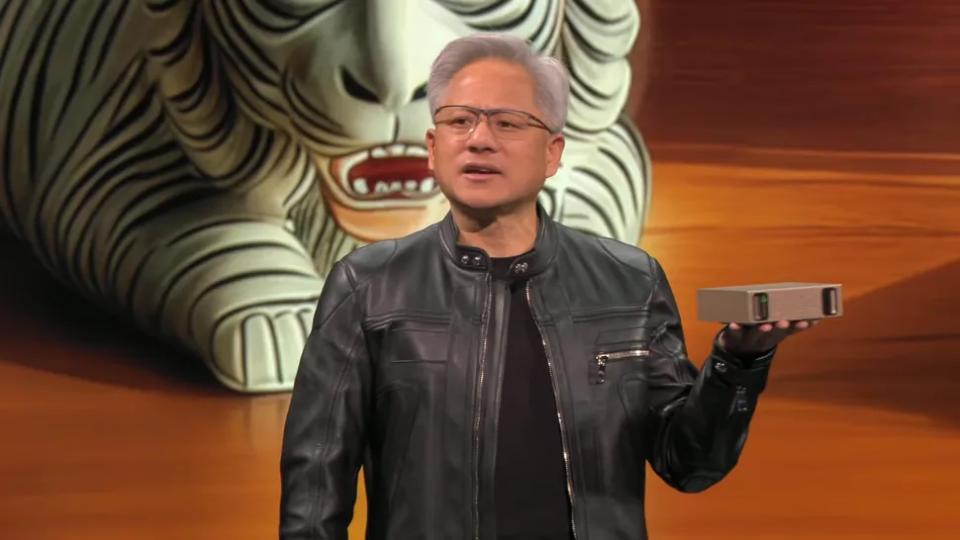
黄仁勋做出最新预测:所有超级计算机都有量子计算
Di Yi Cai Jing· 2025-05-19 06:12
Group 1 - Huang Renxun predicts that all future supercomputers will have a quantum acceleration component, integrating GPU, QPU (Quantum Processing Unit), and CPU [1][4] - NVIDIA emphasizes its role as an AI infrastructure provider, revealing a five-year plan that impacts financing, power, and land planning for industry players [3] - The company is developing a giant AI supercomputer in Taiwan, collaborating with partners like TSMC and Foxconn to build the first AI infrastructure and ecosystem [4] Group 2 - The DGX Spark personal AI computer has been fully produced and is expected to launch soon, with the DGX Station also introduced, capable of running AI models with significant parameters [5] - Huang Renxun discusses the evolution of AI capabilities, highlighting the importance of reasoning and understanding in AI, which will be foundational for future robotics [5] - NVIDIA is actively seeking business opportunities globally, including a chip supply agreement with Saudi Arabia's Public Investment Fund for 18,000 AI chips [6]
英伟达豪赌“物理AI”:下一个风口,还是又一个GE Predix?
3 6 Ke· 2025-05-14 09:45
Core Insights - The article discusses the rapid advancement of "Physical AI," particularly through NVIDIA's ambitious strategy to create a platform-level infrastructure that integrates training, simulation, and deployment in physical systems [1][2][11] - It highlights the collaboration between NVIDIA and leading industrial giants like Siemens, BMW, and General Motors to incorporate AI into complex physical systems such as manufacturing and autonomous driving [1][11] Summary by Categories Definition and Differentiation - Physical AI, embodied intelligence, and spatial intelligence represent different pathways for AI to perceive, integrate, and alter the physical world [2][6] - Spatial intelligence focuses on AI's understanding of three-dimensional structures and relationships, while embodied intelligence emphasizes interaction with the environment through physical actions [3][4][9] - Physical AI serves as the central nervous system connecting perception and action, enabling AI to truly enter the physical realm [5][6] Technological Framework - The core of Physical AI is NVIDIA's "three computers" architecture, which includes training with real and synthetic data, creating high-fidelity virtual environments, and deploying trained models in real-world applications [14][16] - Key technologies supporting Physical AI include synthetic data generation, virtual simulation platforms, and model generalization capabilities [9][10][11] Historical Context and Comparison - The article draws parallels between NVIDIA's Physical AI strategy and GE's earlier industrial internet platform, Predix, which ultimately failed due to its closed ecosystem approach [15][19][21] - Unlike GE, NVIDIA's strategy emphasizes an open, developer-first approach, providing a comprehensive toolkit rather than a singular solution [23][24][27] Future Trends and Industry Implications - The integration of AI into physical systems is seen as a long-term evolution rather than a short-term trend, requiring patience and strategic investment in foundational capabilities [37][39] - Companies in the industry are advised to focus on building internal capabilities and understanding the underlying logic of the tools they use, rather than merely adopting them superficially [33][35][36]

217亿收购Windsurf,转型“公益公司”,OpenAI更务实了
创业邦· 2025-05-09 10:01
仅2个月后,OpenAI便用实际行动回应了凯文的预言。 「奔向AGI」 栏目聚焦AI大模型、AI agent、AI应用、芯片、机器人等前沿、热门的AI技术和商业创 新。 5月6日,据彭博社、路透社等多家外媒报道,OpenAI已与AI编程工具开发商Windsurf达成收购协议,交易金额达30亿美元(约合人民币217亿元),这将成为 OpenAI自成立以来规模最大的一笔收购案。 此前,OpenAI曾数次试图收购估值已达90亿美金的Cursor,但据说双方在价格等细节上未能达成一致,OpenAI才将目光转向了市场份额第二的Windsurf。 作者丨刘杨楠 编辑丨巴里 图源丨CNN 去年,Windsurf在General Catalyst领投的一笔交易中估值为12.5亿美元。此次收购价格较 Windsurf去年12.5亿美元的估值翻倍。 2025年3月15日,OpenAI首席产品官凯文·威尔在一档播客中表示,GPT-5即将推出,并预测AI将在编程领域第一次"永远超越人类"。 这个问题的答案,或许并不指向AI是否会代替人类开发者的宏大命题,其更大的现实意义在于,让外界看到,刨除资本和舆论的附加光环后,作为一家企业, O ...