AI大模型

Search documents
协鑫能科发布“聚星”虚拟电厂平台 以大模型重构“能源+AI”新生态
Zheng Quan Shi Bao Wang· 2025-11-12 09:49
Core Insights - The "Juxing" virtual power plant platform launched by GCL-Poly Energy Technology aims to create a smart energy system that integrates energy production, storage, consumption, and trading [1][2] - GCL-Poly has over ten years of experience in virtual power plant operations and has expanded its business across multiple provinces in China, including Jiangsu, Shanghai, Zhejiang, Sichuan, and Shenzhen [2] Company Overview - GCL-Poly's "Juxing" platform features a three-tier smart system: enterprise-level, operator-level, and city-level virtual power plants, each with distinct functionalities [1] - The enterprise-level virtual power plant focuses on real-time data monitoring, energy optimization, fault alarm handling, data analysis, and remote intelligent operation [1] - The operator-level virtual power plant serves as a powerful management hub for distributed resources, enabling cross-regional coordination and grid response [1] - The city-level virtual power plant acts as the command center for smart grids, managing operations, demand matching, bidding optimization, monitoring, and revenue settlement [1] Industry Context - GCL-Poly has aggregated nearly 1 million kilowatts of adjustable load nationwide, with over 30% of this load coming from the auxiliary service market in Jiangsu [2] - The company holds a first-level qualification as a "Demand Side Management Service Institution," managing a user scale exceeding 20 GW, which supports the growth of its virtual power plant business [2] - The development of virtual power plants is seen as a key pillar for achieving carbon neutrality, with projected adjustment capacities of over 20 million kilowatts by 2027 and over 50 million kilowatts by 2030 [2] - The State Council has identified innovative applications like virtual power plants as a key focus area in the clean energy sector [2]

AI“天才少女”罗福莉宣布加入小米!曾被雷军千万元年薪挖角
Sou Hu Cai Jing· 2025-11-12 09:11
Core Insights - Xiaomi is focusing on building its AI capabilities, particularly in large models, as indicated by the recruitment efforts for key developers like Luo Fuli [3][4] - The company is investing heavily in GPU resources, with plans to establish a large GPU cluster to enhance its AI model development [4] - Xiaomi's financial performance in the AI and electric vehicle sectors shows significant revenue, with a reported income of RMB 213 billion in Q2 2025 [4] Group 1: Recruitment and Talent Acquisition - Luo Fuli, a key developer from DeepSeek, was reportedly offered a high salary by Xiaomi's founder Lei Jun to lead the AI model team [3] - There has been no official confirmation from Xiaomi regarding Luo Fuli's employment status, although she has expressed a desire for a quiet work environment [3] - Luo Fuli's recent academic and professional background highlights her as a prominent figure in AI research, potentially indicating her future role at Xiaomi [5][7] Group 2: Investment in AI Infrastructure - Xiaomi is actively building a GPU cluster to support its AI model development, starting with 6,500 GPU resources [4] - Lei Jun's leadership is pivotal in this initiative, emphasizing the importance of AI hardware in the company's strategy [4] - The establishment of this infrastructure is expected to significantly boost Xiaomi's research capabilities in AI [4] Group 3: Financial Performance - In Q2 2025, Xiaomi reported RMB 213 billion in revenue from its innovative business segments, including smart electric vehicles and AI [4] - The revenue from smart electric vehicles was RMB 206 billion, with a gross margin of 26.4% for the innovative business segment [4] - Despite the revenue, the segment reported an operating loss of RMB 3 billion, indicating challenges in profitability [4]


各家都想做的“大众点评”,“真实”护城河到底是什么?
第一财经· 2025-11-12 08:48
Core Viewpoint - Dazhong Dianping is investing at least 3 billion in the next five years to upgrade its "local life information infrastructure," emphasizing the importance of accurate and timely information in the local life industry [1][2][7]. User's Real Needs - Users often face issues due to incomplete or inaccurate information, leading to poor experiences, highlighting the necessity for comprehensive and truthful information [3][6]. - Accurate information is fundamental for user decision-making and is essential for maintaining trust between users and platforms [6][14]. Industry Trends - The local life sector has become a focal point in consumer markets since Meituan introduced the concept, with significant competition emerging among platforms [4][11]. - The O2O market in China is projected to reach 3.9 trillion yuan by 2025, growing at 17.6% annually, indicating a robust growth trajectory for the industry [11]. Competitive Landscape - The competition among local life platforms often centers around metrics like traffic, subsidies, and user scale, but the true competitive edge lies in the accuracy of information rather than short-term incentives [11][12]. - Platforms can attract traffic through marketing, but inaccurate information can lead to low conversion rates and negative reputations [12]. Information Infrastructure - Dazhong Dianping's investment in information infrastructure aims to ensure accurate and timely reflection of the physical world, which is crucial for user decision-making [7][20]. - The platform's ability to gather and verify information is a comprehensive test of its capabilities, requiring significant resources and user feedback [20][21]. Trust and User Engagement - Establishing trust through reliable information allows platforms to create a positive feedback loop, where accurate data attracts quality users, leading to more authentic reviews and engagement [14][22]. - Dazhong Dianping has built a strong user base that relies on its platform for decision-making, further enhancing its information ecosystem [22]. Future Directions - The company plans to continue investing in its infrastructure to serve as a "global dynamic yellow pages" for consumers, leveraging AI to enhance its offerings in the local life sector [23].


95后“AI才女”罗福莉,宣布加入小米!曾被雷军千万元年薪挖角,是DeepSeek关键开发者!她出身农村普通家庭,“是家族骄傲”
Mei Ri Jing Ji Xin Wen· 2025-11-12 07:58
Core Insights - The news highlights the announcement of AI prodigy Luo Fuli joining Xiaomi, emphasizing her role in advancing AI technology within the company [1][4]. Group 1: Company Developments - Luo Fuli, known for her significant contributions to AI, particularly as a key developer for the DeepSeek model, has been recruited by Xiaomi to lead its AI large model team [5][6]. - Xiaomi is actively building a GPU cluster to enhance its AI model research capabilities, with an initial resource of 6,500 GPUs, indicating a strong commitment to AI development [6]. - The company reported a revenue of RMB 21.3 billion from its smart electric vehicle and AI innovation segment in Q2 2025, with smart electric vehicle revenue at RMB 20.6 billion and a gross margin of 26.4% [8]. Group 2: Strategic Vision - Xiaomi's founder Lei Jun has articulated that AI large models are crucial for the future of smart connected vehicles, presenting significant innovation opportunities [7]. - The company's core strategy revolves around an integrated ecosystem of "people, vehicles, and homes," with vehicles serving as a critical node for AI applications [8]. Group 3: Individual Background - Luo Fuli, who has a strong academic background, including a degree from Beijing Normal University and further studies at Peking University, has gained recognition as an AI talent [11][13]. - Her upbringing in a rural family with a strong educational emphasis has contributed to her achievements, making her a source of pride for her community [11][13].

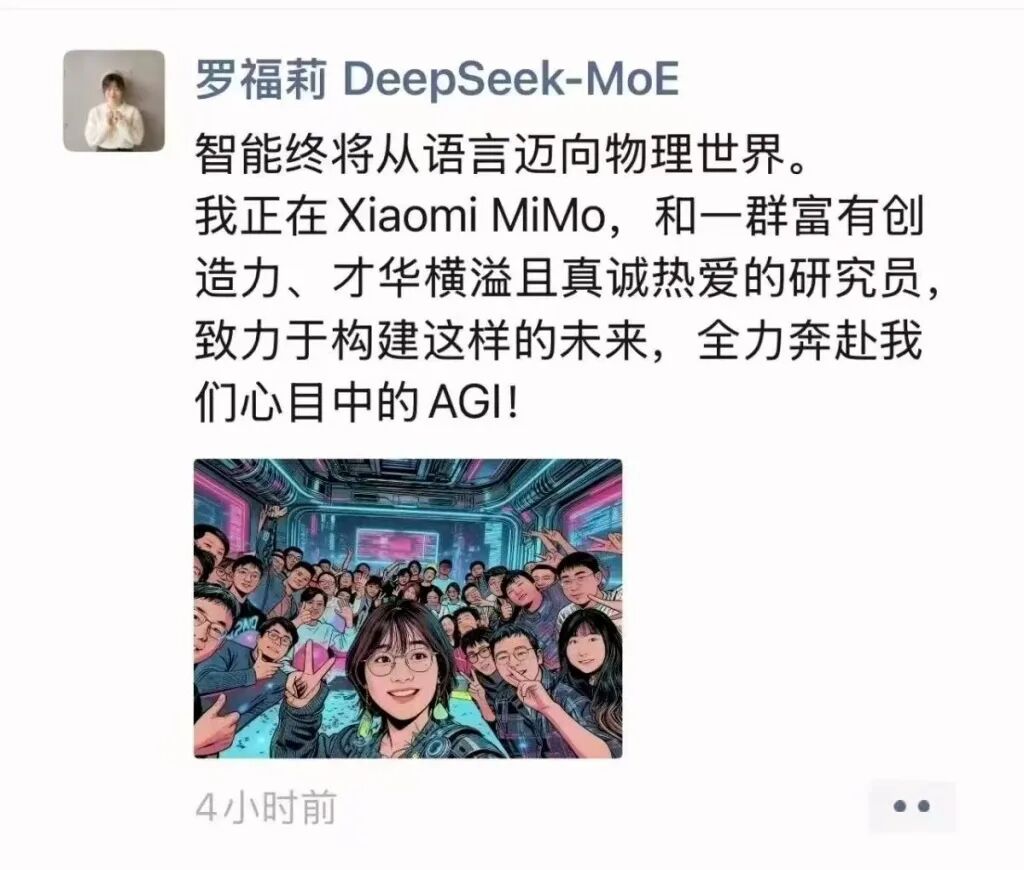
前DeepSeek研究员罗福莉已加入小米 此前传闻雷军曾以千万年薪招揽
Xin Lang Cai Jing· 2025-11-12 07:27
Core Insights - The article discusses the recent hiring of Luo Fuli, a key developer from DeepSeek, by Xiaomi to lead its AI large model team, indicating Xiaomi's commitment to advancing its capabilities in artificial intelligence [1][4]. Group 1: Company Developments - Luo Fuli announced her joining Xiaomi's MiMo team, which focuses on building a reasoning large model, marking her official entry into the company [1]. - Xiaomi is reportedly building a large GPU cluster to enhance its investment in AI large models, with an initial resource of 6,500 GPUs already in place [4]. - The hiring of Luo Fuli, rumored to be at a salary of tens of millions, reflects Xiaomi's strategic focus on AI hardware, with founder Lei Jun playing a significant leadership role in this initiative [4]. Group 2: Background of Luo Fuli - Luo Fuli holds a bachelor's degree in computer science from Beijing Normal University and a master's degree in computational linguistics from Peking University [5]. - Prior to joining Xiaomi, she worked at Alibaba's DAMO Academy and later at DeepSeek, where she contributed to the development of the DeepSeek-V2 model [5].
网传雷军千万年薪招揽,罗福莉官宣加入小米
Guan Cha Zhe Wang· 2025-11-12 07:12
Core Insights - The article highlights the significant move of researcher Luo Fuli joining Xiaomi to lead its AI model team, indicating Xiaomi's aggressive strategy in the AI sector [1][4][6] Group 1: Luo Fuli's Background and Move to Xiaomi - Luo Fuli, a prominent figure in AI research, previously worked at Alibaba and DeepSeek, where she contributed to the development of the DeepSeek-V2 model [4][6] - Reports suggest that Xiaomi's founder Lei Jun offered Luo a substantial salary to lead the AI model team, reflecting the company's commitment to enhancing its AI capabilities [4][6] - Luo's transition to Xiaomi has been anticipated since early 2023, with her involvement in a collaborative paper between Peking University and Xiaomi's model team further fueling speculation [6] Group 2: Xiaomi's AI Strategy and Investments - Xiaomi has established its AI laboratory model team, led by Luan Jian, to focus on AI advancements, with a significant investment in GPU resources for model training [7] - The company has made strides in AI model development, including the open-sourcing of its inference model Xiaomi MiMo, which outperformed OpenAI's models in specific benchmarks [7] - Xiaomi plans to allocate a quarter of its 30 billion RMB R&D budget to AI by 2025, aiming to integrate AI technology across its product lines and evolve its operating system to an AI-centric platform [8]
前DeepSeek研究员罗福莉已加入小米,此前传言被雷军千万年薪挖角
Sou Hu Cai Jing· 2025-11-12 06:55
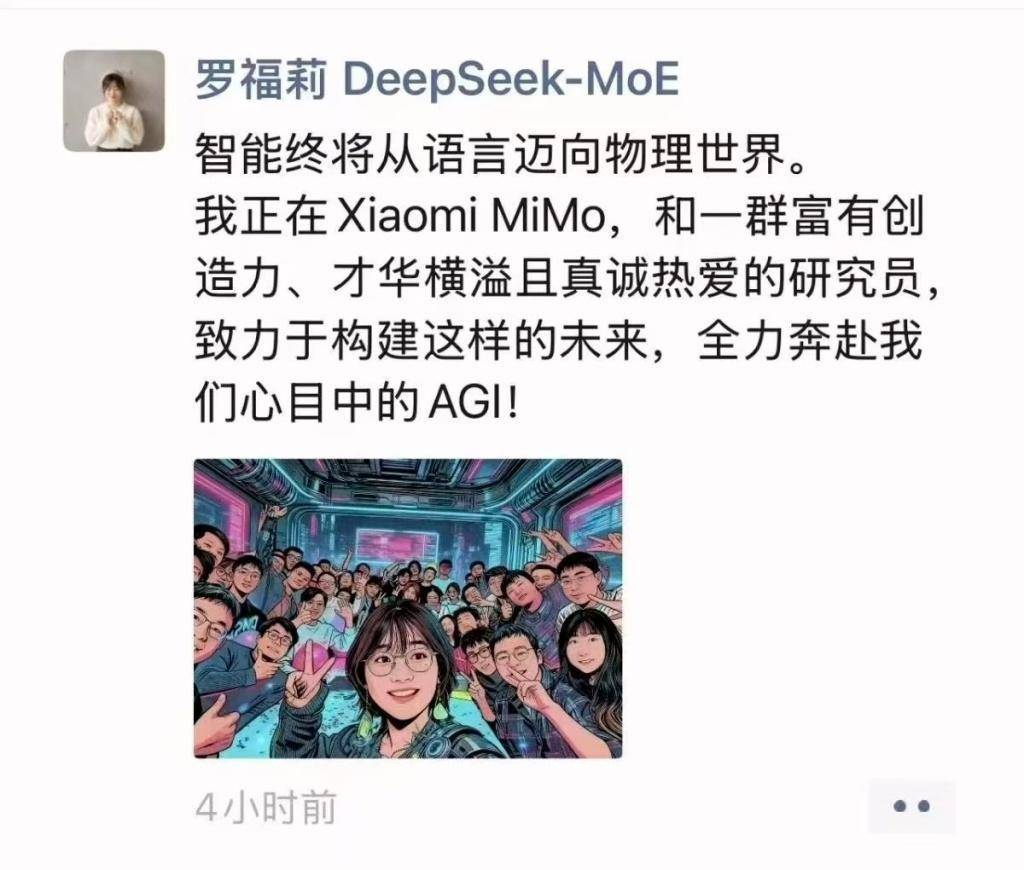
Core Insights - The article highlights the announcement of Luo Fuli's joining Xiaomi to lead the development of AI large models, specifically the Xiaomi MiMo, which is the company's first inference large model [1][5]. Group 1: Company Developments - Luo Fuli expressed her commitment to building a future focused on Artificial General Intelligence (AGI) while working with a talented team at Xiaomi [1]. - Xiaomi MiMo is positioned as a significant step in Xiaomi's AI strategy, indicating the company's ambition in the AI large model space [1]. Group 2: Background of Luo Fuli - Luo Fuli, born in Sichuan, has an impressive academic background, having attended Beijing Normal University and later being admitted to Peking University for further studies [5]. - During her master's program, she published eight papers at the top international conference ACL in 2019, with two as the first author, showcasing her expertise in artificial intelligence [5]. - Prior to joining Xiaomi, she worked at Alibaba's Damo Academy, Huansheng Quantitative, and DeepSeek, where she led the development of the multilingual pre-training model VECO and contributed to the MoE large model DeepSeek-V2 [5].
2025天猫“双11”算力规模破纪录 阿里云提供千万核高性能CPU算力
Zheng Quan Ri Bao Wang· 2025-11-12 06:42
Core Insights - This year's Tmall "Double 11" event has set a new record for computing power, with Alibaba Cloud providing over 10 million CPU cores, enhancing core business performance by over 30% [1] - The introduction of AI applications and the complexity of business scenarios have increased the demands on computing, storage, and network technologies [1] - Alibaba has announced an investment of over 380 billion yuan in cloud and AI hardware infrastructure [1] Computing Power - The 2025 Tmall "Double 11" utilized Alibaba Cloud's public cloud to schedule high-performance computing with over 10 million cores, successfully supporting the event with a capacity exceeding 2 million [2] - Alibaba Cloud's self-developed technologies have significantly improved performance, with business performance in areas like recommendations and marketing increasing by 30% to 50%, and real-time latency reduced by over 30% [2] - The Lingjun Intelligent Computing Cluster provided AI computing power, optimizing inter-card connectivity and bandwidth for personalized and efficient AI services during the event [2] AI Applications - This year marks the first large-scale application of the Tongyi series models for "Double 11," enhancing consumer experience and e-commerce operations [3] - The AI data analyst in the upgraded Business Manager application covers 90% of core analysis scenarios for small and medium-sized businesses, significantly improving analysis and decision-making efficiency [3] - The Qwen-MT translation model supported the translation needs for overseas products, achieving a 40% reduction in single-call latency and handling over 1.4 billion calls in a single day for product translations [3] Evolution of Cloud Services - Since Alibaba Cloud first supported Tmall "Double 11" in 2015, the event has evolved from basic cloud usage to a comprehensive deployment of a full-stack AI system [4] - The peak traffic is no longer the biggest technical challenge, as Alibaba Cloud leverages innovative cloud and AI technologies to enhance the experience for merchants and consumers during "Double 11" [4]

跌光1873亿,网红汽车炸雷了
首席商业评论· 2025-11-12 05:15
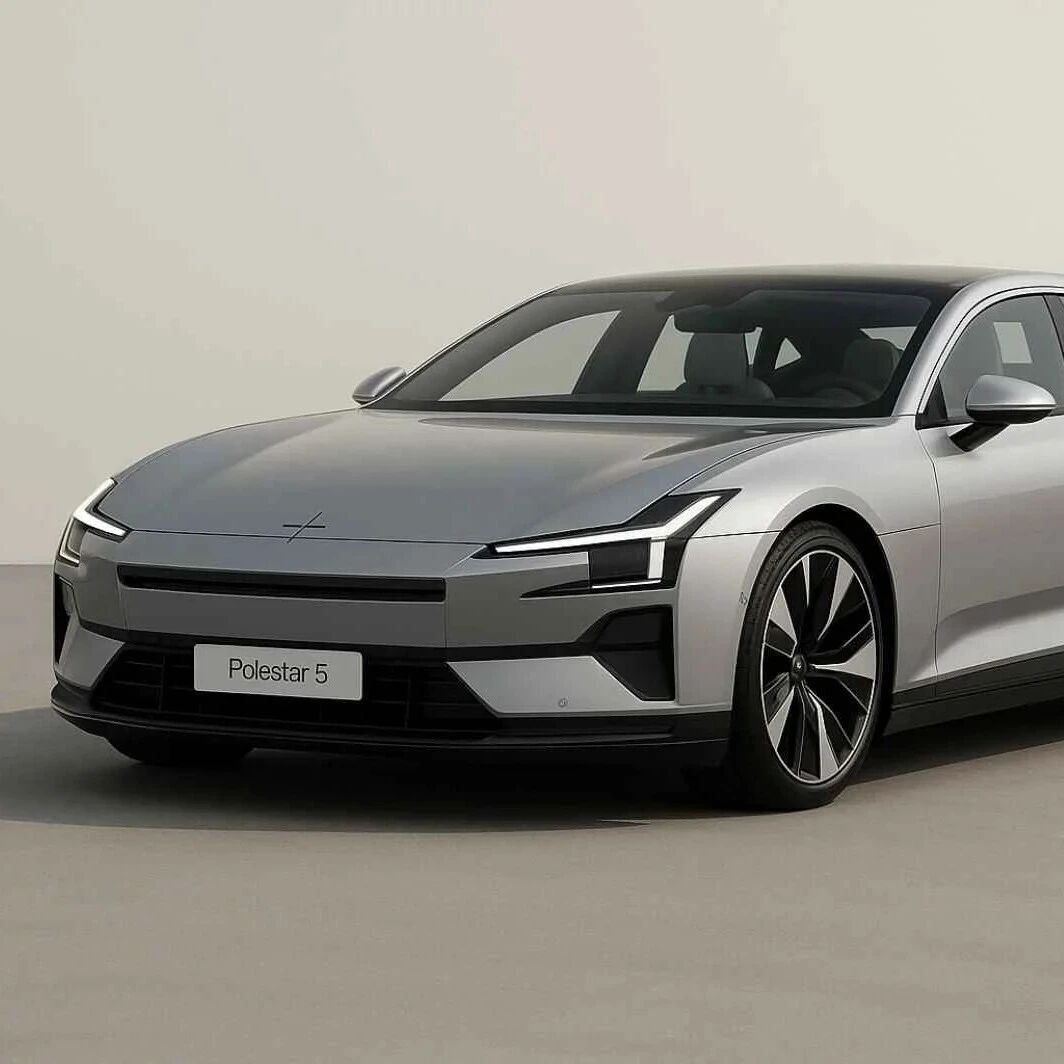
Core Viewpoint - Polestar, once a prominent player in the Chinese electric vehicle market, is now facing severe challenges, including a warning from NASDAQ regarding potential delisting due to its stock price falling below $1 for an extended period [5][26]. Financial Performance - In the first half of 2025, Polestar sold over 30,000 vehicles, generating revenue of $1.423 billion, but incurred a net loss of $1.193 billion, marking a 119.4% increase in losses compared to the previous period [5][25]. - As of June 2025, Polestar's total liabilities reached $7.909 billion, with total assets of $3.643 billion, resulting in an alarming debt-to-asset ratio of 217% [10][25]. Market Position and Strategy - Polestar's market capitalization has plummeted from a peak of $28 billion to approximately $1.7 billion, indicating a loss of over $26.3 billion in value [7][26]. - The company has shifted its sales strategy in China from physical stores to online sales, closing its last direct store in Shanghai [5][25]. Historical Context - Polestar was established in 2017 as a collaboration between Volvo and Geely, aiming to create a global electric vehicle brand that could compete with Tesla [11][15]. - Initially, Polestar was seen as a strong contender in the electric vehicle market, with high expectations for its global expansion [11][15]. Recent Developments - In 2024, Polestar's performance deteriorated significantly, with a 40% drop in delivery volume in the first quarter and a revenue decline of 36% year-on-year [24]. - The company has faced criticism for its management structure, which has been described as disconnected from the Chinese market, leading to operational inefficiencies [18][20]. Future Outlook - Polestar is currently under pressure to comply with NASDAQ regulations within 180 days to avoid delisting, while also attempting to expand its presence in the U.S. market [26][28]. - The company is exploring new strategies to adapt to the rapidly changing consumer demands in China, despite the challenges it faces [25][28].
月薪已炒到6W?强烈建议大家冲一冲这个新兴领域,彻底赢麻了!
菜鸟教程· 2025-11-12 03:31
Core Insights - AI large models are reshaping traditional CRUD development models, with over 60% of enterprises investing in AI products, making "large model application development engineers" highly sought after and extremely scarce [1][2] - Understanding AI large model technologies such as Fine-tuning, Agent, and RAG is essential for developers to successfully implement AI applications in various business scenarios [1][2] - Currently, 78% of large model application development positions offer annual salaries between 600,000 to 1,000,000, with internships paying as much as 4,000 per day, significantly above market averages [2] Industry Trends - Major companies like Huawei, Meituan, Alibaba, ByteDance, and Baidu are rapidly increasing their hiring for large model positions, with a 69% rise in job openings and salaries exceeding 1,000,000 [2] - The AI sector is viewed as a critical opportunity for tech professionals, especially given the saturation and competition in the market, making it potentially the best chance for career advancement in recent years [2][10] Course Offerings - The "Large Model Application Development Practical Camp" is designed to help developers build a complete application development path from scratch, focusing on AI application development logic, technical systems, and real-world project experience [2][4][7] - The course includes practical case studies from various business scenarios, covering the underlying logic of AI application development and providing hands-on experience with AI tools and product development [7][13] Career Development - The course aims to help participants connect with product/business teams, build technical barriers, and avoid job insecurity, particularly for those approaching the age of 35 [10][18] - Participants will gain insights into high-paying job opportunities, including internal referrals and direct hiring rights, enhancing their chances of securing lucrative positions [13][16][22] Learning Outcomes - The curriculum includes a breakdown of enterprise-level real projects, covering essential AI technologies and their applications, ensuring participants can confidently face AI technological advancements [7][13] - The course has successfully served over 20,000 students, receiving positive feedback and helping many secure high-paying job offers [8]