数字经济

Search documents
从“客场全球化”到“主场全球化”
Sou Hu Cai Jing· 2026-01-18 21:32
Core Viewpoint - The upcoming APEC meeting in Shenzhen in 2026 highlights China's emphasis on "high-level opening up" amidst a complex global economic landscape, characterized by significant changes and challenges. Group 1: Current Global Economic Landscape - The global economic landscape is marked by a "six coexistence" complexity, featuring both "grouping" and "fragmentation," with regional trade agreements like RCEP covering 30% of global GDP and reducing 90% of tariffs, while agreements like CPTPP and USMCA create exclusive trade barriers [1] - The coexistence of "multipolarization" and "bilateralization" is evident, with emerging economies gaining influence and bilateral trade agreements becoming essential for risk hedging [1] Group 2: High-Level Opening Up - High-level opening up is defined by a shift from "liquidity opening" to "institutional opening," focusing on reforms in rules, regulations, and standards to create a stable, fair, and transparent business environment, marking a fundamental shift from "policy dividends" to "institutional dividends" [3] - The transition from "guest globalization" to "home globalization" emphasizes leveraging China's vast domestic market to transform from a "global factory" to a "global market," with China accounting for 18-20% of the global market economy and being the largest single-country market for many goods and services [4] - The optimization of opening up strategies is moving from "regional breakthroughs" to "global collaboration," focusing on systemic and coordinated approaches to enhance regional cooperation, as seen in initiatives like the Yangtze River Delta integration and the Guangdong-Hong Kong-Macau Greater Bay Area [5][6] Group 3: Enhanced Functions of Opening Up - The shift from a "channel economy" to a "hub economy" emphasizes creating global resource allocation hubs, with cities like Shanghai aiming to become major nodes for resource distribution and value creation through innovative service systems [7]
年用电量首破10万亿度 彰显中国经济“新”动能
Xin Lang Cai Jing· 2026-01-18 21:31
(来源:经济参考报) 国家能源局最新数据显示,2025年我国全社会用电量历史性突破10万亿千瓦时,达到10.4万亿千瓦时, 同比增长5%。从全球来看,中国一个国家的用电量超过多个经济体总和,相当于美国全年用电量的两 倍多,超过欧盟、俄罗斯、印度、日本四个经济体的年用电量总和。 "十年间用电量从5万亿千瓦时到10万亿千瓦时,这样的增长速度在全球主要经济体中绝无仅有。"中国 电力企业联合会常务副理事长杨昆表示,作为经济运行的"晴雨表",(全社会用电量数据)这一里程碑 式的跨越,彰显出中国超大规模经济体的强劲韧性与发展活力,也映照出产业结构升级、绿色转型的发 展新逻辑,更体现了我国能源保障能力的全面提升。 在传统认知里,电量飙升往往与水泥窑的轰鸣、钢铁厂的火光绑定。如今,这种"电量增长等于高耗能 扩张"的旧逻辑已被彻底打破,新制造、新基建、新场景成为新增用电的主力。 机构普遍预测,"十五五"期间,我国全社会用电量年均增速在4.2%至5.6%之间。若GDP年均增长5%, 按电力弹性系数测算,全社会用电量增速约为5.5%,到2030年有望突破13万亿千瓦时。机构还预计, 到2030年,我国终端电气化率有望达到35%,电 ...
乐都区数据标注基地正式运营 海东将创建国家级数据标注试点城市
Xin Lang Cai Jing· 2026-01-18 18:29
Group 1 - The core data labeling base in Ledou District, Haidong City, officially commenced operations on January 15, with a total area of 2,528.34 square meters and 400 labeling workstations [1] - The data labeling industry layout includes three operational bases in Haidong City, with a total of 10 registered labeling companies and 1,130 workstations, creating 324 jobs [1] - The base aims to support the creation of a national-level data labeling pilot city, with an expected annual labeling volume exceeding 30 million entries [1] Group 2 - During the 14th Five-Year Plan period, Haidong City will leverage the industrial agglomeration effect of the Ledou core base to promote the digital economy's quality upgrade [2] - The focus will be on data resource management ecology and the assetization of data resources, laying a solid foundation for the successful establishment of a national-level data labeling pilot city [2]
网络欺诈成全球数字经济最大威胁
Xin Lang Cai Jing· 2026-01-18 18:28
Core Insights - The World Economic Forum's report warns that cyber fraud has evolved into one of the most disruptive forces in the digital economy, posing a significant threat to global economic security [3][4] - Cyber fraud is no longer small-scale crime but a systematic threat driven by organized, cross-border criminal activities utilizing advanced technologies [3] Group 1: Evolution of Cyber Fraud - Cyber fraud has transitioned from random attacks to precision strikes, with criminal organizations leveraging AI to analyze vast amounts of data and identify potential victims [3] - A notable case in Southeast Asia involved a criminal group using deepfake technology to impersonate a CEO, successfully deceiving a financial officer into transferring $47 million [3] - In Brazil, digital payment fraud cases increased by 187% in the first half of 2025, with impoverished populations being particularly vulnerable due to a lack of digital literacy [3] Group 2: International Cooperation and Challenges - Cybersecurity has transcended national borders, necessitating a collective global response to address the issue effectively [4] - The EU is working on a "Digital Single Market Security Framework" to coordinate cybersecurity policies among its 27 member states [4] - The African Union aims to establish basic cybersecurity systems for all member states by 2027, highlighting the disparity in cybersecurity budgets across the continent [4] Group 3: Multi-faceted Response Strategies - The report advocates for a framework to build a "resilient digital future," emphasizing the need for multi-layered and collaborative responses [4] - Emerging technologies like quantum encryption and blockchain are seen as promising solutions, with a focus on developing self-healing networks that can detect and isolate anomalies in real-time [4] - The G7 is discussing the establishment of "digital product safety baseline standards" to ensure consumers are aware of the security levels of digital products [4]


安伟会见参加“人工智能+”与数字经济知名上市公司企业家河南行活动重要嘉宾 共享时代机遇 共赢数智未来
Shang Hai Zheng Quan Bao· 2026-01-18 18:15
Group 1 - Zhengzhou is focusing on digital transformation and industrial upgrading, leveraging its historical strength and vibrant economy to create a conducive environment for innovation and investment [2] - The city aims to build a new foundation for computing power and create new industrial clusters, while enhancing the business environment to attract quality resources and capital [2] - The collaboration with various enterprises is expected to foster innovation platforms, expand application scenarios, and share market benefits, contributing to the development of a smart economy and society [2][3] Group 2 - Guests expressed their admiration for Zhengzhou's cultural charm, innovative vitality, and industrial strength, indicating a strong potential for further cooperation in artificial intelligence and digital economy [3] - The focus will be on attracting new technologies, scientific innovation companies, and investment capital to support high-quality economic and social development in Zhengzhou [3]




一年内150余家企业入驻天府软件园
Xin Lang Cai Jing· 2026-01-18 17:25
Group 1 - The Tianfu Software Park has successfully facilitated the establishment of over 150 new companies within a year, showcasing its efficient service model and commitment to supporting business operations [1] - The park's initiatives, such as the "Progressive Optimization Promotion" and "Full Park Action," have led to a record high in signed area for new enterprises [1] - Companies like PixelBloom have praised the rapid registration process, which allows them to quickly initiate their business activities [1] Group 2 - Ubisoft's Chengdu studio has expanded significantly since its establishment in 2008, growing from a small team to hundreds of employees and taking on major game development tasks [2] - The park has introduced measures to support companies during office renovations, such as providing free transitional housing to minimize costs and ensure seamless operations [2] - The Chengdu studio's management expressed satisfaction with their decision to remain in Chengdu for 17 years, highlighting the park's supportive environment [2] Group 3 - The Tianfu Software Park is actively promoting the implementation of AI technologies, exemplified by the collaboration with Zhenzhi Technology to create a "Holographic Smart Parking Lot" project [3] - The park is focused on enhancing the digital economy and technological innovation through initiatives like establishing industry funds and attracting leading enterprises [3] - Partnerships with major companies, such as Huawei, have led to the creation of the first "Digital Service Innovation Center" in the country, further strengthening the park's technological capabilities [3]

年用电量首超10万亿度 展现中国经济发展活力
Xin Lang Cai Jing· 2026-01-18 13:17
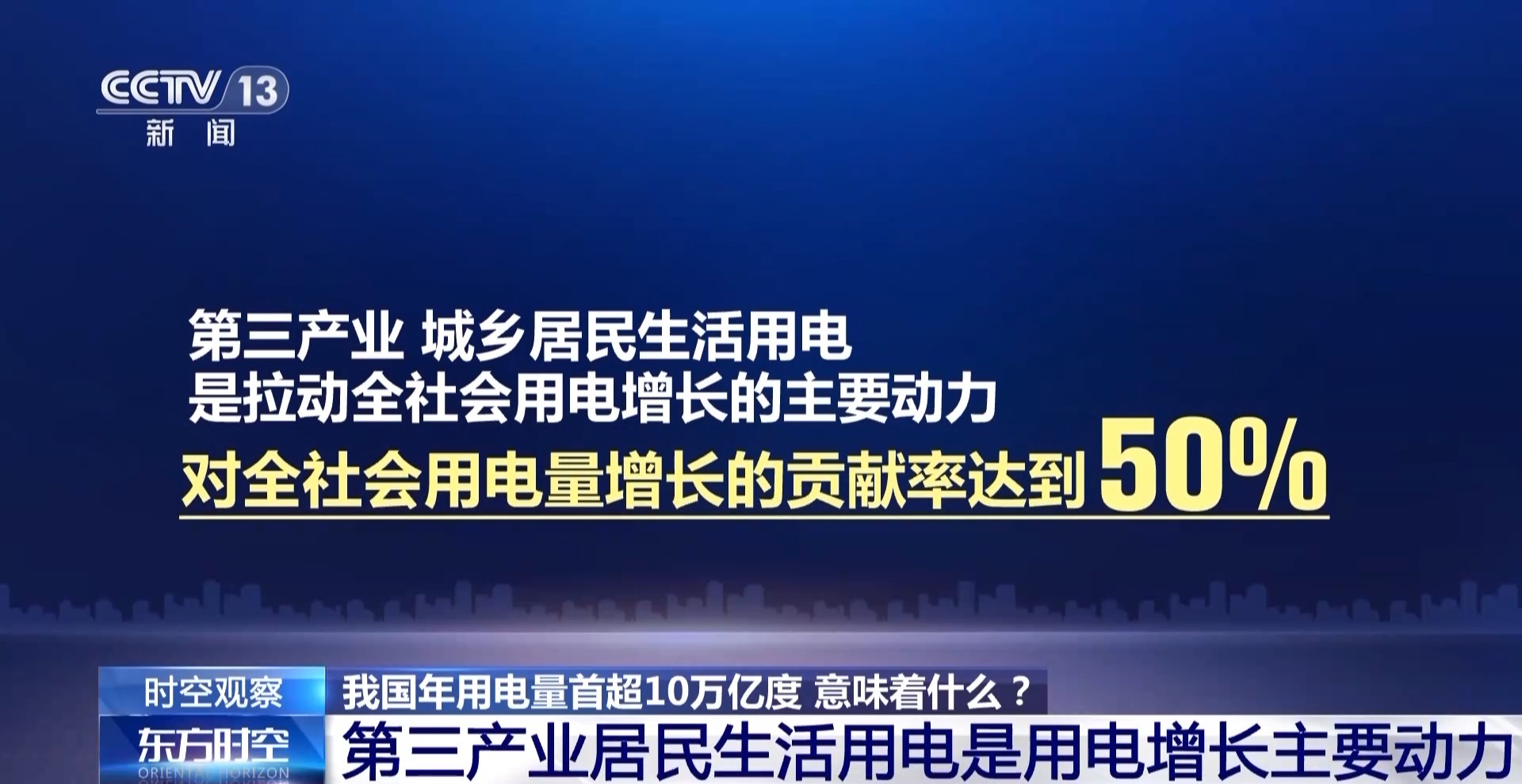
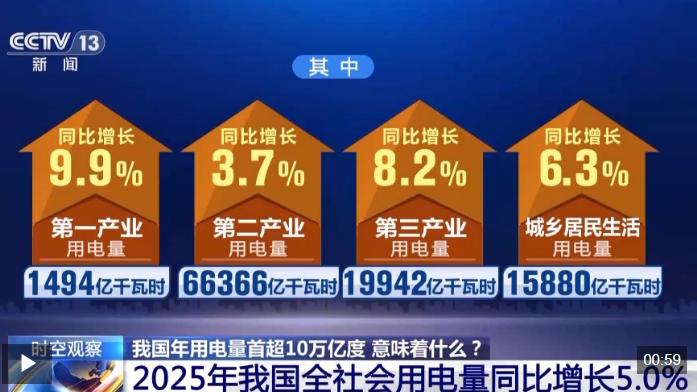
Group 1 - The core point of the article is that China's total electricity consumption is projected to exceed 10 trillion kilowatt-hours by 2025, marking a significant milestone as the first country to reach this level, which is more than double the annual electricity consumption of the United States and surpasses the combined consumption of the EU, Russia, India, and Japan [1][3][4] - In 2025, China's total electricity consumption is expected to reach 10,368.2 billion kilowatt-hours, representing a year-on-year growth of 5.0% [1][3] - The primary sectors contributing to this growth include the first industry with a consumption of 149.4 billion kilowatt-hours (up 9.9%), the second industry with 6,636.6 billion kilowatt-hours (up 3.7%), and the third industry with 199.4 billion kilowatt-hours (up 8.2%) [1][3] Group 2 - The third industry and residential electricity consumption are the main drivers of overall electricity growth, contributing to 50% of the increase [3][6] - The rapid growth in the third industry is attributed to sectors such as electric vehicle charging services, which saw a consumption growth rate of 48.8%, and information transmission, software, and IT services, which grew by 17.0% [3][6] - The electricity consumption in high-end manufacturing has surpassed traditional high-energy-consuming industries, indicating a structural shift towards knowledge-intensive and innovation-driven sectors [4][8] Group 3 - The electricity supply system's resilience is being tested as the country aims to achieve this unprecedented level of consumption, with a focus on building a clean and low-carbon power generation system and an efficient interconnected transmission network [4][6] - The digital economy is experiencing rapid growth, with the data industry in Guizhou seeing a staggering 95.01% increase in electricity consumption, driven by the "East Data West Computing" initiative [8] - The transition towards a high-tech, high-value-added industrial structure is evident, with the increasing share of green electricity supply signaling a positive outlook for a new energy system dominated by renewables [8]
视频丨年用电量首超10万亿度 展现中国经济发展活力
Yang Shi Xin Wen Ke Hu Duan· 2026-01-18 12:50
Core Insights - China's total electricity consumption is projected to exceed 10 trillion kilowatt-hours in 2025, marking the first time any country has reached this milestone, which is more than double the annual electricity consumption of the United States and surpasses the combined consumption of the EU, Russia, India, and Japan [2][4][5] Group 1: Electricity Consumption Breakdown - In 2025, total electricity consumption is expected to reach 10,368.2 billion kilowatt-hours, representing a year-on-year growth of 5.0% [2] - The breakdown of electricity consumption by sector includes: - Primary industry: 149.4 billion kilowatt-hours, up 9.9% - Secondary industry: 6,636.6 billion kilowatt-hours, up 3.7% - Tertiary industry: 199.4 billion kilowatt-hours, up 8.2% - Urban and rural residential electricity: 158.8 billion kilowatt-hours, up 6.3% [2] Group 2: Driving Forces Behind Growth - The tertiary sector and residential electricity consumption are the main drivers of overall electricity growth, contributing to 50% of the increase [4] - Within the tertiary sector, the electric vehicle charging and swapping services, as well as information transmission, software, and IT services, have seen significant growth rates of 48.8% and 17.0%, respectively [4][6] Group 3: Structural Changes in Energy Consumption - The second industry remains the primary electricity consumer, accounting for approximately 64%, with growth shifting from high-energy-consuming industries to high-end manufacturing [6] - In 2025, electricity consumption in the computer, communication, and other electronic device manufacturing sectors is expected to exceed 50 billion kilowatt-hours, surpassing traditional industries like steel and chemicals [6] Group 4: Digital Economy and Innovation - The digital economy is experiencing rapid growth, with the "East Data West Computing" initiative driving significant increases in electricity consumption in the data industry, particularly in Guizhou, where internet data service electricity consumption surged by 95.01% [8] - The demand for computing power is also rising exponentially, as evidenced by the Huawei Cloud data center in Guian New Area, which has seen a 56.92% increase in electricity consumption [8] Group 5: Implications of Exceeding 10 Trillion Kilowatt-Hours - The surpassing of 10 trillion kilowatt-hours indicates a robust and stable economic development across various sectors, reflecting the resilience of China's energy infrastructure and the strong integration capabilities of its modern industrial system [4][5] - The shift towards high-tech, high-value-added industries and the increasing share of green electricity supply signal a positive outlook for the development of a new energy system centered around renewable sources [8]
陈道富:探索并构建“新投融资体制”
母基金研究中心· 2026-01-18 08:32
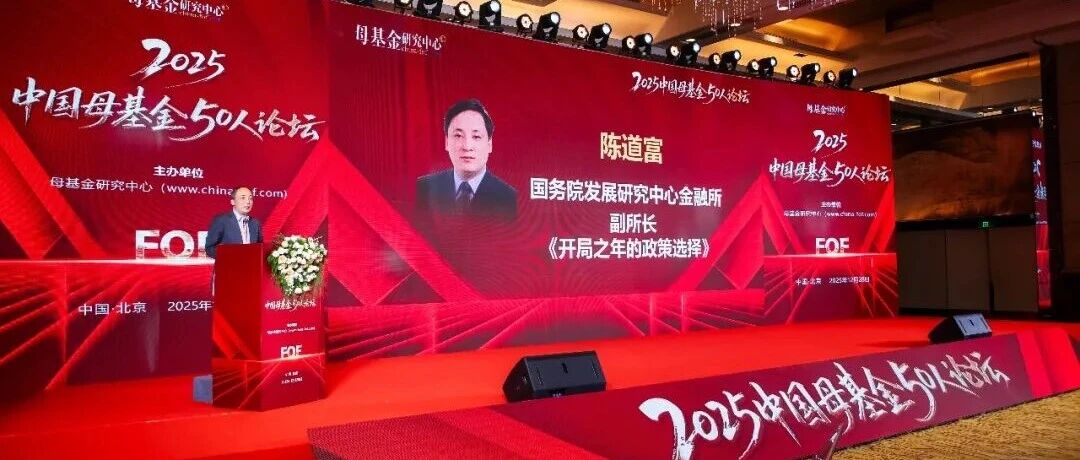
Core Viewpoint - The article discusses the insights shared at the 2025 China Mother Fund Forum, focusing on the evolving investment landscape and the need for a new investment and financing system to adapt to the challenges posed by the digital economy and service-oriented growth [2][3][8]. Summary by Sections Policy Choices and Economic Outlook - The analysis emphasizes the importance of understanding the policy choices for 2026 within the framework of the "14th Five-Year Plan" and China's modernization goals, highlighting the need for significant progress while maintaining stability in policy direction [3][4]. - Key judgments about the economic situation include recognizing the challenges faced in 2025, the necessity for structural reforms, and the importance of consolidating a stable economic foundation for future growth [5][6]. Investment Trends and Challenges - A critical observation is that fixed asset investment growth has entered negative territory in 2025, necessitating efforts to stabilize effective investment in 2026. Traditional investment models in infrastructure and manufacturing are reaching their peak, prompting the need for new investment directions [7][8]. - Future investment will focus on areas integrated with artificial intelligence and the digital economy, as well as high-quality development in the service sector. However, these sectors present high uncertainty and require a shift from traditional financing models [7][9]. New Investment and Financing System - The article advocates for the establishment of a new investment and financing system that aligns with the digital age and service economy, highlighting various emerging practices such as increased equity investment by insurance funds and the role of public REITs in asset revitalization [8][9]. - The new system must accommodate the unique characteristics of digital and intelligent transformation investments, which require a more nuanced approach to risk and return, emphasizing the need for a collaborative effort among market participants to optimize existing policies and create innovative financing tools [9][10].
美国人发现,打完贸易战,全球再难冒出第二个中国这样的工业大国了
Sou Hu Cai Jing· 2026-01-18 01:46
Core Viewpoint - The ongoing trade friction between the US and China has significantly raised the barriers to entry in global manufacturing, leading to a reconfiguration of the industrial landscape, where only countries with comprehensive systems can thrive [1][20][29]. Group 1: Trade Friction and Its Impact - The trade conflict initiated in 2018 has escalated from tariffs on steel and aluminum to a potential 145% tariff on various goods, indicating a shift towards hard decoupling [2][9]. - The global supply chain has been disrupted, altering the logic of manufacturing and increasing costs, particularly in the US where labor and infrastructure issues persist [4][5][6]. - Countries like India and Vietnam face significant challenges in becoming viable alternatives to China due to systemic inefficiencies and infrastructural limitations [7][8][15]. Group 2: China's Resilience and Transformation - China has not retreated in the face of trade friction; instead, it has deepened its industrial transformation, achieving full industrial chain coordination by 2025 [13][21]. - The integration of advanced technologies such as AI and digital economy practices into manufacturing processes has become standard in Chinese factories, enhancing productivity and global competitiveness [10][31][39]. - China's ability to maintain a robust export figure of $524.7 billion to the US in 2025 is attributed to technological integration rather than low-cost dumping [13][31]. Group 3: Global Manufacturing Landscape - The competition in global manufacturing has shifted from merely low labor costs to a comprehensive evaluation of system integration capabilities, including energy stability, skilled labor, and financial support [10][24][35]. - The rise of multi-currency settlements among Southeast Asian countries reflects a pragmatic shift away from reliance on the US dollar, driven by the need for risk mitigation [11][18][37]. - The industrial landscape is consolidating around countries that can provide complete ecosystems for manufacturing, with China being a prime example due to its extensive supply chain and infrastructure [24][29][39]. Group 4: Future Outlook - The next decade is expected to see a continuation of manufacturing not "de-China-izing" but rather "in China+" as companies seek efficiency and responsiveness in their supply chains [26][29]. - The barriers to entry in manufacturing have risen, making it increasingly difficult for new players to compete without a comprehensive set of capabilities [24][34]. - The focus will shift towards green manufacturing, AI integration, and circular economies, with China positioning itself as a leader in these emerging fields [39].